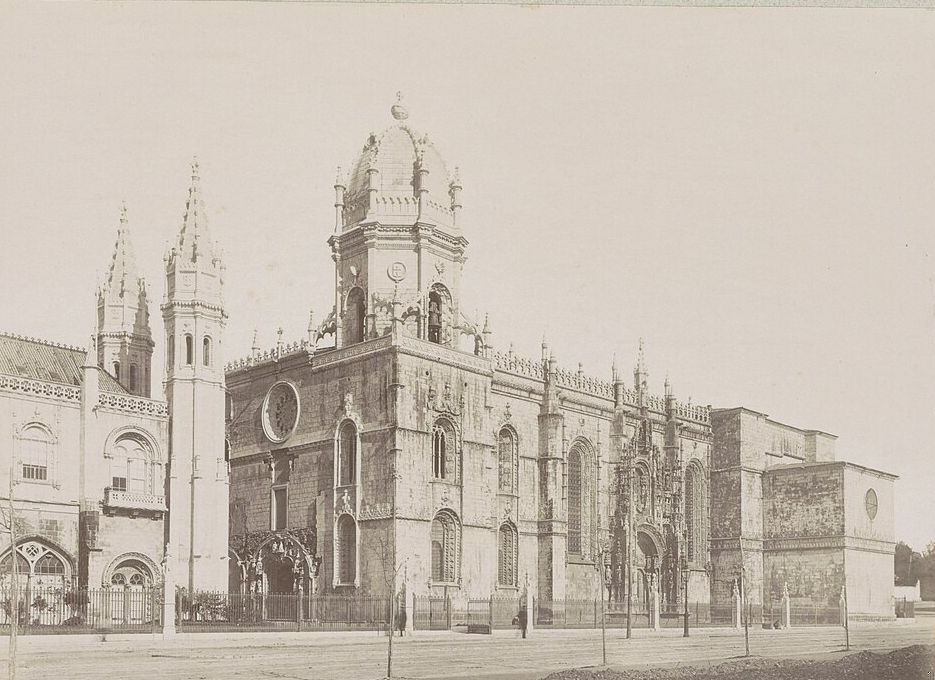
The cloister of the Jerónimos, with its ground floor complete by 1519, is carved on every surface with royal and religious badges (the armillary sphere, the cross of the Order of Christ, the royal shield), Passion medallions on the piers, Saint Jerome reliefs, plants, grotesques and fantastic animals, many taken from printed engravings. The monastery says that most of the sea-themed carving in the building, the ropes, fish, anchors and ships, sits in the parts restored in the 1800s. Ropes are not denied in the older work, but the sea is not the main subject of the cloister of the 1500s.
Pick one arch of the cloister and read it slowly. Every surface is carved: the piers, the slim shafts that split the opening, the panels above. It is the best place in the monastery to test what you have been told about it, because the story most visitors arrive with is that this is the sea turned to stone. The monastery says otherwise.
What to hunt for on one arch
Four arches make a walk, and any one will do. Look for:
- A globe made of hoops. This is the armillary sphere, a royal badge. We call it that and nothing more. A claim that it was King Manuel's personal device rests on a source we could not open.
- The cross of the Order of Christ, and the royal shield.
- Round medallions on the piers with the symbols of Christ's Passion.
- Reliefs of Saint Jerome, patron of the order that lived here.
- Plants, grotesques and fantastic animals, many drawn from printed engravings.
Apart from the niche sculptures, the Passion medallions and the Jerome reliefs, the scheme is predominantly secular. The heritage inventory calls it palace-like, closer to a palace than a place of prayer.
What was actually built when
Hear a stop from this walk
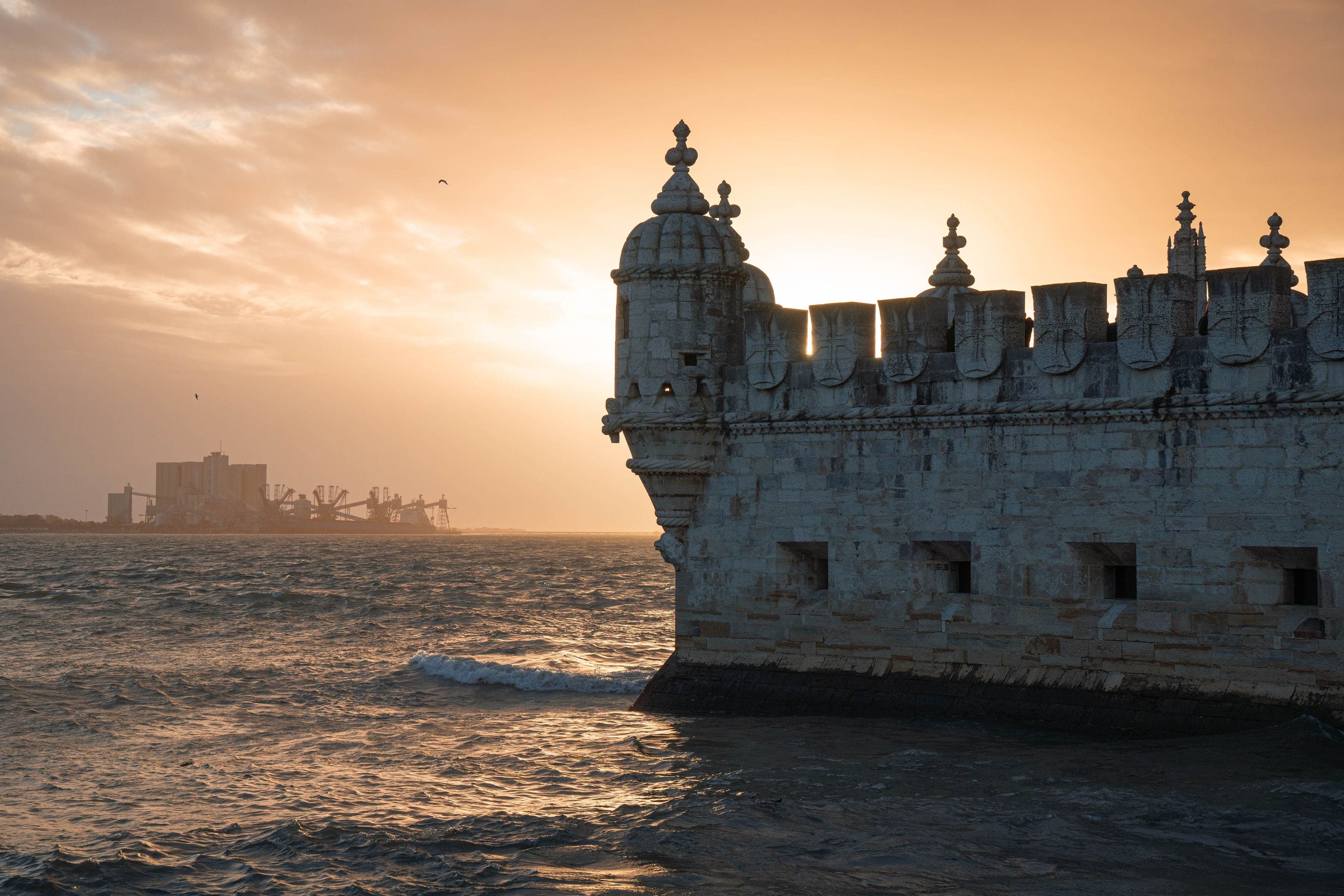
Torre de Belém: Once in the River
The ground floor of the cloister was complete by 1519. Who finished it is where the sources differ. The monastery credits Diogo Boitaca with finishing the ground floor. The heritage inventory has Boitaca plan the cloister and João de Castilho hold its contract from 1517, with the work done by 1519. We tell both and pick neither.
The galleries have many-ribbed vaults on carved brackets, and the inner corners of the garden are cut on the diagonal, making an octagon inside the square. The lower arches are flattened and the upper ones are round.
The sea, and where it is
You may have been promised ropes and ships. The monastery's own statement is exact. It says that most of the maritime decoration seen today in the building, ropes, fish, anchors and ships, is in the parts restored in the 1800s. Notice what that says and what it does not.
- It says "most", not all.
- It says "restored parts", not that the carvers of the 1500s added nothing nautical.
- It covers the whole building, not only the cloister.
- The same monastery's page on Google Arts and Culture lists ropes among the cloister's motifs, and its school guide, a dated source, lists nautical themes on the lower cloister.
A twisted stone cord does run round the refectory, built in 1517 to 1518, and the south front has twisted colonnettes, so a rope alone tells you nothing about a date. We could not reach the studies that would sort the cloister's ropes by date, so we do not try. Read this stone for a king and a faith first, and treat the sea as something the restorers emphasised.
The upper storey is the restorers' storey
If you climb to the upper cloister, you are looking at more restoration. The ground floor and two walks of the upper floor were complete by 1519, and the rest was taken up again from 1540. Then in 1886 the gargoyles, small buttresses, niche tops and the shafts dividing the arches were restored, on a design by the engineer Raimundo Valadas. A simple test is on the gargoyles: those with a channel cut in them are originals of the 1500s, and those without one are decoration added in the 1800s.
Between the old and the new there is also the Renaissance: the parapet of medallions and busts above the balcony is by Diogo de Torralva, from the 1540s.
Where sources disagree
- How many niches. The monastery says twenty niches with life-size statues, the inventory twenty-four with reliefs. A school guide adds King Manuel among them. The count is unresolved.
- Who finished the ground floor, as above.
- Why some piers differ. The inventory says the first pier of the west walk and the piers of the north walk differ from most others in carving and theme, and gives no reason.
See it
You need the cloister ticket, which is timed, sold separately from any guide, and often sells out and cannot be bought on the day. Book before you travel. The garden in the middle is seen from the walks only. Roamer's independent English audio guide tells this story on the south walk, in the Jerónimos Monastery guide, and the whole visit is laid out in the Jerónimos, space by space. To tell the 1500s from the 1800s on the outside too, see real or revival. The guide is not affiliated with the monastery.
Cover: the arcaded front of the Jerónimos in low light. Photograph by Efrem Efre, Pexels.
Frequently asked questions
- What is carved on the Jerónimos cloister?
- Royal badges (the armillary sphere, the cross of the Order of Christ and the royal shield), round medallions of the Passion of Christ on the piers, reliefs of Saint Jerome, plants, grotesques and fantastic animals, many drawn from printed engravings. Apart from the niche sculptures, the Passion medallions and the Jerome reliefs, the scheme is mostly secular and has been called palace-like.
- Is the Jerónimos cloister covered in ropes and ships?
- Less than its reputation says. The monastery states that most of the sea-themed carving in the building, ropes, fish, anchors and ships, is in the parts restored in the 1800s. Ropes do appear in older work: a twisted stone cord runs round the refectory of 1517 to 1518, and the monastery's own pages list ropes among the cloister motifs. So one rope proves nothing about its date.
- What is the armillary sphere?
- A globe made of hoops, used here as a royal badge. We call it that and no more, because we could not confirm it as King Manuel's personal emblem.
- Do you need a ticket to see the Jerónimos cloister?
- Yes. The cloister is the paid, timed part of the visit, and tickets often sell out and cannot be bought on the day. The church is free.
Ready to experience it?
Belém: The Shore That Moved
100 min · 3.9 km · easy
More from Lisbon
Explore more at your own pace.
Best Architecture Walking Tours in Lisbon (2026)
Camões's Tomb at the Jerónimos: The Poet and the Doubt
Real or Revival: How to Tell the Jerónimos of the 1500s from the 1800s
The Jerónimos Monastery in Lisbon: What to See, Space by Space
Vasco da Gama's Tomb at the Jerónimos: Whose Bones Are Inside?