Nowa Huta was meant to be a new kind of town for a new kind of country, and it was planned to the last avenue. What it did not have was a church. The IPN historian Lucja Marek puts it plainly: no place of worship was provided in the plans, because it was to be "a model socialist city without God". Walk up its axis from the central square and out of the plan, and you arrive at the church it got anyway.
A town for a steelworks
The decision to build a steel combine and a town for its workers came in May 1947, the IPN says, and the site, at the village of Mogila east of Krakow, was chosen at the end of February 1949. Building of the first estates began that year: the heritage register says March, the IPN about four months later, so the safe word is simply 1949. On 1 January 1951 it became part of Krakow. The register names Tadeusz Ptaszycki as the general designer.
The plan is a stage set. The city describes Plac Centralny as a pentagon on the edge of the Vistula escarpment, with five broad avenues fanning out from it and dividing the town into four housing sectors, A to D. Its arcaded fronts, built from 1952 to 1956 to designs by Janusz Ingarden and Tadeusz Ptaszycki, borrow from the French Renaissance and classicism: palace fronts for steelworkers. Some pieces were never built. The city lists a theatre by the escarpment, an obelisk in the middle of the square, and a town hall with a tall spire that was to close the view up Aleja Roz, the Avenue of Roses. In 2004 the city council added a patron to the square's name: Ronald Reagan.
Roses, then Lenin, then roses
Hear a stop from this walk
Arka Pana: The Lord's Ark
Aleja Roz was planned as the town's main axis. In 1973 a statue of Lenin by Marian Konieczny was set up in its centre and unveiled on 28 April. The IPN gives its size, a figure six and a half metres tall, and its story: a bomb under it on the night of 17 to 18 April 1979 damaged only its heel; a police booth stood beside it round the clock; in the autumn of 1989 young protesters attacked it again and again, and on the night of 10 December 1989 the authorities took it down. About three years later a Swedish businessman, Bengt Erlandsson, bought it for his museum of curiosities in Varnamo. The avenue has been replanted with roses since.
The plan itself changed after 1956. Two blocks from the palace fronts stands the Swedish Block, designed by Marta and Janusz Ingarden and built from 1957 to 1959: 260 metres long, with 272 flats, built, the city says, after Janusz Ingarden's visit to Sweden. The Ludowy Theatre, by the Ingardens and Edmund Dabrowski, opened on 3 December 1955 with a play about Krakow peasants and highlanders that gave its name to three of the estates around it. It is still a theatre.
The cross and the church
After 1956 the authorities allowed a church; in 1959 they withdrew the permission. On 27 April 1960 residents defended a cross standing on the empty plot at the corner of what were then Marks and Mayakovsky streets. The IPN calls it the largest protest of its kind in communist Poland, sparked mainly on religious grounds. A "millennium school" was built on the plot instead, and in 2007 a monument to the Nowa Huta Cross by Stefan Dousa was set up beside the small church of the Sacred Heart nearby. The street is now called Defenders of the Cross.
The 2023 boundary of the Historic Monument runs along Bienczycka and Kocmyrzowska streets, and the walk crosses it into the old village of Bienczyce. That is where the Church was sent. A parish was set up there at a small chapel in 1952, and in July 1965 the priest, Father Jozef Gorzelany, obtained a permit "to extend a chapel". Cardinal Karol Wojtyla broke ground on 14 October 1967 and consecrated the church on 15 May 1977. The parish says it was built by hand like a medieval church, with shovels, picks, barrows and peasant carts, to a design by Wojciech Pietrzyk, its walls faced with pebbles from Polish rivers under a roof shaped like a boat. People call it the Arka Pana, the Ark of the Lord. In front of it is a square named for Bogdan Wlosik, a twenty year old steelworker whom the IPN says was shot near the church by a secret police captain on 13 October 1982, five days after Solidarity was banned; the captain was convicted in 1991.
Visiting
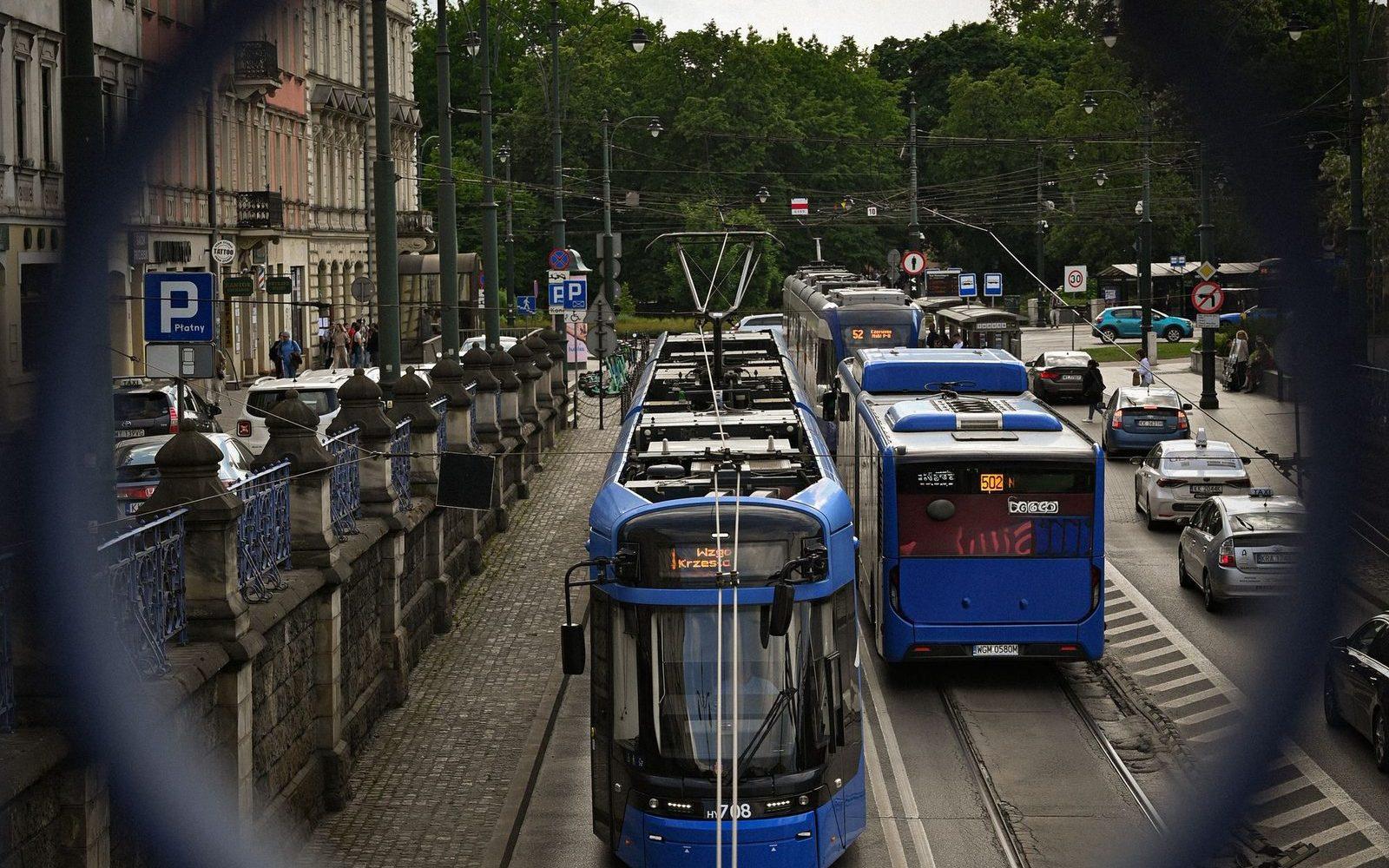
Nowa Huta is a living district, not a museum. Look at the residential blocks from the street, keep away from the school and kindergarten grounds, and keep quiet at the church during Mass. The Nowa Huta Museum in the old Swiatowid cinema is temporarily closed while its building is modernised, from 2025 to 2028. Plac Centralny is served by several tram lines; line numbers change with works, so check MPK Krakow or Jakdojade.
The state's own description, in the 2023 decree that made Nowa Huta a Historic Monument, is the best summary: a socialist realist town plan built as a manifesto of socialist ideas, which turned out to be a stage of social uprisings. Nowa Huta: The Town Without a Church walks exactly that line, ten stops, about 70 minutes and 2.1 kilometres, from Plac Centralny up Aleja Roz and out of the plan to the Arka Pana. The introduction and the first stop play in full; every later stop plays a short preview before you choose to buy. For the old town it was built to stand beside, see Krakow walking tours.
Frequently asked questions
- When was Nowa Huta built?
- Building of the first housing estates began in 1949: the heritage register says March, the IPN about four months after the site was chosen in late February. Nowa Huta became part of Krakow on 1 January 1951. Plac Centralny and Aleja Roz were built from 1952 to 1956.
- What happened to the Lenin statue in Nowa Huta?
- Marian Konieczny's statue was unveiled on Aleja Roz on 28 April 1973, survived a bomb in 1979, and was dismantled on the night of 10 December 1989. About three years later it was sold to a Swedish businessman, Bengt Erlandsson, for his museum in Varnamo, the IPN says.
- How do you get to Nowa Huta from central Krakow?
- By tram. Plac Centralny im. Ronalda Reagana is served by several lines; check the current lines on the MPK Krakow site or Jakdojade, as line numbers change with works.
Ready to experience it?
Nowa Huta: The Town Without a Church
60 min · 2.1 km · easy
More from Krakow
Explore more at your own pace.
Krakow: The Square, the Coronation Hill, the Jewish Town, and Two Grounds Beyond
Podgorze and the Ghetto: A Town Walled In
Rynek Glowny: How to Read Krakow's Main Market Square
The Remuh Synagogue and Cemetery: Kazimierz's Working Synagogue
Plac Nowy and the Okraglak: The Round Hall at the Middle of Kazimierz