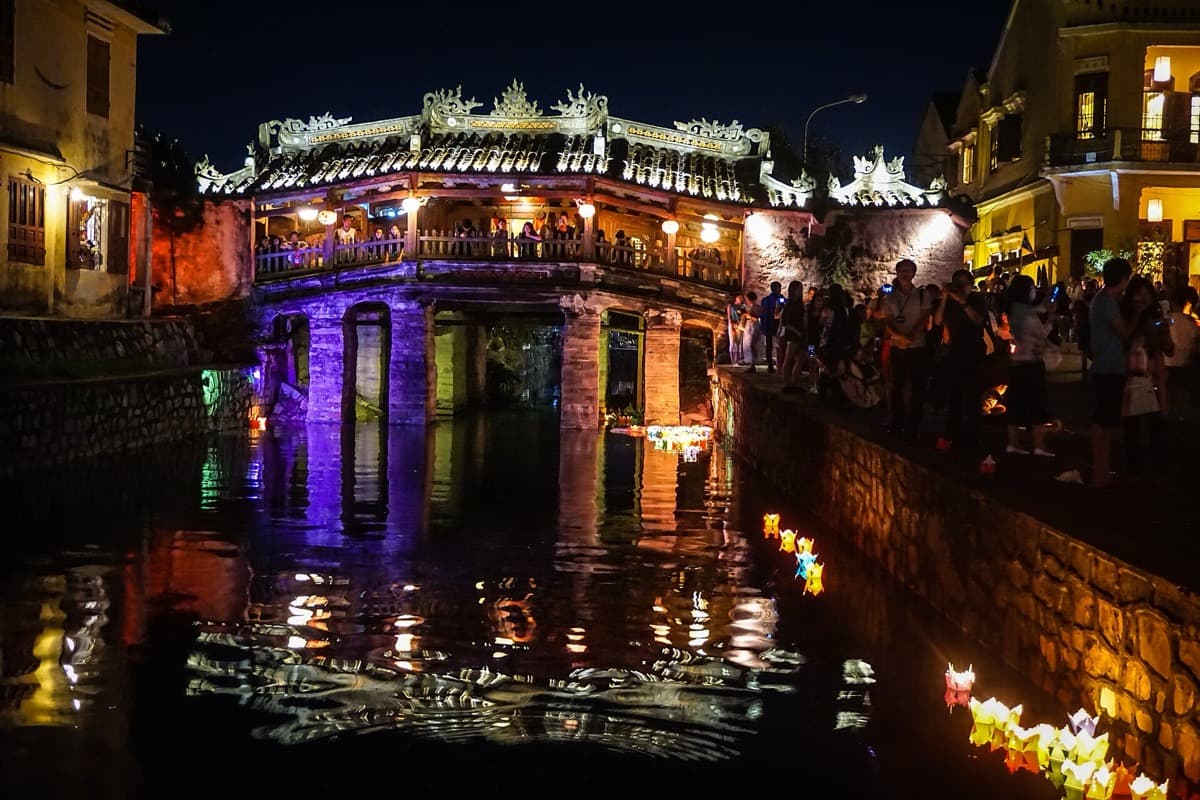
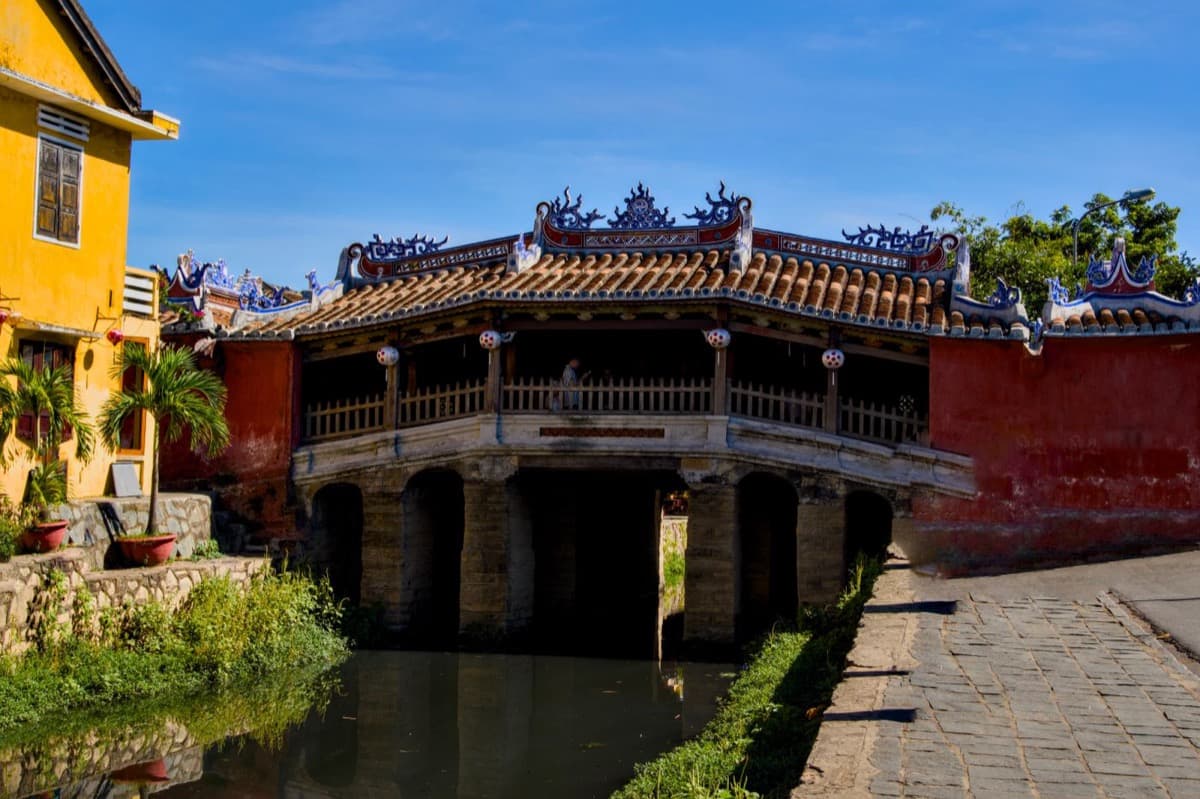
Stand at the western edge of Hoi An's old town and look at the little roofed bridge crossing the canal. It is small, barely eighteen metres across, timber and tile, with a curved roof and a temple built into one side. It does not look like the origin of anything. But this is Chùa Cầu, the Bridge Pagoda, and Hoi An's whole story begins here. Everything else in the old town sits east of this point, downriver toward the vanished harbor. This is the threshold.
The bridge is anchor stop one of the merchant port walk, and it deserves a slower look than most people give it, because almost every important fact about the town is compressed into this one small crossing.
Two communities, one bridge
Japanese merchants settled in this port, then called Faifo, during the fifteen hundreds and sixteen hundreds. Their presence here was not incidental. Between 1600 and 1635, at least seventy red-seal ships, the licensed Japanese trading vessels of the Tokugawa era, sailed to Hoi An, and by around 1617 a distinct Japanese quarter, a Nihonmachi, had formed in the town. These were serious traders operating a serious route.
A small canal ran through the settlement, separating the Japanese quarter from the Chinese one on the far bank. The Japanese community built this bridge to stitch the two together. Construction began in 1593 and finished in 1595, in the reign of the shoguns and a full generation before the Pilgrims landed at Plymouth. Read that fact plainly: the emblem of Hoi An is a Japanese-built crossing that predates most of what tourists think of as old anywhere in the Americas. It is the physical handshake between two foreign merchant communities who agreed to build something in the middle.
The temple on the bridge
Hear a stop from this walk
Bach Dang Riverfront: The Water That Made and Unmade the Town
Look partway across, on the north side, and you will find the detail that makes this crossing unique. A small temple is built right into the structure, its entrance overlooking the water. Japanese residents are said to have added this temple atop the bridge in 1653, making it both a crossing and a place of worship, a combination rare enough that it became the town's defining landmark rather than just a convenient way over a canal.
Legend ties the temple to Namazu, the giant catfish of Japanese folklore blamed for earthquakes. In the myth Namazu thrashes underground and the ground shakes. The bridge was imagined as pinning the creature in place, its head said to lie in India, its body in Vietnam, and its tail in Japan, so that as long as the bridge stood, the earth would stay still. Whether or not anyone believed it literally, the story tells you something true: this was a structure carrying the anxieties of people a very long way from home, who had crossed a dangerous sea and wanted the ground beneath them to hold.
A name for a town of guests
In 1719 a Vietnamese lord named Nguyễn Phúc Chu visited the bridge and gave it a name: Lai Viễn Kiều, which means a bridge to welcome guests from afar. According to the bridge's own record, that name still stands. It is difficult to imagine a more fitting phrase for the place. Hoi An lived on guests from afar. Japanese, Chinese, Portuguese, Dutch, all arriving by water to trade silk and ceramics and spices. The town's entire prosperity was built on welcoming strangers who came across the sea, and its central monument is, by name, a welcome to exactly those strangers.
The bridge in your pocket
If the bridge looks familiar even before you arrive, there is a reason. In 2006 the State Bank of Vietnam put it on the twenty-thousand đồng banknote. A small footbridge built by foreign merchants in a port that later failed became, four centuries on, one of the images a modern nation chose to represent itself in the money its citizens carry every day. That is a remarkable afterlife for a crossing over a canal that no longer even carries much water.
It is worth pausing on what that says about Hoi An's second life. The town's trade collapsed in the nineteenth century when the harbor silted and the ships moved to Da Nang, and the whole story of that collapse and the preservation it accidentally produced is the subject of the harbor that failure saved. The bridge is the emblem of a town that turned its own obsolescence into heritage, and the banknote is the proof that the strategy worked. Hoi An sells its past, and the bridge is the logo.
What to notice on the spot
The bridge you see has been restored many times over its four centuries, most recently in a careful restoration that rebuilt weakened timber and reopened in 2024. Do not expect a pristine original. Expect a much-repaired survivor, which is honest to what it is.
Look at the roof line and the way the temple breaks the symmetry on the north side. Look for the carved dog and monkey figures that guard the two ends, commonly read as marking the years the work began and ended in the zodiac cycle: begun in a year of the monkey, finished in a year of the dog. And then look at the water, or what is left of it, and picture the canal that once divided a Japanese street from a Chinese one, with this bridge as the only agreed-upon ground between them.
The bridge is included in the old town combined ticket, though you can walk across the general area and photograph it freely. Keep your voice low near the temple, which is still a place of worship. Then step off the eastern end and keep walking, because you are now leaving the threshold and entering the port itself, the merchant houses, the ceramics, the market, and the quay, all of it downriver from the little bridge where two strangers agreed to meet in the middle.
Ready to experience it?
Ancient Town: The Port That Time Forgot
80 min · 1 km · easy
More from Hoi An
Explore more at your own pace.
Hoi An Travel Guide: How Many Days, Getting Around, When to Go (2026)
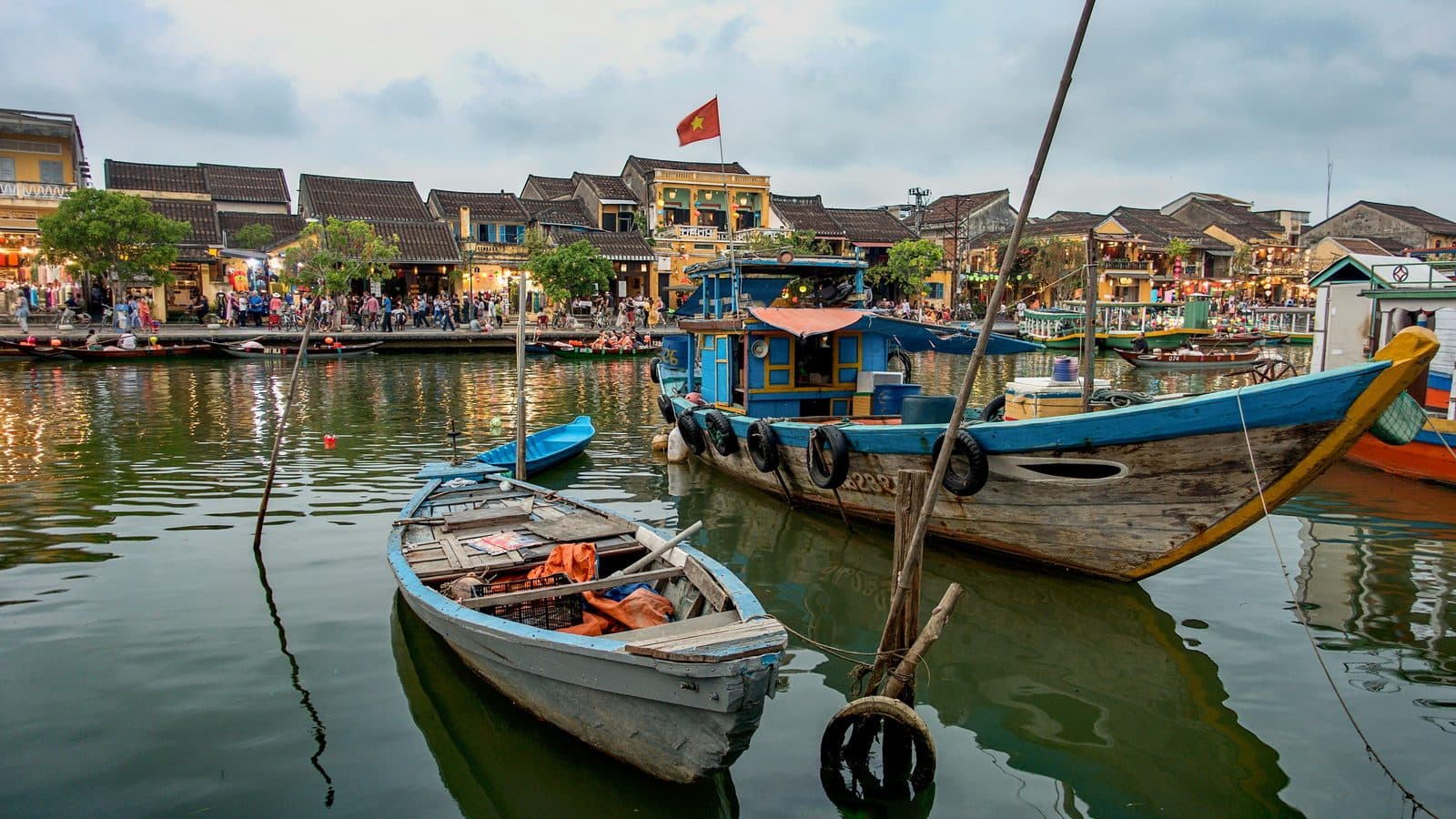
How to See Hoi An: The Town That Failure Saved
One Day in Hoi An: A Walkable Ancient Town Itinerary (2026)
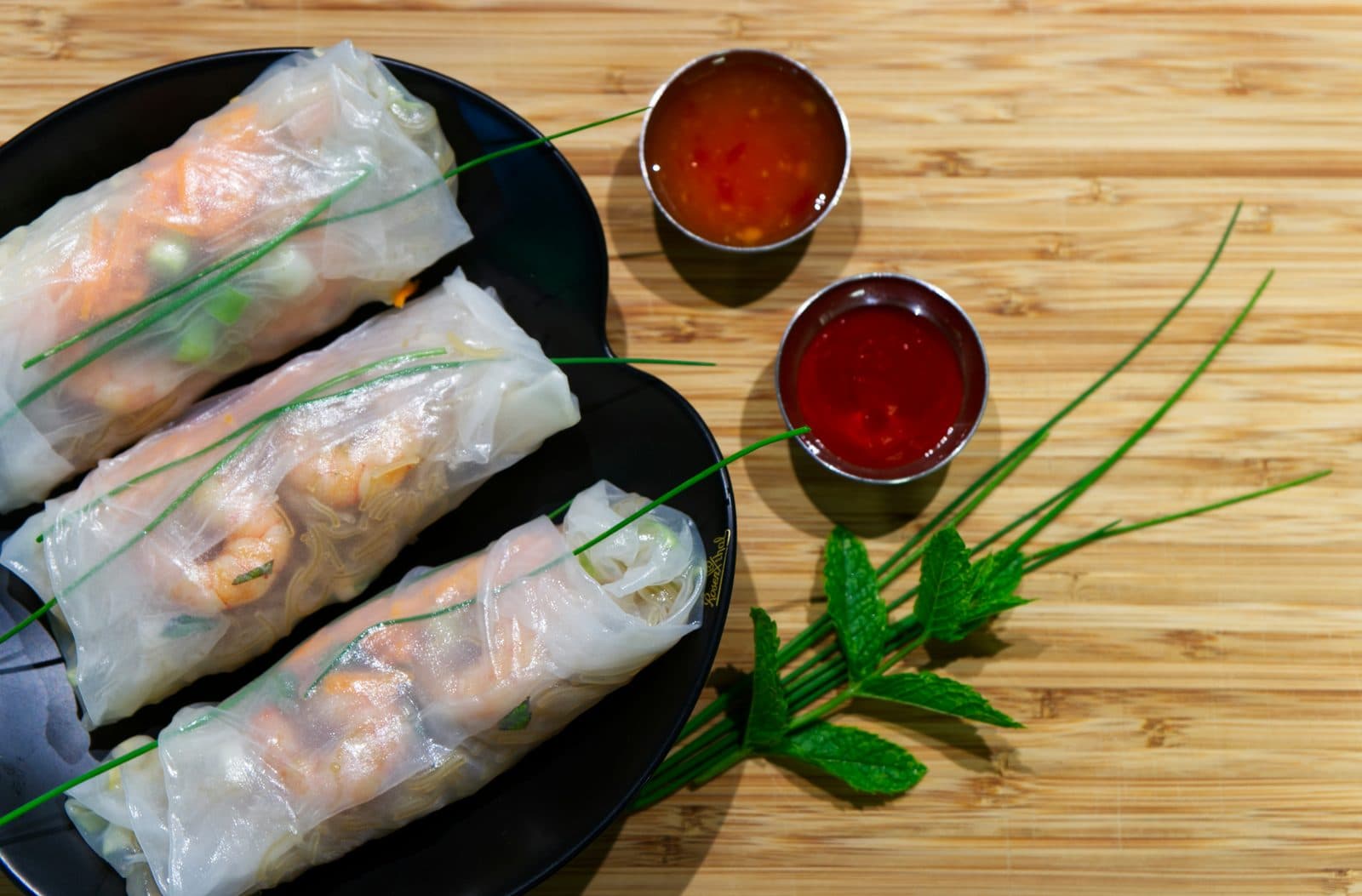
What to Eat in Hoi An: A Food Guide (2026)
A Map of Who Fled Where: Reading Hoi An's Assembly Halls