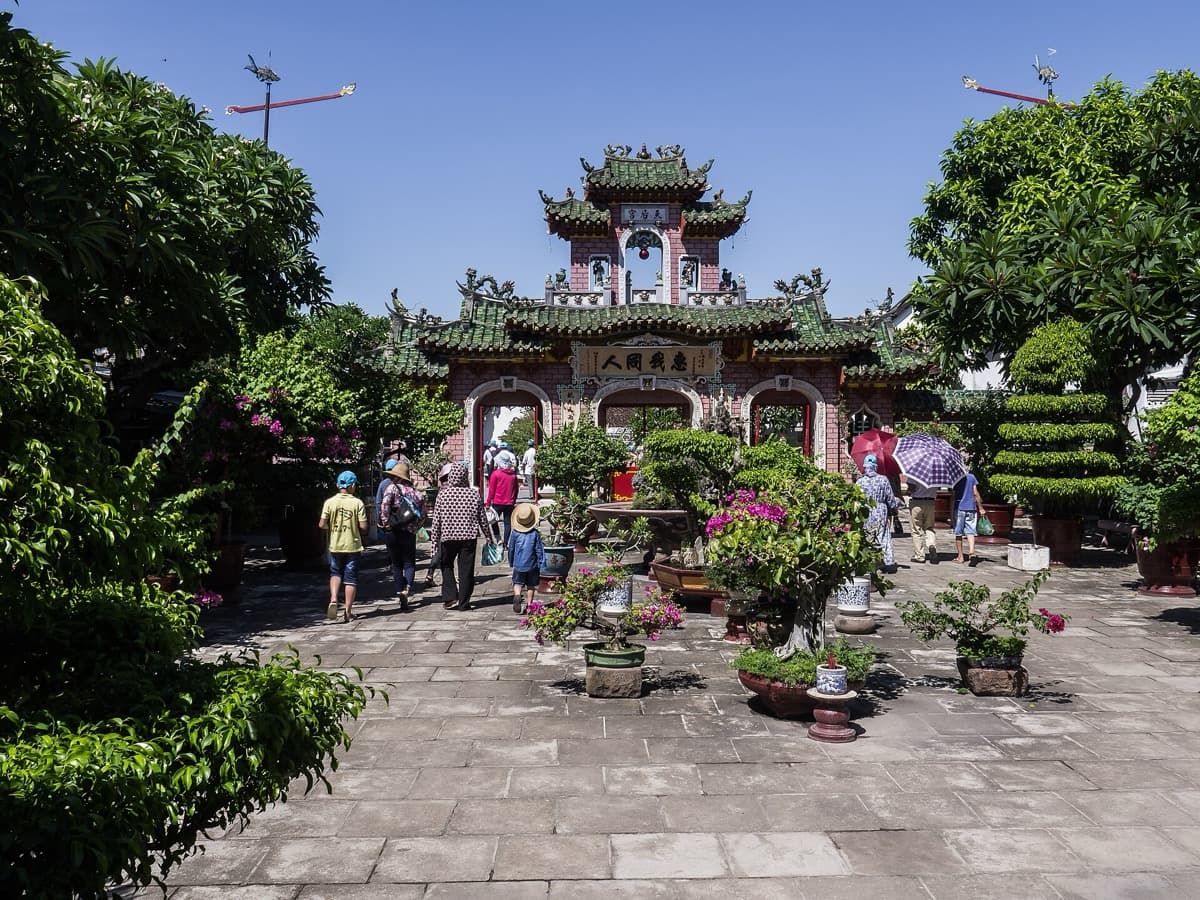
Of all the ornate buildings along Trần Phú Street, one stops people in the doorway. The Fujian hall, Phúc Kiến, is the grandest and largest of Hoi An's assembly halls, spread across roughly two thousand square metres, entered through a famous ornate gate with three arches. Most visitors come for the spectacle: the color, the coiled dragons, the smoke of enormous incense coils hung from the ceiling. But the hall is worth understanding, not just photographing, because it is the single clearest statement of the story that runs under the whole street of homesick temples. This is stop three of that walk, and it is where the argument is written plainest.
A hall that began as something else
The building did not start as a Chinese hall at all. The common account, and the dates in the records genuinely disagree, is that the site began around 1692 as a modest Buddhist pagoda, a thatched-roofed temple built by local Vietnamese and known as Kim Sơn. Over the following decades the structure decayed. Fujian merchants acquired it, rebuilt it in brick and hardwood on a far grander scale, and rededicated it as their community hall, with the restoration commonly said to have reopened around the middle of the seventeen hundreds.
That origin is quietly telling. A Vietnamese Buddhist pagoda became a Chinese immigrant institution, which is exactly the kind of layering that defines Hoi An. Nothing here is one culture only. Even the grandest monument to the Fujian community sits on the footprint of a Vietnamese temple, the way the Chinese quarter and the Japanese quarter and the local village all lived on top of one another in a town too small and too busy to keep its communities apart.
The exile that the building commemorates
Hear a stop from this walk
Chaozhou Assembly Hall (Trieu Chau): Homesickness Carved in Wood
To understand why the Fujian community was rich enough and numerous enough to build on this scale, you have to know the event that brought them. In the middle of the sixteen hundreds, the Ming dynasty fell to the Qing. Loyalists and traders who would not live under the new rulers fled south by sea. The Nguyễn lords of central Vietnam let them settle, and out of that settlement grew the Minh Hương community, Chinese who worshipped and eventually intermarried alongside the Vietnamese.
The Fujian, sometimes called the Hokkien, were among the most prominent of these groups during Hoi An's golden age as a trading port, which is why their hall is the biggest on the street. So read the scale correctly. This is not the confidence of a settled, comfortable community. It is a monument raised by refugees, people whose entire history in this country began with a dangerous flight across open water, many of whom never fully went home. The grandeur is a kind of defiance: we lost our country, and look what we built on the far side of the sea.
The goddess on the altar
This is why the hall's main deity matters so much. Phúc Kiến is dedicated to Thiên Hậu, also known as Mazu, the goddess who protects sailors and fishers on the open ocean. Venerated across coastal China and the entire Chinese diaspora, she is the guardian of the crossing.
Stand in front of her altar and hold the two facts together. These were people whose survival had depended on a sea voyage, and here, at the center of their grandest building, is the goddess they believed had carried them across alive. The hall is arranged to deepen that feeling, moving you front to back through a public front hall, a main hall, and a rear sanctuary, from open and public to quiet and sacred as you go. The three parallel sections are sometimes said to trace the Han character for three, 三. By the time you reach the back, the crowds thin, the light drops, and you are standing where the community placed the memory of the voyage that made them who they are.
Prayers for the future, not just the past
A hall built out of exile could easily have been only a monument to loss. Phúc Kiến is not. Alongside Thiên Hậu, the hall honors a set of protective figures, including deities associated with fertility and childbirth and the midwives believed to help infants learn to feed and to smile. Couples come here to pray for children.
That detail completes the building's meaning. A community that had lost its homeland turned its grandest hall toward the continuation of the family: the next generation, born safely, in a new country. The sea goddess guards the crossing that already happened. The fertility deities guard the future that has not happened yet. Grief for the old country and hope for the new one occupy the same room. That is the emotional architecture of a diaspora, and few buildings anywhere state it as directly as this one.
How to see it well
Phúc Kiến is included in the Hội An old town combined ticket. Go early if you can, before the tour groups fill the courtyards, and dress to cover your shoulders and knees, because this is an active place of worship where locals still come to pray and light incense.
Then do the thing most visitors skip: slow down and look up. The finest work, the carved beams, the painted ceiling, the great hanging incense coils that burn for weeks, is easy to miss at eye level. Walk the three sections in order, from the arched gate to the rear sanctuary, and let the space quiet you as you go. And carry out the one idea the whole hall exists to teach. The biggest, most beautiful building on this street was raised by people who had lost everything, to thank the sea for letting them live, and to ask it to bless the children they would raise in the country that took them in.
Ready to experience it?
Assembly Halls: The Halls of the Overseas Chinese
75 min · 1 km · easy
More from Hoi An
Explore more at your own pace.
Hoi An Travel Guide: How Many Days, Getting Around, When to Go (2026)
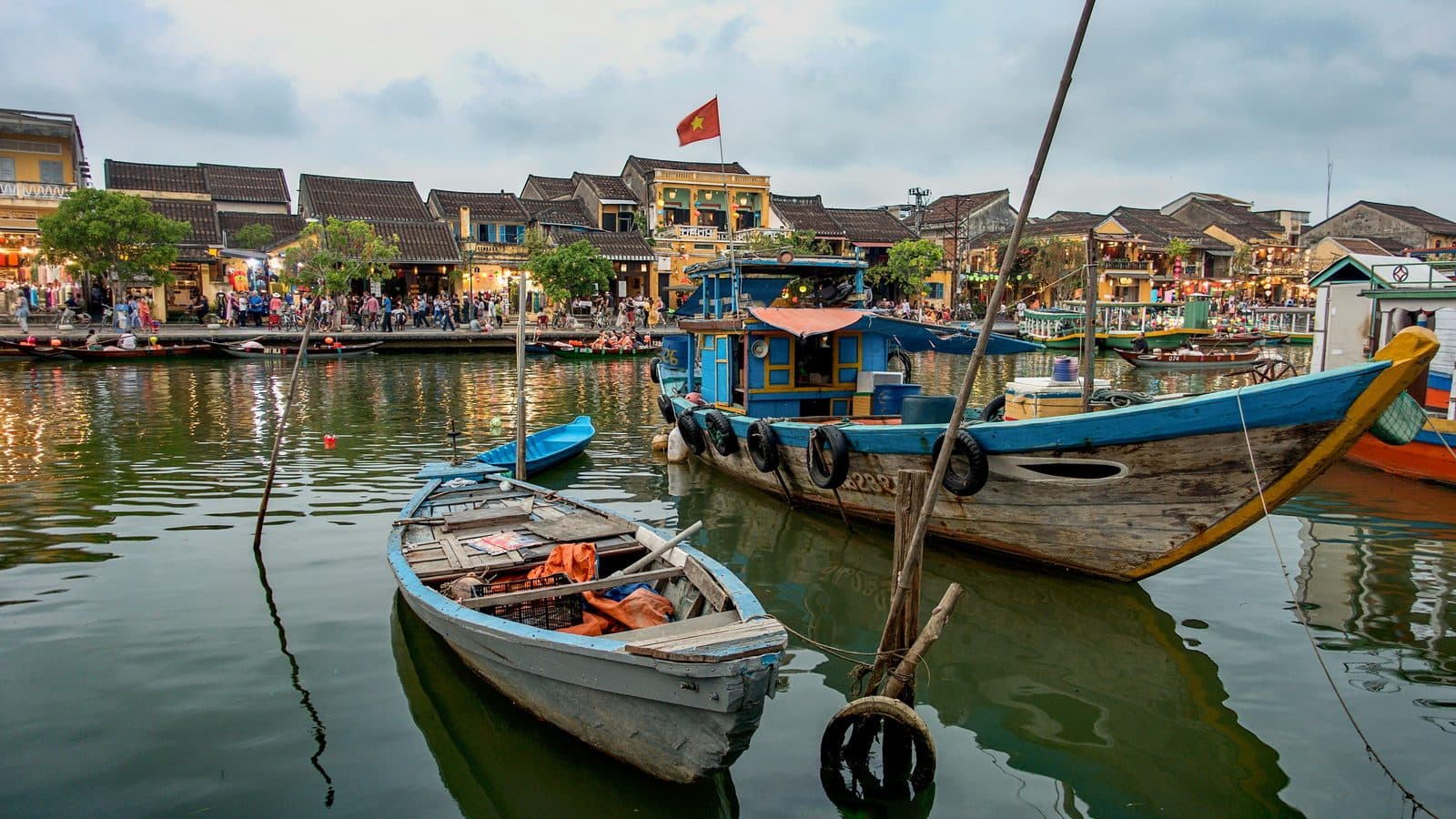
How to See Hoi An: The Town That Failure Saved
One Day in Hoi An: A Walkable Ancient Town Itinerary (2026)
What to Eat in Hoi An: A Food Guide (2026)
A Map of Who Fled Where: Reading Hoi An's Assembly Halls