LearnExploreProfile
Jerash: Walking a Complete Roman City
Cultural Explainer

Jerash: Walking a Complete Roman City

July 21, 20268 min read
  • The civic core: a whole ceremonial city, still legible
  • The sacred way: one holy ground reused for the next god
  • Why walk it your own way
  • Sources

Plan Your Visit

  • Visiting Jerash: A Practical 2026 Planning Guide7 min read
  • One Day in Jerash: A Walkable Morning-to-Evening Plan7 min read
  • Best Self-Guided Walking Tours in Jerash (2026)3 min read

More from Jerash

  • The Jerash Cathedral: A Church Built From a Temple, and the Sacred Way Behind It6 min read
  • Hadrian's Arch in Jerash: The Gateway to a City That Was Never Built6 min read
  • The Oval Plaza at Jerash: How One Stone Oval Explains a Whole Roman City6 min read
  • The Temple of Artemis in Jerash: Columns Engineered to Sway6 min read
Jerash: The Colonnaded Heart of Roman Gerasa
Self-guided audio tour

Jerash: The Colonnaded Heart of Roman Gerasa

90 min · 1.5 km · moderate

Start free
See all Jerash tours

Walk Jerash and you walk a complete Roman provincial city, a place the classical world usually leaves in fragments but that here survives almost whole. This was Gerasa, a town of the Decapolis in the hills of northern Jordan that grew rich on trade and rebuilt itself in marble and columns under Roman rule. Pompey brought it into the Roman sphere in sixty-three B C, and by one hundred and six A D it belonged to the province of Arabia. What makes the site rare is not any single ruin but the survival of the whole plan: a triumphal gate at the edge, an oval forum no other Roman city preserves, a mile of colonnaded street still scored by ancient wheels, temples to the city's gods, and Christian churches with mosaic floors laid where those gods were left behind. You can read the entire thing at your own pace, on foot, with no van and no schedule.

The two self-guided walks split Gerasa the way the ancient city split itself: the civic and ceremonial south, and the sacred and Christian north. Taken together, they trace a single argument about why so much of this place is still standing.

The civic core: a whole ceremonial city, still legible

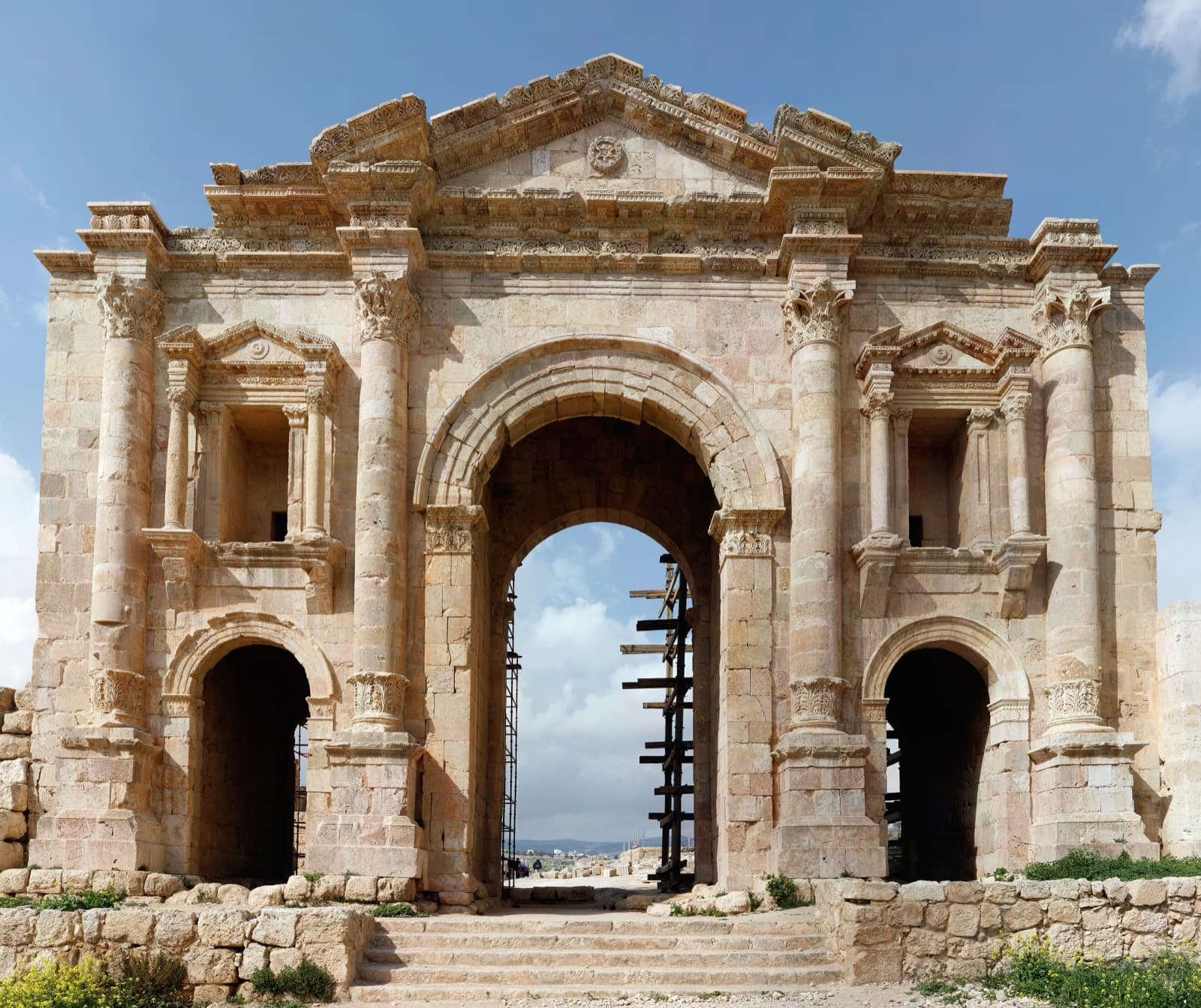
The southern walk follows the monuments a citizen or a traveller would have met on the way in. It begins at Jerash: The Colonnaded Heart of Roman Gerasa, under Hadrian's Arch, a triple gateway raised to commemorate the emperor Hadrian's visit in the winter of one hundred and twenty-nine to one hundred and thirty A D. The detail that rewards standing still is that the arch is stranded. It sits about four hundred and sixty metres outside the walls, with open ground between, because it marked a southward expansion of the city that was planned and then never built. You are standing at the edge of an ambition that was announced and quietly set aside.

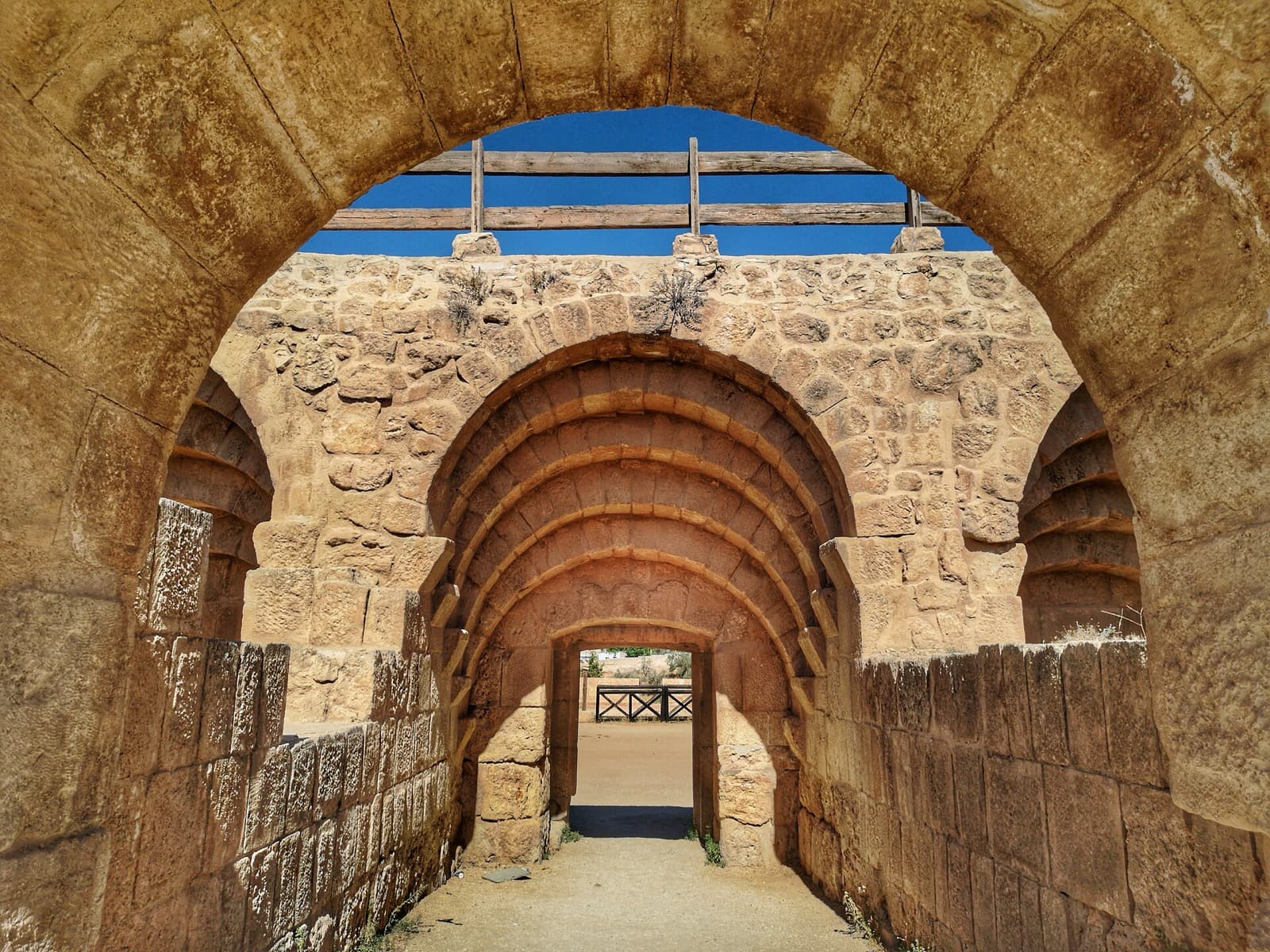
From there the route passes the Hippodrome, a chariot arena about two hundred and forty-five metres long whose stone tiers could seat up to fifteen thousand. It is one of the smaller Roman circuses but one of the best-preserved, so where most such arenas survive only as an outline, here the shape reads whole. Then comes the South Gate, built around Hadrian's visit and likely the prototype for the grander arch to its south, and above it the Sanctuary of Zeus, whose lower terrace was raised in twenty-seven to twenty-eight A D by a named local architect, Diodoros, son of Zebedas, with the upper temple consecrated in one hundred and sixty-two to one hundred and sixty-three A D.

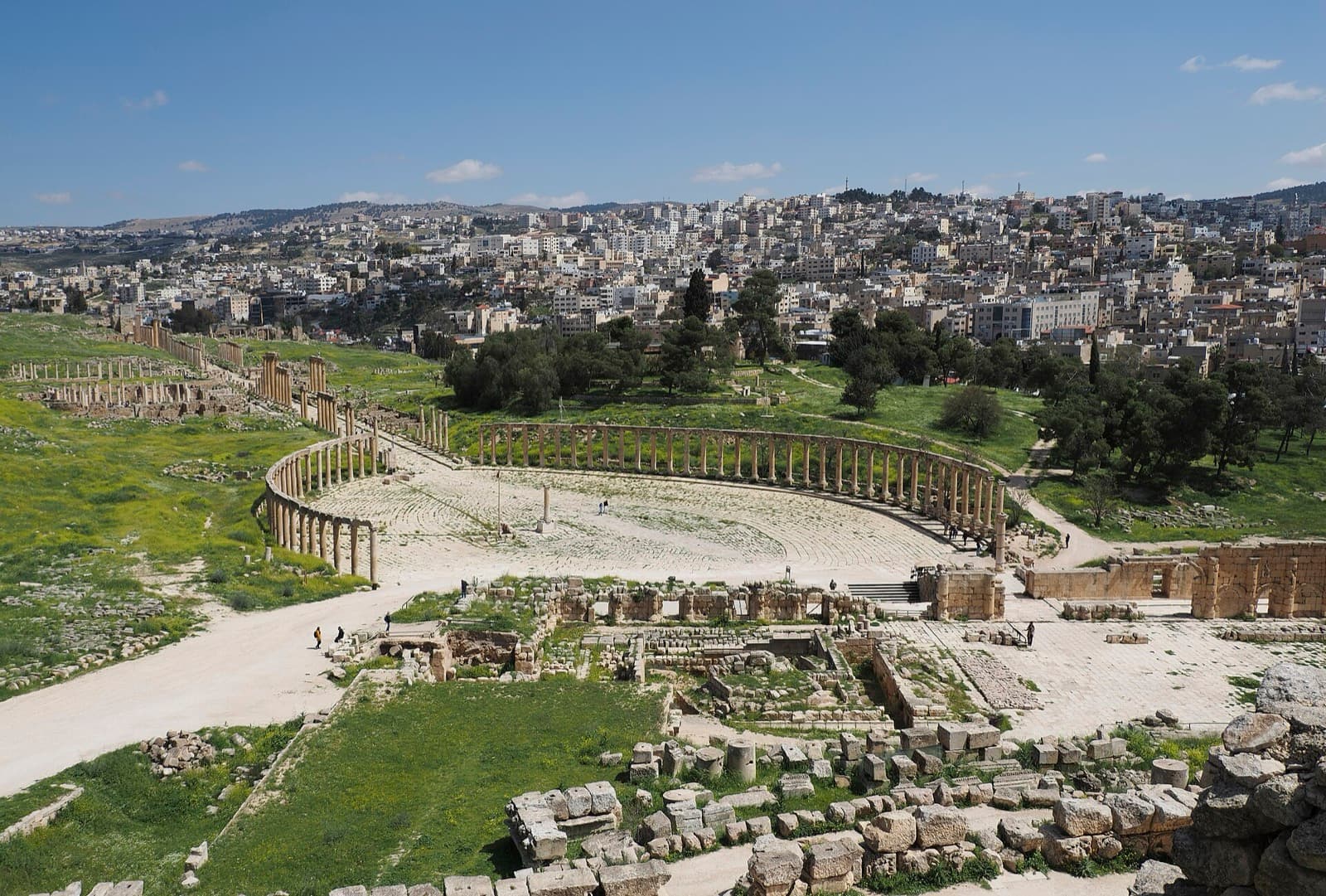
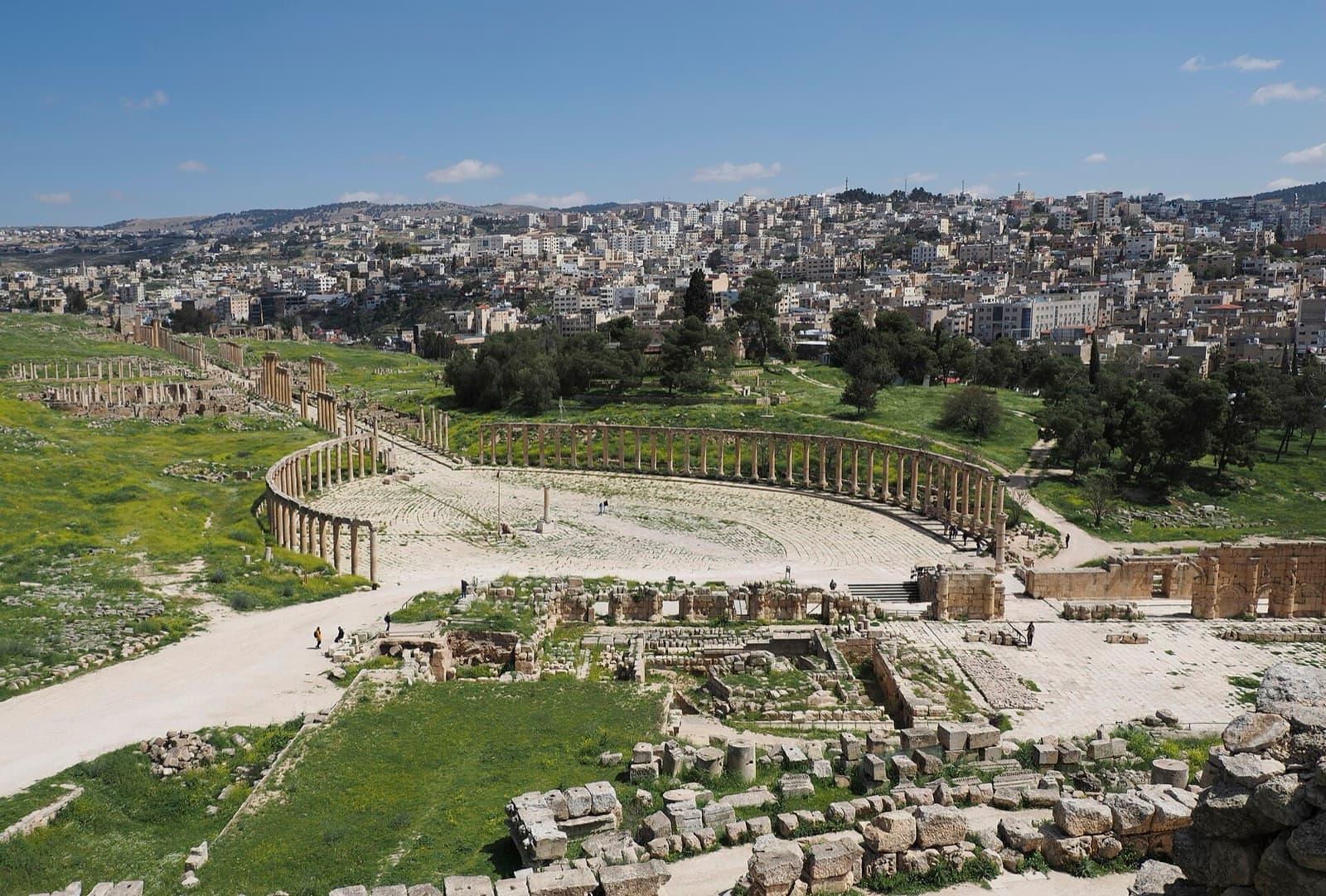
The monument Gerasa is known for is the Oval Plaza, a broad public square shaped not as the usual Roman rectangle but as a sweeping oval about ninety metres by eighty, ringed by fifty-six Ionic columns of the first century A D. Its oval form is genuinely rare, and it is not decoration for its own sake. It is a solution: the colonnaded main street runs on one axis, the older Zeus terrace sits on another, and the two do not line up, so the builders swept the space into an oval that joins one axis to the other. Geometry turned into elegance.

The walk closes at the South Theatre, built in the late first century A D under Domitian, seating more than three thousand. A person standing on the marked focal point at the centre of the orchestra floor can be heard clearly in every seat without raising his voice: two thousand years on, the theatre still answers a whisper. Greek letters carved into some seats still mark places reserved for particular spectators, and an inscription records a former legionnaire among the benefactors who paid for it. From the plaza the Cardo Maximus runs about eight hundred metres north, its original limestone flagstones, each forty to fifty centimetres thick, still scored by ruts worn into the stone by iron-rimmed wheels. Put your hand in one groove and you touch the fossil of ordinary days.

The sacred way: one holy ground reused for the next god

Hear a stop from this walk

The Cardo Maximus: The Marble Street Rutted by Two-Thousand-Year-Old Wheels

0:00 / 0:20

The northern walk, Jerash: The Temple of Artemis and the Sacred Way, reads the half of Gerasa that belonged to its gods, and it carries the deeper thread of the whole site: the pagan and Christian cities are stacked on the same ground, and so much survives because these places were abandoned and reused rather than torn down.

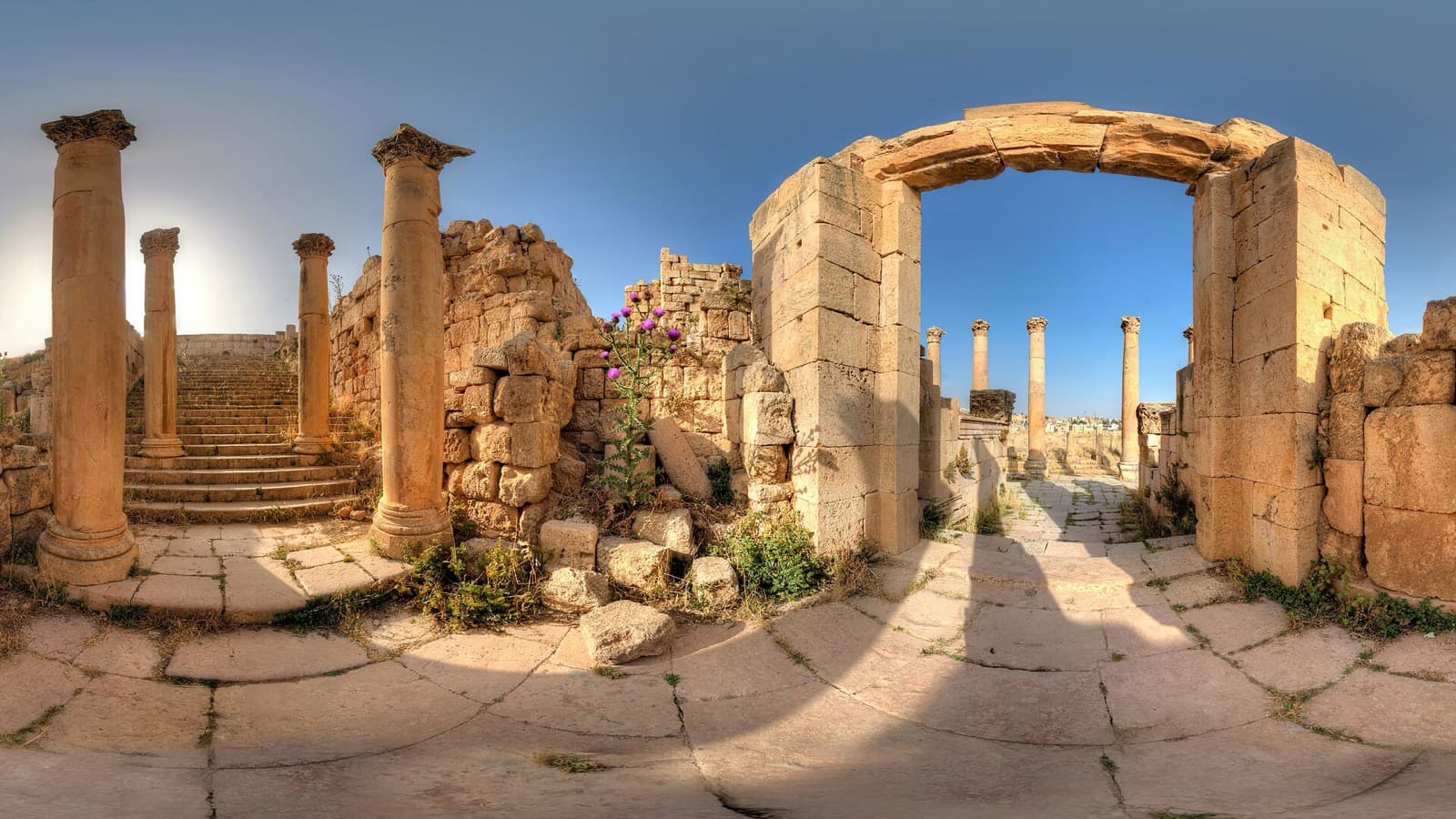
It begins at the Nymphaeum, the city's chief ornamental fountain on the colonnaded street, built about one hundred and ninety-one A D and dedicated to the water nymphs. Water once poured from carved lion heads into a great basin, its lower facade faced in marble, its upper level in painted stucco. A short way on stands the Cathedral, the oldest church in the city, built in the fourth century directly on the platform of an earlier Roman temple. The builders even set columns and stones from that older temple into the church, and the gateway you pass through was itself a reused Roman temple gate. From behind the Cathedral, the via sacra climbs a monumental staircase, and a second stair leads up through a colonnade of twenty-two Corinthian columns into the enclosure of the city's patron goddess.

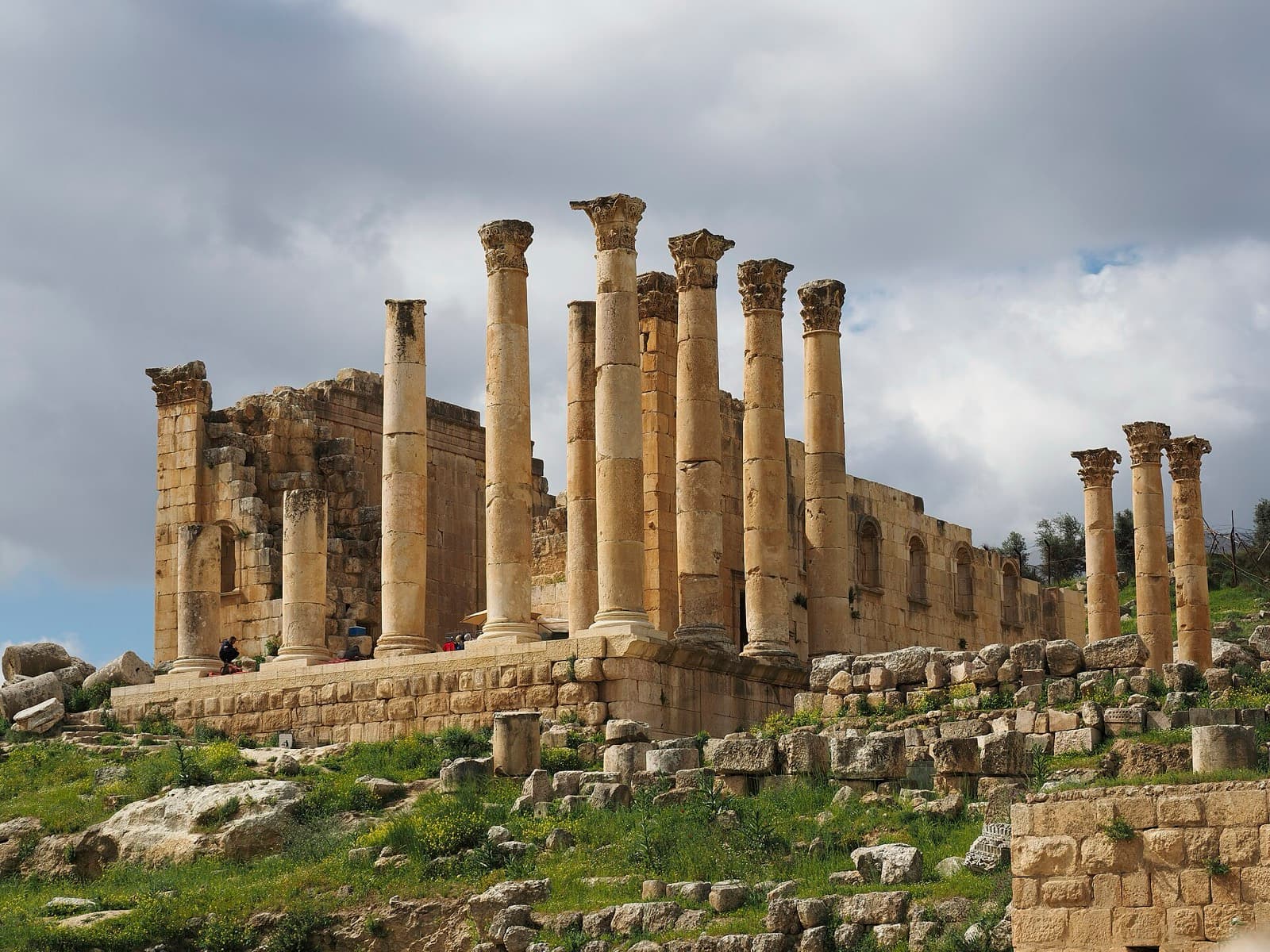
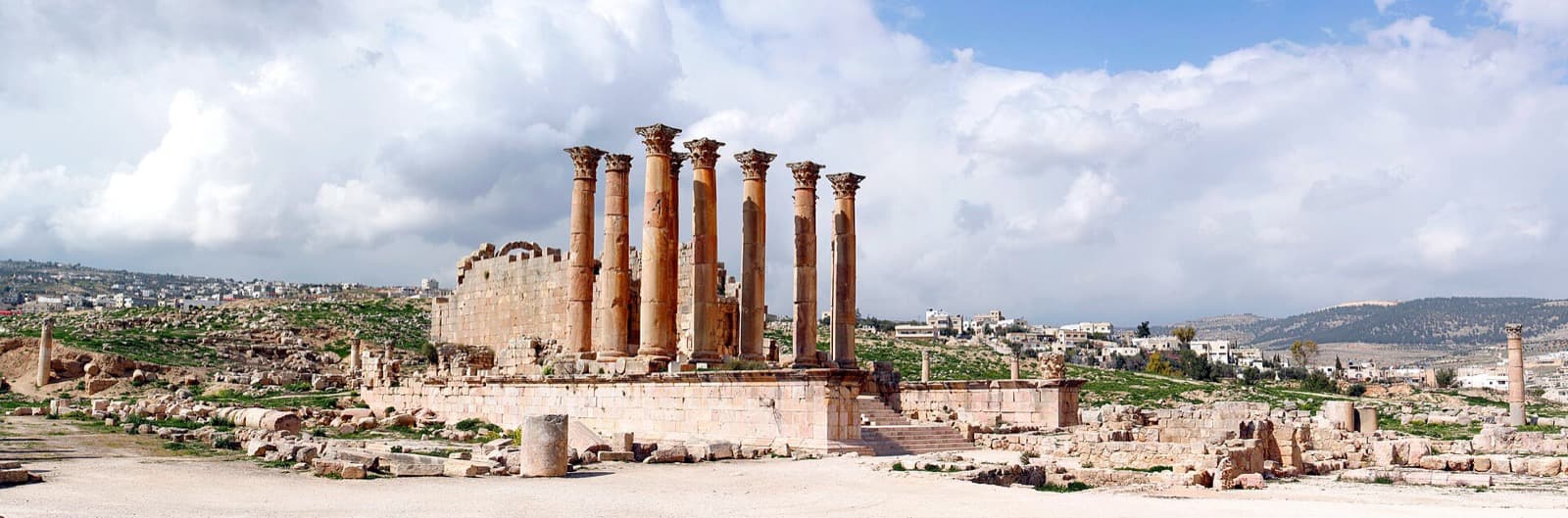
That climax is the Temple of Artemis. Work began after one hundred and thirty-six A D, its great gateway completed in one hundred and fifty A D under Antoninus Pius, and the temple itself was never finished, which is why so much of its raw structure survives. Eleven Corinthian columns of the porch still stand at thirteen point two metres, some carrying the carved signature of the contractor, Hygeinos, who signed his own work in stone. The columns were engineered to sway rather than snap, and that flexibility is credited with carrying them through the earthquake of seven hundred and forty-nine A D that flattened much of Jerash. Guides slide a key blade into a joint so you can watch a shaft flex gently in the wind.

Beside and below the temple, the city that replaced the gods spreads out in coloured tile. Jerash held at least fourteen churches built between the fourth and seventh centuries, several sited deliberately in the shadow of the old sanctuary. A linked complex of three churches raised under Bishop Paul includes Saint George, completed in five hundred and twenty-nine, Saint John the Baptist, consecrated in five hundred and thirty-one, and Saints Cosmas and Damian, consecrated in five hundred and thirty-three, whose nave holds the finest mosaic in all of Jerash. It names not emperors but donors, including the churchwarden Theodore and his wife Georgia. The nearby North Theatre began as a bouleuterion, the council chamber, its stone seats still inscribed in Greek with the names of the voting tribes who sat there. The walk ends at the North Gate, built under Trajan about one hundred and fifteen A D, deliberately wedge-shaped to reconcile the straight city street with the Roman road arriving at an angle from Pella.

Why walk it your own way

Jerash is a marquee site, busy with tour vans, guides, and touts working the great gates. The value of doing it self-guided is that the completeness of the city is exactly what a group schedule flattens. You can linger under Hadrian's Arch, sit alone on the theatre mark to test the acoustics, kneel to find the wheel ruts, or wait out the crowd under the swaying columns. Each half takes about ninety minutes and roughly a kilometre and a half on foot, though the whole point is that the clock is yours. Start early, soon after the site opens around eight, walk the southern monuments while the vans are still on the road, and the Oval Plaza and the theatres are nearly yours. Plan more time than you expect, because a complete Roman city rewards a slow reader. Start with the Jerash walking tours to choose your half, or your day.

Sources

  • Jordan Tourism Board, official Jerash site guide (visitjordan.com)
  • UNESCO World Heritage Centre, tentative and inscribed listings for Jordan
  • Jarash / Gerasa archaeological summaries, American Center of Research (ACOR) publications
  • C. H. Kraeling (ed.), Gerasa: City of the Decapolis, standard archaeological reference for the site's monuments and inscriptions
  • Roamer self-guided tour research files for Jerash (fact-audited transcripts for the civic core and sacred way walks)

Frequently asked questions

Why is Jerash considered one of the best-preserved Roman cities?
Unlike most classical cities that survive only in fragments, Gerasa retains its whole civic plan: the triumphal Hadrian's Arch, the Hippodrome, the Oval Plaza, a colonnaded Cardo Maximus about eight hundred metres long, two theatres, and the Temple of Artemis. Its monuments survived largely because they were abandoned and reused rather than torn down. The engineered flexibility of the Artemis columns even carried them through the earthquake of seven hundred and forty-nine A D.
What is the Oval Plaza at Jerash and why is it unusual?
The Oval Plaza is Gerasa's signature public square, shaped as a broad oval about ninety metres by eighty and ringed by fifty-six Ionic columns of the first century A D. Its oval form is rare in the Roman world, where forums were usually rectangular. The shape was a practical solution that gracefully joined the axis of the colonnaded main street to the off-axis terrace of the Temple of Zeus.
How long does it take to walk Jerash?
The site divides naturally into a southern civic half and a northern sacred half, and each self-guided walk covers about six stops over roughly ninety minutes and one and a half kilometres on foot. Doing both comfortably can fill a half day or more if you linger. The ground is stony and exposed, so sturdy shoes and water are essential.
What makes the Temple of Artemis columns famous?
Eleven Corinthian columns of the porch still stand at thirteen point two metres tall, and they were engineered to sway slightly in tremors rather than snap. That flexibility is credited with carrying them through the earthquake of seven hundred and forty-nine A D that flattened much of Jerash. Guides often slide a key blade into a base joint so visitors can watch a shaft flex gently in the wind.
When is the best time to visit Jerash?
Come early, soon after the site opens around eight in the morning, or in the last hours before closing, to beat both the heat and the tour groups. The stone core is almost entirely exposed with little shade, so midsummer midday is punishing, and spring and autumn are the most comfortable seasons. An early start buys you the Oval Plaza and the theatres in relative quiet.

Ready to experience it?

Jerash: The Colonnaded Heart of Roman Gerasa
Self-guided audio tour

Jerash: The Colonnaded Heart of Roman Gerasa

90 min · 1.5 km · moderate

Start free

More from Jerash

Explore more at your own pace.
One Day in Jerash: A Walkable Morning-to-Evening Plan
Overview

One Day in Jerash: A Walkable Morning-to-Evening Plan

7 min
Visiting Jerash: A Practical 2026 Planning Guide
Overview

Visiting Jerash: A Practical 2026 Planning Guide

7 min
The Jerash Cathedral: A Church Built From a Temple, and the Sacred Way Behind It
Companion

The Jerash Cathedral: A Church Built From a Temple, and the Sacred Way Behind It

6 min
The Oval Plaza at Jerash: How One Stone Oval Explains a Whole Roman City
Companion

The Oval Plaza at Jerash: How One Stone Oval Explains a Whole Roman City

6 min
Hadrian's Arch in Jerash: The Gateway to a City That Was Never Built
Deep dive

Hadrian's Arch in Jerash: The Gateway to a City That Was Never Built

6 min
The Temple of Artemis in Jerash: Columns Engineered to Sway
Deep dive

The Temple of Artemis in Jerash: Columns Engineered to Sway

6 min
Jerash: The Colonnaded Heart of Roman Gerasa
Self-guided audio tour

Jerash: The Colonnaded Heart of Roman Gerasa

90 min · 1.5 km · moderate

Stops on this walk

  1. 1Hadrian's Arch
  2. 2The Hippodrome
  3. 3The South Gate and the Temple of Zeus
  4. 4The Oval Plaza

Take it with you

We will send the tour to your inbox, ready for your trip.