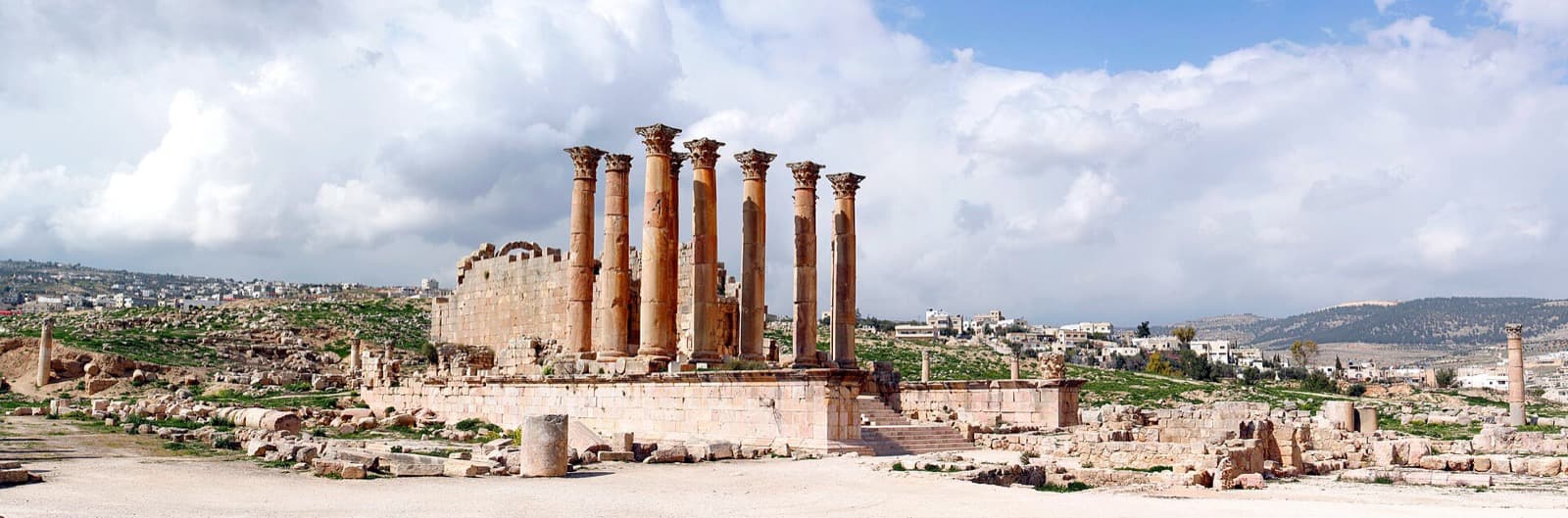
The Temple of Artemis crowns the northern half of ancient Gerasa, and its eleven surviving Corinthian columns were engineered to sway. That is the single fact worth carrying up the sacred stair. Each column stands thirteen point two metres tall, was designed to flex slightly in a tremor rather than snap, and that flexibility is credited with carrying the temple through the earthquake of 749 that laid waste to much of the surrounding city. Standing beneath them, you are looking at ancient engineering that treated an unstable ground as a problem to be absorbed rather than resisted.
A goddess wearing an older name
Artemis was the patron goddess of Gerasa, the city the Romans built here in what is now northern Jordan. The Greek name Artemis, though, was laid over an older local deity likely worshipped before Greek colonists arrived. One goddess wearing another's name is a pattern that repeats across this whole hillside, where the ground keeps wearing new gods. Below the temple, the city's fourth-century cathedral rises on the platform of an earlier Roman temple, which in turn is said to have stood over a still older Nabataean shrine. The sanctuary of Artemis sits at the top of that layered logic: the newest, grandest name given to a sacred place that people had approached for centuries.
Work on the sanctuary began after the year 136, and the great gateway, the propylaeum, was completed in 150 under the emperor Antoninus Pius. The temple was approached as a slow, rising ceremony. A sacred way ran from the eastern residential quarter, crossed a bridge over the Chrysorhoas stream that splits the valley, passed through gates on the colonnaded main street, then climbed a monumental staircase. A second stair led on through a colonnade of twenty-two Corinthian columns into the walled courtyard. By the time you reached the goddess, the architecture had already choreographed your body into the posture of a procession.
The power of an unfinished building
Hear a stop from this walk
The North Cardo and the North Gate: The Crooked End of the Great Street
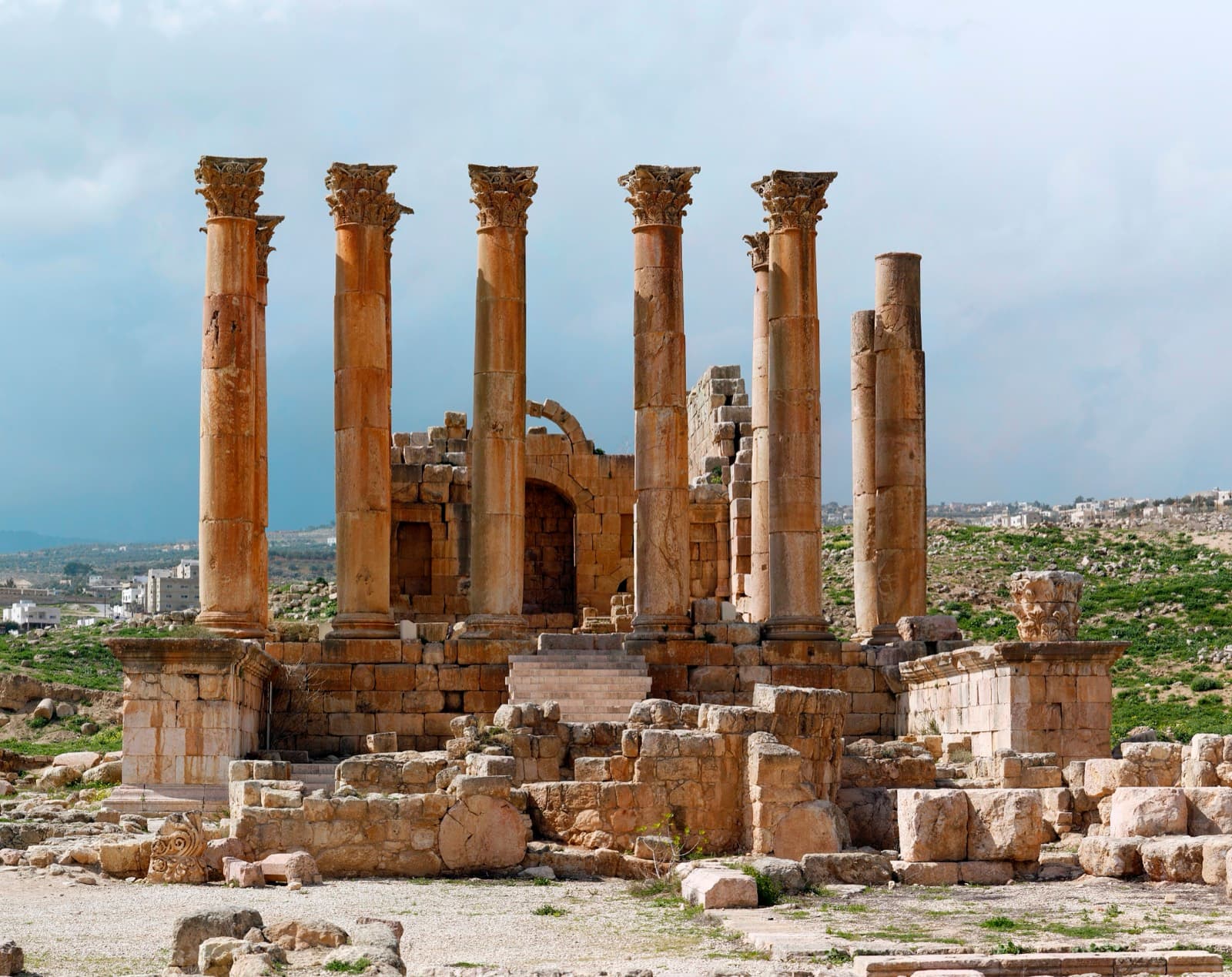
Here is the detail that most visitors miss: the temple was never finished. The portico around the cella was designed as six columns by eleven, and eleven columns of the front porch still stand today. But the building behind them was never completed. That unfinished state is precisely why so much survives. What stands is stripped to its bones, the raw structure rather than the decorated shell, so you read the engineering directly instead of the ornament that would have hidden it.
Look at the capitals. They remain extraordinarily crisp after nearly nineteen centuries, the acanthus leaves cut sharp enough that you can trace individual fronds. And look lower, at the shafts. Some of them still carry the carved signature of the contractor, a man named Hygeinos, who signed his own work in stone. That signature is worth pausing on. It is a working builder putting his name to a job on a site that was, in the end, never brought to completion, a small human mark left on an enormous unfinished ambition.
Why the columns sway
The famous demonstration is simple. Guides slide a spoon or a key blade into a joint at the base of a column so you can watch the whole shaft move gently in the wind. It looks like a trick, and it is often presented as one, but the effect rests on real engineering. The temple sits high and exposed to wind, on ground that has always been prone to tremors, and its columns were built with joints that let the drums shift against one another, so a shaft can flex under load rather than transmitting the full shock rigidly down its length. In a stable climate that would be a curiosity. In a seismic zone it is survival.
The test came in 749, when a catastrophic earthquake struck the region and laid waste to much of Jerash. Buildings and colonnades across the site came down. The columns of Artemis, built to absorb movement, stayed up. Their engineered flexibility is credited with carrying them through the shock that destroyed so much around them. You are looking, in other words, at a structure that outlived the disaster it was quietly designed against, standing now for the same reason it stood then.
What to understand standing in front of it
The showpiece of the northern city is usually thick with tour groups, and the swaying-column demonstration draws a crowd. The advantage of walking Gerasa at your own pace is that you can wait for the groups to move on, then simply stand under the columns for as long as you like and watch the shafts against the sky in a breeze. Do not rush the moment for the spoon trick alone. The larger point is that this temple was built to move so it would not fall, and that intention connects to everything around it. Below the terrace, at least fourteen Byzantine churches went up as Gerasa turned Christian, several of them clustered deliberately beside the abandoned sanctuary of Artemis, their mosaic floors laid exactly where the old gods were left behind. Nothing here was really thrown away, only reused. The temple survived because it was abandoned and stripped rather than demolished, and the churches survived because the city that built them kept reusing its own holy ground.
That is the thread of the whole walk: a pagan and a Christian city stacked on the same stones, held together by the accident that reuse preserves more than destruction does. The Temple of Artemis is the hinge of it, the last and grandest name for a place people kept climbing toward, engineered so cleverly against the ground that it is still here to be climbed toward today.
Walk it yourself
The Temple of Artemis is the third stop on a self-guided route through the sacred, northern half of Gerasa, running from the great fountain on the colonnaded street, up the processional stair to the temple, and on to the mosaic churches and the old council theatre beyond. It covers roughly one and a half kilometres over about ninety minutes, on your own clock, with no van and no schedule. If you are planning your visit, start with the overview of Jerash walking tours, then see everything on offer in Jerash and take the temple at the pace it was built to reward.
Sources
- Temple of Artemis, Jerash (Wikipedia): overview of the sanctuary's dating, dimensions, the eleven surviving columns, and the contractor Hygeinos.
- The Sanctuary of Artemis in Jerash (History and Archaeology Online): the propylaeum, the sacred way, and the engineered flexibility of the columns.
- Roamer tour "Jerash: The Temple of Artemis and the Sacred Way," fact-audited stop transcript for the Temple of Artemis and the wider sacred quarter.
- Visit Jordan, ancient city of Jerash site pages: practical context for the Gerasa archaeological site and its monuments.
Ready to experience it?
Jerash: The Temple of Artemis and the Sacred Way
90 min · 1.5 km · moderate
More from Jerash
Explore more at your own pace.
One Day in Jerash: A Walkable Morning-to-Evening Plan
Visiting Jerash: A Practical 2026 Planning Guide
The Jerash Cathedral: A Church Built From a Temple, and the Sacred Way Behind It
The Oval Plaza at Jerash: How One Stone Oval Explains a Whole Roman City
Hadrian's Arch in Jerash: The Gateway to a City That Was Never Built