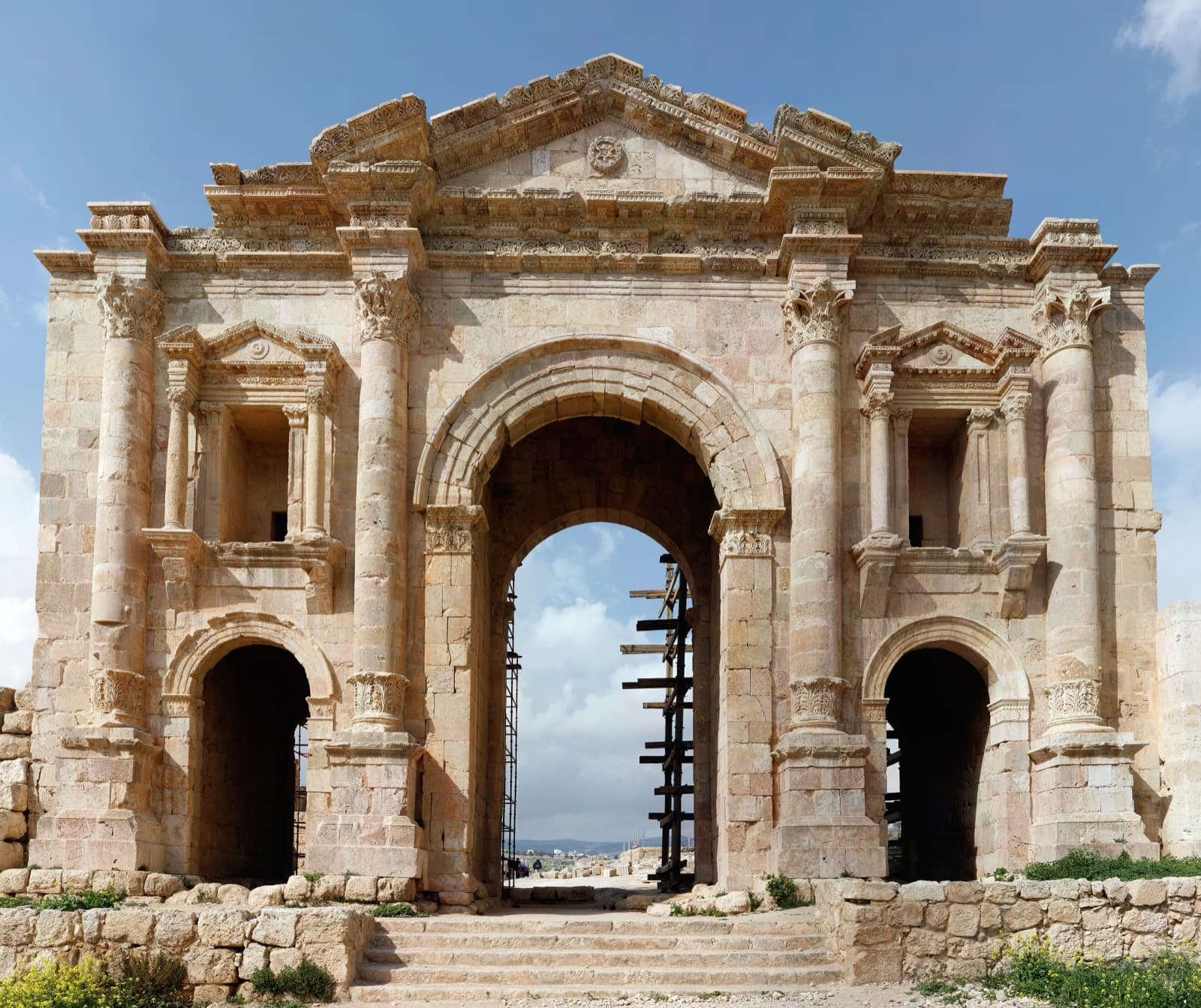
Hadrian's Arch is a triple triumphal gateway at the southern edge of ancient Gerasa, raised to mark a single imperial visit and now standing stranded far outside the city walls because it was meant to be the threshold of an expansion that Gerasa planned but never built. Walk up to it from the modern entrance and the first thing you register is that it stands almost alone. There is open ground on every side, no wall attached, no street running through it to anywhere in particular. That isolation is not decay or accident. It is the whole point, and understanding why is the reason to stand here before you go any further into the ruins.
A gate raised for one winter
The arch commemorates a specific occasion: the visit of the emperor Hadrian to Gerasa in the winter of 129 to 130 AD. When a Roman emperor arrived in a provincial city, the city replied in stone. Hadrian spent his reign touring the eastern provinces, and his passage through a town often set off a burst of monumental building, as the local elite competed to leave a permanent record that the emperor had been here, on this ground, in their lifetime. Gerasa's answer was this gateway.
The form is a classic triumphal arch: one tall central passage flanked by two smaller openings, with wooden doors once hung in the gaps. It originally rose nearly 22 meters. What you see today is close to that full ambition, because a reconstruction completed in 2007 brought the surviving structure back up to roughly 21 meters. So the scale in front of you is not a fragment or a suggestion. It is very nearly what a traveler in the second century would have seen, minus the wooden doors and the crowds.
Look at the base of each column. Topping it is a row of carved acanthus leaves, a distinctive touch that reads as unusual for a Roman gate. The detail is often interpreted as a Nabataean echo, a reminder that Gerasa sat at a meeting point of Roman and Arabian traditions. This was a city of the Decapolis, drawn into the Roman sphere by Pompey in 63 BC and formally part of the Roman province of Arabia by 106 AD. The acanthus at your feet is the visible seam between two worlds: Roman ceremonial architecture executed with a decorative vocabulary that points east.
The gate that leads nowhere
Hear a stop from this walk
The Cardo Maximus: The Marble Street Rutted by Two-Thousand-Year-Old Wheels
Here is the detail that rewards standing still. The arch is stranded. It sits well south of the actual city walls, about 460 meters from the South Gate, with nothing but open ground in between. If you have arrived expecting a gateway to open directly onto the city, the geography is confusing at first. You pass through a monumental arch and then keep walking, across a long empty stretch, before you reach anything else.
That gap is deliberate. The arch marks where Gerasa intended to grow. At the height of its prosperity, the city planned a great expansion southward, pushing new construction out beyond the existing walls, and this gate was designed to be the formal threshold of that new district. Build the ceremonial doorway first, on the line where the future city would begin, and let the streets and buildings fill in behind it.
The expansion was never built. The streets never came, the new district stayed as open ground, and the gate was left where it stood, pointing into a Gerasa that existed only on a planner's map. So when you stand under it, you are standing at the edge of an ambition. You are looking at a doorway to a city that never arrived, ambition announced in stone and then quietly set aside. Cities usually erase their unbuilt plans, or the plans simply leave no trace at all. Here, the intention survives at full height, because someone finished the monument before abandoning the scheme behind it.
Why this is the right place to begin
For a walk through Gerasa's ceremonial core, Hadrian's Arch is the correct starting point for a reason beyond simple geography. It sets the terms for everything you are about to see. Gerasa is one of the best-preserved provincial Roman cities anywhere, and the temptation is to treat it as a finished, static thing, a city frozen at its peak. The arch corrects that impression before you take a single step inside. It shows you a city that was still planning, still reaching, still betting on a bigger future when the money or the moment ran out.
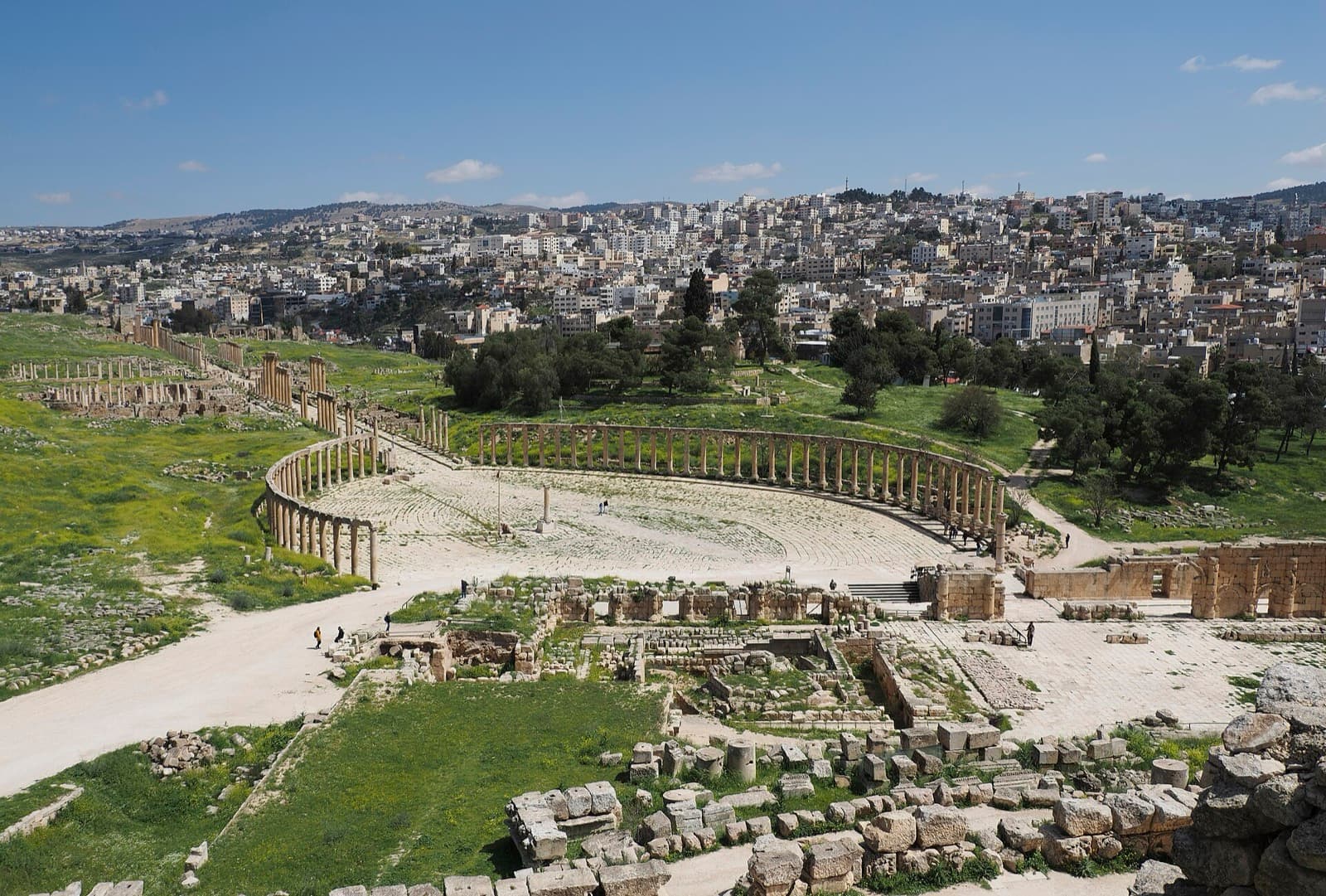
Everything north of here, the arena, the oval forum, the temple terrace, the theatre, the colonnaded main street, is the Gerasa that got built. This gate is the Gerasa that did not. Reading the ruins with that in mind changes them from a monument to Roman permanence into a record of a living town making decisions, some of which paid off for two thousand years and some of which came to nothing but a beautiful stranded gate.
There is no group here to hurry you along, and no reason to rush the transition from this quiet threshold into the busier ruins ahead. Take your time under the central passage. Look up at the height the reconstruction restored, find the acanthus on the column bases, and then turn north and look at the long stretch of open ground between you and the wall. That emptiness is the exhibit. Once you have read it, the walk into the real city can begin.
The jerash-colonnaded-civic-core tour opens at exactly this spot and then runs six stops through the southern half of ancient Gerasa, from the arch to the Hippodrome, the South Gate and Temple of Zeus, the Oval Plaza, the South Theatre, and the rutted flagstones of the Cardo Maximus. It covers roughly one and a half kilometers on foot at your own pace, with the narration keyed to each monument as you reach it. For more on the site and how to walk it, see our Jerash walking tours guide, or browse everything in Jerash.
Standing there
The single thing to carry away, standing in front of Hadrian's Arch, is that a gate is a promise about what lies beyond it. This one promised a city, and the city never came. That makes it one of the clearest surviving pieces of evidence anywhere at Gerasa of a plan the town made and did not keep. The rest of the site shows you Roman ambition realized. This gate shows you Roman ambition announced and then abandoned, still standing at nearly its original height, still opening onto empty ground. Read it that way, and the whole walk that follows reads differently.
Sources
Ready to experience it?
Jerash: The Colonnaded Heart of Roman Gerasa
90 min · 1.5 km · moderate
More from Jerash
Explore more at your own pace.
One Day in Jerash: A Walkable Morning-to-Evening Plan
Visiting Jerash: A Practical 2026 Planning Guide
The Jerash Cathedral: A Church Built From a Temple, and the Sacred Way Behind It
The Oval Plaza at Jerash: How One Stone Oval Explains a Whole Roman City
The Temple of Artemis in Jerash: Columns Engineered to Sway