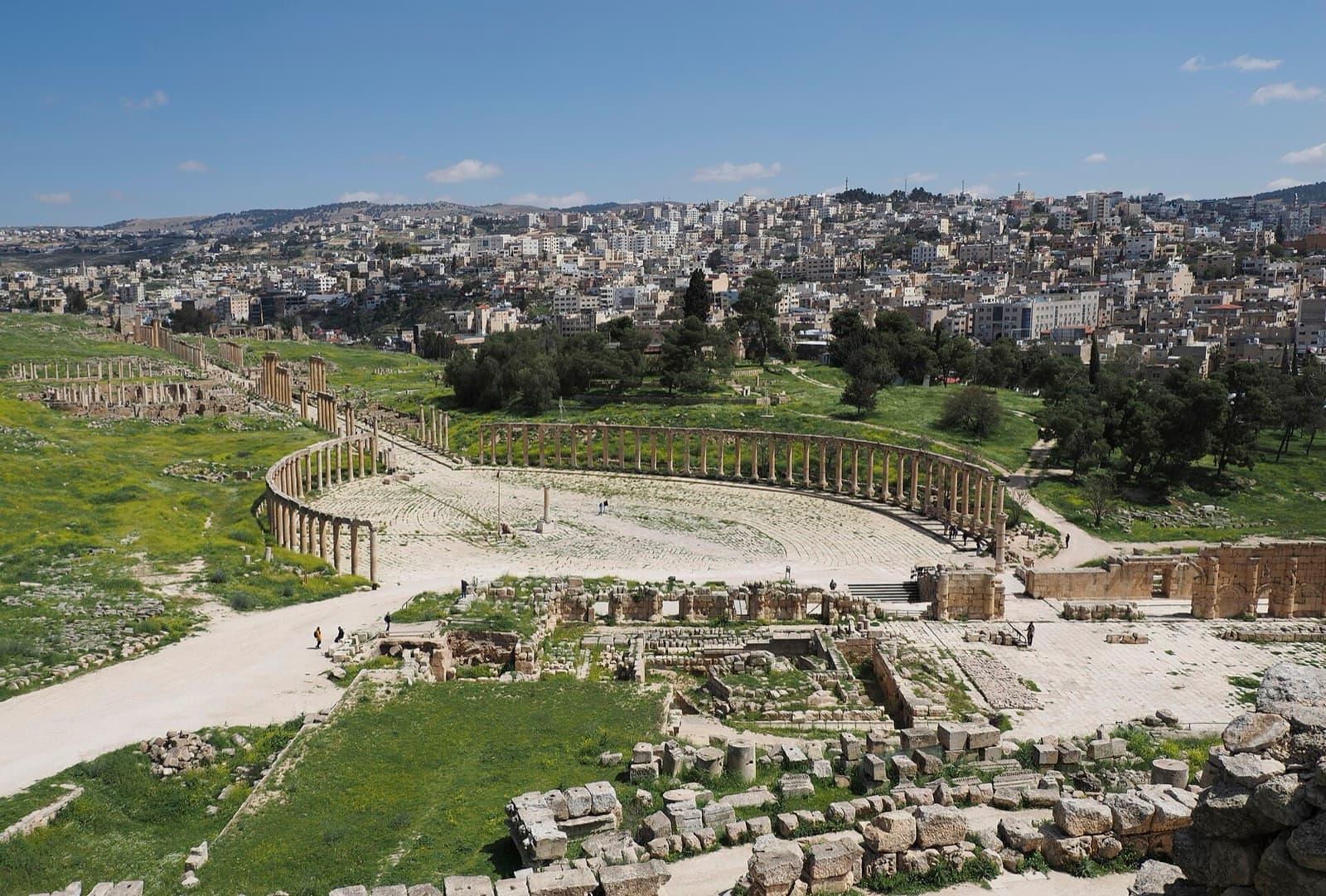
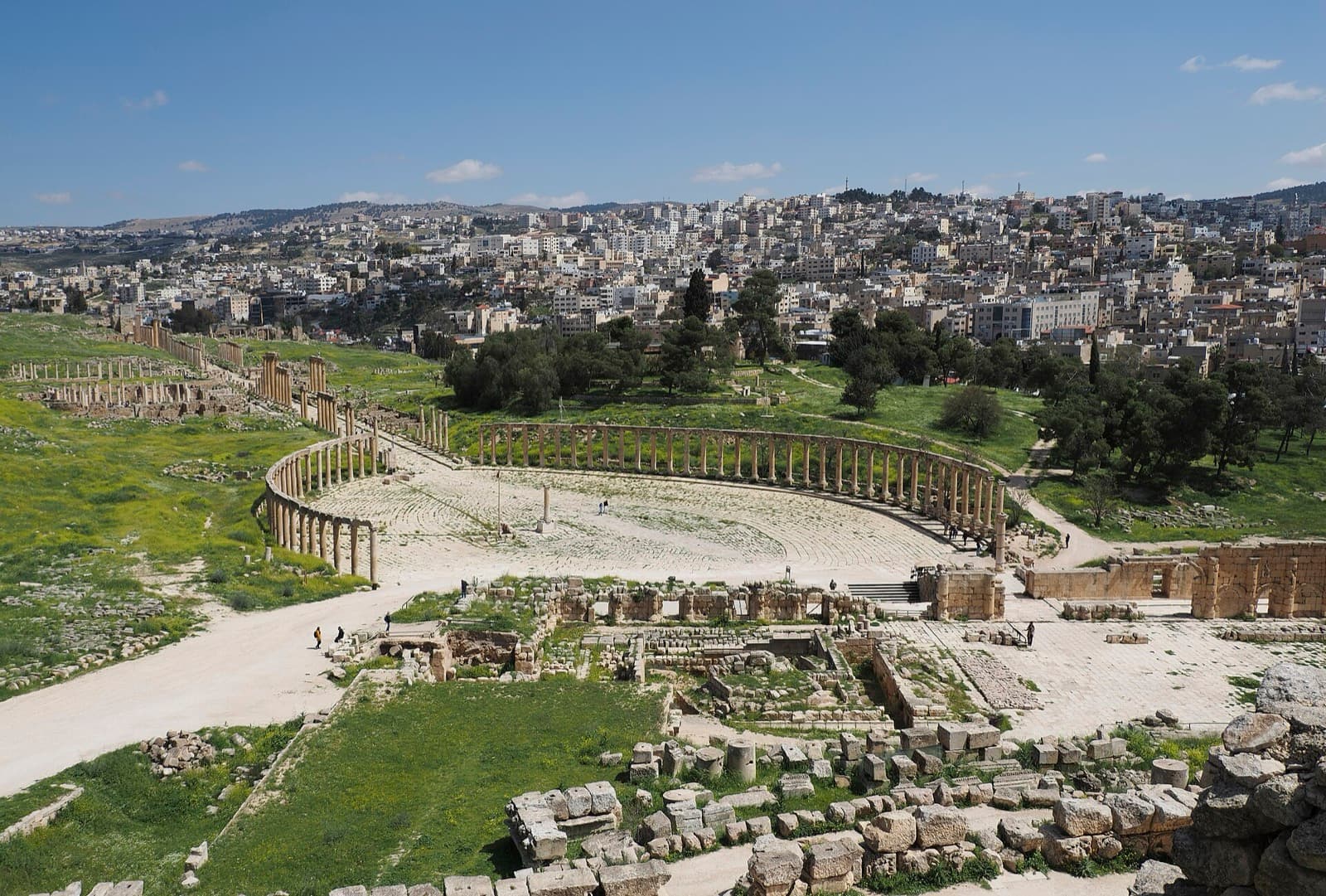
Stand in the Oval Plaza at Jerash and the reason ancient Gerasa is one of the best-preserved Roman cities anywhere becomes physical, not abstract. A broad stone oval, roughly ninety metres by eighty, sweeps around you, ringed by fifty-six Ionic columns carrying a continuous beam. The limestone paving is laid in concentric arcs that follow the curve, so the whole floor seems to turn under your feet. No other Roman city has quite this space. And it was not built to be pretty. It was built to solve a problem, and understanding that problem is the fastest way into the argument the whole southern walk is making: this is a complete civic core, engineered as a single working machine, and you can still read every gear of it.
The oval is a fix, not a flourish
Roman forums are almost always rectangles. Gerasa's is an oval because two lines refused to meet. The colonnaded main street, the Cardo Maximus, runs on one axis. The older Temple of Zeus terrace, raised on the hillside above, sits on another, slightly off. Force the two together and you get an ugly corner. The builders instead swept the space into an oval that joins one axis to the other gracefully, geometry turned into elegance.
Some sources place the plaza's full form around one hundred and ten A D, near the turn of the second century, though the ring of columns is first-century work. Stand near the centre and turn slowly. Every line of the ceremonial city converges here: the arena and gate behind you, the temple above, the long street ahead. There is a modern column at the middle that holds a flame during the Jarash Festival, but the ancient ring is the point. This is the heart of the walk, and on your own schedule it belongs to you alone for as long as you stand in it. That single fact, that the plaza is a joint between axes, is the thesis in miniature. Nothing at Gerasa is decoration for its own sake. Everything is a decision you can still see.
Reading the joint backward: the emperor's gate and the arena
Hear a stop from this walk
The Cardo Maximus: The Marble Street Rutted by Two-Thousand-Year-Old Wheels
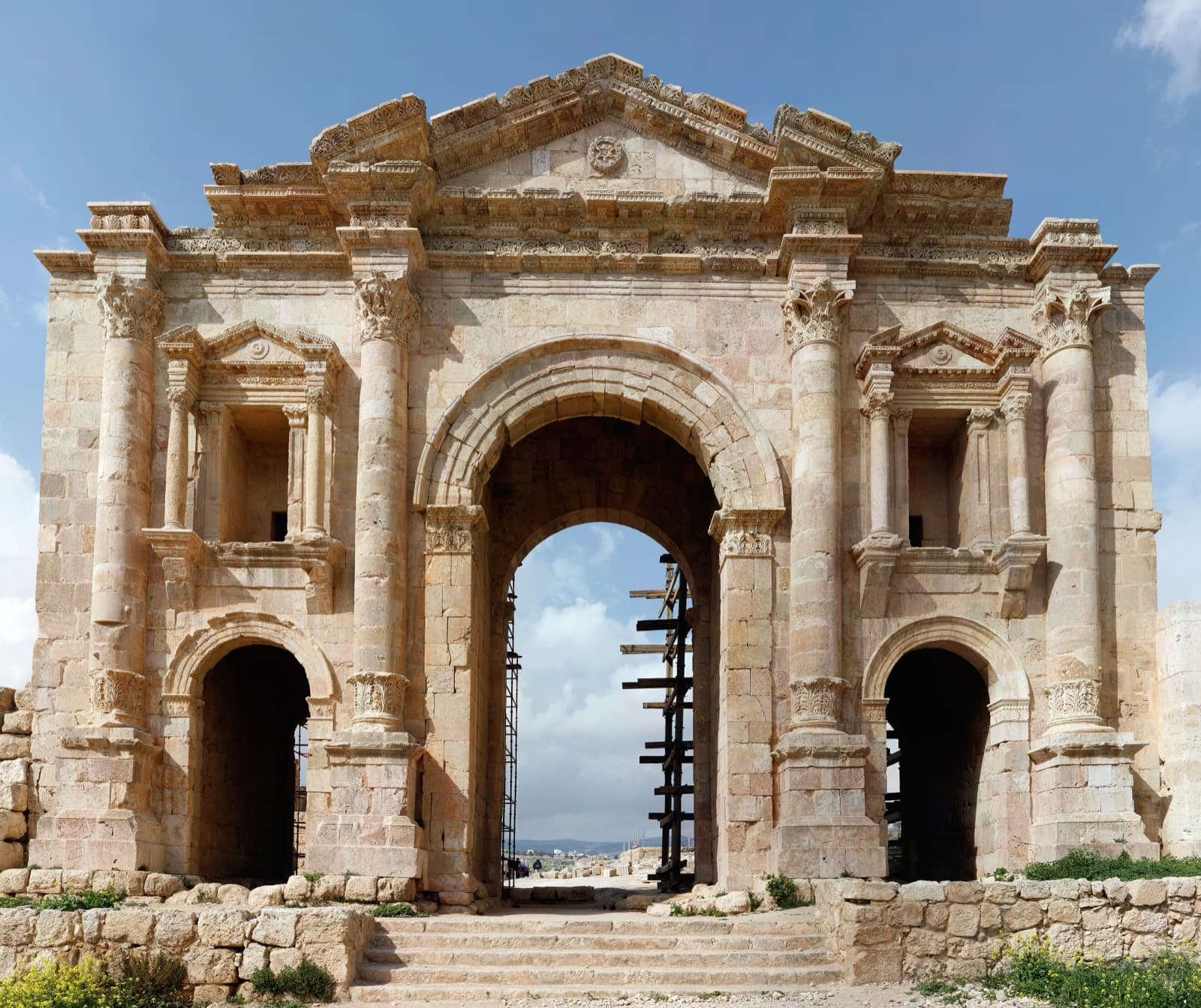
To understand why the axes needed joining, walk the approach the way the tour does. The route begins about a kilometre and a half of unhurried walking away, and about ninety minutes end to end, at Hadrian's Arch on the southern edge of the site. The arch is stranded. It stands roughly four hundred and sixty metres outside the actual city walls, with open ground between, because it marked where Gerasa meant to grow. The city planned a great southward expansion and raised this triple gateway, once nearly twenty-two metres tall (a reconstruction finished in two thousand and seven brought it back to roughly twenty-one), to be the new formal threshold. The expansion was never built. You begin, in other words, at the edge of an ambition, a doorway to a city that never came.
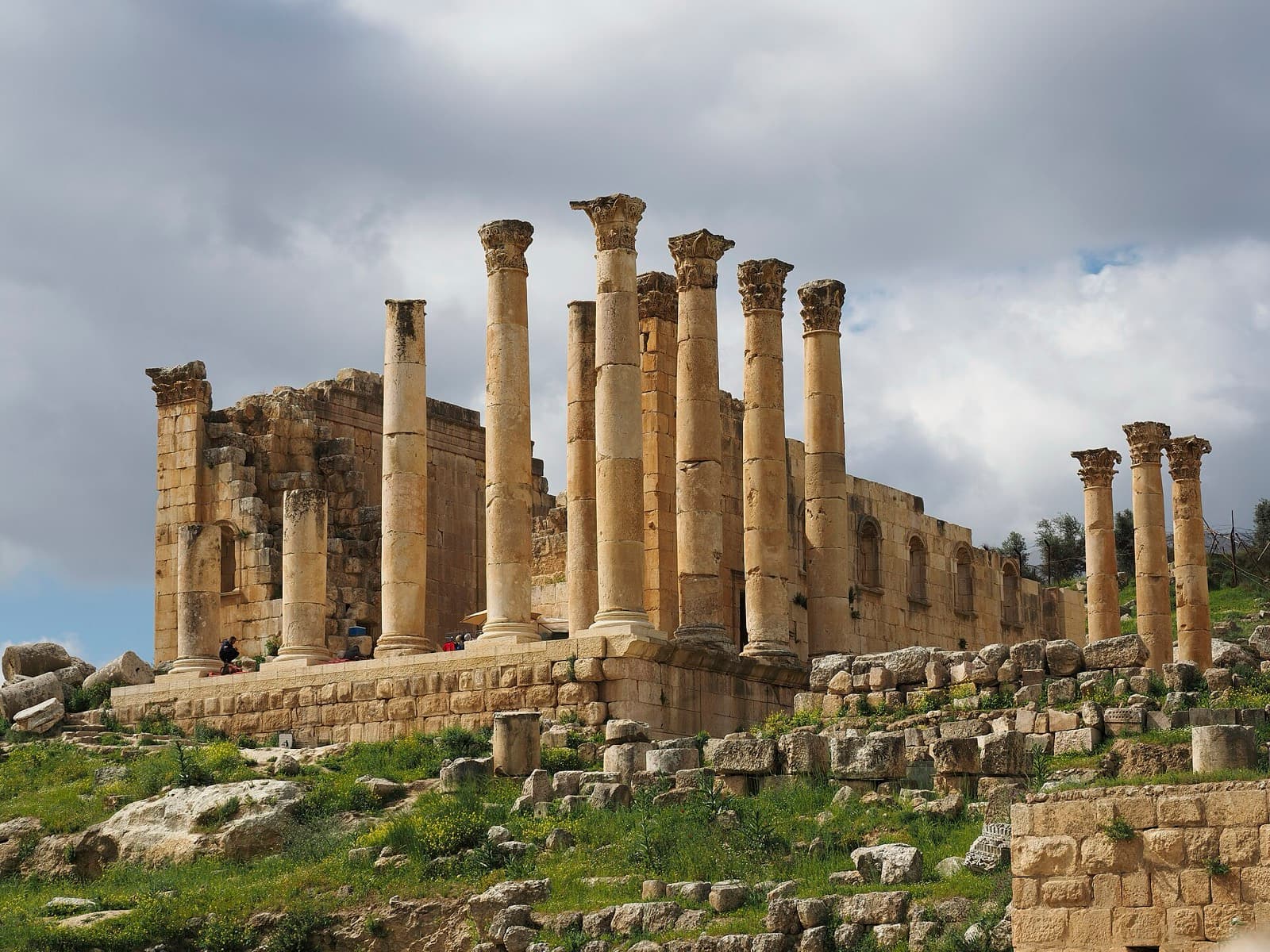
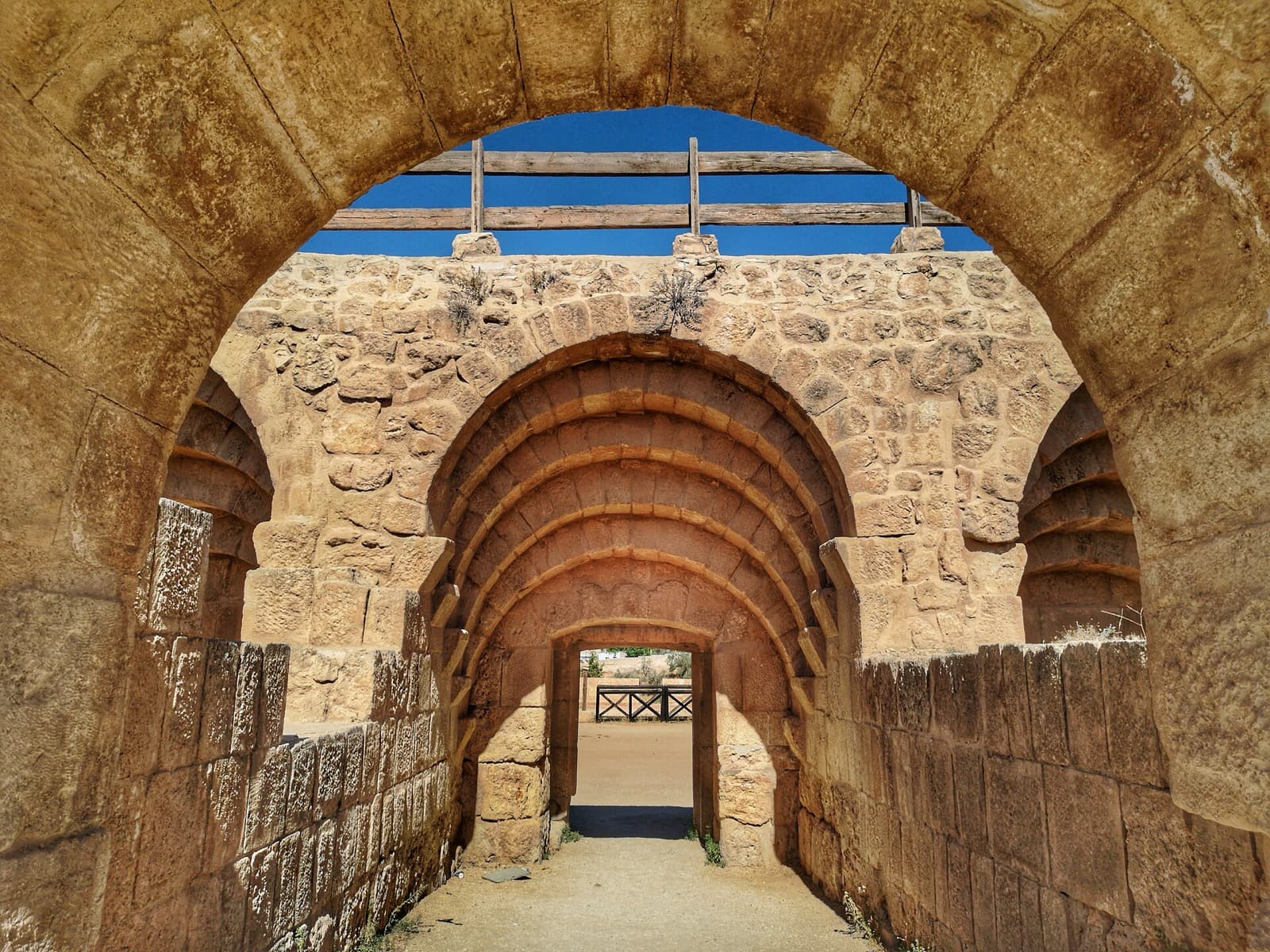
North of the arch the ground opens into the Hippodrome, a chariot arena about two hundred and forty-five metres long that could hold up to fifteen thousand spectators. It is one of the smaller Roman circuses but also one of the best-preserved, so where most such arenas are only outlines, here you read the whole shape: the long straights, the curved end, the banks of seats. Then comes the South Gate, built around one hundred and twenty-nine to one hundred and thirty A D, right around the emperor Hadrian's visit, and likely the trial run for the grander arch to the south. Above it rises the Sanctuary of Zeus. Its lower terrace was raised in twenty-seven to twenty-eight A D by a named local architect, Diodoros, son of Zebedas, which is a rare thing to know: the actual man who set the plan. The upper temple was consecrated much later, in one hundred and sixty-two to one hundred and sixty-three A D. That off-axis terrace is one of the two lines the oval had to reconcile. Climb it, turn around, and the plaza lies at your feet, the resolution to everything below.
The voice and the wheel ruts
The walk does not end at scale. It narrows to a single human voice. West of the plaza sits the South Theatre, built in the late first century A D under the emperor Domitian, seating more than three thousand in two steep tiers. There is a marked focal point at the centre of the orchestra floor. A person standing there and speaking at an ordinary volume, without raising it, can be heard clearly in every seat, top to bottom. Two thousand years on, the theatre still answers a whisper. Look closely and the detail is everywhere: an inscription records a former legionnaire among the benefactors who paid for it, and Greek letters carved into some seats still mark reserved places.
Then the city releases you north along the Cardo Maximus. This is where the argument becomes something you touch. You stand on the original limestone flagstones, each about forty to fifty centimetres thick, and they are scored by ruts worn into the stone by iron-rimmed wheels over centuries of traffic. Put your hand in one. Originally more than five hundred columns lined this street, which runs about eight hundred metres north, and beneath the paving an underground drainage channel about a metre and a half deep still runs its full length. It ranks among the longest and best-preserved colonnaded streets surviving from the Roman world.
Why walk it yourself
Jerash is the busiest northern site in Jordan after Petra, and the tour vans arrive in the mid-morning. Nothing on this route needs you on anyone else's clock. Arrive near opening, around eight, and the Oval Plaza and the South Theatre are nearly yours. Sit alone where fifteen thousand once shouted. Kneel to find the ruts. Read the plaza as the joint it is, then follow the ruts north as far as you like while the groups turn back. If you want the fuller picture of the site first, browse the other Jerash walking tours and the practical detail on the Jerash city page. Then bring the audio and walk the colonnaded core at the only pace that lets a stranded gate, a turning floor, and a whisper in a stone bowl actually land.
Sources
- Roamer tour transcript, "Jerash: The Colonnaded Heart of Roman Gerasa" (fact-audited primary source for every stop, date, and measurement cited here).
- Archnet and Universes.art, entries on the Oval Plaza (Gerasa), for the plaza's form and colonnade.
- Judaism and Rome and Wikipedia, "Arch of Hadrian at Gerasa," on the one hundred and twenty-nine to one hundred and thirty A D visit and the two thousand and seven reconstruction.
- Jordan News, "Jerash's Cardo Maximus: An 800-meter-long wonder," on the street's length, columns, and wheel ruts.
- VisitJordan official tourism site, Jerash overview, on the South Theatre acoustics and site context.
Ready to experience it?
Jerash: The Colonnaded Heart of Roman Gerasa
90 min · 1.5 km · moderate
More from Jerash
Explore more at your own pace.
One Day in Jerash: A Walkable Morning-to-Evening Plan
Visiting Jerash: A Practical 2026 Planning Guide
The Jerash Cathedral: A Church Built From a Temple, and the Sacred Way Behind It
Hadrian's Arch in Jerash: The Gateway to a City That Was Never Built
The Temple of Artemis in Jerash: Columns Engineered to Sway