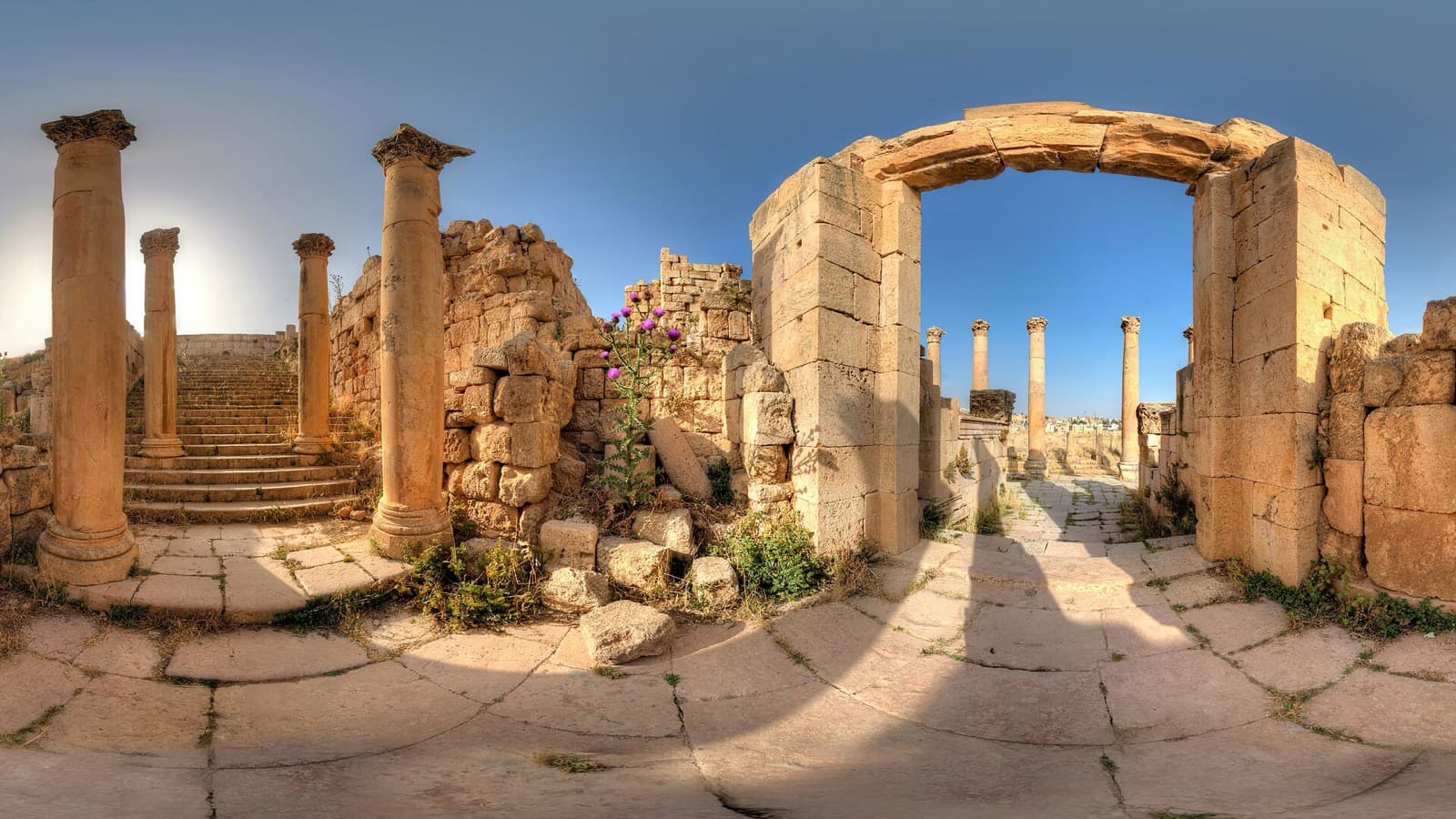
The Cathedral of Jerash is an early church raised on the platform of an older Roman temple, standing at the foot of a monumental stair that once carried processions up to a goddess. That single fact is the whole argument of a walk through the northern, sacred half of ancient Gerasa. The sacred ground here was reused, not replaced. One god's site was inherited by the next, layer set on layer, and so much of it survives precisely because these buildings were abandoned and repurposed rather than torn down. If you want one place to understand what the rest of this route is doing, stand at the Cathedral first.
A gateway, then a church that remembers a temple
You reach it a short way along the Cardo Maximus, the great colonnaded main street. An ornamental gateway opens off the street, and behind it stands the Cathedral, sometimes called the Cathedral of Saint Mary, the oldest church in the city. Scholars date it to the late fourth or early fifth century, and the exact year is still argued. What makes it more than an old church is what lies underneath. The Cathedral rises on the platform of an earlier Roman temple, and its builders did not start from scratch. They took columns and stones from that temple and set them straight into the church. The very gateway you walk through to reach it was assembled from the reused parts of a grand Roman temple gate on the Cardo.
For a long time tradition held that the underlying temple belonged to Dionysus, the god of wine. That identification is worth holding loosely. Excavations in the nineteen nineties found no evidence to confirm the dedication, so it survives as an old story rather than settled fact. Beneath the temple, in turn, is said to have stood a still older shrine of the Nabataean god Dushara, chief deity of the royal house of the Arab people who ruled this region before Rome arrived. Whether or not every link in that chain is proven, the pattern is what matters, and it is visible in the masonry: one holy ground handed down the line, each new faith building on the bones of the last.
The stair does the work
Hear a stop from this walk
The North Cardo and the North Gate: The Crooked End of the Great Street
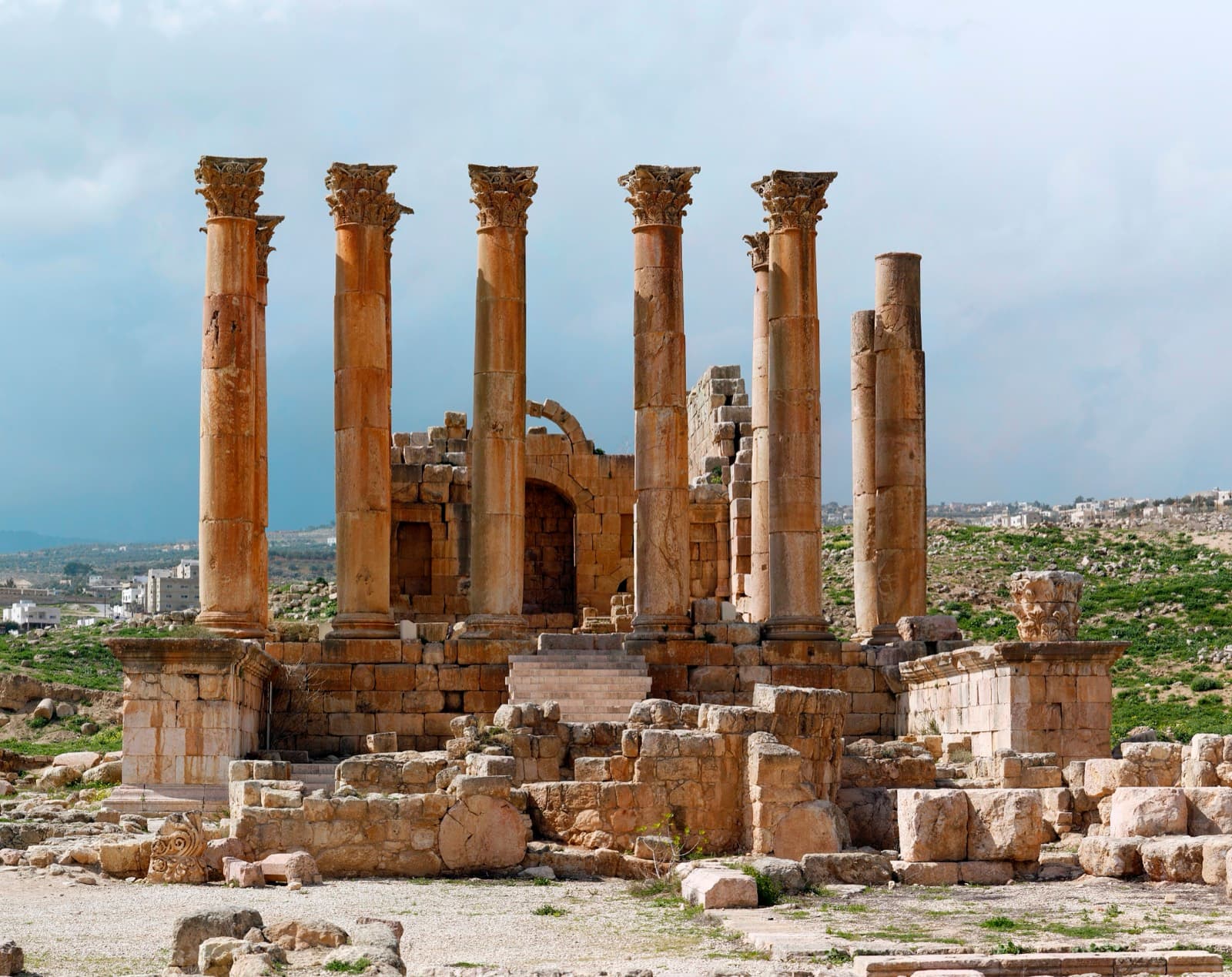
Turn to the slope behind the Cathedral, because this is where the city staged its devotion. A sacred way, a via sacra, ran here from the eastern residential quarter. It crossed a bridge, now gone, over the Chrysorhoas, the stream that splits the valley, passed through gates on the cardo, and then climbed a wide monumental staircase toward the walled courtyard of the Temple of Artemis. At the top of that stair a colonnade of twenty-two columns, flanked by corner towers, carried the route on into the sacred enclosure itself.
This is choreography built in stone. The ancient city did not want you to arrive at its patron goddess casually. It wanted the approach to feel like a slow, rising ceremony, and it engineered the ground to produce that feeling. Walking it now, on your own time, you get the same effect the designers intended, minus the crowd and the schedule. Take the stair slowly and let it do to you what it was built to do.
Why the Cathedral unlocks the rest of the walk
Once you have read the Cathedral as a temple wearing a church, the other stops start to rhyme. Below and beside the temple terrace sit the Byzantine churches, at least fourteen were built across Gerasa between the fourth and seventh centuries, several of them clustered deliberately in the shadow of the old sanctuary. The finest group, three linked churches raised under Bishop Paul, holds mosaic floors that name ordinary donors rather than emperors, including a churchwarden named Theodore and his wife Georgia in the church of Saints Cosmas and Damian, dated by a floor inscription to five hundred and thirty-three. The old gods were left behind exactly where the new floors were laid.
Climb to the top of the sacred stair and you reach the climax, the Temple of Artemis, sanctuary of the city's patron goddess. Eleven Corinthian columns of the porch still stand, each thirteen point two metres tall, and they carry a famous quirk: they are engineered to flex slightly rather than snap, which is credited with carrying them through the enormous earthquake of seven hundred and forty-nine that flattened much of Jerash. The capitals still bear the carved signature of the contractor, a man named Hygeinos, who signed his own work in stone.
The northern half of the site keeps widening the theme. The North Theatre began not as an entertainment hall but as a bouleuterion, the council chamber, and many of its stone seats are inscribed in Greek with the names of the voting delegations who sat there. It is often described as one of the most complete surviving records of an ancient city's civic seating plan. Further north, the great street reaches its oldest, plainest stretch, closing at the North Gate, built under the emperor Trajan around one hundred and fifteen and shaped as a wedge so it could reconcile the dead-straight city street with the Roman road arriving at an angle from Pella. Gods, faithful, citizens, and the road out: the walk gives you the whole city in sequence, and the Cathedral is the hinge where pagan and Christian meet on one platform.
Walking it on your own clock
Jerash is a marquee site, busy with tour groups, guides, and touts who work the great gates. The pleasure of doing this half as a self-guided loop is that you set the pace. Linger under the columns as long as you like, skip a stop, double back, with no van and no tip pressure. The northern sacred circuit runs roughly ninety minutes over about one and a half kilometres. The ground is stony ancient paving with worn stairs and little shade, so wear real shoes, carry water, and come early or late when the sun rakes the columns and the crowds thin.
For more routes across the site, see the full set of Jerash walking tours, and for planning and access details start at Jerash. Site entry is included with the Jordan Pass, which is worth buying before you travel if Petra and other stops are on your itinerary.
Sources
- Jerash Cathedral, Wikipedia. Overview of the church, its reuse of an earlier temple platform, and the Dionysus and Dushara identifications.
- The Cathedral Complex, Jerash (universes.art). Notes on the dating, the gateway assembled from reused parts, and the failure of the nineteen-nineties excavations to confirm the Dionysus dedication.
- The Sanctuary of Artemis, Gerasa (universes.art). The via sacra route, the bridge over the Chrysorhoas, the twenty-two-column colonnade, and the eleven standing porch columns.
- Temple of Artemis, Jerash, Wikipedia. Column dimensions, the engineered flexibility, the Hygeinos signature, and the construction history under Antoninus Pius.
- Ancient city of Jerash, Visit Jordan. Official site information on the monuments, ticketing, and the layout of Gerasa.
Ready to experience it?
Jerash: The Temple of Artemis and the Sacred Way
90 min · 1.5 km · moderate
More from Jerash
Explore more at your own pace.
One Day in Jerash: A Walkable Morning-to-Evening Plan
Visiting Jerash: A Practical 2026 Planning Guide
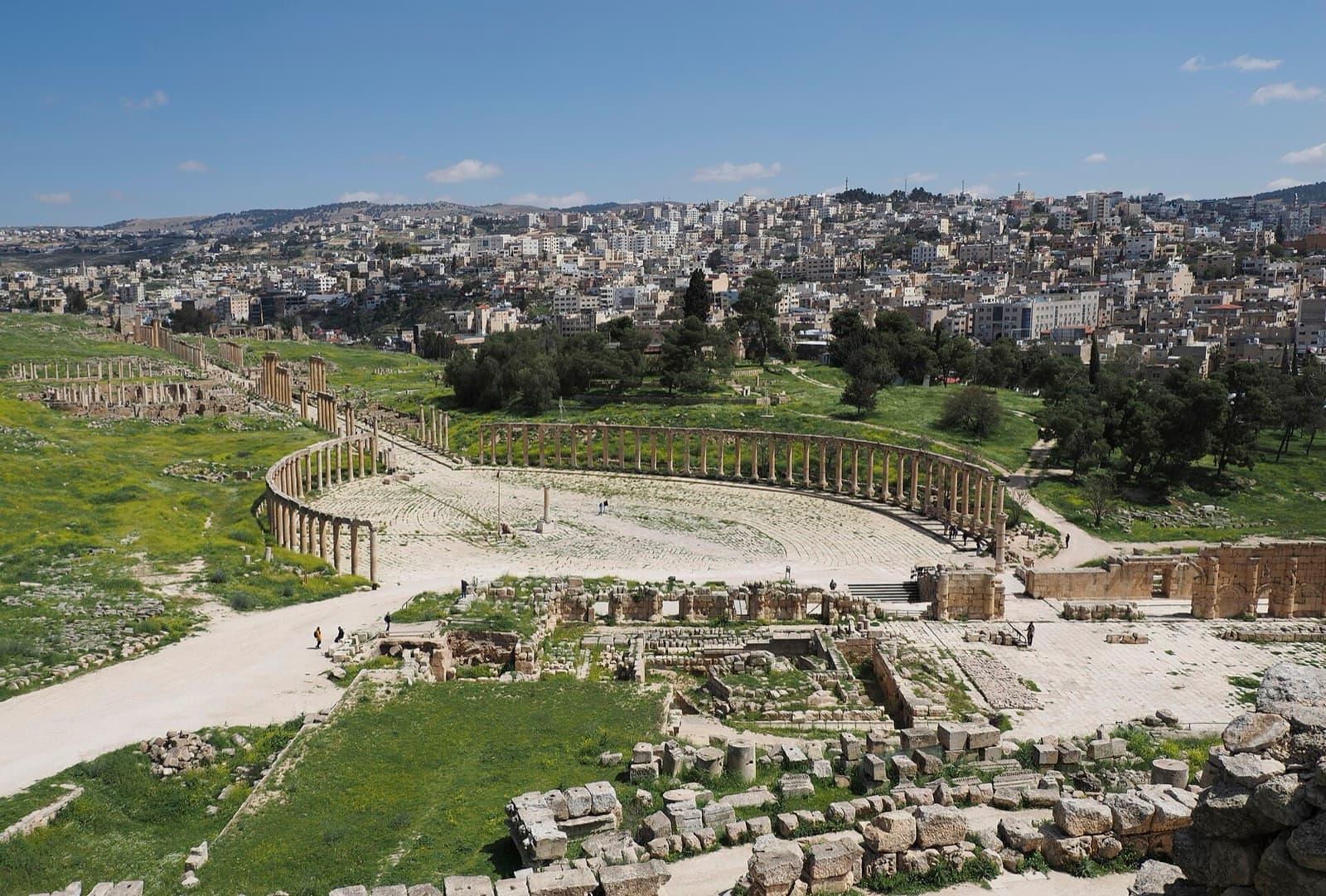
The Oval Plaza at Jerash: How One Stone Oval Explains a Whole Roman City
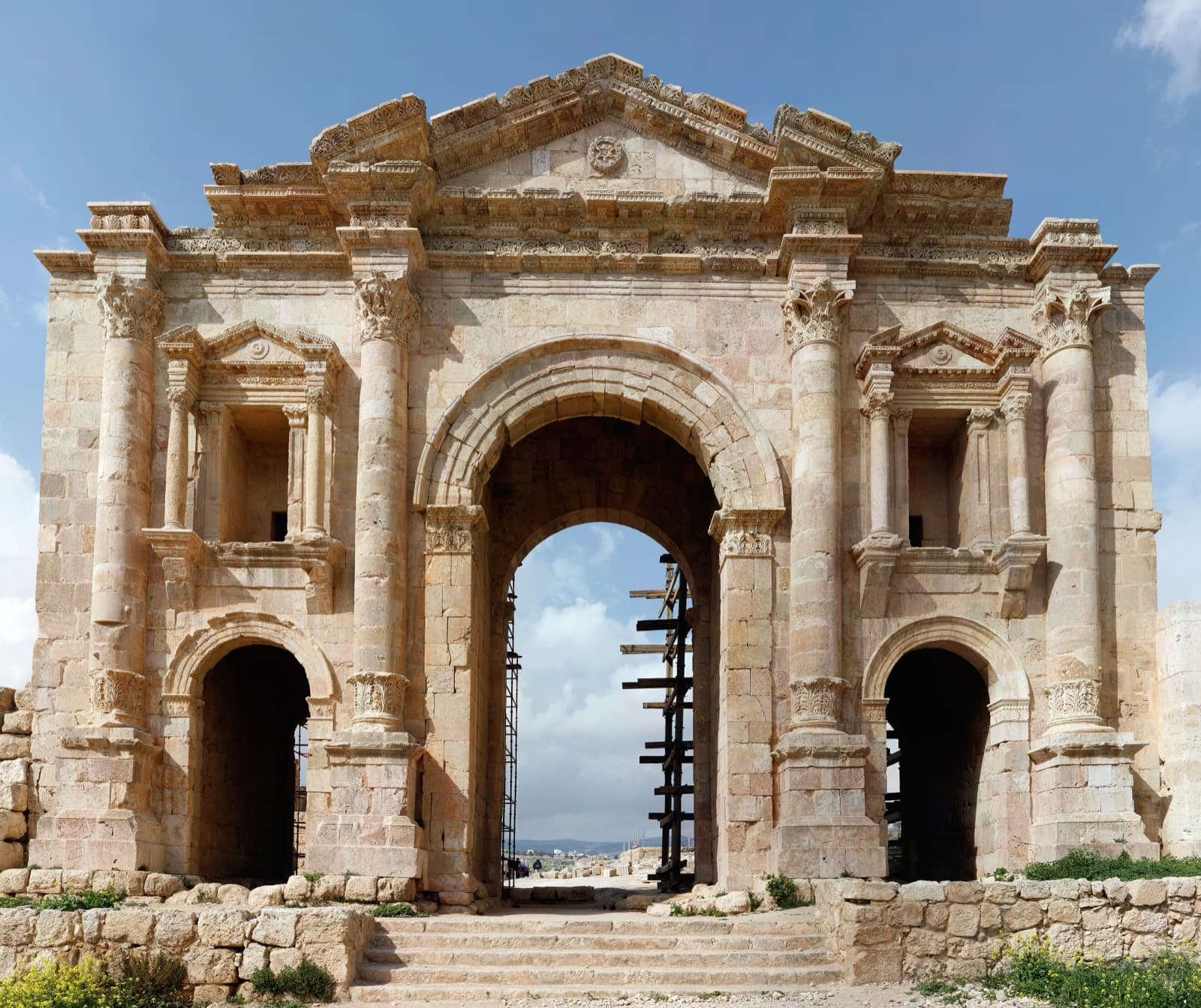
Hadrian's Arch in Jerash: The Gateway to a City That Was Never Built
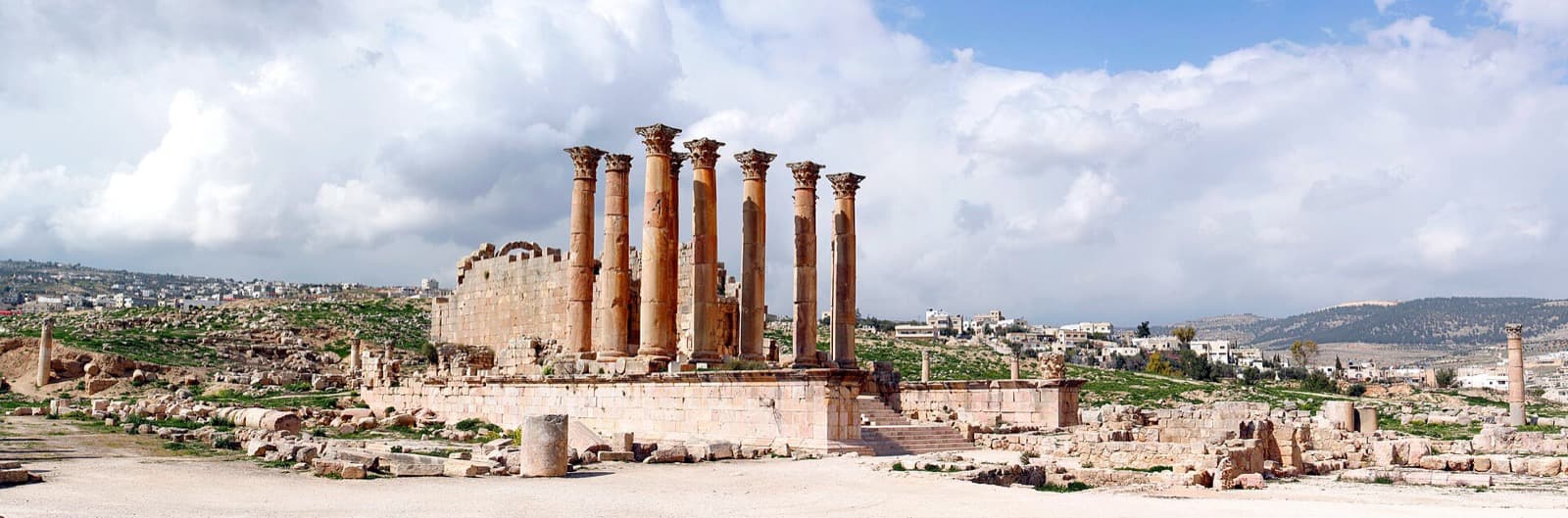
The Temple of Artemis in Jerash: Columns Engineered to Sway