Merchant City: The Tobacco Fortune
100 min · 3 km · easy
Glasgow, Scotland's largest city, built its beauty on complicated money, and it now names that money openly. In the seventeen hundreds the Tobacco Lords grew rich importing American tobacco produced by enslaved people, and their fortunes are written into the street names and grand buildings of what is now called the Merchant City. The nineteenth century turned that mercantile wealth into shipbuilding, heavy engineering, and the sandstone grandeur of George Square, Kelvingrove, and the university tower above the West End. The University of Glasgow has since published a report acknowledging the money it received from slavery-linked donors, part of a wider civic reckoning. Read the merchant streets, the medieval cathedral and its necropolis, and the cultured West End, and you read a city that spent a fortune, some of it entangled with Atlantic slavery, on beauty it then handed to everyone. You can read all of it at your own pace on the Glasgow walking tours.
A map that confesses
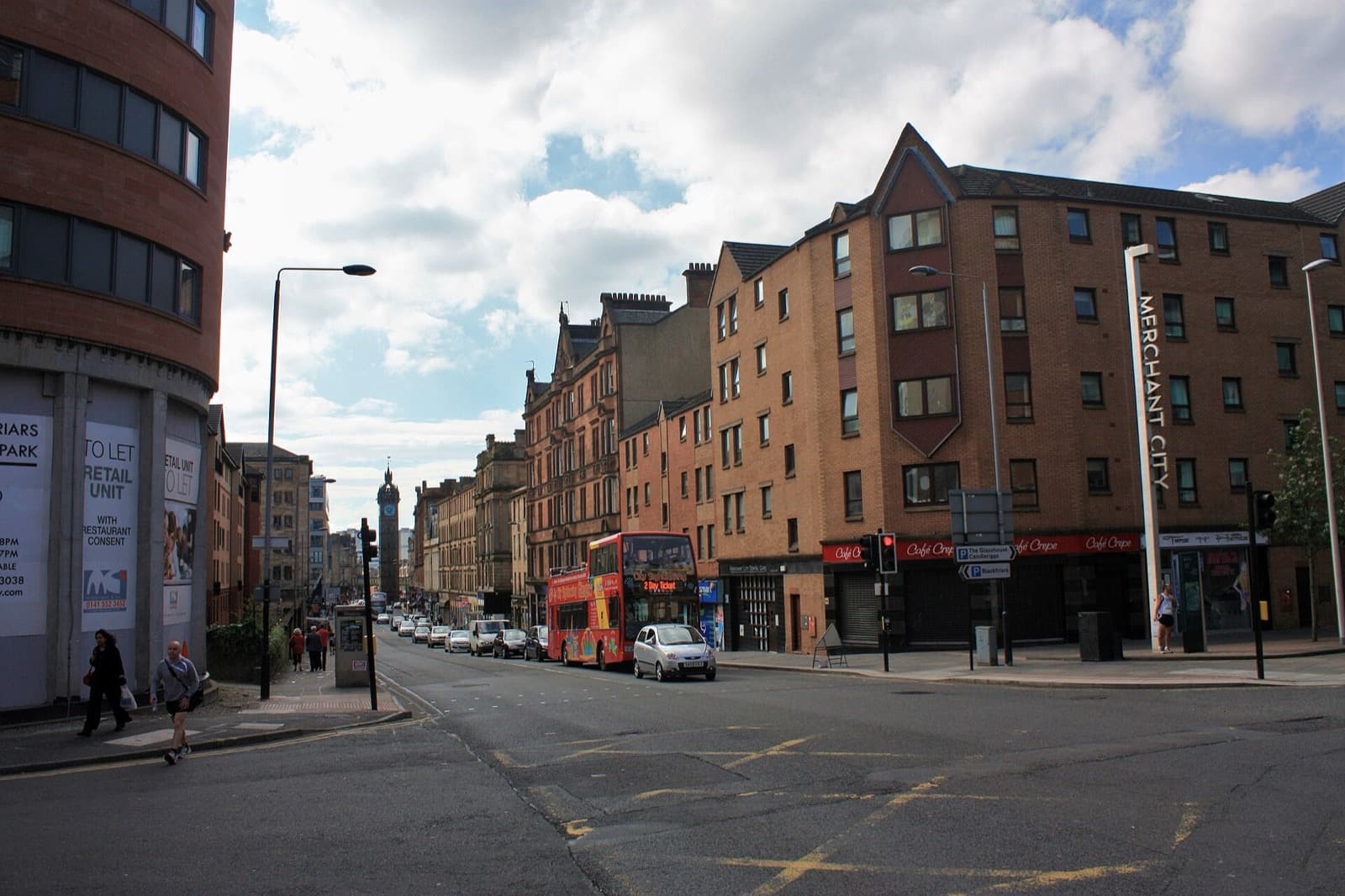
The clearest place to see the through-line is the grid of streets east of George Square. On the Merchant City tour, the map itself does the confessing. Glassford Street, opened in seventeen ninety-three, is named for the Tobacco Lord John Glassford, whose Shawfield Mansion was demolished in seventeen ninety-two so the street could run through it. Virginia Street carries the name of the tobacco colony. Jamaica Street is named for the West Indies and its sugar. Buchanan Street remembers the tobacco trader Andrew Buchanan, whose family owned plantations in Virginia. Glasgow's colonial trade, above all tobacco between seventeen forty and seventeen seventy-five, built much of what stands here, and when tobacco faltered around the American Revolution the merchants pivoted to West Indies sugar and cotton. These trades were rooted in the transatlantic economy of enslaved labour, and the city's museums now document that trade and the people it exploited.
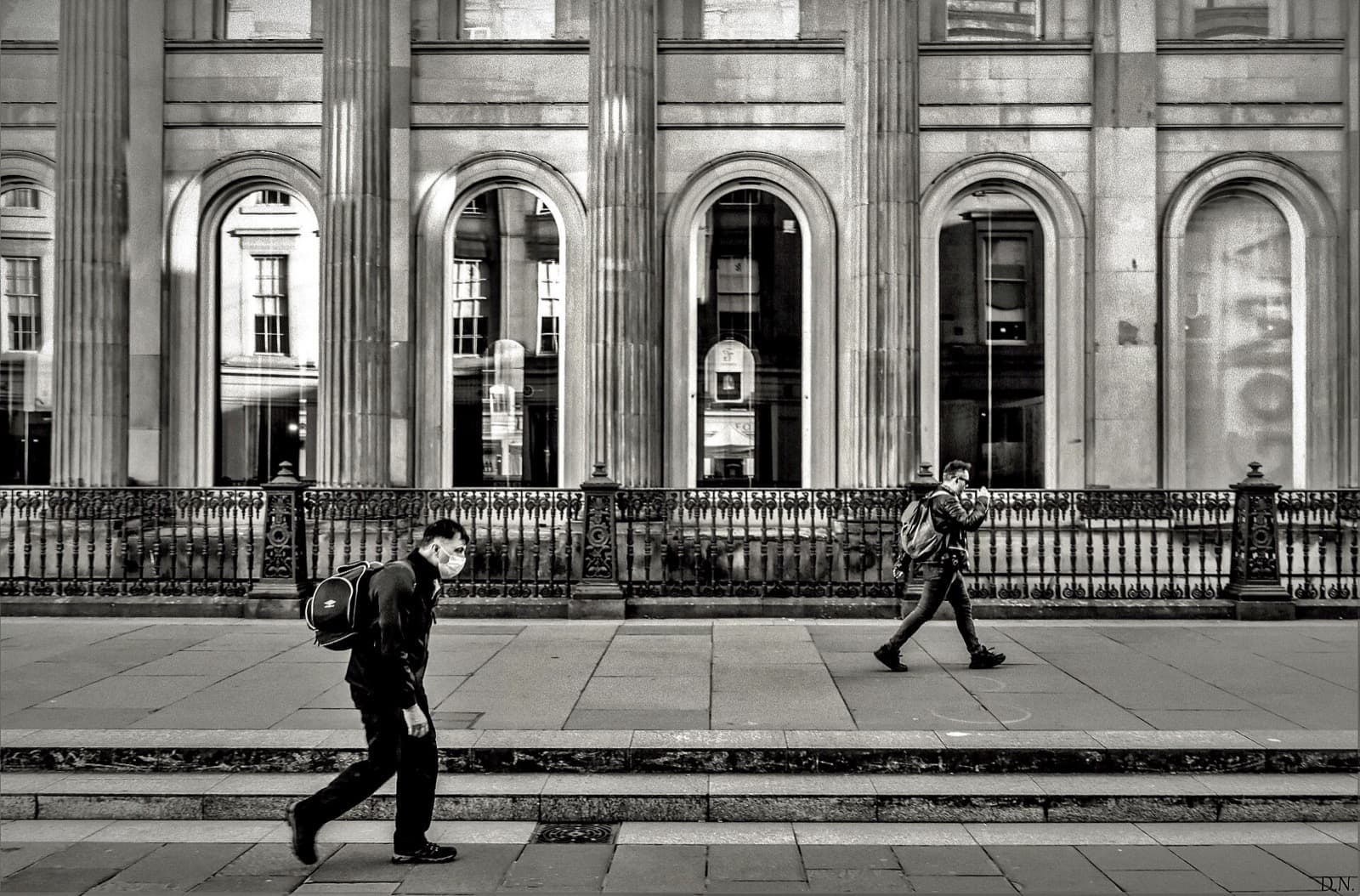
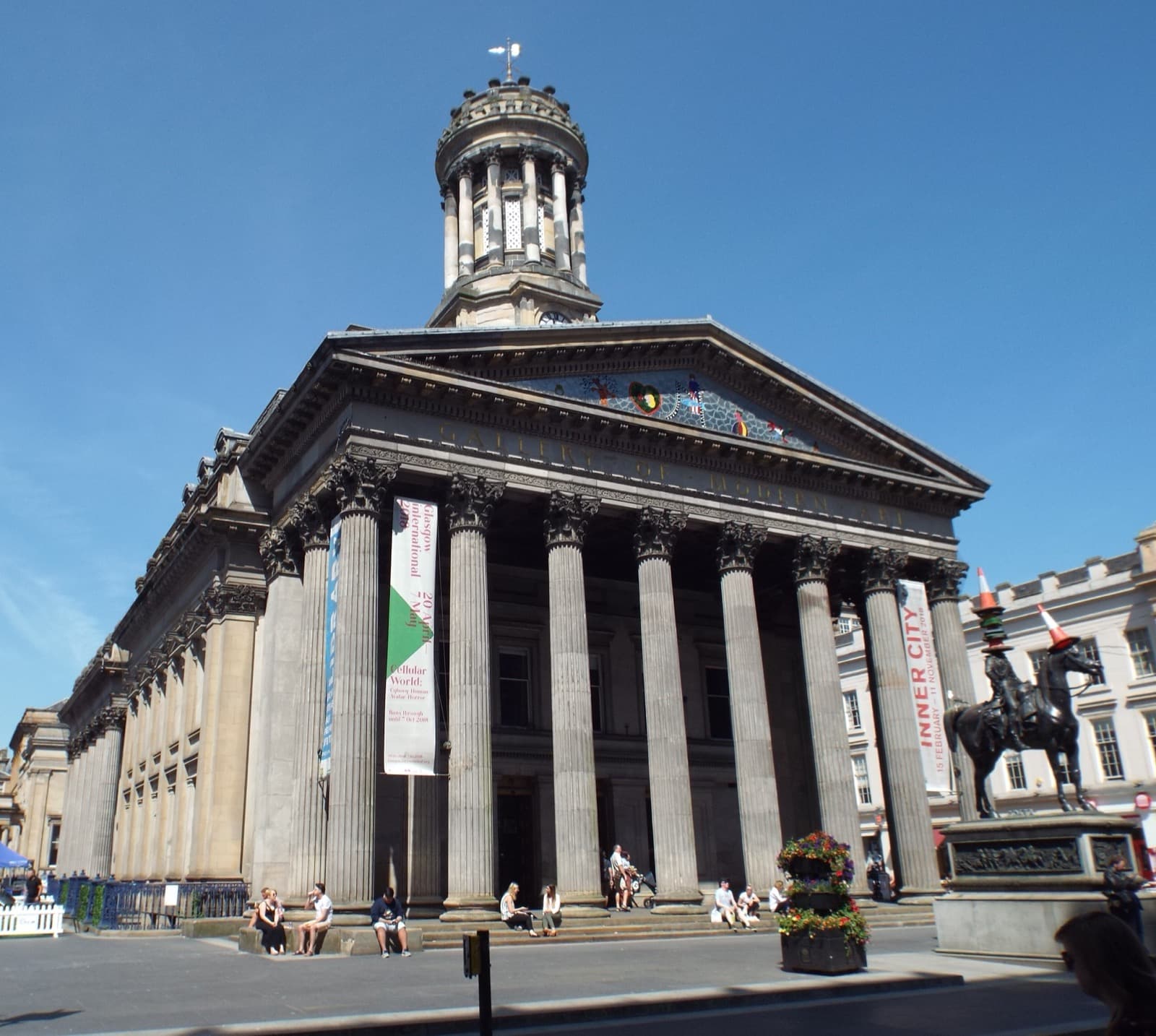
The single building that holds the whole story is the Gallery of Modern Art. It was built in seventeen seventy-eight as the townhouse of a Tobacco Lord, William Cunninghame of Lainshaw, whose fortune rested substantially on the triangular slave trade. David Hamilton reconstructed it as the Royal Exchange between eighteen twenty-seven and eighteen thirty-two, adding the towering Neoclassical portico, and it opened as a gallery in nineteen ninety-six. The building is magnificent, and its money is not innocent, and Glasgow now says both things at once. In front of it rides the Duke of Wellington, sculpted by Carlo Marochetti in eighteen forty-four, and on his head, almost always, sits a traffic cone. That cone is entirely unofficial, a folk habit the authorities have tried and failed to end, and Wikipedia records it as a recognised symbol of the city.
The reckoning has a document
Hear a stop from this walk
The Gallery of Modern Art: The Tobacco Lord's Mansion
Glasgow's honesty about its founding money is not just tone, it is on paper. In September twenty eighteen the University of Glasgow published a report titled Slavery, Abolition and the University of Glasgow, becoming the first British university to declare income derived from slavery. It estimated tens of millions of pounds in present-day value from slavery-linked gifts and committed to a programme of reparative justice. Both tours carry this fact rather than tuck it away, because it is the reckoning the whole city is now doing in its street signs, its museums, and its academic accounts.
Older than the merchants
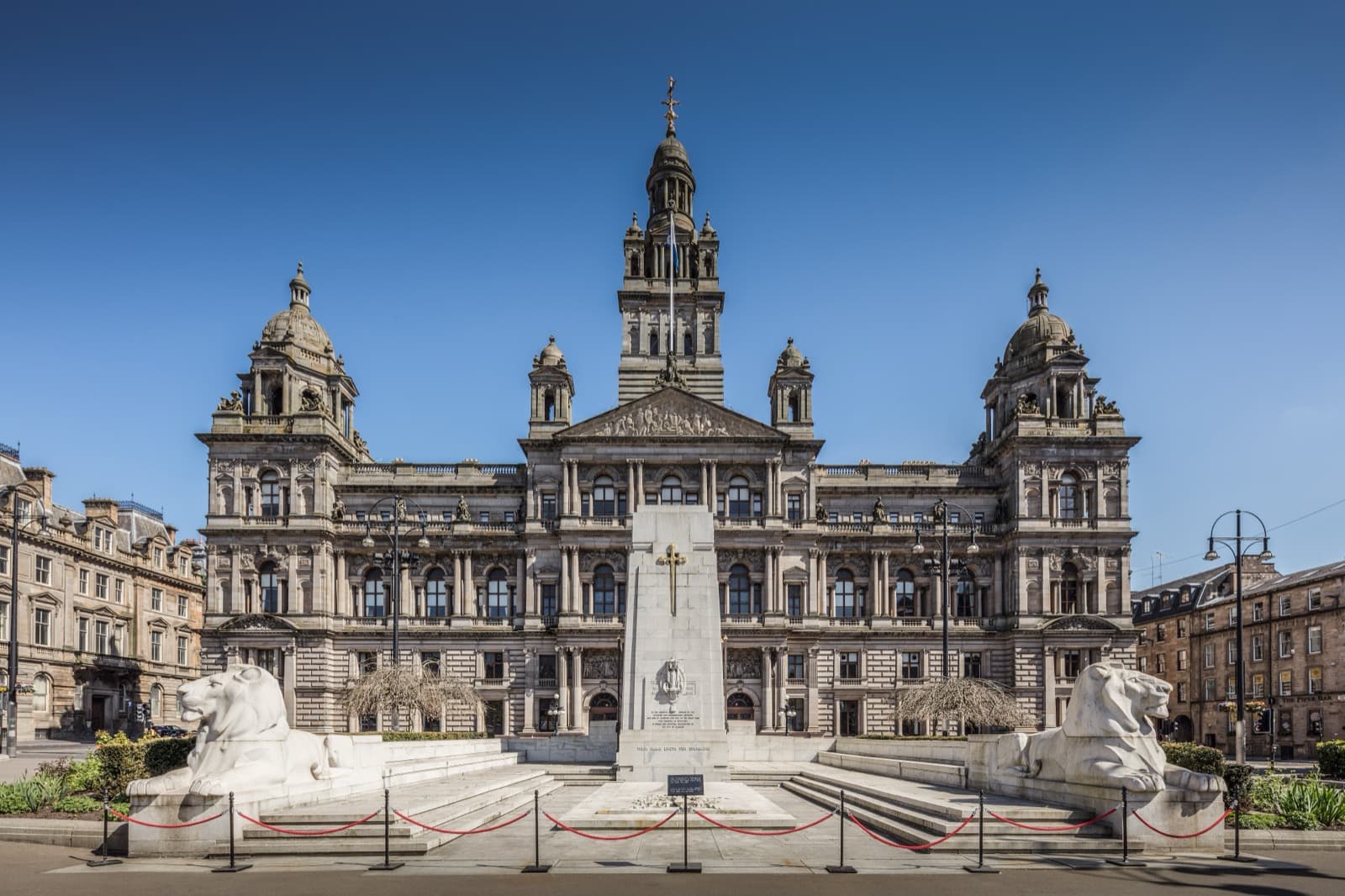
The Merchant City walk deliberately runs backward in time, from the eighteenth-century grid to an older Glasgow underneath it. George Square itself, laid out in seventeen eighty-one and named for King George the Third, is fronted by the City Chambers, designed by William Young, its foundation stone laid in eighteen eighty-three and inaugurated by Queen Victoria in eighteen eighty-eight. The square holds eleven public sculptures and a Doric column raised in eighteen thirty-seven to Sir Walter Scott, the first monument to Scott anywhere, before Edinburgh's. This was the seat of a city that called itself the Second City of the Empire, and the marble staircases inside were built to prove the boast.
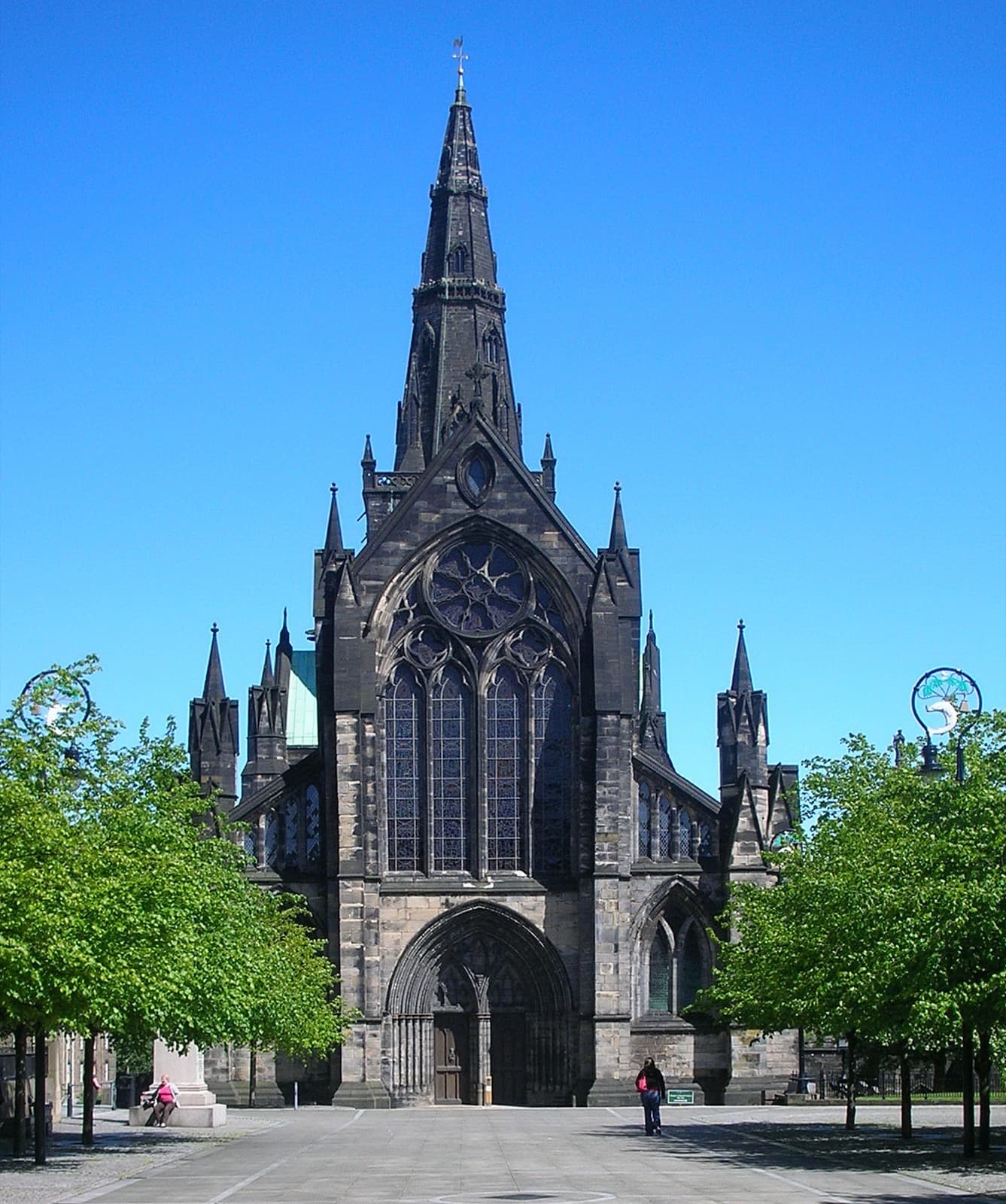
Walk east and downhill and the ground gets older. The Trades Hall on Glassford Street, built between seventeen ninety-one and seventeen ninety-four to a design by Robert Adam, who died before it was finished, still houses the fourteen Incorporated Crafts. By the Trades House's own account it is the oldest building in Glasgow, apart from the cathedral, still used for its original purpose. At Glasgow Cross the Tolbooth Steeple, begun in sixteen twenty-six and completed in sixteen thirty-four, is nearly all that survives of the old jail and council house after its main block came down in nineteen twenty-one. And at the top of the rise stands Glasgow Cathedral, built mainly across the thirteenth to fifteenth centuries over the tomb of Saint Mungo, believed buried on the spot around six twelve. Historic Environment Scotland records it as the only medieval cathedral on the Scottish mainland to survive the Reformation of fifteen sixty virtually intact. Across the road, Provand's Lordship, built in fourteen seventy-one, is the oldest house in Glasgow.
The walk ends on the hill above, in the Glasgow Necropolis, opened in eighteen thirty-three and modelled on Pere Lachaise in Paris. Its more than fifty thousand burials and roughly three and a half thousand monuments are chiefly the tombs of the merchants and industrialists whose fortunes you have read all the way up from George Square. They lie in obelisks and temples on the hill, above the cathedral that came centuries before them.
Where the city went to think
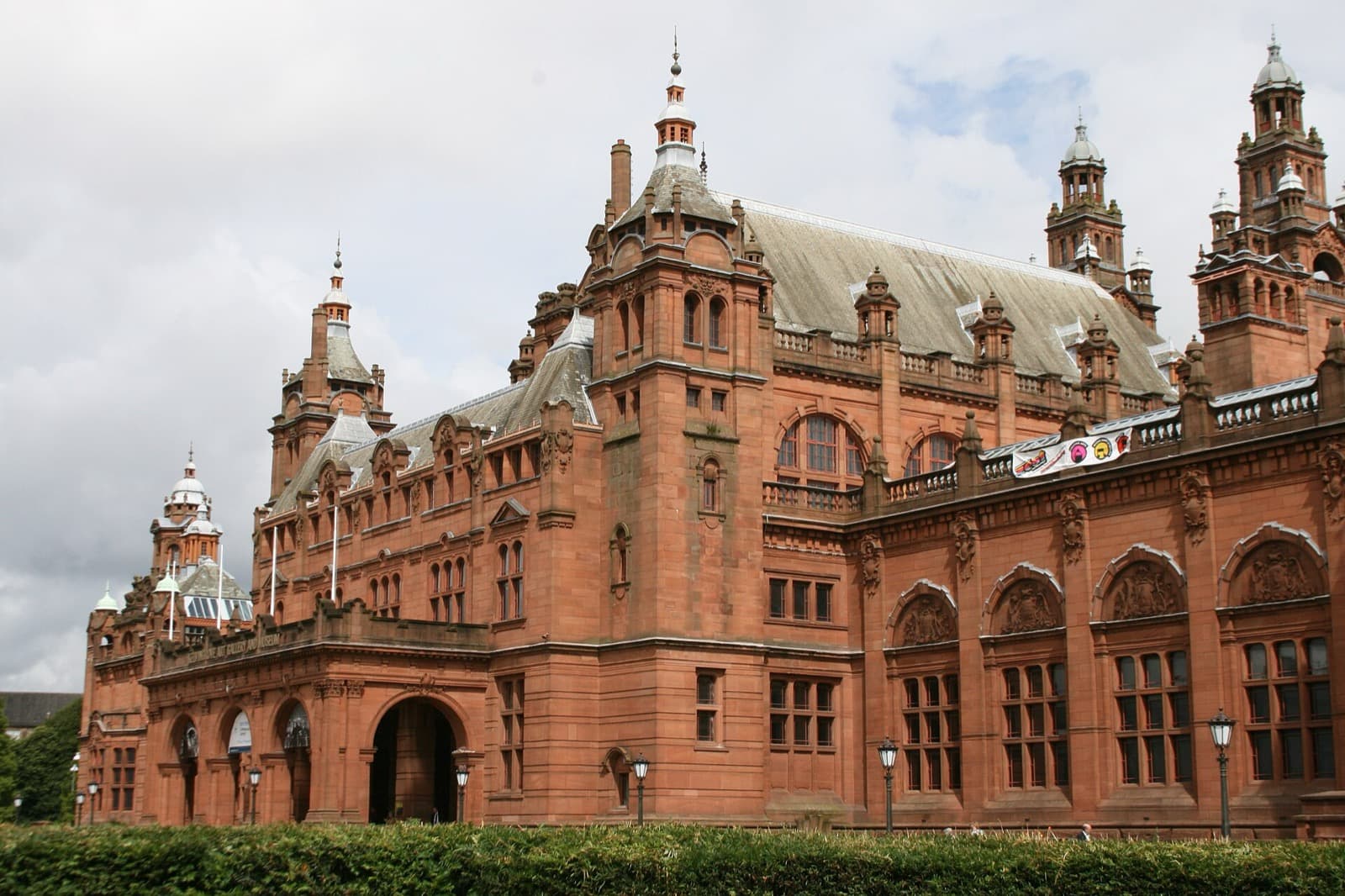
If the Merchant City shows how the money was made, the West End and Kelvingrove tour shows what the confident Victorian city chose to spend it on. Kelvingrove Art Gallery and Museum, opened in nineteen oh one in warm Spanish Baroque red sandstone by John Simpson and E. J. Milner Allen, was the Palace of Fine Arts for that year's Glasgow International Exhibition. Entry is free, and after its two thousand and six reopening it became the most popular free-to-enter museum in Scotland, holding Salvador Dali's Christ of Saint John of the Cross and a suspended Spitfire. The old story that its heartbroken architect leapt from a tower because the building was raised back to front is a myth the museum itself has debunked.
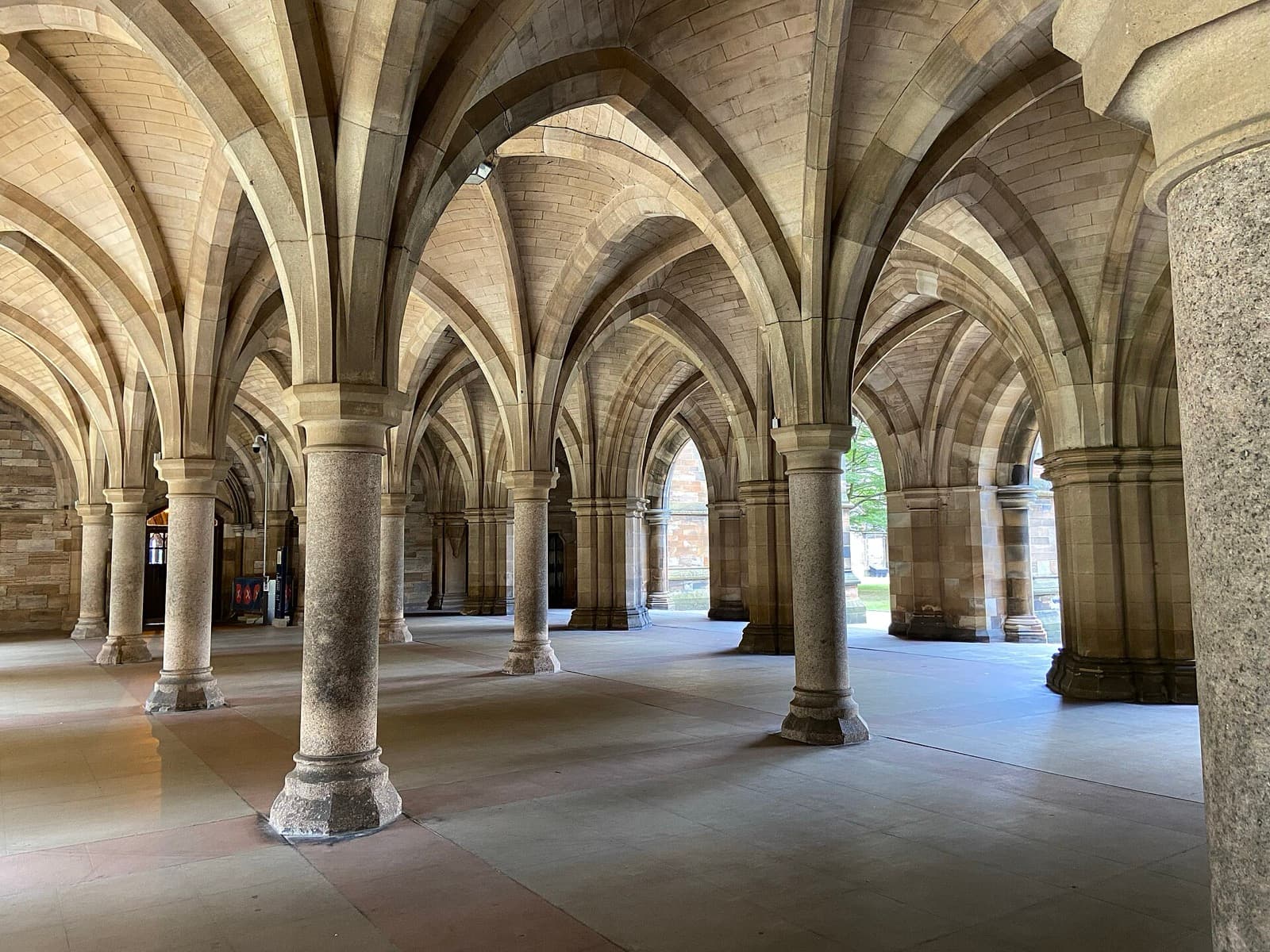
Above the park climbs the University of Glasgow, founded in fourteen fifty-one by a papal bull of Pope Nicholas the Fifth at the request of King James the Second of Scotland, and older than Columbus's voyage across the Atlantic. It moved to Gilmorehill in eighteen seventy, its Gothic Revival main building designed by Sir George Gilbert Scott, its spire completed between eighteen eighty-seven and eighteen ninety-one to roughly eighty-five metres. Adam Smith and William Thomson, Lord Kelvin, studied or taught here. And here too the West End tour is honest: the university's twenty eighteen slavery report ties this hill of learning back to the same Atlantic economy that named the merchant streets. The beauty and the reckoning stand together.
The rest of the district reads as a Victorian city investing in the good life. The Stewart Memorial Fountain of eighteen seventy-two honours Lord Provost Robert Stewart, who secured Glasgow's clean water from Loch Katrine, a public-health revolution that saved more lives than any battle. The Hunterian, opened in eighteen oh seven from the cabinet of the anatomist William Hunter, is Scotland's oldest public museum. Ashton Lane keeps the district living in the present, and the Kibble Palace, re-erected at the Botanic Gardens in eighteen seventy-three, shelters century-old tree ferns and marble statues under curved glass. Great Western Road, driven out into open country from the eighteen forties, ends the walk with Alexander Thomson's Great Western Terrace, often called the grandest in the city.
Two walks, one truth: Glasgow built beauty on complicated money, and it now reads its own map honestly, at whatever pace you choose.
Sources
- University of Glasgow, Slavery, Abolition and the University of Glasgow (report), September 2018
- Historic Environment Scotland, Glasgow Cathedral
- Glasgow Trades House, history of the Trades Hall and the fourteen Incorporated Crafts
- Glasgow Life / Glasgow Museums, Gallery of Modern Art and Kelvingrove Art Gallery and Museum
- Glasgow Necropolis Heritage Trail, Friends of Glasgow Necropolis
Frequently asked questions
- Who were the Tobacco Lords of Glasgow?
- The Tobacco Lords were eighteenth-century Glasgow merchants who grew rich importing American tobacco produced by enslaved people. Their names survive on Merchant City streets such as Glassford Street, named for John Glassford, and in buildings like the seventeen seventy-eight townhouse of William Cunninghame of Lainshaw, now the Gallery of Modern Art. Glasgow's tobacco trade peaked between seventeen forty and seventeen seventy-five before merchants pivoted to West Indies sugar and cotton.
- Why do so many Glasgow streets have names like Virginia and Jamaica?
- The Merchant City grid east of George Square was named directly for the colonial trade that funded it. Virginia Street is named for the tobacco colony, Jamaica Street for the West Indies and its sugar, and Glassford and Buchanan streets for individual tobacco traders. These trades were rooted in the transatlantic economy of enslaved labour, which the city's museums now document openly.
- What did the University of Glasgow say about slavery?
- In September twenty eighteen the University of Glasgow published a report titled Slavery, Abolition and the University of Glasgow, becoming the first British university to publicly declare income derived from slavery. It estimated tens of millions of pounds in present-day value from slavery-linked gifts and committed to a programme of reparative justice. Both the Merchant City and West End walks carry this fact directly.
- Why is there a traffic cone on the Duke of Wellington statue in Glasgow?
- The traffic cone on the Duke of Wellington statue outside the Gallery of Modern Art is an entirely unofficial folk habit of Glasgow's people. Authorities have tried to stop it, but residents keep replacing the cone. Wikipedia records it as a recognised symbol of the city and a piece of public art in its own right.
- How old is the University of Glasgow?
- The University of Glasgow was founded in fourteen fifty-one by a papal bull of Pope Nicholas the Fifth at the request of King James the Second of Scotland, making it older than Columbus's voyage across the Atlantic. It is the fourth-oldest university in the English-speaking world. It moved to its Gilmorehill site in the West End in eighteen seventy, where its Gothic tower rises to roughly eighty-five metres.
Ready to experience it?
Merchant City: The Tobacco Fortune
100 min · 3 km · easy
More from Glasgow
Explore more at your own pace.
Glasgow Travel Guide: How Many Days, Getting Around, and When to Visit
One Day in Glasgow: A Walkable Morning-to-Evening Itinerary
Glassford Street and the Map That Confesses: Glasgow's Merchant City
The Gothic Tower on Gilmorehill: Reading Glasgow's West End from the University Cloisters
Glasgow Cathedral: The Medieval Survivor Built Over a Saint's Grave