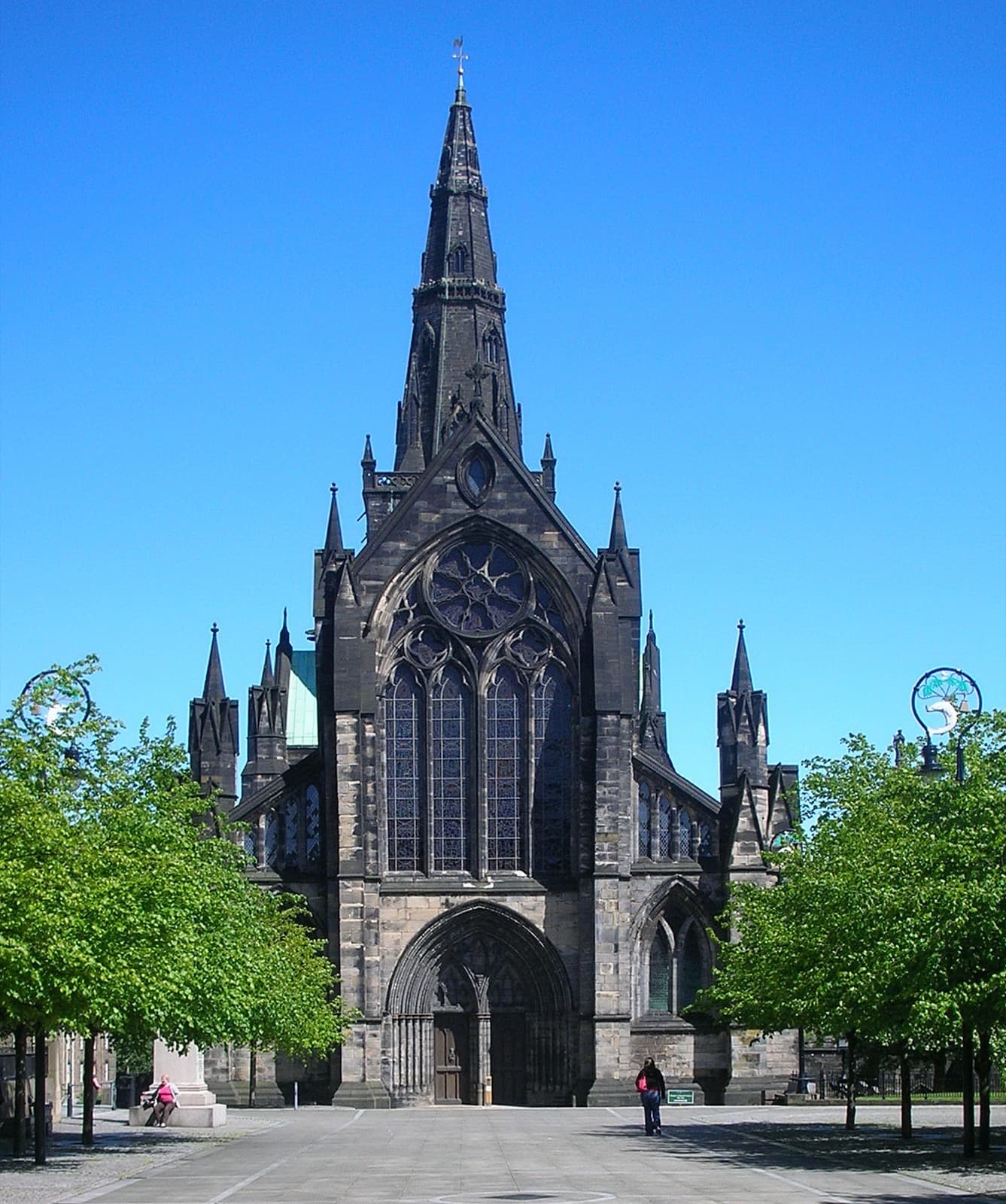
Glasgow Cathedral is the only medieval cathedral on the Scottish mainland to have survived the Protestant Reformation of 1560 virtually intact, and it stands over the tomb of Saint Mungo, the grave around which the whole of Glasgow grew. Those two facts, survival and origin, are the reason this dark stone church on a rise at the east end of the city rewards a careful, unhurried look. Most visitors walk in expecting a handsome old building. What they are actually standing inside is the single continuous thread running back to the moment Glasgow began, and one of the rarest medieval survivals in the country.
What it is
The building carries several names, and each tells you something. It is Glasgow Cathedral. It is the High Kirk, and kirk simply means church in Scots. It is Saint Mungo's, and Saint Kentigern's, after the same man under two names. It was built mainly across the thirteenth to fifteenth centuries, with its great expansion beginning under a medieval bishop from around the year 1181, and it reached its present form by the fifteenth century. That is a long build. Cathedrals were rarely raised in a single generation, and this one accumulated its bays and its lower church across three hundred years of bishops, masons, and money, each adding to what the last had left.
The result is a church of two levels, the upper church and the lower church, or crypt, one of the finest pieces of medieval vaulting in Scotland. The crypt is not a basement in the modern sense. It was built deliberately, to hold and honour a tomb, and to give pilgrims somewhere to gather around it.
The grave at the centre
Hear a stop from this walk
The Gallery of Modern Art: The Tobacco Lord's Mansion
The reason for the whole structure lies below. Glasgow Cathedral was built over the tomb of Saint Kentigern, known to the city as Saint Mungo, the monk regarded as the founder and patron of Glasgow, and believed buried on this very site around the year 612. That date is worth pausing on. It places a burial here roughly six centuries before the stone you are looking at was cut. The church did not come first and then acquire a saint. The saint came first, and the church grew up to shelter his grave.
Down in the lower church, his shrine drew Christian pilgrims from across the land, right up until the Reformation. For centuries this crypt was a destination, a place people travelled to reach. Understanding that reframes everything visible from George Square and the merchant grid below. The Tobacco Lords laid out their streets in the eighteenth century, but the city they built on had already existed for a thousand years, and it existed because of a monk's grave on this hill. Glasgow, in the most literal sense, grew up around a burial.
Why it survived when so many did not
Here is the fact that sets Glasgow Cathedral apart from nearly every comparable building in Scotland. Historic Environment Scotland, which cares for the building, records that this is the only medieval cathedral on the Scottish mainland to have survived the Protestant Reformation of 1560 virtually intact.
The Scottish Reformation was not gentle to church buildings. Across the country, cathedrals and abbeys were stripped of their altars and imagery, and many were left to ruin. St Andrews, once the ecclesiastical capital, is a roofless shell today. Elgin, the so-called Lantern of the North, stands broken. What happened at Glasgow was different. Rather than being torn down, the cathedral was repurposed, divided internally to serve as parish churches for the reformed congregation. Because it kept a working use, it kept its roof, its walls, and its vaults. A building that is still needed is a building that survives, and Glasgow's people needed this one enough to adapt it rather than abandon it. That is the whole difference between a functioning cathedral and a picturesque ruin.
Standing in the upper church, the thing to grasp is that you are seeing medieval fabric that elsewhere in Scotland is simply gone. This is not a reconstruction or a Victorian rebuild dressed as old. It came through 1560 essentially whole, and it has been in continuous use ever since.
The oldest house across the road
The cathedral does not stand alone. Directly across the road is Provand's Lordship, built in 1471 by Andrew Muirhead, then Bishop of Glasgow, as part of a hospital. It is the oldest house in Glasgow, now a museum cared for by the city, and it is free to enter. Set the two buildings against each other and you have the medieval core of Glasgow in a single glance: the great church and the modest stone house, both survivors of an age that has otherwise vanished from the streets below. Give Provand's Lordship its own visit. Buildings this old, still standing and still open, are not common anywhere.
The one thing to understand standing here
If you take away a single idea from this spot, make it this. Everything downhill, the marble City Chambers, the Tobacco Lord mansions, the confident Neoclassical grid of the Merchant City, is younger than this church by centuries, and all of it sits on ground first made important by the grave beneath your feet. The merchant city was the second act. This was the first. Stand in the crypt in your own silence, without a group hurrying you past the tomb, and you are standing at the actual root of Glasgow, the point from which the rest of the city, wealth, beauty, and harder truths alike, eventually unfolded.
The cathedral is free to enter, and so is Provand's Lordship. Neither rewards a quick pass. They reward slow, quiet looking, at your own pace.
Walk the tour
Glasgow Cathedral is the sixth stop on the self-guided Merchant City walk, which begins in the civic grandeur of George Square, reads the tobacco and sugar fortunes written into the merchant grid, and then climbs back in time to this medieval root and the Necropolis hill beyond it. It is the moment the walk turns from the eighteenth-century trading city to the thousand-year-old burgh underneath it. You can find the full route and more context in our guide to Glasgow walking tours, and browse everything to see and do across the city on the Glasgow page. Walk it in order, at your own pace, and let the cathedral be the place where the story reaches its origin.
Sources
- Historic Environment Scotland, Glasgow Cathedral: the official guardian's record of the building's medieval construction and its survival of the 1560 Reformation on the Scottish mainland.
- Provand's Lordship (Wikipedia): documents the 1471 house built by Bishop Andrew Muirhead as the oldest surviving dwelling in Glasgow.
- Glasgow Cathedral (Wikipedia): the construction sequence from the twelfth-century consecration through the fifteenth century, and the cathedral's other names as Saint Mungo's and Saint Kentigern's.
- Saint Mungo / Kentigern (Wikipedia): the saint as founder and patron of Glasgow, buried on the cathedral site in the early seventh century.
- Roamer tour, "Merchant City: The Tobacco Fortune": the fact-audited on-site narration for Glasgow Cathedral, Saint Mungo's tomb, and the walk's route.
Ready to experience it?
Merchant City: The Tobacco Fortune
100 min · 3 km · easy
More from Glasgow
Explore more at your own pace.
Glasgow Travel Guide: How Many Days, Getting Around, and When to Visit
One Day in Glasgow: A Walkable Morning-to-Evening Itinerary
Glasgow: Beauty Built on Complicated Money
Glassford Street and the Map That Confesses: Glasgow's Merchant City
The Gothic Tower on Gilmorehill: Reading Glasgow's West End from the University Cloisters