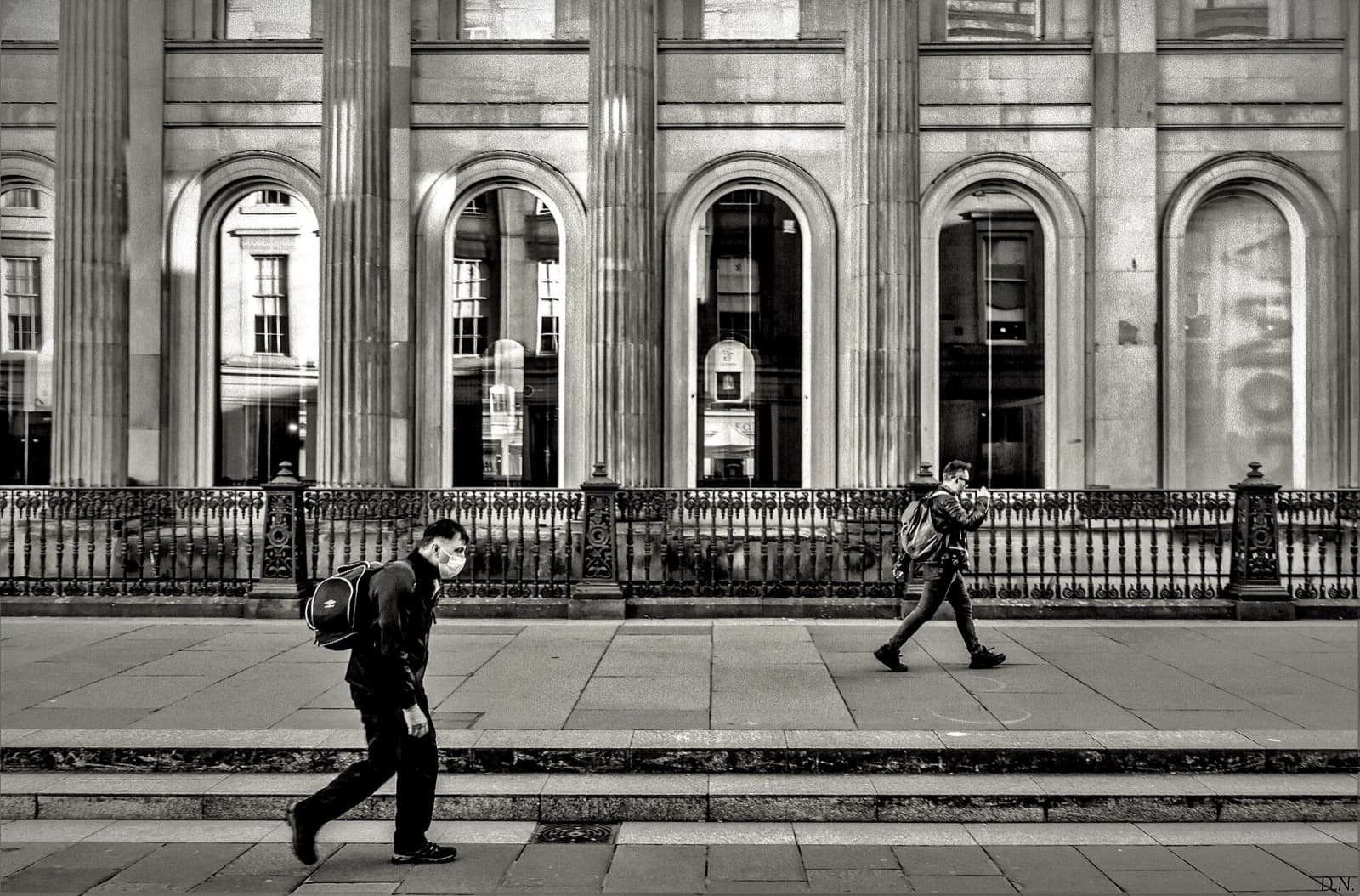
A walk through Glasgow's grand merchant grid and back to its medieval root, reading both the beauty of the architecture and the fortune, entangled with enslaved labour, that paid for it.
Start · George Square: The Palace of the Second City
DirectionsStops
- 1
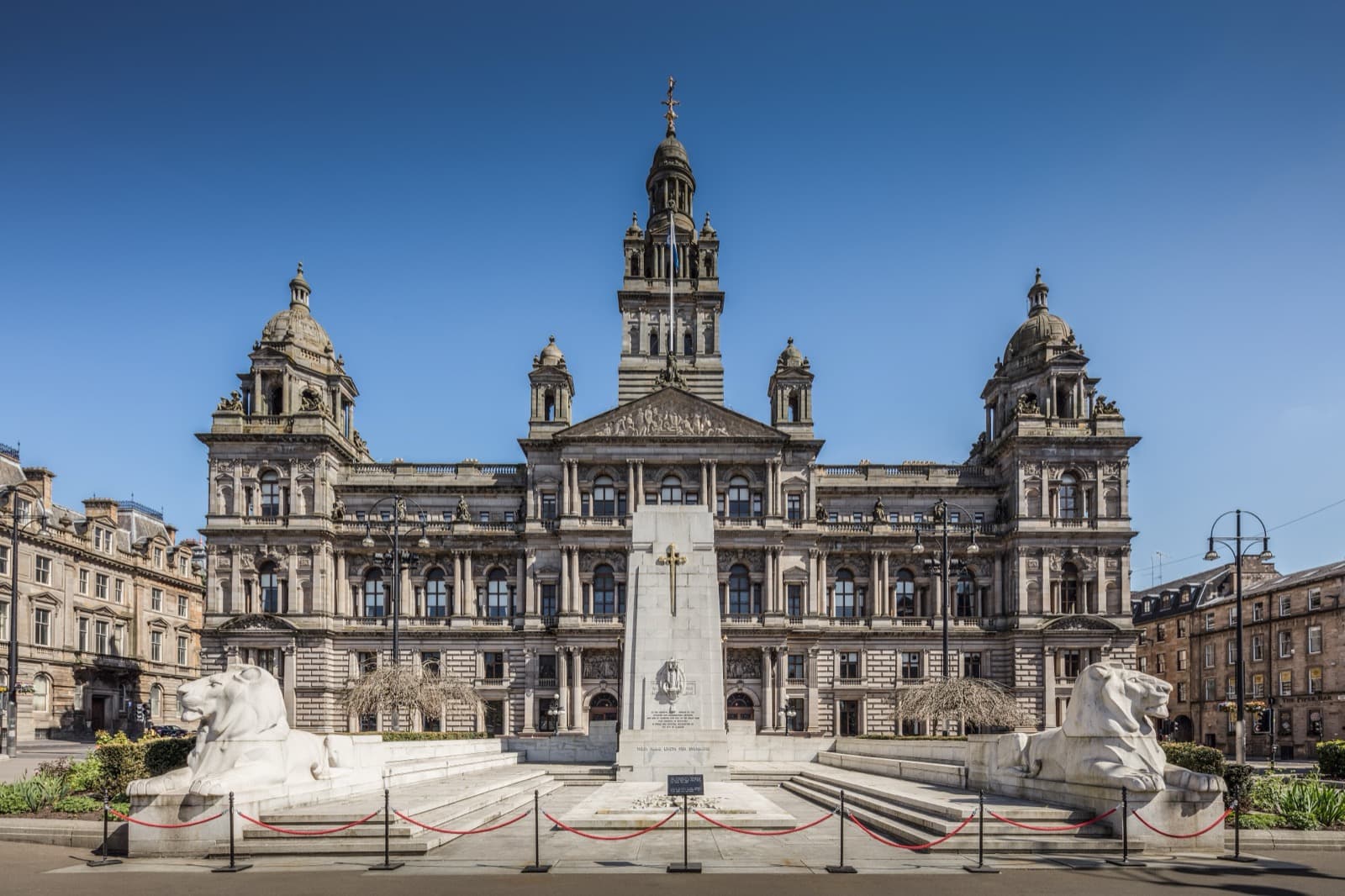
George Square: The Palace of the Second City
Glasgow's principal civic square, ringed by monuments and fronted by the marble-staired City Chambers that ran a city which called itself the Second City of the Empire.
- 2
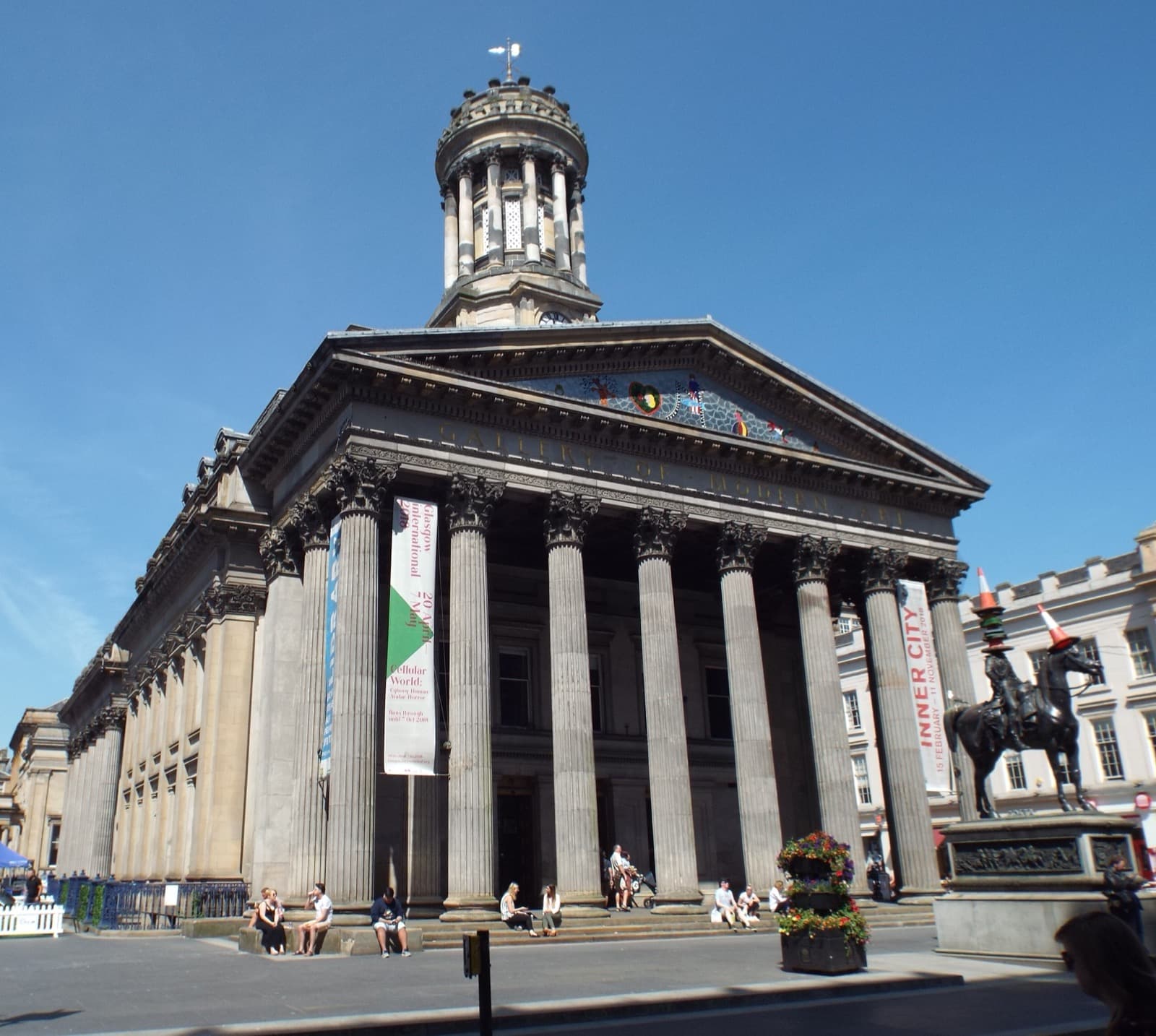
The Gallery of Modern Art: The Tobacco Lord's Mansion
A modern art gallery inside a Tobacco Lord's eighteenth-century townhouse, fronted by a Wellington statue whose traffic cone the city refuses to give up.
- 3
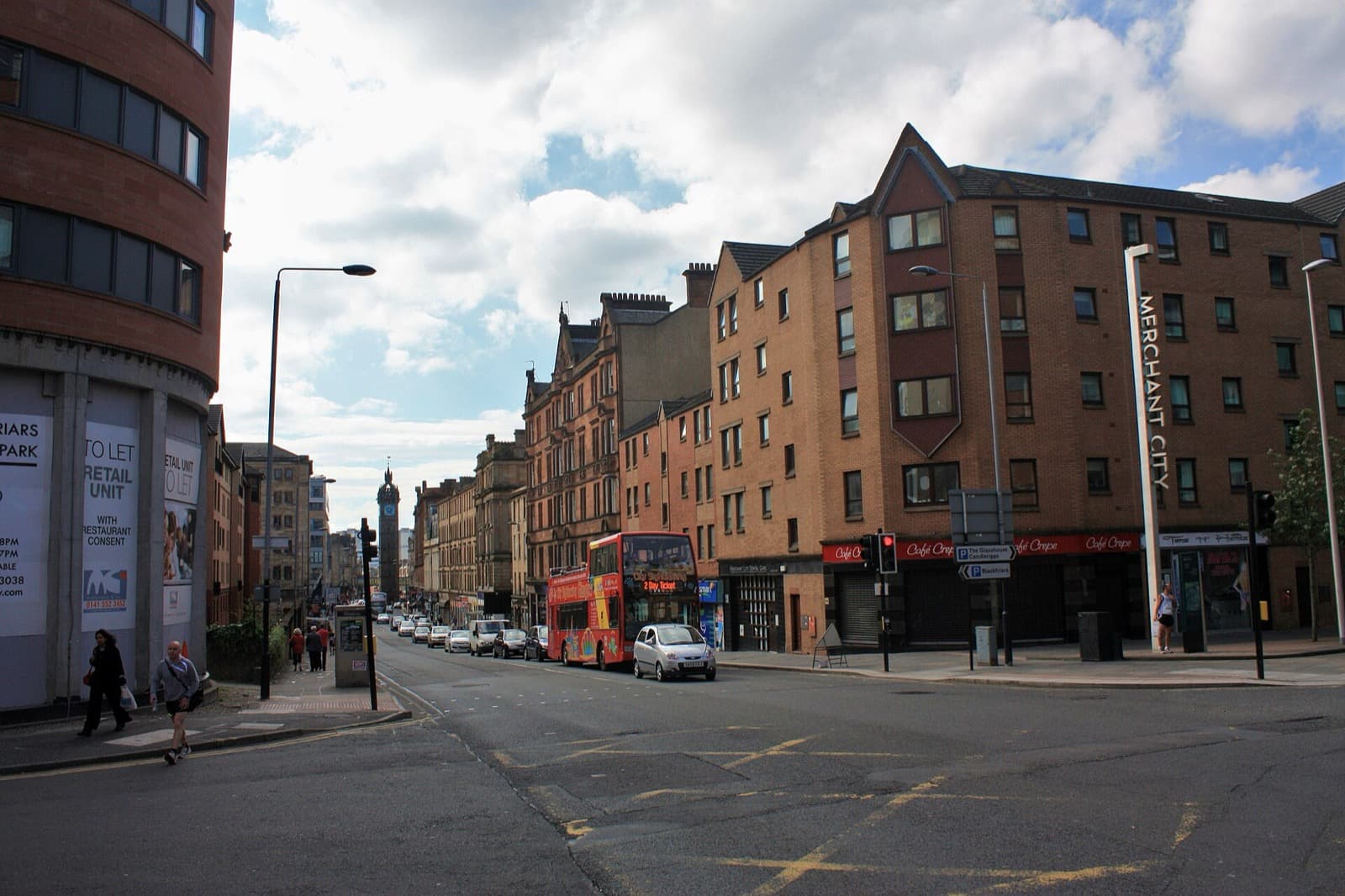
The Merchant City: The Map That Confesses
The grid of merchants' streets whose very names, Virginia, Jamaica, Glassford, record the tobacco and sugar trade that built them.
- 4
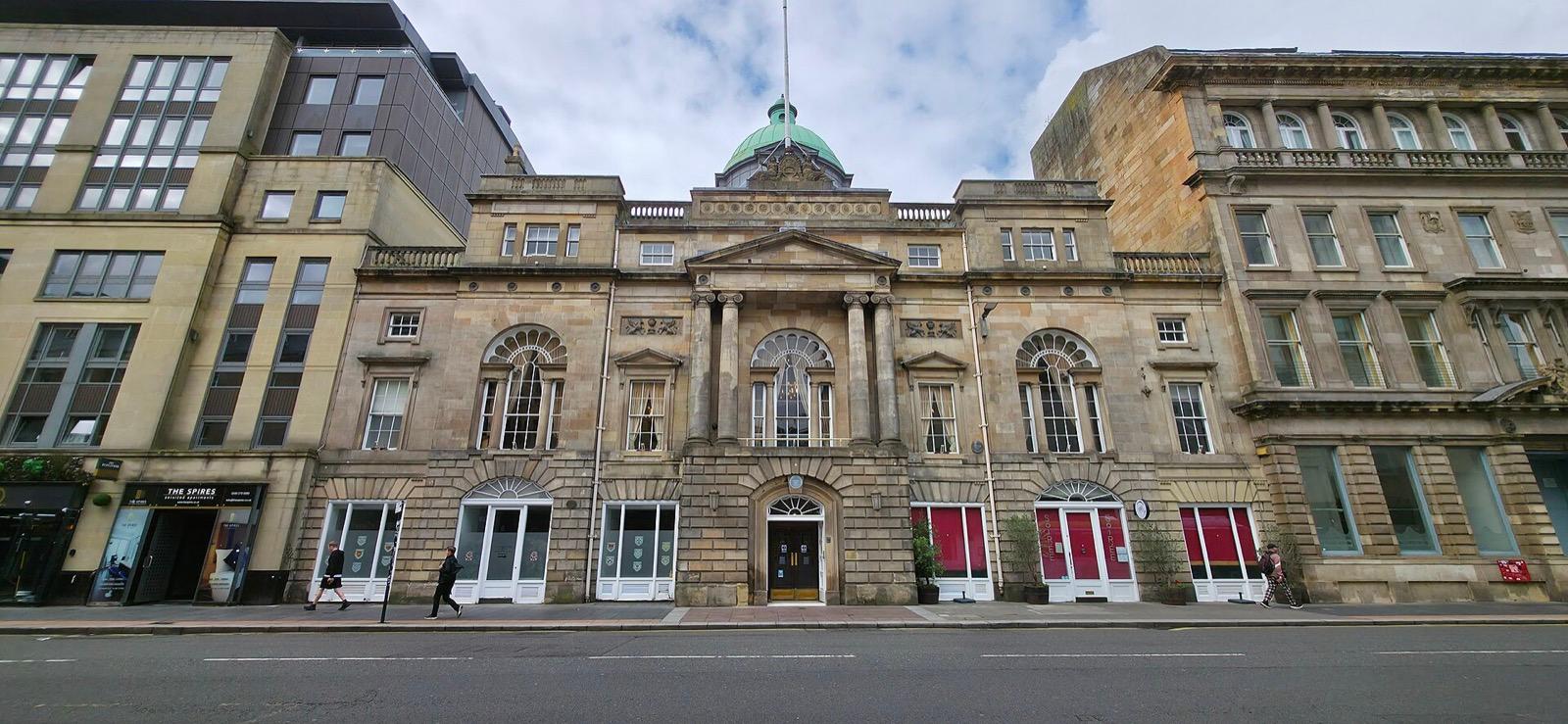
The Trades Hall: The Guild Hall Robert Adam Built
A Robert Adam guild hall, still used by the craftsmen's Trades House, and by the Trades House's own account the oldest building in Glasgow apart from the cathedral still serving its original purpose.
- 5
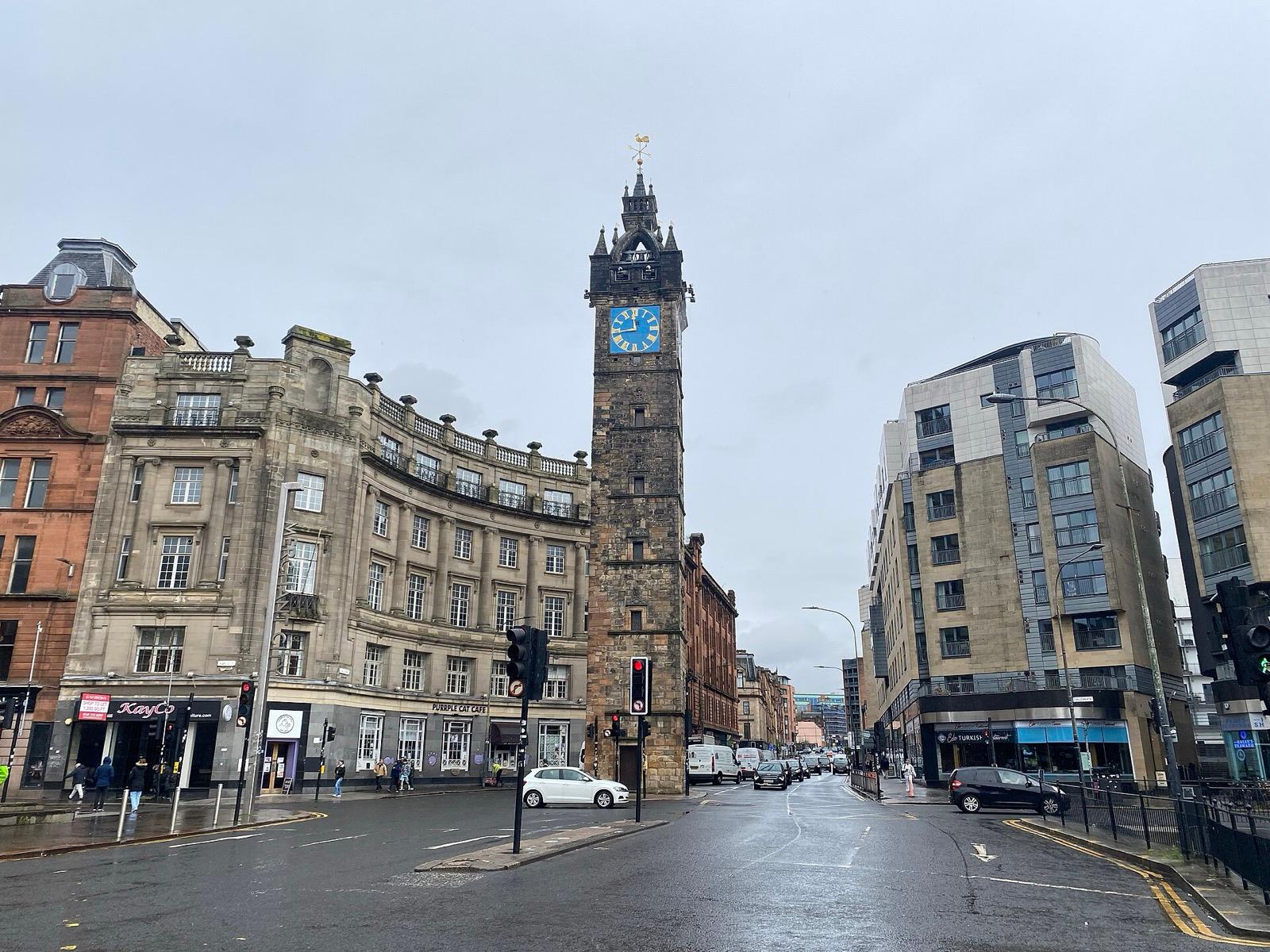
Glasgow Cross: The Lone Steeple of the Old Burgh
A tall lone steeple, all that survives of the old Tolbooth, standing where the medieval burgh kept its law and its market.
- 6
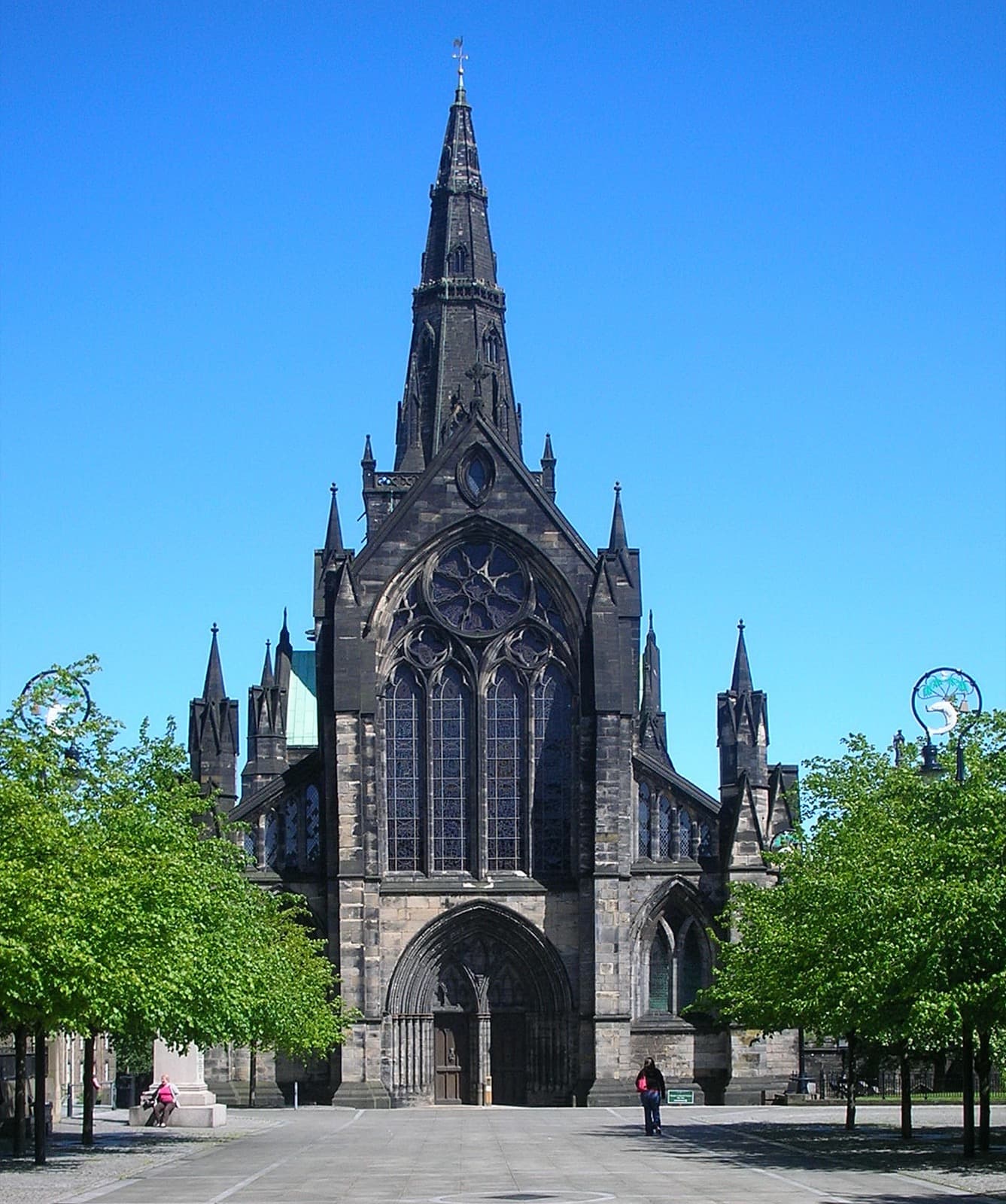
Glasgow Cathedral: Over the Grave of Saint Mungo
The medieval cathedral built over the tomb of Saint Mungo, the only cathedral on the Scottish mainland to survive the Reformation virtually intact, facing Glasgow's oldest house.
- 7
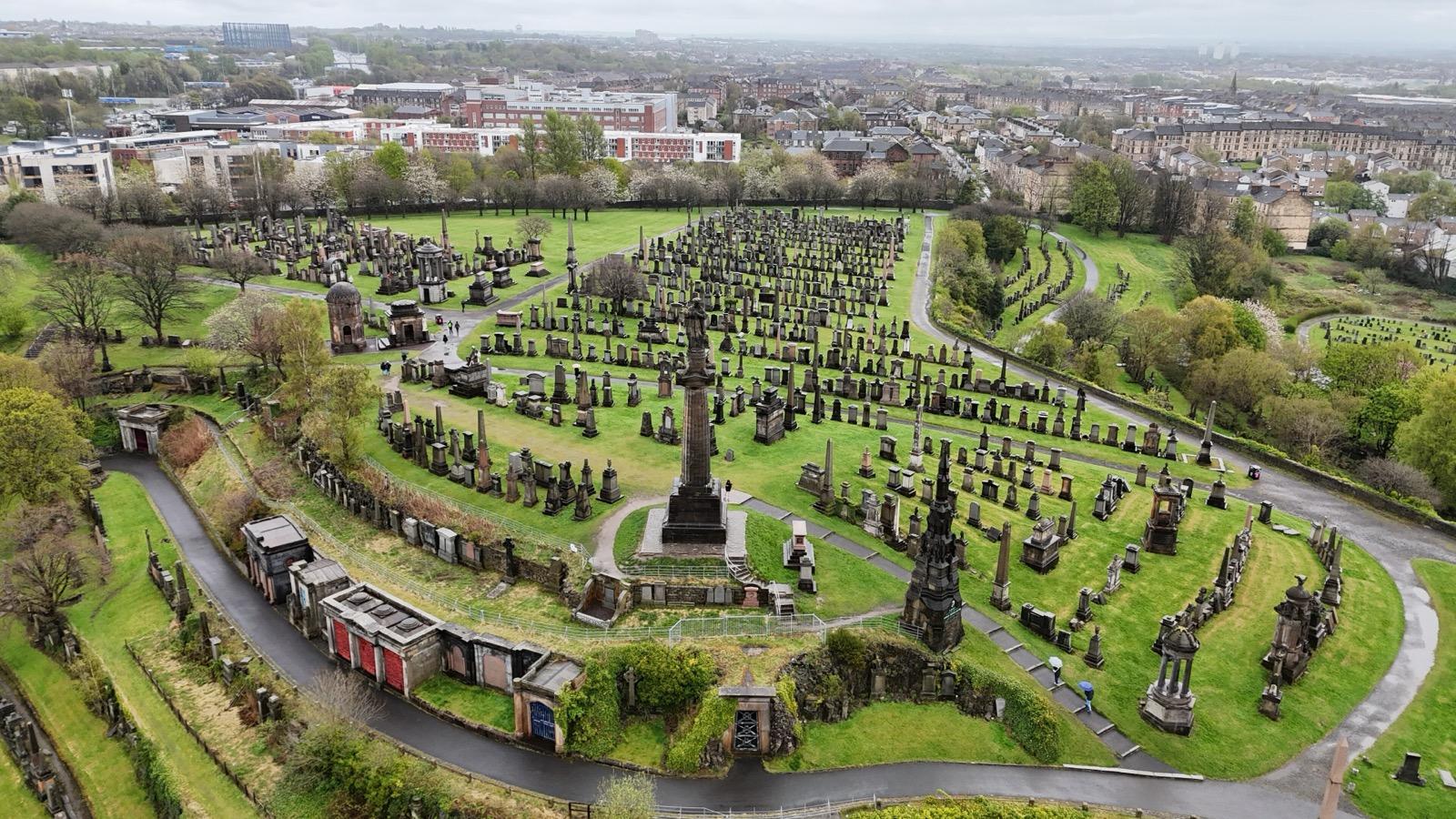
The Glasgow Necropolis: The Hill of the Merchant Dead
A Victorian garden cemetery of grand merchant tombs on the hill above the cathedral, crowned by a John Knox column older than the graves.
Details
Best Time to Visit
A dry morning is ideal, giving you soft light on George Square and time to reach the cathedral and Necropolis before afternoon crowds. Late spring through early autumn offers the mildest weather and the longest daylight, but Glasgow's west-coast skies change fast in any season, so an overcast or showery day is entirely normal and no reason to wait. Weekday mornings are quietest in the Merchant City; the cathedral and Necropolis are calmest early, when you can stand in the crypt or read a headstone in near silence.
Pro Tips
- •Do the walk in order from George Square eastward, so the route builds from the civic square through the merchant grid and back in time to the medieval cathedral and the Necropolis hill.
- •Read the street signs in the Merchant City as you go, Glassford, Virginia, Jamaica, Ingram, because the names themselves are part of the story the tour is telling.
- •Check ahead for the free City Chambers tours and for Doors Open or event days at the Trades Hall if you want to see the marble interiors, since both are only open at certain times.
- •Save real time for the cathedral crypt and for Provand's Lordship across the road; both are free and both reward slow, quiet looking rather than a quick pass.
- •Climb into the Necropolis at the end for the view back over the cathedral and city, and give yourself room to wander the monuments; there is no group timetable pushing you on.
- •Carry a waterproof and comfortable shoes, and treat any rain as part of the Glasgow experience rather than a problem to escape.
Safety & Precautions
- •The route runs gently uphill from Glasgow Cross to the cathedral and then climbs into the Necropolis, so wear supportive footwear and take the slopes at your own pace, resting when you need to.
- •West-coast weather changes quickly, so bring a waterproof and a warm layer even on a bright morning, and take care on paths and steps in the Necropolis when they are wet.
- •Treat the cathedral, its crypt, and the Necropolis with quiet respect; these are a working church and an active burial ground, so keep your voice low and step carefully among the graves.
- •Keep valuables discreet and stay aware of traffic and your surroundings as in any city, especially crossing the busy junctions around Glasgow Cross, and note that some museums may charge entry in pounds.
Travel advisory: Exercise Increased Caution (Level 2).
Gallery
Related Reading
Go deeper on what you'll see, hear, and walk through.
Overview
Best Self-Guided Walking Tours in Glasgow (2026)
3 min
Overview
Glasgow Travel Guide: How Many Days, Getting Around, and When to Visit
7 min
Overview
One Day in Glasgow: A Walkable Morning-to-Evening Itinerary
6 min
Thematic
Glasgow: Beauty Built on Complicated Money
7 min
Companion
Glassford Street and the Map That Confesses: Glasgow's Merchant City
6 min
Deep dive
Glasgow Cathedral: The Medieval Survivor Built Over a Saint's Grave
6 min
Read
What to Eat in Glasgow: Local Dishes and How to Order Them
7 min
Read the walk
The full story of Merchant City: The Tobacco Fortune, in words. Prefer to listen? Play it narrated, from home or on location.
Introduction
Glasgow's historic core tells two stories at once, and this walk reads them both. There is the Merchant City, the grand grid of streets east of George Square, raised on the eighteenth-century fortunes of the Tobacco Lords and the later sugar and cotton trades. That wealth was beautiful, and it was entangled with the transatlantic economy of enslaved labour, a truth the city now names openly in its street signs, its museums, and the University of Glasgow's own report. Beneath and beyond that merchant city lies an older Glasgow, the medieval burgh that grew around the shrine of Saint Mungo, whose cathedral and hilltop city of the dead still crown the east end. This route holds both truths without flinching. You will admire the marble and the Neoclassical mansions, and read, in the same breath, where the money came from, exactly as Glasgow itself now does. There are seven stops across about three kilometres, and the walk runs roughly ninety minutes to two hours on foot, longer if you linger, and you can and should linger. Every stop is a short, skippable chapter. No group, no schedule, no guide steering you, no tip expected. Sit in George Square as long as you like. Read a headstone in the Necropolis in your own silence, in the changeable west-coast weather of Glasgow, in Scotland. This is autonomy: your pace, your route, your own quiet map. When you arrive at George Square, begin with stop one.
1. George Square: The Palace of the Second City
This is George Square, laid out in seventeen eighty-one and named for King George the Third, the great civic heart of Glasgow. Around it stand eleven public sculptures, among them Robert Burns and the engineer James Watt, and at the centre rises a Doric column some eighty feet tall, of pale Giffnock sandstone, erected in eighteen thirty-seven to Sir Walter Scott. That column was the first monument raised to Scott anywhere, before even Edinburgh's. Turn to the east side and you meet the building that made the square a stage. The Glasgow City Chambers was designed by the architect William Young. Its foundation stone was laid in eighteen eighty-three, Queen Victoria inaugurated it in eighteen eighty-eight, and it was completed the following year. Since then it has been the home of the city's government. Step inside on one of its free tour days and you find marble staircases and council chambers of almost imperial confidence, a Victorian building that proclaims exactly how the city saw itself: the Second City of the Empire, as Glasgow proudly called itself at the height of its industrial wealth. That was the city's own boast, and the Chambers were built to prove it. Take your time here. This is a square to sit in, not to be marched across, and there is no group at your shoulder and no schedule to keep. Watch the crowds cross beneath Scott's column, and when you are ready, the story of where that imperial confidence came from begins just around the corner, at the mansion of a tobacco baron.
2. The Gallery of Modern Art: The Tobacco Lord's Mansion
This grand pillared building is the Gallery of Modern Art, and its story is the story of the whole tour. It was built in seventeen seventy-eight as the townhouse of a Tobacco Lord, William Cunninghame of Lainshaw. Wikipedia states plainly that he made his fortune through the triangular slave trade. Later the mansion became the Royal Exchange, reconstructed by the architect David Hamilton between eighteen twenty-seven and eighteen thirty-two, when that towering Neoclassical portico was added, and in nineteen ninety-six it opened as the Gallery of Modern Art. So hold both things at once. The building is magnificent, and the fortune that raised it rested substantially on the transatlantic economy of enslaved African labour, on plantations in the Americas and the Caribbean. Glasgow does not hide this now. The University of Glasgow published a report titled Slavery, Abolition and the University of Glasgow in September twenty eighteen, the first British university to declare such income, estimating tens of millions of pounds in present-day value from slavery-derived gifts, and it committed to a programme of reparative justice. The city's museums tell the same history openly. In front of the gallery rides the Duke of Wellington, sculpted by Carlo Marochetti in eighteen forty-four. On his head, almost always, sits a traffic cone. This is not official. It is a beloved folk habit of Glasgow's people, and Wikipedia notes it has become a symbol of the city and a piece of public art in its own right. The authorities have tried to stop it. The people keep putting the cone back. Admire the mansion, read its uncomfortable fortune, and enjoy the cone the city simply will not take down.
3. The Merchant City: The Map That Confesses
You are now walking into the Merchant City, the grid of warehouses and merchants' houses laid out east of George Square in the later eighteenth century. Read the street signs as you go, because the map itself confesses where the money came from. This is Glassford Street, opened in seventeen ninety-three and named for the Tobacco Lord John Glassford, whose great Shawfield Mansion was demolished in seventeen ninety-two so the street could run through it. Nearby is Virginia Street, named for the tobacco colony, and Jamaica Street, named for the West Indies and its sugar. Buchanan Street carries the name of the tobacco trader Andrew Buchanan, whose family owned plantations in Virginia. Ingram Street remembers a merchant provost of the city. Glasgow's colonial trade, above all tobacco between seventeen forty and seventeen seventy-five, built much of what you see, and when tobacco faltered the sugar and cotton trades with the West Indies grew in its place. State the plain truth soberly: these trades were rooted in Atlantic slavery. The names on these corners are the names of men who traded in the produce of enslaved labour, and Glasgow now reckons with that publicly. The University of Glasgow's slavery report set out the university's own entanglement, and the city's museums document the trade and the people it exploited. There is no need for spectacle here. Simply read the map. Each elegant corner is beautiful, and each carries, in its name, the record of the fortune's source. Take the grid at your own pace, one street sign at a time, and let the city tell you, in its own signage, exactly what it now chooses to name.
4. The Trades Hall: The Guild Hall Robert Adam Built
After the merchants, the makers. This is the Trades Hall on Glassford Street, built between seventeen ninety-one and seventeen ninety-four, and designed by the great architect Robert Adam, who won the commission in seventeen ninety-one but died before it was finished. It was…
Full narration for this stop unlocks with the tour.
5. Glasgow Cross: The Lone Steeple of the Old Burgh
Here at Glasgow Cross the tour pivots back in time. This crossing, where the Trongate, the High Street, the Gallowgate, and the Saltmarket meet, was the beating heart of the medieval and early-modern burgh. The tall seven-storey tower rising above the traffic is the Tolbooth…
Full narration for this stop unlocks with the tour.
6. Glasgow Cathedral: Over the Grave of Saint Mungo
You have reached the oldest heart of Glasgow. This is Glasgow Cathedral, also called the High Kirk, and Saint Mungo's, and Saint Kentigern's. A word: the kirk simply means the church. It was built mainly across the thirteenth to fifteenth centuries, its great expansion beginning…
Full narration for this stop unlocks with the tour.
7. The Glasgow Necropolis: The Hill of the Merchant Dead
The walk ends on the hill. Cross from the cathedral precinct over the ornamental bridge and climb gently into the Glasgow Necropolis, the great Victorian garden cemetery that crowns the rise immediately east of the cathedral. It opened in eighteen thirty-three and was modelled…
Full narration for this stop unlocks with the tour.