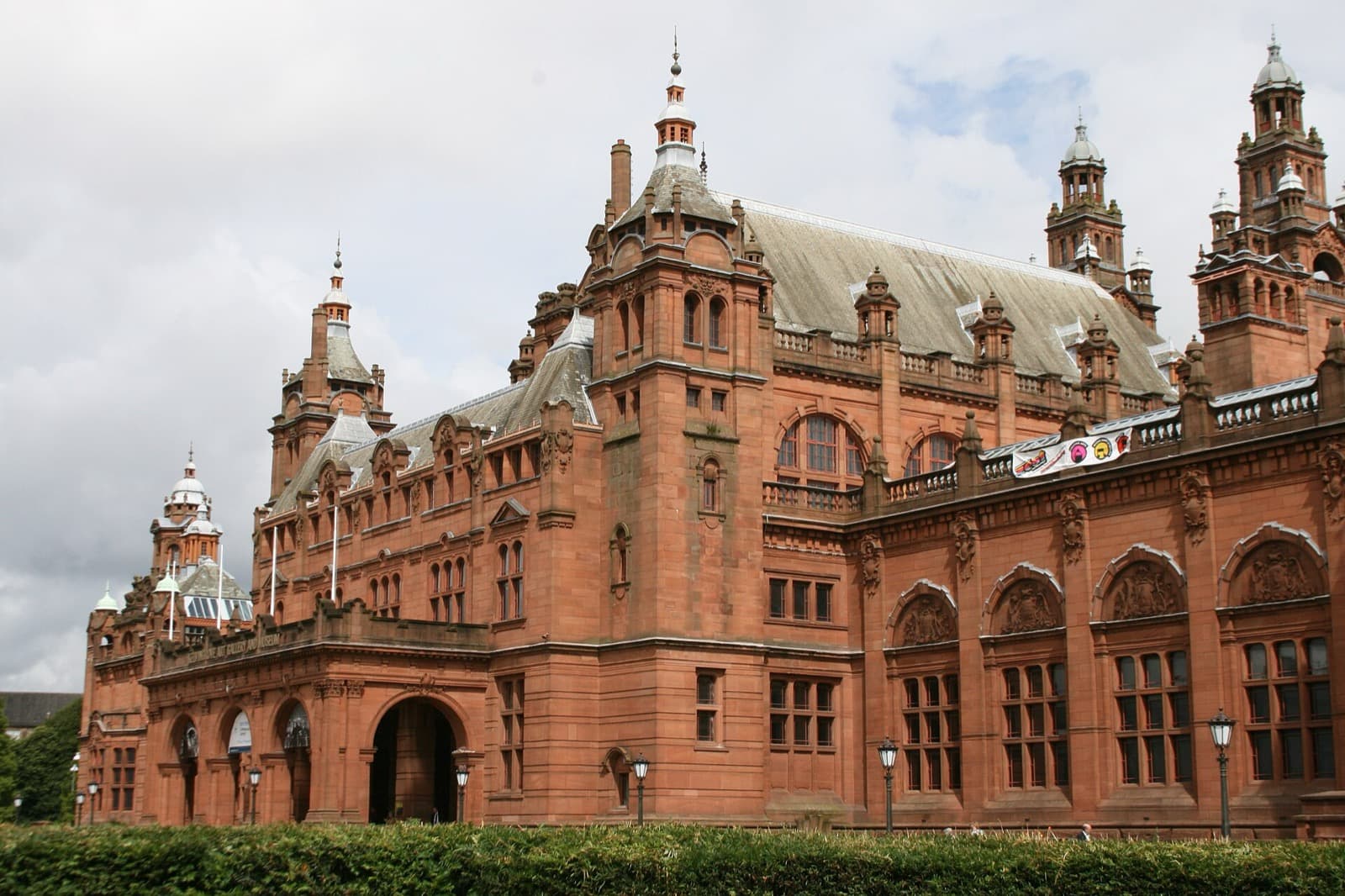
Kelvingrove Art Gallery and Museum is the red sandstone palace of art that Victorian Glasgow built to share its fortune with everyone, free and forever. Stand in front of it in the West End of Glasgow, Scotland, and that single idea is the thing to hold onto: a confident, money-making city chose to spend part of its wealth on beauty and then hand it to the public at no charge. The building has never carried an entry fee, and it still does not. That civic gift, more than any one painting inside, is what you are looking at.
A palace built for an exhibition
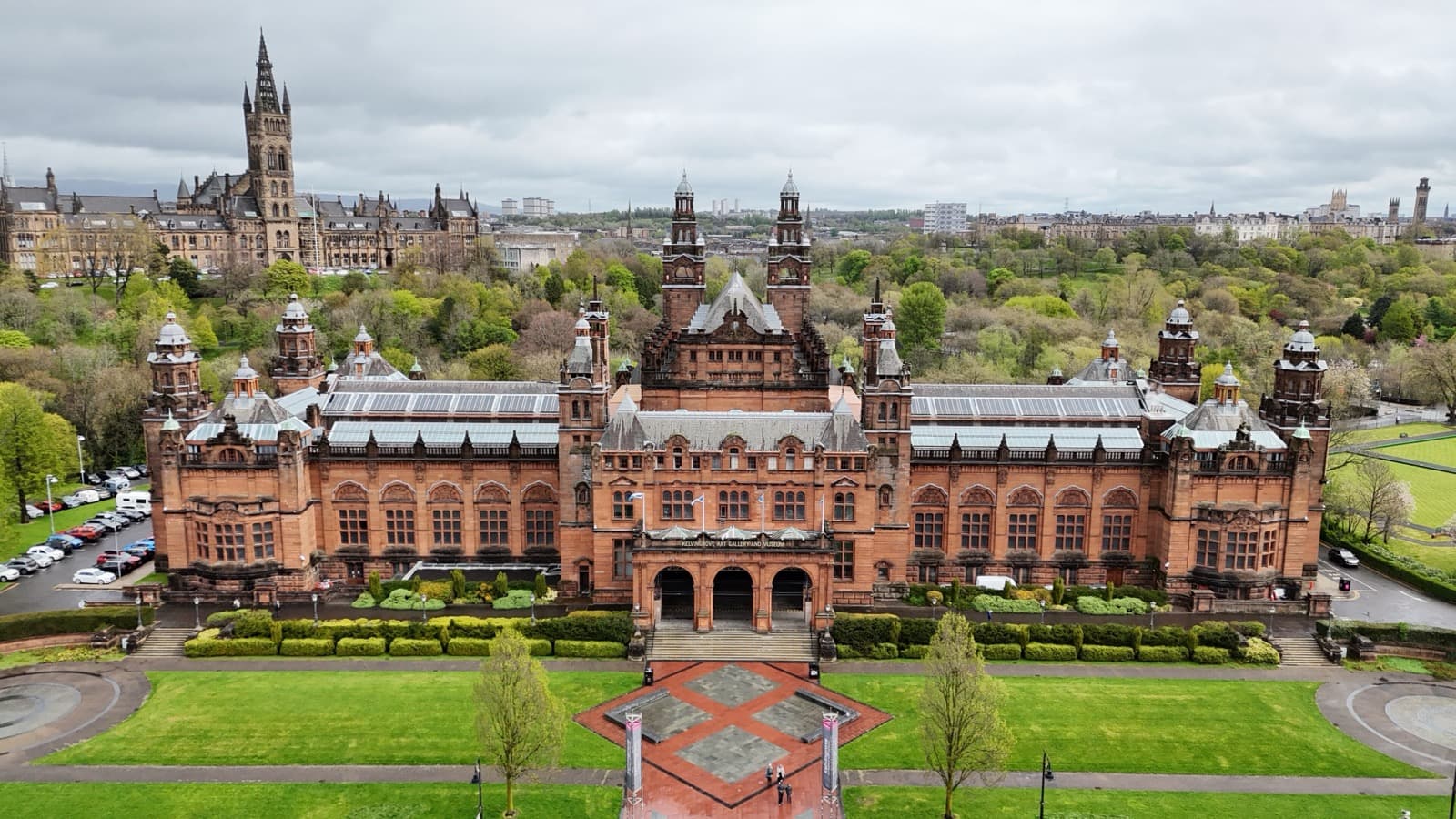
Kelvingrove opened in 1901, designed by John Simpson and E. J. Milner Allen in a warm Spanish Baroque style. Its outer walls are cut from Locharbriggs red sandstone, the stone that glows almost pink on a bright Glasgow day and turns a deep rust in the rain. The building was conceived as the Palace of Fine Arts for the Glasgow International Exhibition of 1901, one of a series of great fairs the city staged in the surrounding park.
There is a nice piece of civic arithmetic in how it was paid for. Its construction was financed partly by the profits of an earlier exhibition, held on this same stretch of Kelvingrove Park in 1888, an event that drew close to six million visitors. In other words, one great public gathering funded the permanent home for the art of the next. Money that a lesser city might have pocketed was turned into a building meant to outlast everyone who paid for it. In 2026 the building marks its one hundred and twenty-fifth anniversary.
The one thing to understand: it faces the park on purpose
Hear a stop from this walk
Kelvingrove Art Gallery and Museum: The City's Treasure House
If you take away a single fact standing here, make it this one, because it corrects the story most visitors are told. You will almost certainly hear that Kelvingrove was built back to front, that the grand entrance ended up facing the park by mistake, and that the architect, on realising his blunder, threw himself from one of the towers in despair.
It is a wonderful story. It is also entirely false, and the museum itself has publicly debunked it. The grand entrance was always intended to face into Kelvingrove Park, not out toward the road. There is a plain logic to it once you know: the park was the setting, the green stage the palace was designed to preside over. So when you walk up and the building seems to have its back to the street, that is not an error to smirk at. It is the whole point. The palace was oriented toward leisure, toward the wooded valley and the crowds strolling in it, rather than toward commerce and traffic. Read the building that way and it stops looking confused and starts looking generous.
What refuses to sit still inside
The collections inside are famous for their sheer, cheerful refusal to stay in one lane. Kelvingrove holds fine art, natural history, arms and armour, and Egyptian antiquities under one roof, and it does not apologise for the mix. The signature object is Salvador Dali's painting Christ of Saint John of the Cross, a work that draws a steady stream of visitors to one quiet room. A short walk away, a genuine Spitfire fighter aircraft hangs above the galleries, suspended over the natural-history displays as though caught mid-climb.
Then there is the sound. A great pipe organ, the 1901 Lewis and Company instrument, fills the central hall during free daily recitals. If you can time your visit around one, do. Hearing the organ move through that vaulted hall, with the light coming down and the collections spread around you, is the closest thing the museum has to a signature experience, and it costs nothing.
After a major refurbishment, Kelvingrove reopened in 2006 and became the most popular free-to-enter museum in Scotland, and one of the most visited free museums in Britain. That popularity is worth pausing on. This is not a hushed, ticketed treasure house that a city keeps at arm's length. It is a place Glaswegians treat as their own attic, somewhere you might duck into on a rainy afternoon with no plan at all, because it is warm, it is free, and it is theirs.
How to stand in front of it
The practical advice here is simple: give yourself permission to move at your own speed. Kelvingrove is heavily group-toured, and the coach circuits move through in a set loop, glancing at the Dali, glancing at the Spitfire, back on the bus. Nothing about the building requires you to do the same. You can double back to a single painting, sit under the organ for a whole recital, or wander into the arms-and-armour hall on a whim. The palace was built for unhurried public pleasure, and the best way to honour that is to be unhurried in it.
Begin with the exterior, the way the city itself does. Note the Spanish Baroque flourishes, the towers, the way the red sandstone catches the weather. Then remember that the entrance faces the park by design, and let that reframe everything: a Victorian city at the height of its industrial power, choosing to point its finest building toward green space and leisure rather than toward money.
Walk the West End it anchors
Kelvingrove is the opening stop, and the reason to come, on a self-guided walking route through Glasgow's West End that reads the whole confident nineteenth-century district in one leisurely loop. From the palace of art the walk continues into wooded Kelvingrove Park and its fountain to clean water, up to the Gothic tower of the University of Glasgow, through Scotland's oldest public museum and the cobbled student lanes off Byres Road, and out to a great domed glasshouse of ferns and marble. Every stop on that spine is free to enter, so you can dip in and out with no clock and no ticket.
If you want the full context around this landmark, browse the other Glasgow walking tours or start from the Glasgow city page and set out for the West End at your own pace. The palace was built to be wandered. So wander it.
Sources
- Kelvingrove Art Gallery and Museum, Wikipedia. Encyclopedia overview of the building's 1901 opening, architects, Locharbriggs sandstone, collections, the 1901 Lewis and Company organ, and 2006 reopening.
- Glasgow Life: Kelvingrove Art Gallery and Museum. The official museum operator's page, including the free-entry policy and the debunking of the back-to-front legend.
- International Exhibition (1888), Wikipedia. Details of the 1888 fair in Kelvingrove Park, its visitor figures, and the profit that went toward building the Palace of Fine Arts.
- Roamer tour transcript, West End: Kelvingrove and the University (fact-audited). Verified narration for the anchor stop, including the 1888 exhibition financing and the free-entry civic gift.
Ready to experience it?
West End: Kelvingrove & the University
120 min · 3.5 km · moderate
More from Glasgow
Explore more at your own pace.
Glasgow Travel Guide: How Many Days, Getting Around, and When to Visit
One Day in Glasgow: A Walkable Morning-to-Evening Itinerary
Glasgow: Beauty Built on Complicated Money
Glassford Street and the Map That Confesses: Glasgow's Merchant City
The Gothic Tower on Gilmorehill: Reading Glasgow's West End from the University Cloisters