Climb Gilmorehill in Glasgow's West End and you reach a Gothic tower rising above the trees, the main building of the University of Glasgow, founded in 1451 and now reckoning openly with money that came from Atlantic slavery. This one hill is where a smoky, money-making city went to study and to think, and it is the clearest way into a self-guided walk that reads Victorian Glasgow at study and at leisure: art, fresh water, green space, and learning, all free to wander at your own pace.
An institution older than Columbus's voyage
The university was founded in 1451 by a papal bull of Pope Nicholas the Fifth, at the request of King James the Second of Scotland. That date is worth sitting with. It is the fourth-oldest university in the English-speaking world, and it predates Columbus's crossing of the Atlantic by more than forty years. The teaching started long before the building you see today. What crowns Gilmorehill now is a nineteenth-century statement: the university moved up here in 1870, and its soaring main range, designed by Sir George Gilbert Scott, opened that year in full Gothic Revival splendour. The tower's spire came later, completed between 1887 and 1891 to the design of Scott's son, John Oldrid Scott, climbing to roughly eighty-five metres and visible for miles across the city.
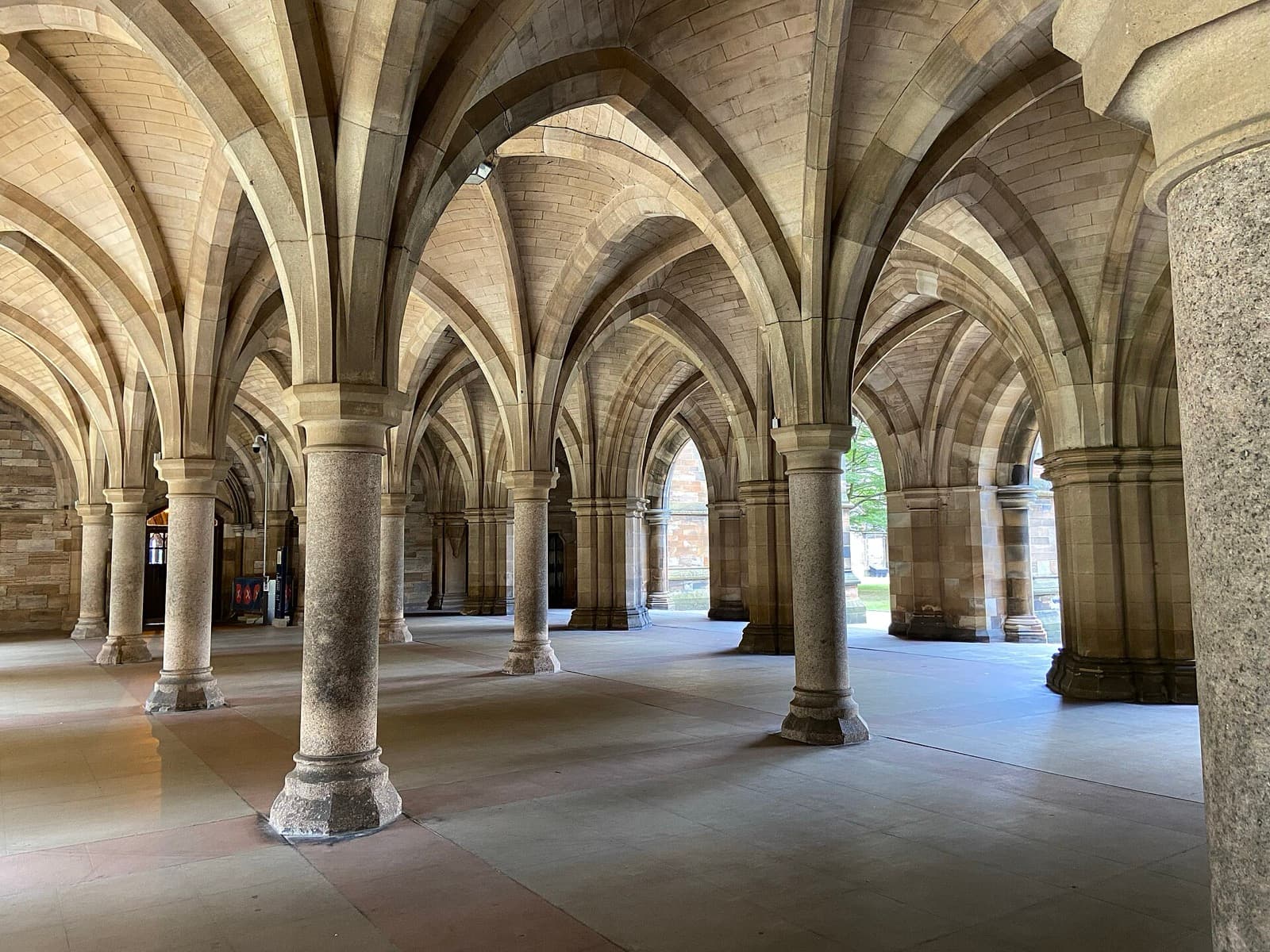
Between the building's two quadrangles runs a vaulted undercroft called the Cloisters, and it is among the loveliest spaces in Glasgow. Group tours pass through it in a set loop. You do not have to. Stand in the stone hush as long as it holds you, watch the light angle through the vaulting, and you understand the whole argument of the West End in a single room: a working city choosing to spend its fortune on beauty and learning, then leaving the grounds and the Cloisters free for anyone to walk in.
The names, and the reckoning
Hear a stop from this walk
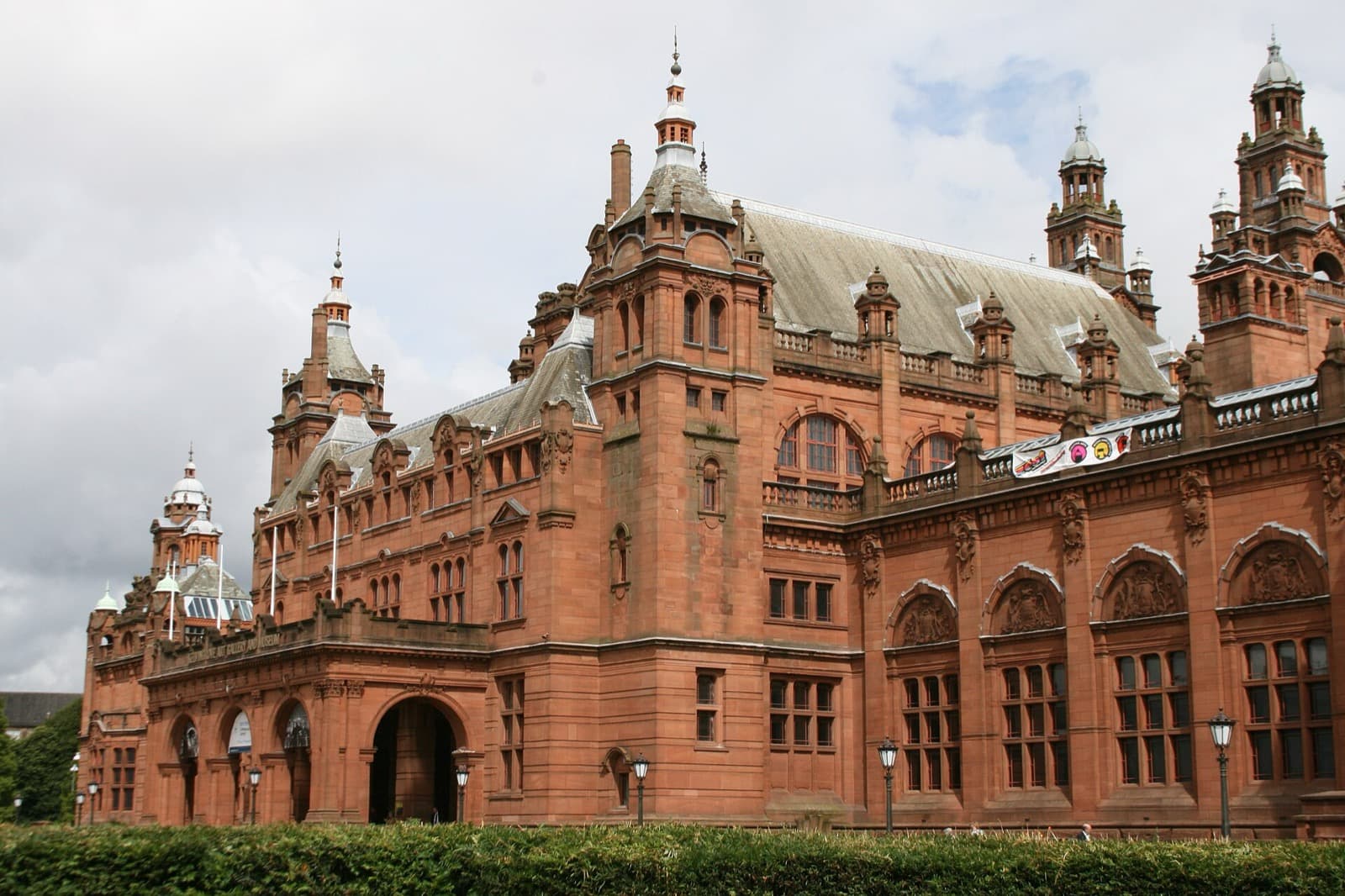
Kelvingrove Art Gallery and Museum: The City's Treasure House
The people who studied and taught here shaped the modern world. Adam Smith, the economist, was here. So was William Thomson, better known as Lord Kelvin, the physicist who took his title from the very river that runs through the park below the hill. That small fact ties the walk together: the Kelvin threads down through the parkland you crossed to reach this point, and it lent its name to a man who helped invent modern physics.
The honesty this walk insists on lives here too. The West End's Victorian confidence rested partly on an imperial economy that included the profits of enslaved labour. By the university's own account, published in its slavery report in 2018, it became the first British university to acknowledge historic money of that kind and to commit to a programme of reparative justice. The beauty and the reckoning stand together, and both are true. This is not a footnote to skip past. It is part of why the hill matters, and why walking it slowly, on your own schedule, lets you hold both at once rather than being marched past one to reach the other.
Why the university opens the rest of the walk
Inside that same Gothic building is a quieter marvel, the Hunterian, which opened in 1807 and is Scotland's oldest public museum. It grew from the cabinet of one man, the anatomist and physician William Hunter, who left his collections to the university on his death in 1783. What began as a single physician's curiosity now runs from Roman Scotland and the Antonine Wall through geology and coins to a Whistler collection and the reconstructed interiors of Charles Rennie Mackintosh's Glasgow home. It is exactly the kind of place a solo wanderer loves: follow whatever thread catches you, a Roman altar or a case of coins, with no one hurrying you along.
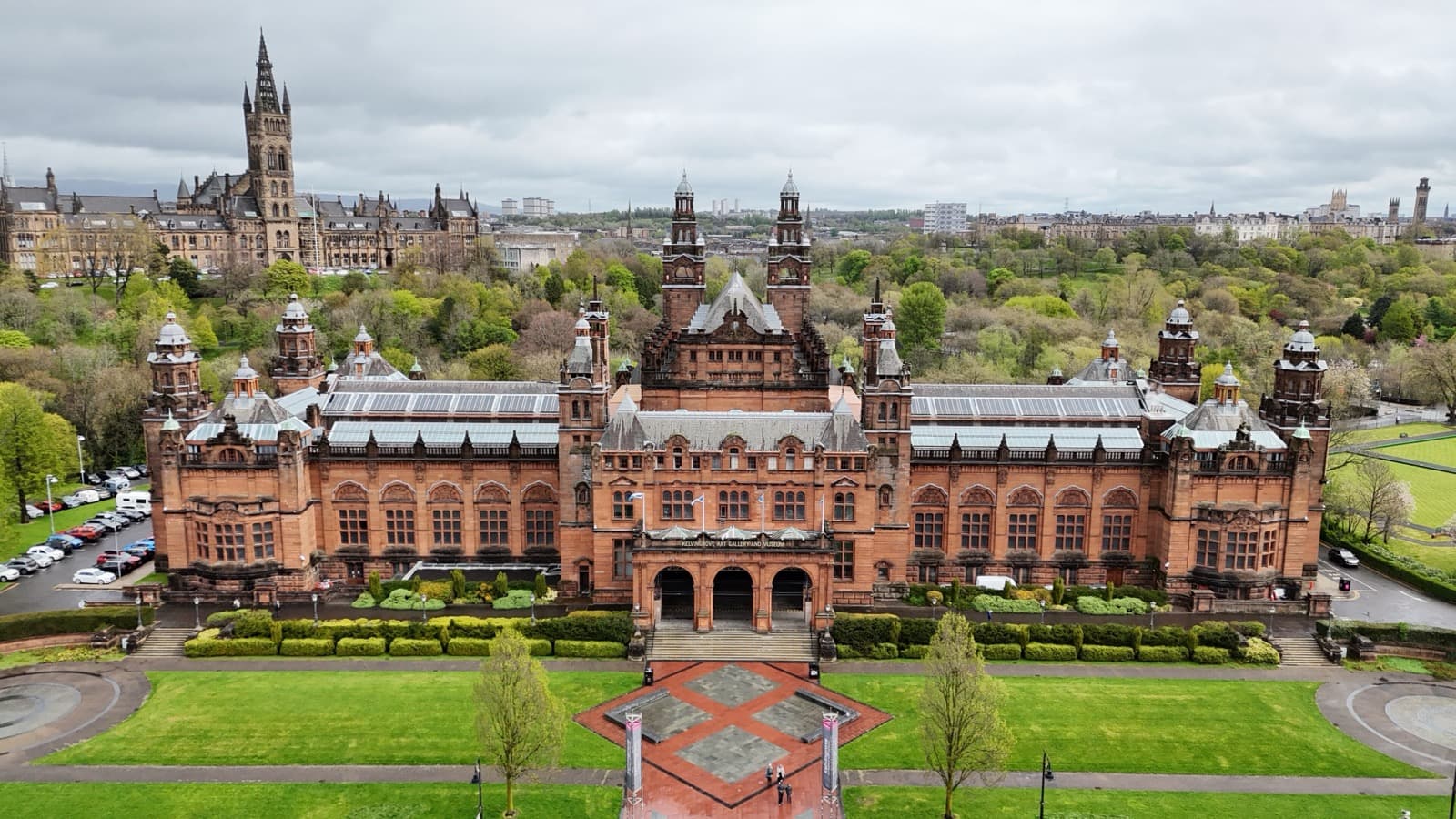
Stand on the hill and you can see how the rest of the route radiates outward. Below sits Kelvingrove Art Gallery and Museum, the red sandstone palace of art that opened in 1901 and that a whole city treats as its attic and its treasure house, free after its 2006 reopening and one of the most visited free museums in Britain. Around it spreads Kelvingrove Park, established in 1852, with the Stewart Memorial Fountain of 1872 at its centre, a monument not to a general or a king but to the Lord Provost who brought fresh water to Glasgow from Loch Katrine. That is the quiet Victorian revolution the walk keeps returning to: clean water, which saved more lives than any battle.
Come down off Gilmorehill and the present takes over. Byres Road is the lively artery of the district, and off it runs Ashton Lane, a cobbled back lane strung with festoon lights, its little Grosvenor cinema open since May 1921. Keep north and you reach the Glasgow Botanic Gardens, on this site since 1842, and the Kibble Palace, a domed glasshouse of curved cast iron and glass that began life as one man's private conservatory on Loch Long before being re-erected here in 1873. Under its dome, tree ferns that have grown for around a hundred and twenty years arch over marble statues in the humid, hushed air. It is the calmest room on the route. The walk ends on Great Western Road, the boulevard driven out into open countryside from the 1840s and lined with pale grand terraces, among them Great Western Terrace by Alexander Thomson, the architect nicknamed Greek Thomson for his love of ancient classicism.
Walking it your way
The full route runs about three and a half kilometres across seven stops, roughly two hours if you keep moving and far longer if you let yourself linger, which is rather the point. The going is level to gently rolling, with the one honest climb up to the university. Every anchor on the spine is free: the art gallery, the university grounds and Cloisters, the Hunterian, and the Botanic Gardens all cost nothing, so you can dip in and out without watching a ticket or a coach timetable. The Gilbert Scott Building is the emotional centre of it, the moment the whole afternoon comes into focus. For the full route and the other West End tours, see Glasgow walking tours, and for the wider city start from Glasgow.
Sources
- University of Glasgow, "A Brief History" (gla.ac.uk): founding date, papal bull, and the move to Gilmorehill.
- University of Glasgow, "Slavery, Abolition and the University of Glasgow" report announcement, 2018: the reparative-justice commitment.
- The Hunterian (gla.ac.uk) and Wikipedia, "Hunterian Museum, Glasgow": founding on William Hunter's collection and its 1807 opening.
- Kelvingrove Art Gallery and Museum, Glasgow Life (glasgowlife.org.uk): the 1901 palace of art and its free-entry civic collection.
- Glasgow Botanic Gardens and Canmore/Historic Environment Scotland on the Kibble Palace: the 1873 re-erection and the glasshouse's history.
Ready to experience it?
West End: Kelvingrove & the University
120 min · 3.5 km · moderate
More from Glasgow
Explore more at your own pace.
Glasgow Travel Guide: How Many Days, Getting Around, and When to Visit
One Day in Glasgow: A Walkable Morning-to-Evening Itinerary
Glasgow: Beauty Built on Complicated Money
Glassford Street and the Map That Confesses: Glasgow's Merchant City
Glasgow Cathedral: The Medieval Survivor Built Over a Saint's Grave