The Santa Croce quarter is a place that keeps what it lost. Around Santa Croce almost everything was pulled down, moved or rebuilt, and then kept on purpose: a fish market's loggia standing in the wrong square, a church porch with no church behind it, a medieval house rebuilt in 1911, a Roman arena that survives only as the bend of a street, and two flood lines on one corner house. Walk the quarter with that idea in your pocket and every stop becomes a small test. What was taken away here, and what was saved?
Roamer's walk runs ten stops over about 1.8 kilometers and takes about seventy-five minutes. It is flat, and every stop works from the street, so you can do it on your own schedule, linger where something catches you, and skip what does not.
Garden land at the edge of the old city
The walk starts at the Synagogue of Florence, finished in 1882 under a copper dome that has weathered green. The date is the story. In 1570 a Medici duke shut Florence's Jews into a ghetto where Piazza della Repubblica is now; in 1861 the Jews of Tuscany became full citizens, and the community chose garden land inside the old walls for its new temple. A few streets on, the Sant'Ambrogio market went up on another big vegetable garden in 1873, about a year before the central market at San Lorenzo. Two buildings on empty ground: a city filling in its own edges.
Three things that were moved or emptied
Hear a stop from this walk
Basilica of Santa Croce: The Marble Front
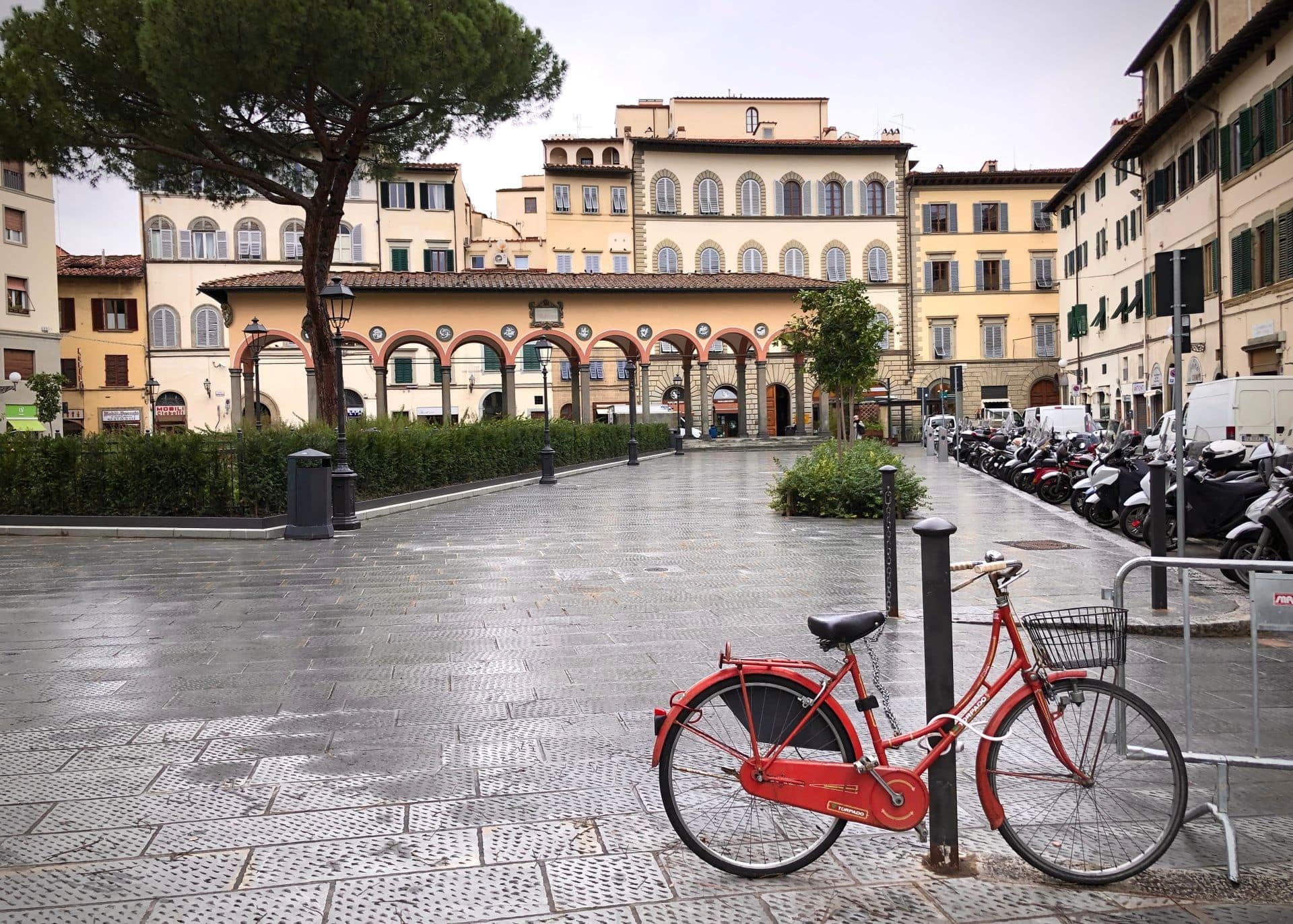
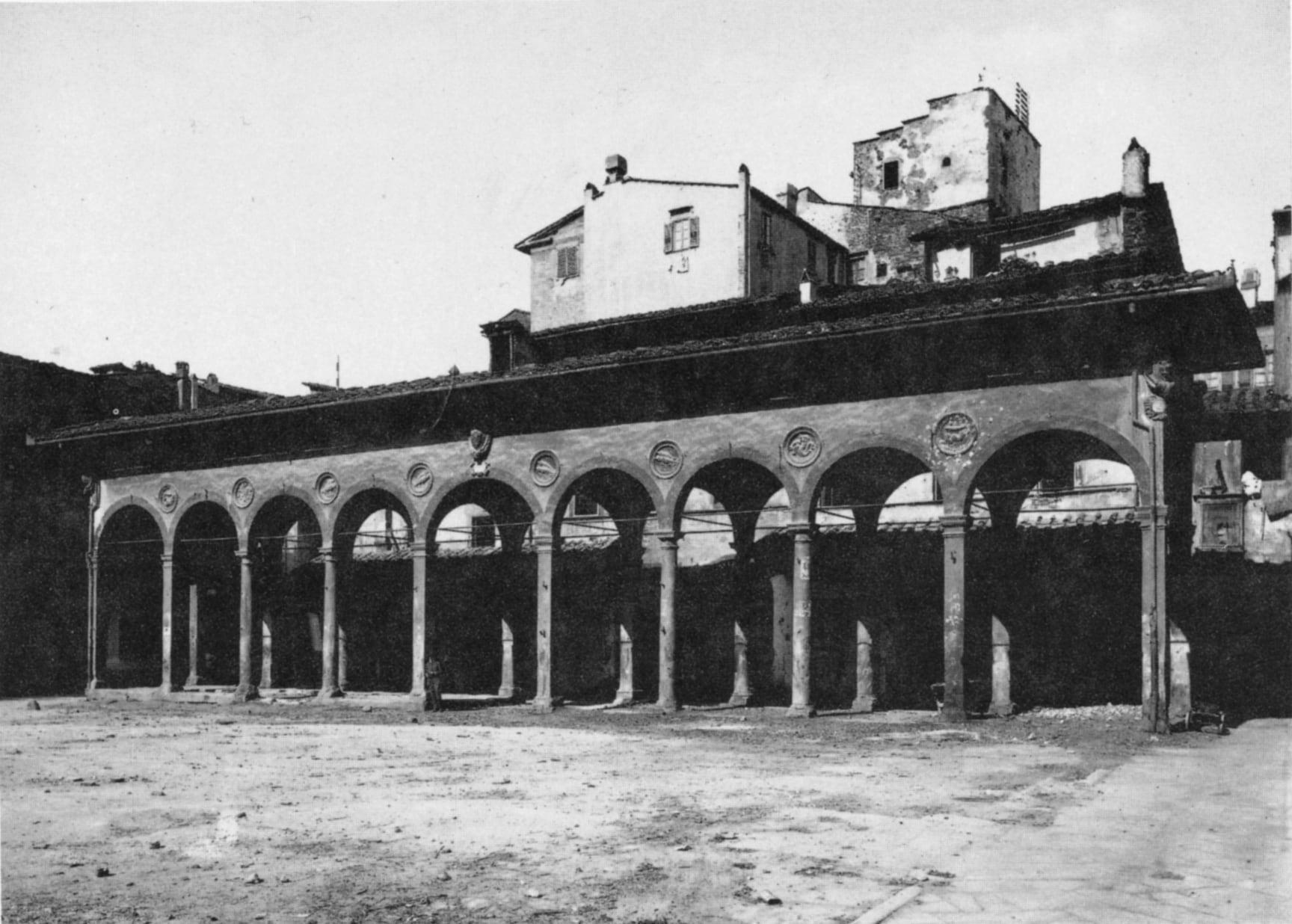
The middle of the walk is where the quarter's habit shows most clearly. In Piazza dei Ciompi stands the Loggia del Pesce, which Giorgio Vasari built in 1568 and 1569 for the fish sellers of the old market square. When the city cleared that market at the end of the 1800s, the loggia came down with it. Pieces were stored, and in 1955 the city put it up again here. The coats of arms on it are original; the fish in the roundels are modern copies. The loggia has its own story, and it is worth reading before you stand in front of it.
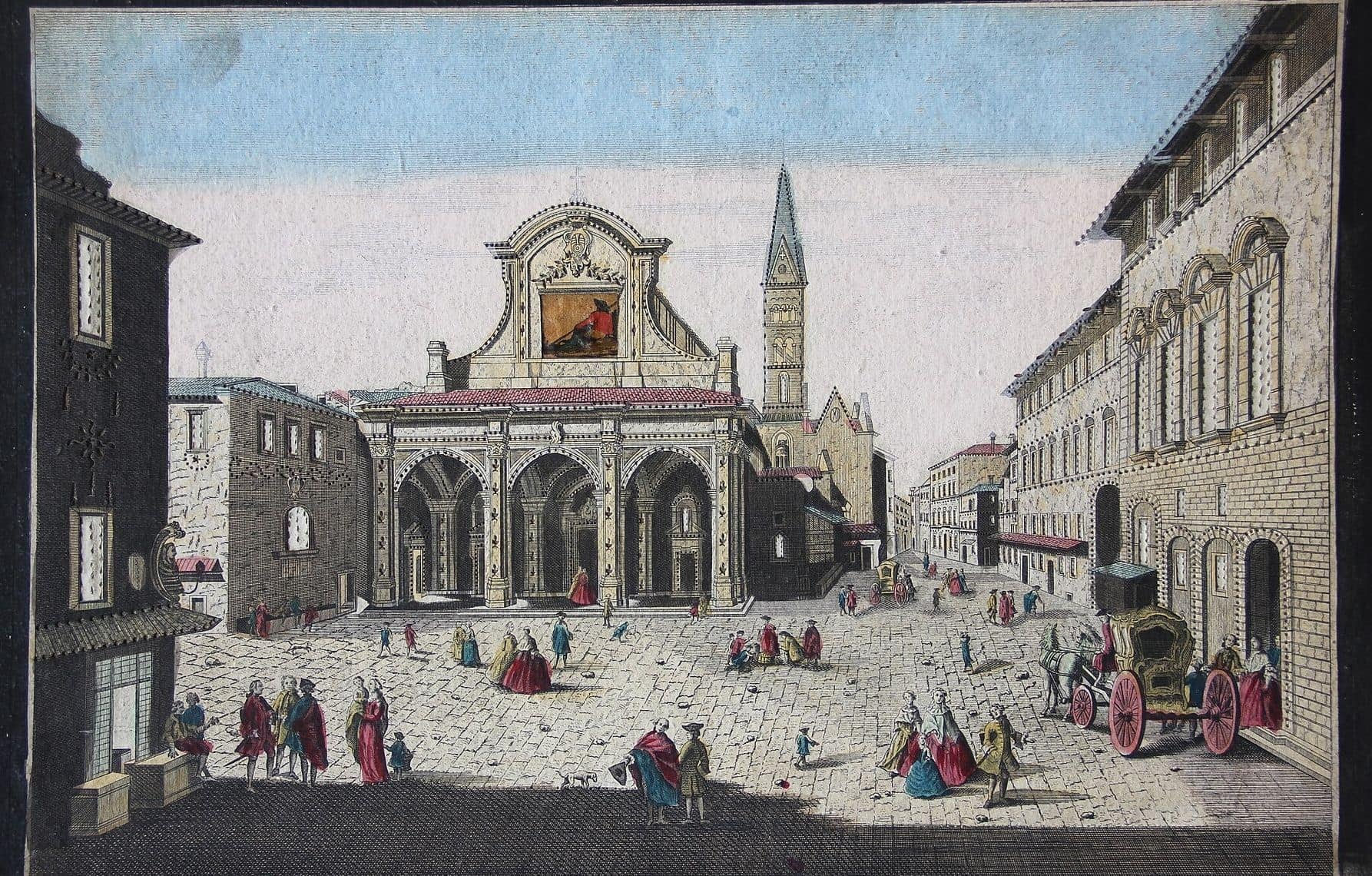
A few minutes away, in Piazza San Pier Maggiore, three stone arches carry houses on their backs. They were the porch of a church consecrated in 1067 and pulled down in 1783 because people thought it would fall. The porch stayed, and the street through its middle arch runs where the nave used to be. That front door with no church is the most literal picture of the walk's idea.
Then Dante's lanes. The Alighieri did hold property around the Torre della Castagna, where the priors of the guilds met in 1282. But the bronze-bust house called the Casa di Dante is a rebuilding of 1911, made the way people then imagined a medieval house, and Florence's scholarly record of its buildings calls the result decidedly arbitrary. Kept on purpose, again, even when what was kept was partly invented.
What you can read in the shape of things
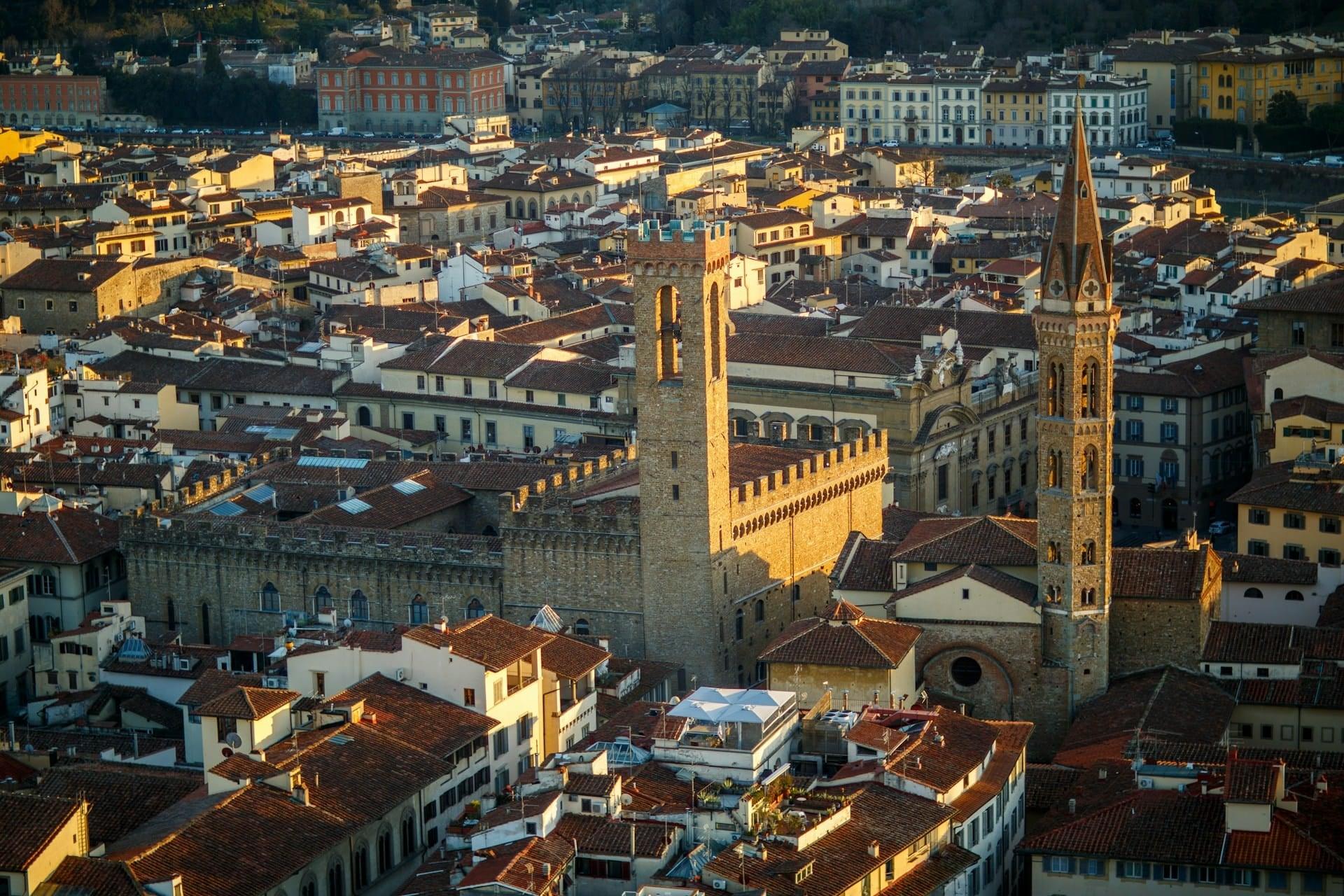
Some of what this quarter kept is not a building at all. On Borgo degli Albizi, the senator Baccio Valori lined his house front with fifteen stone herms of famous Florentines, finished in 1604, and the neighborhood answered by calling it the Palazzo dei Visacci, the palace of the ugly mugs. In Piazza San Firenze the walk looks back at two towers, the battlemented Bargello and the needle-thin bell tower of the Badia, whose bells readers have long heard in a passage of Dante's Paradiso.
Piazza dei Peruzzi is the quietest surprise. Its house fronts bend in one smooth curve because they stand on the rim of a second-century Roman amphitheater, which the city's own figures put at about 113 by 90 meters. Families built on its walls and seating, and the streets followed the ring. Via Torta, the twisted street, still follows it; a plan of around 1865 to straighten it was never carried out.
Water lines and a square that was a field
At the mouth of Via Torta, a corner house carries two marble plaques. The long one marks the Arno on 13 September 1557, more than three and a half meters up. The small one, higher still, marks 4 November 1966. Beyond it opens Piazza Santa Croce, once land outside the walls that became the city's arena for jousts and for calcio, the old costumed ball game, still played here every June with its final on the feast of Saint John. A marble disc dated 1565 on the painted front of Palazzo dell'Antella marks the halfway line.
The walk ends at the basilica's marble front, which came more than five centuries after the church was begun in the 1290s and was unveiled in 1863. Beside it stands Dante, paid for by a national subscription and unveiled in the middle of the square in 1865. The 1966 flood damaged him, and in 1971 he was set at the corner of the steps, against protests, so the square could be a playing field again. Even the poet was moved and kept.
That is the pleasure of this walk: once you see the pattern, you cannot stop seeing it. The quarter is not a museum of untouched things. It is a record of choices about what to save.
The walk is Santa Croce and the Bargello: Dante and the Flood Line, ten stops from the synagogue on Via Farini to the basilica's front. See all routes on the Florence page.
Sources
- Repertorio delle Architetture Civili di Firenze, Loggia del Pesce (ID 173): Vasari's loggia of 1568 to 1569 in the Mercato Vecchio, the 1699 extension, the parts saved in 1899, the 1955 rebuilding, original shields and modern fish.
- Repertorio delle Architetture Civili di Firenze, Piazza di San Pier Maggiore (ID 2548): the church consecrated in 1067, remodelled in 1638, demolished in 1783, the surviving portico and the street on the line of the nave.
- Comunità Ebraica di Firenze, the synagogue: the temple finished in 1882, its style and materials.
- Feel Florence (Comune di Firenze tourism), Loggia del Pesce: Vasari's commission from Cosimo the First and the fishmongers displaced by the Vasari Corridor.
- Opera di Santa Croce, history of the basilica: the church and its nineteenth-century front, and the 1966 flood.
Ready to experience it?
Santa Croce and the Bargello: Dante and the Flood Line
75 min · 1.8 km · easy
More from Florence
Explore more at your own pace.
Best Architecture Walking Tours in Florence (2026)
Piazzale Michelangelo Walking Tour: The Capital's Terrace and San Miniato
Loggia del Pesce: Vasari's Fish Market in the Wrong Florence Square
Palazzo Rucellai: How Alberti Dressed a Florentine House as a Roman Temple
Ponte Santa Trinita: How Florence Rebuilt Its Bridge As It Was, Where It Was