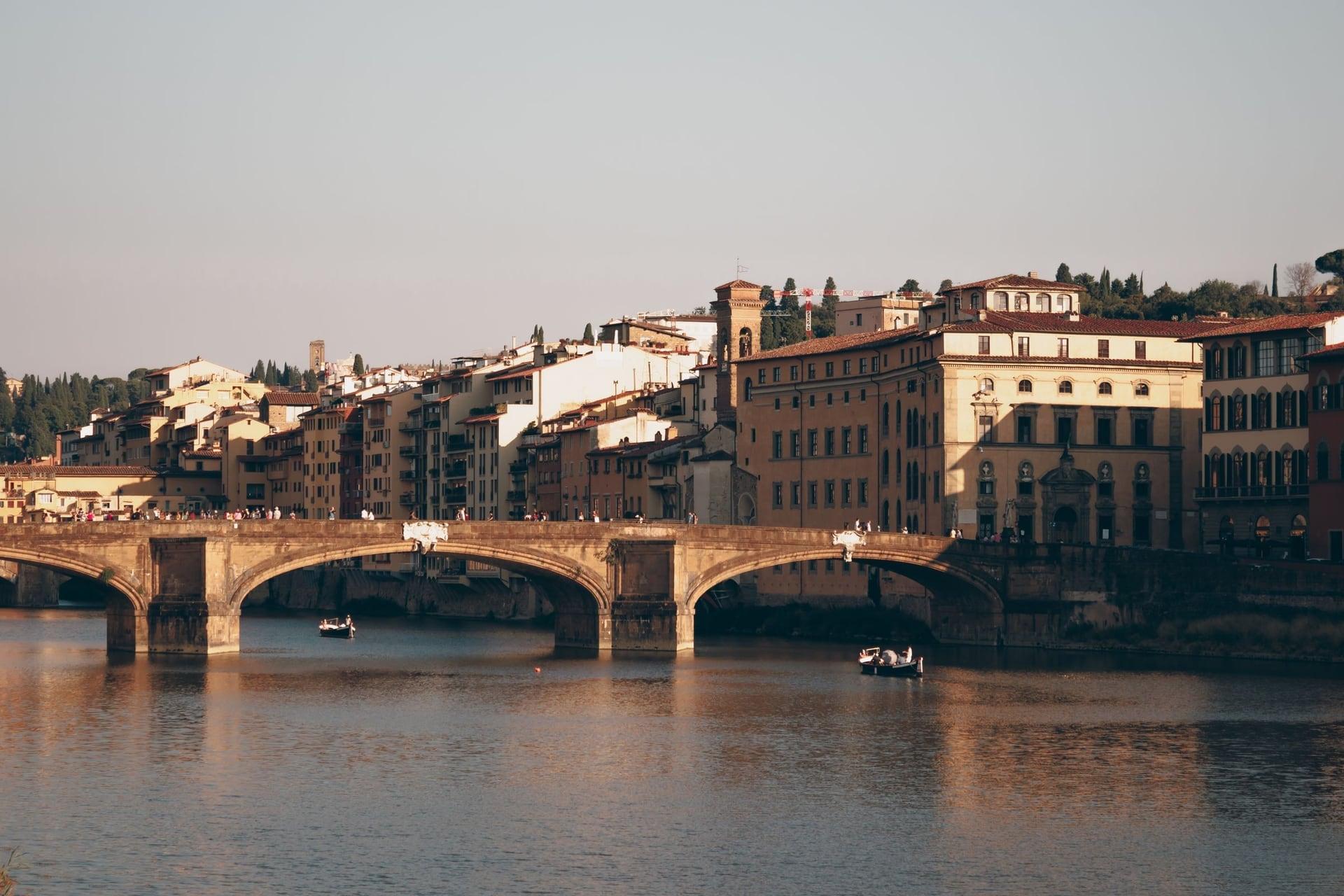
The Ponte Santa Trinita you stand on is a 1958 reconstruction, and Florence fought for eleven years to have it rebuilt as it was, where it was. The city wanted stone rather than concrete, Ammannati's curve recovered exactly, and the same brown stone from the same quarry. It got all three. What it did not do, despite a story you will hear on the parapet, is fish the old bridge out of the Arno piece by piece. The truth is more interesting, and it involves a chain hung on a wall.
Ammannati's bridge
There has been a bridge here since the thirteenth century. The one Florence remembers was built after the flood of 1557, when Cosimo the First gave the rebuilding to Bartolomeo Ammannati, who may have drawn on an idea of Michelangelo's. Ammannati built it between 1567 and 1571 in pietra forte, the warm brown stone of the city, on three long, low arches. At its ends stand statues of the four Seasons by Giovanni Caccini, Pietro Francavilla and Taddeo Landini.
The arches are the masterpiece: long and low, a shape that later proved hard to recover, as you will see. You cannot see them from the roadway. Look back from either riverbank.
One night in 1944
Hear a stop from this walk
Ponte Santa Trinita: As It Was, Where It Was
On the night of 3 to 4 August 1944, the retreating German army blew up every bridge in Florence except the Ponte Vecchio. The Ponte Santa Trinita went with the rest.
The response began almost at once. According to the architectural historian Gianluca Belli of the University of Florence, writing for the Ministry of Culture's catalogue, the Allies laid a temporary Bailey bridge across the ruined piers, and by the end of August 1944 the Tuscan Committee of National Liberation had put the architect Riccardo Gizdulich in charge of recovering the fragments, work that took technicians and volunteers more than a year.
Eleven years of argument
Belli is blunt about what came next: eleven years of studies, designs, discussions and polemics before the building site could open. The need to rebuild the bridge in its original form was supported almost unanimously from the start. The fight was over how.
The Ministry of Public Works in Rome wanted the new bridge built with an inner structure of reinforced concrete. Many in Florence, Belli writes, rejected that outright, among them the art historian Carlo Ludovico Ragghianti, who argued that the character of a work of art lies also in its technique, which cannot be separated from its form. A committee formed to raise the money the ministry would not cover, with gifts that included fifty thousand dollars from the Kress Foundation. When the ministry held out, the committee threatened to withdraw its funds. Florence won. In June 1952 the city gave the design to Gizdulich, for the form, and the engineer Emilio Brizzi, for the structure.
A chain on the wall
Then came the technical puzzle: how do you rebuild a curve that no longer exists? Gizdulich worked out the exact form and size of the lost bridge's parts by photogrammetry, measuring from a series of historic photographs. For the arches he did something wonderfully simple. Rather than hunting for a mathematical curve that matched Ammannati's, he used one that is easy to make full size: the catenary, the curve a chain makes when it hangs from two points. By hanging a small metal chain and adjusting it through many trials, he obtained curves that lay almost exactly over the half-arches in the old photographs.
Work began on 2 May 1955. The four Seasons went back on the bridge in January 1958, and the Ponte Santa Trinita opened on 16 March 1958.
Not fished from the river
Now the story you will hear on the parapet. People often say the bridge was rebuilt from its own stones raised out of the Arno. Belli calls that idea false: the original stones reused were negligible in number. To face the new bridge, the builders had to reopen the pietra forte quarry inside the Boboli Gardens that had been used in the sixteenth century. So the bridge is new stone, cut from the place Ammannati's own stone came from.
One piece did come out of the river, three years late. When the statues returned, Spring was missing her head. It was found in the bed of the Arno in 1961.
Where it sits on the walk
The bridge closes Roamer's Santa Maria Novella walk, which earlier passes the Ponte alla Carraia, rebuilt after the war in a contest where Rome overruled the city. Here the city got its way. Stop at the parapet near the middle, look upstream to the Ponte Vecchio, then walk off the end and look back at the arches from the bank.
The bridge is stop 10 of Santa Maria Novella: Merchant Palaces and the Arno, which you can walk at your own pace from the station; the Oltrarno walk begins at its far end. See all routes on the Florence page.
Sources
- Gianluca Belli, "Marzo 1958: la ricostruzione del ponte a Santa Trinita" (Ministry of Culture catalogue): Ammannati, 1567 to 1571, the possible idea of Michelangelo; the mining of 3 to 4 August 1944; the Bailey bridge and Gizdulich's recovery of fragments; eleven years of argument; Ragghianti's words; the Kress Foundation gift; Gizdulich and Brizzi, photogrammetry and the catenary traced with a hanging chain; works from 2 May 1955; the Seasons back in January 1958; opening on 16 March 1958; the Boboli quarry and the negligible reuse of old stones; Spring's head found in 1961.
- Destination Florence (Comune di Firenze tourism), Ponte Santa Trinita: the first bridge here, the sculptors of the Seasons, the rebuilding as it was, where it was.
Ready to experience it?
Santa Maria Novella: Merchant Palaces and the Arno
60 min · 1.9 km · easy
More from Florence
Explore more at your own pace.
Best Architecture Walking Tours in Florence (2026)
Piazzale Michelangelo Walking Tour: The Capital's Terrace and San Miniato
Santa Croce Walking Tour: The Florence Quarter That Keeps What It Lost
Loggia del Pesce: Vasari's Fish Market in the Wrong Florence Square
Palazzo Rucellai: How Alberti Dressed a Florentine House as a Roman Temple