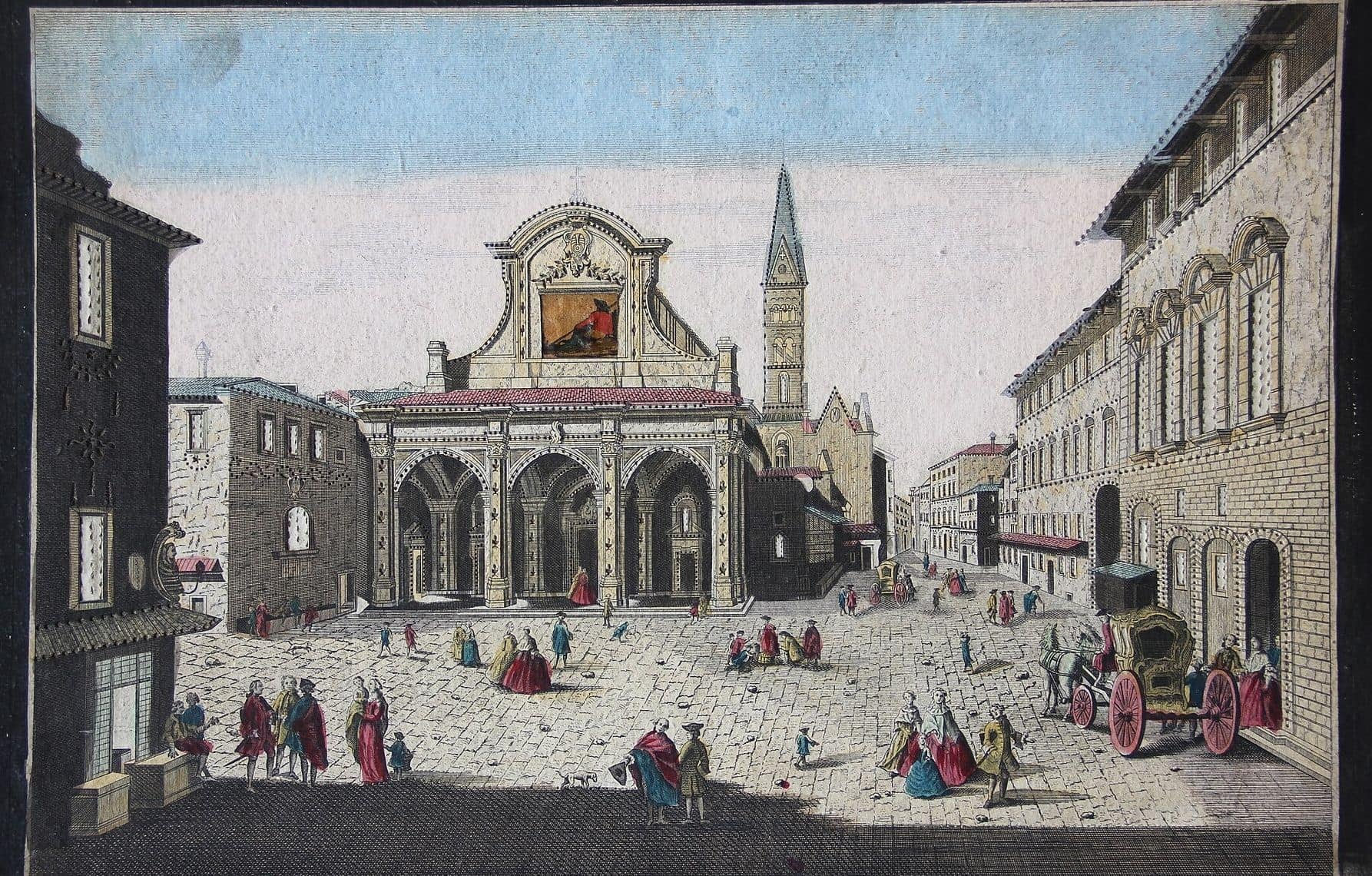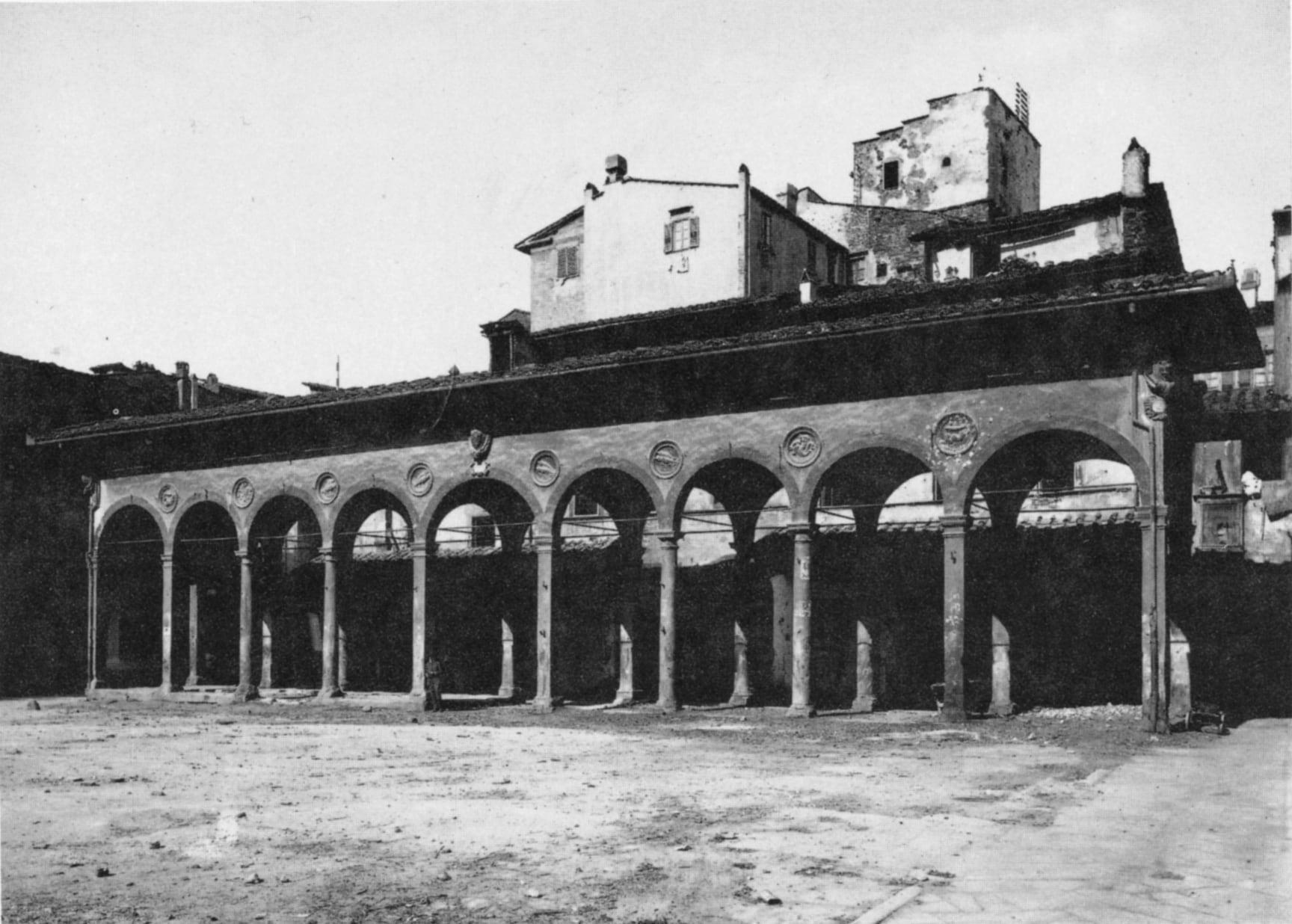
Vasari's Loggia del Pesce stands in the wrong square, and on purpose. Built in 1568 for the fish sellers of the Mercato Vecchio, Florence's old market square, it was taken down with that market at the end of the nineteenth century and rebuilt in Piazza dei Ciompi in 1955. What you see today is a Renaissance building with a modern life story: its shields are old and its fish are new. Once you know that, the long double arcade stops being a pretty backdrop and becomes a puzzle you can solve by looking.
A loggia for displaced fishmongers
The loggia exists because of another building. Giorgio Vasari, painter, architect and the biographer of Florence's artists, designed it in 1567 for the Medici duke Cosimo the First. The fish sellers had worked on the bank of the Arno until the Vasari Corridor, the duke's raised passage along the river, took their place. They needed somewhere new, and the duke gave them a loggia in the market square.
Florence's scholarly record of its buildings, the Repertorio delle Architetture Civili di Firenze, dates the construction precisely: between August 1568 and September 1569, on the west side of the Mercato Vecchio, the area later destroyed to make today's Piazza della Repubblica. A stone on the loggia still carries the date 1568.
In 1699 it grew. Cosimo the Third had it lengthened by one arch at each end, at the expense of the Magistrato della Grascia, the office that oversaw the sale of food in the city. That office left its mark on the building, as you will see.
Demolished, stored, rebuilt
Hear a stop from this walk
Basilica of Santa Croce: The Marble Front
At the end of the 1800s Florence cleared its medieval center. The old market and the ghetto beside it were pulled down to make a modern square. The loggia came down too. According to the Repertorio, during the demolition work of 1899 the best-preserved parts were salvaged with a view to rebuilding, and thanks to the historian Guido Carocci they were deposited at the Museo di San Marco.
They waited more than half a century. In 1955 the Comune's Committee for Civic Aesthetics rebuilt the loggia here, in Piazza dei Ciompi, under the engineer Giulio Cesare Lensi Orlandi Cardini, with money from the Cassa di Risparmio di Firenze. The plan of the day even imagined bringing the Column of Abundance, the market's old column, to this square as well. That part never happened.
The square itself carries a different memory. It is named for the Ciompi, the wool workers whose uprising shook Florence in 1378.
Test it: the shields and the fish
Here is the part you can check with your own eyes. Stand on the side that faces Via Pietrapiana and look for the coats of arms. The Repertorio identifies them: Francesco the First with Giovanna of Austria, Cosimo the First with Eleonora of Toledo, and the emblem of the Grascia, a bushel heaped with grain. These shields are original, remounted in 1955, though completely repainted. The inscription is original too.
Now look at the round panels in the spandrels between the arches, each with a fish. The Repertorio quotes the art historian Maria Sframeli, writing in 1989: of the sixteen original roundels, twelve crumbled during the demolition because they were modelled in lime. The four that were saved went to the Museo di San Marco with the frames, and they have long been missing from the museum. So the fish you see are modern pieces made on the model of the old ones.
The architecture itself is plain and generous: a double row of arches on Tuscan columns, with piers at the ends and the center, covered by a run of small domed vaults. It reads well from the west end, looking back along its length, which is exactly where the walk stops you.
Why it matters on this walk
The Loggia del Pesce is the clearest example of a habit that runs all through the Santa Croce quarter: something is lost, and a piece of it is kept on purpose. A few minutes later the walk reaches a church porch with no church behind it, and later still a Roman arena that survives only as the curve of a street. The loggia is the version you can touch. Its building date is 1568, its address dates from 1955, and both are true.
The loggia is stop 3 of Santa Croce and the Bargello: Dante and the Flood Line, a walk you can take at your own pace from the synagogue to the basilica. See all routes on the Florence page.
Sources
- Repertorio delle Architetture Civili di Firenze, Loggia del Pesce (ID 173): building dates August 1568 to September 1569, the Mercato Vecchio site, the 1699 extension for Cosimo the Third and the Grascia, the 1899 salvage by Guido Carocci, the 1955 rebuilding by the Comitato per l'Estetica Cittadina and Lensi Orlandi Cardini, the Column of Abundance idea, Maria Sframeli on the shields and the lost fish roundels, the architecture.
- Feel Florence (Comune di Firenze tourism), Loggia del Pesce: Vasari's 1567 commission from Cosimo the First for the fishmongers displaced by the Vasari Corridor.
- Comune di Firenze press note on Piazza dei Ciompi: the 1955 rebuilding and the square's name from the Ciompi revolt of 1378.
Ready to experience it?
Santa Croce and the Bargello: Dante and the Flood Line
75 min · 1.8 km · easy
More from Florence
Explore more at your own pace.
Best Architecture Walking Tours in Florence (2026)
Piazzale Michelangelo Walking Tour: The Capital's Terrace and San Miniato
Santa Croce Walking Tour: The Florence Quarter That Keeps What It Lost
Palazzo Rucellai: How Alberti Dressed a Florentine House as a Roman Temple
Ponte Santa Trinita: How Florence Rebuilt Its Bridge As It Was, Where It Was