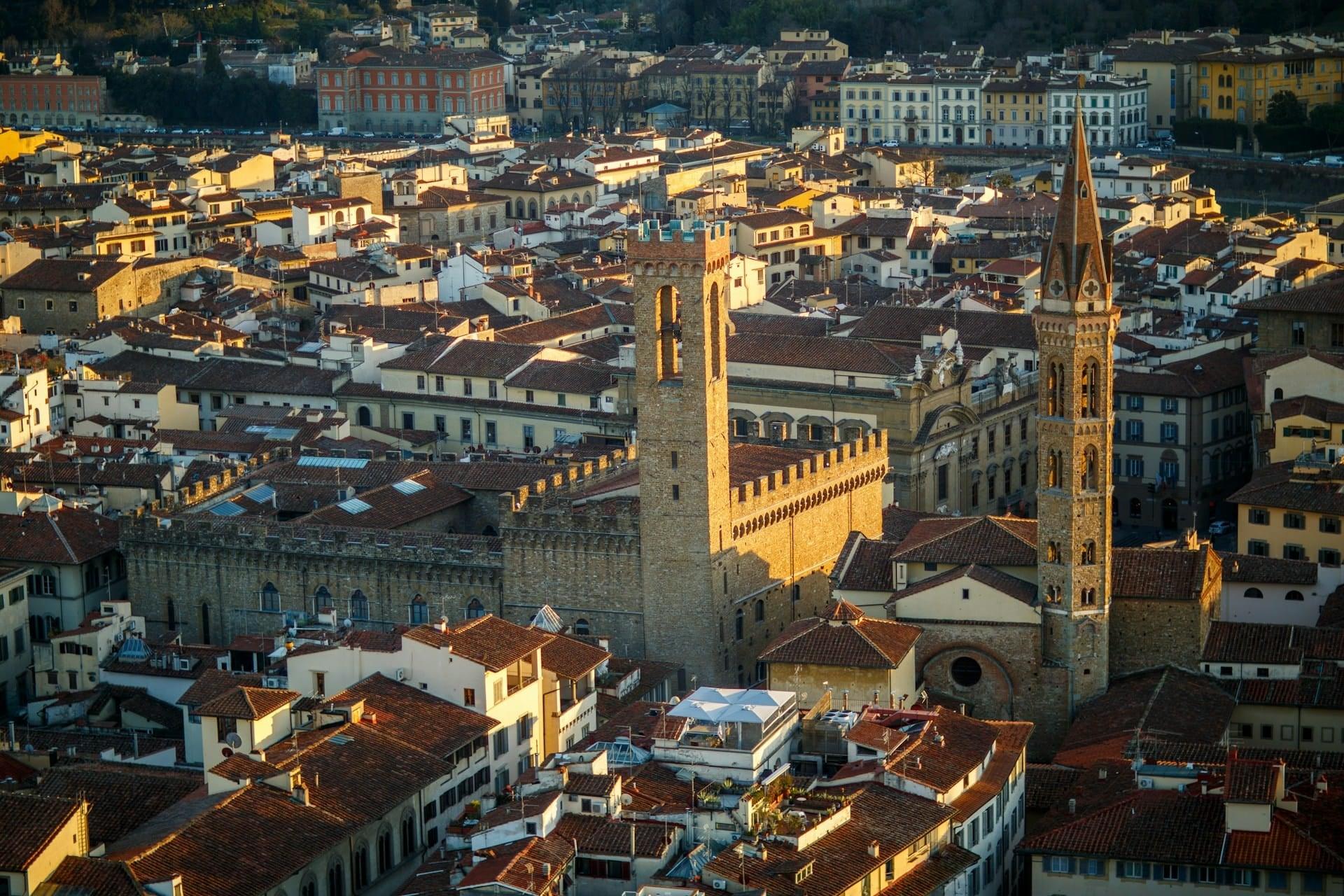
From the synagogue's green dome past Vasari's fish loggia, a porch without a church and Dante's lanes to the Bargello, a Roman arena kept in a street's curve, and Santa Croce's square and marble front.
Start · Synagogue of Florence: The Green Dome
DirectionsStops
- 1
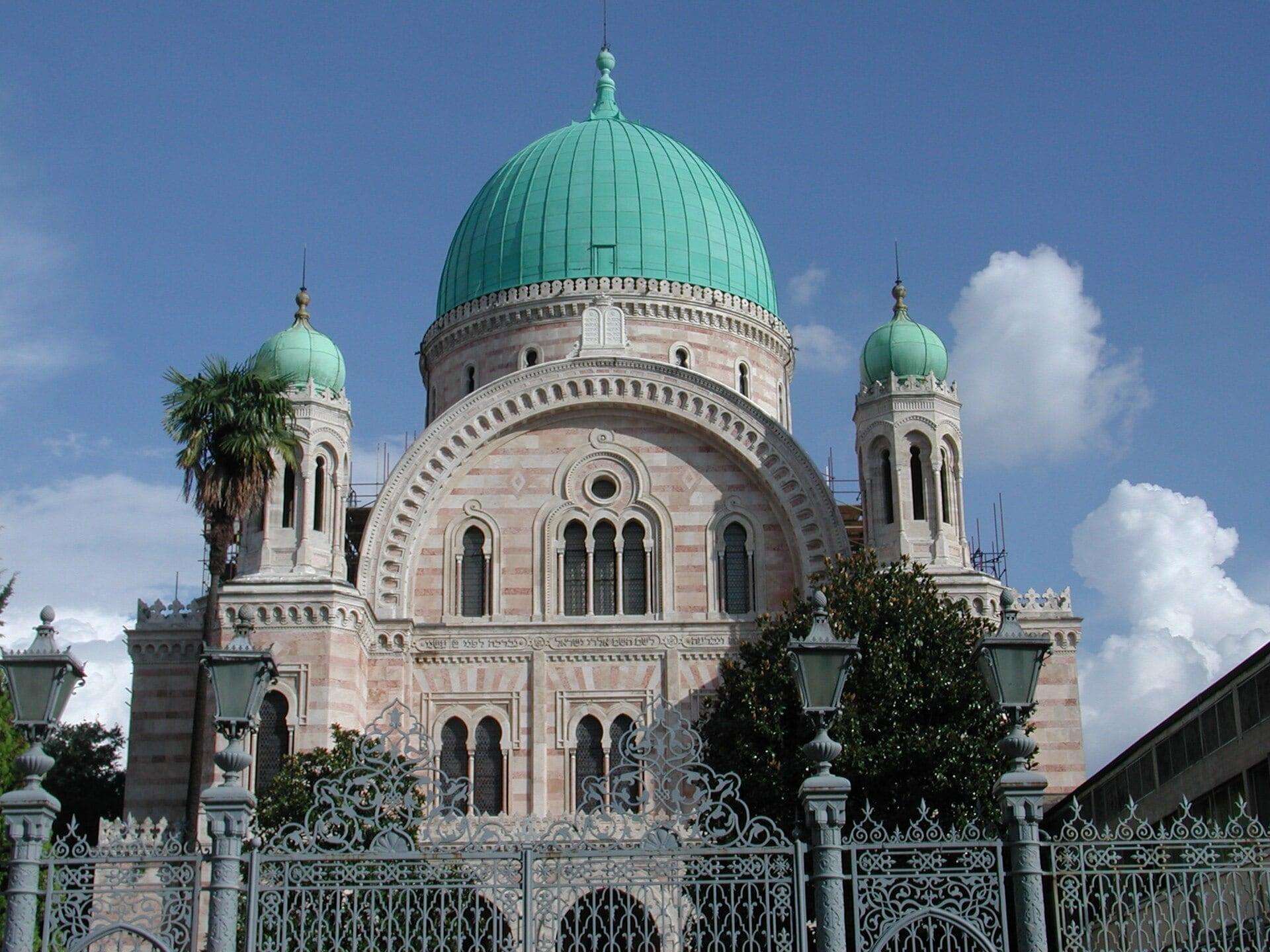
Synagogue of Florence: The Green Dome
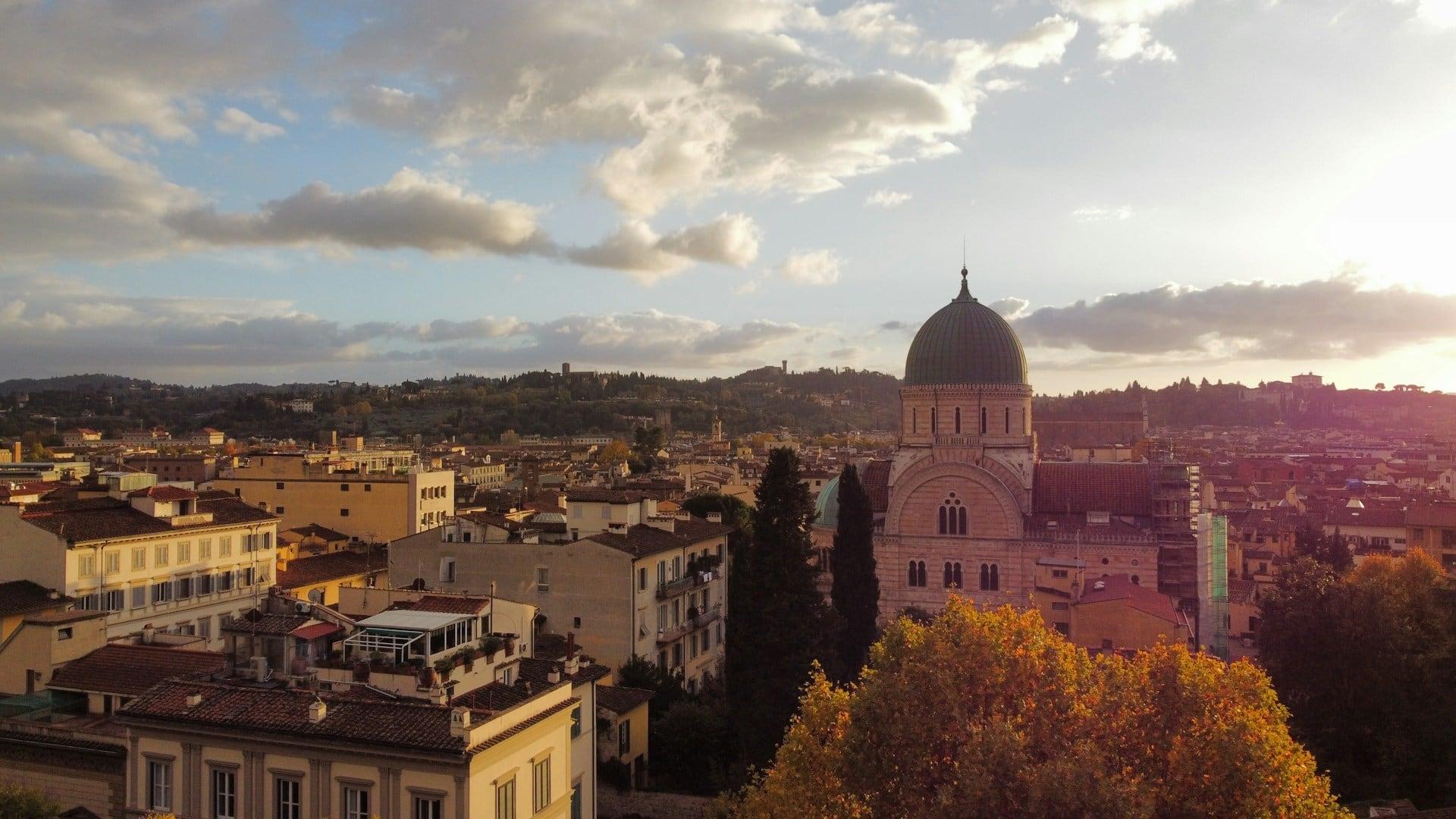
The synagogue Florence's Jews built after emancipation. Finished in 1882 on garden land at the edge of the old city, its copper dome rises over a guarded garden; it survived the German retreat of August 1944.
- 2
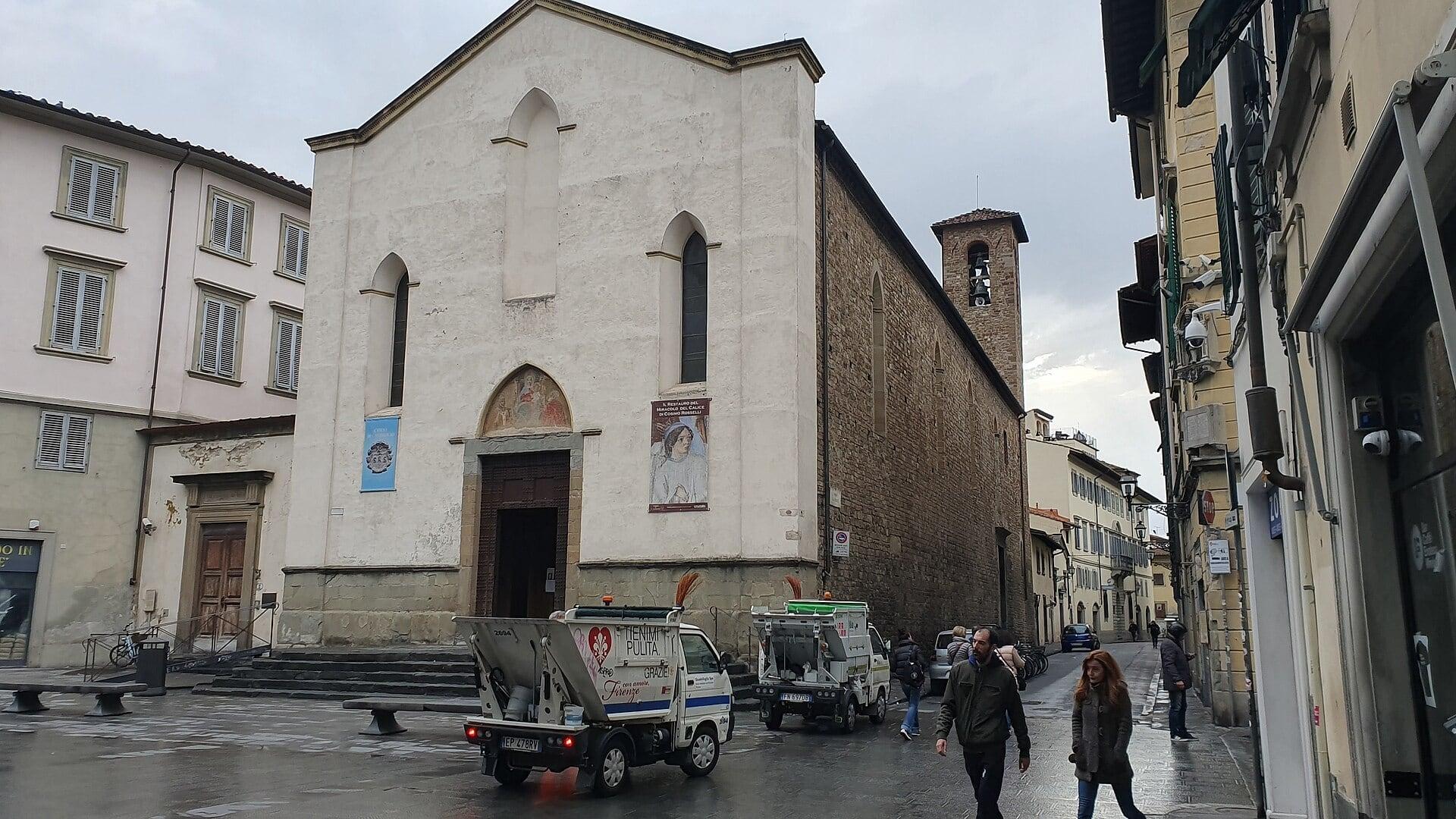
Sant'Ambrogio: The Market Parish
A plain parish church where several streets meet. Its front was rebuilt in 1887; down the street, the Sant'Ambrogio market's iron hall has traded since 1873, every morning but Sunday.
- 3
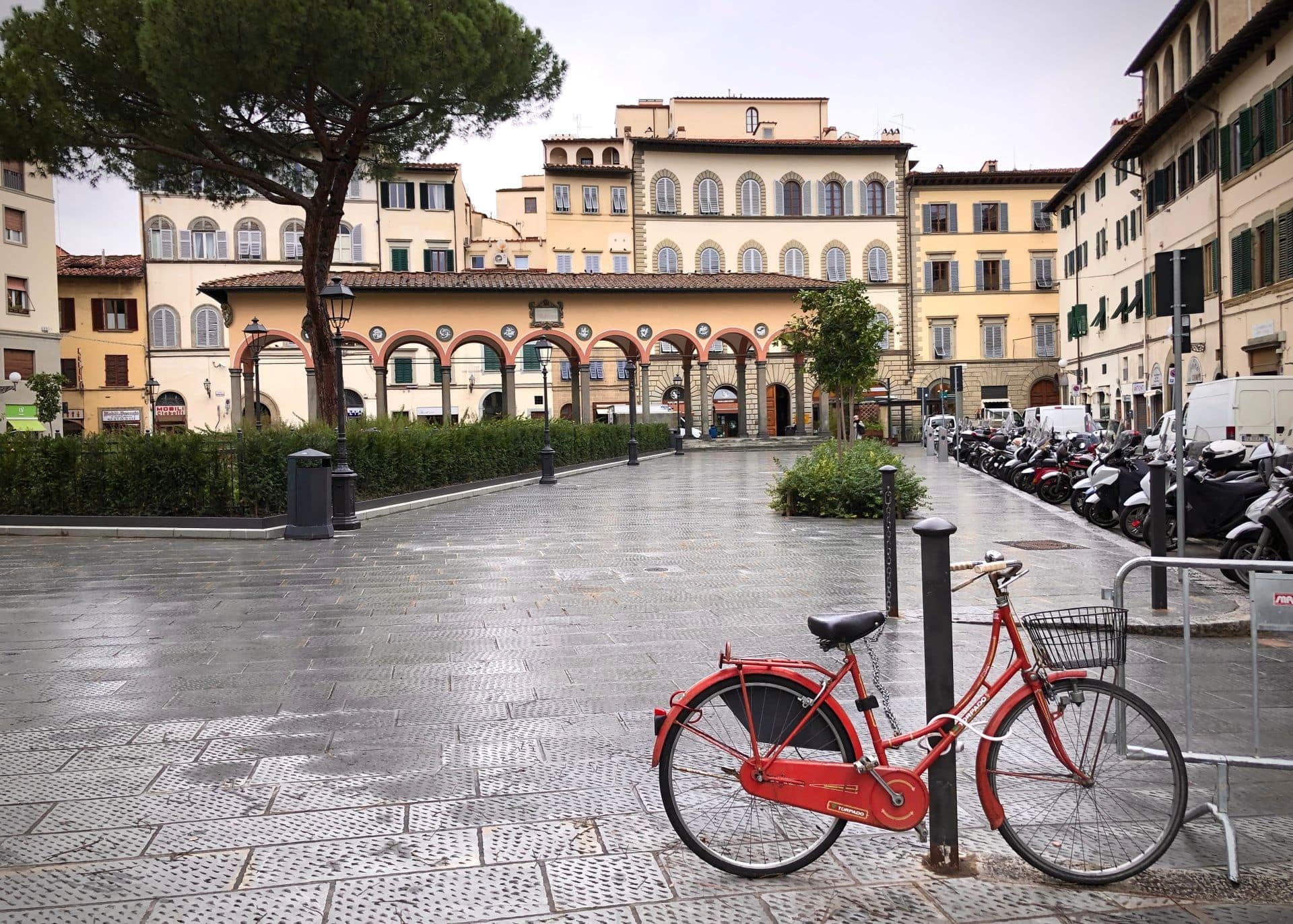
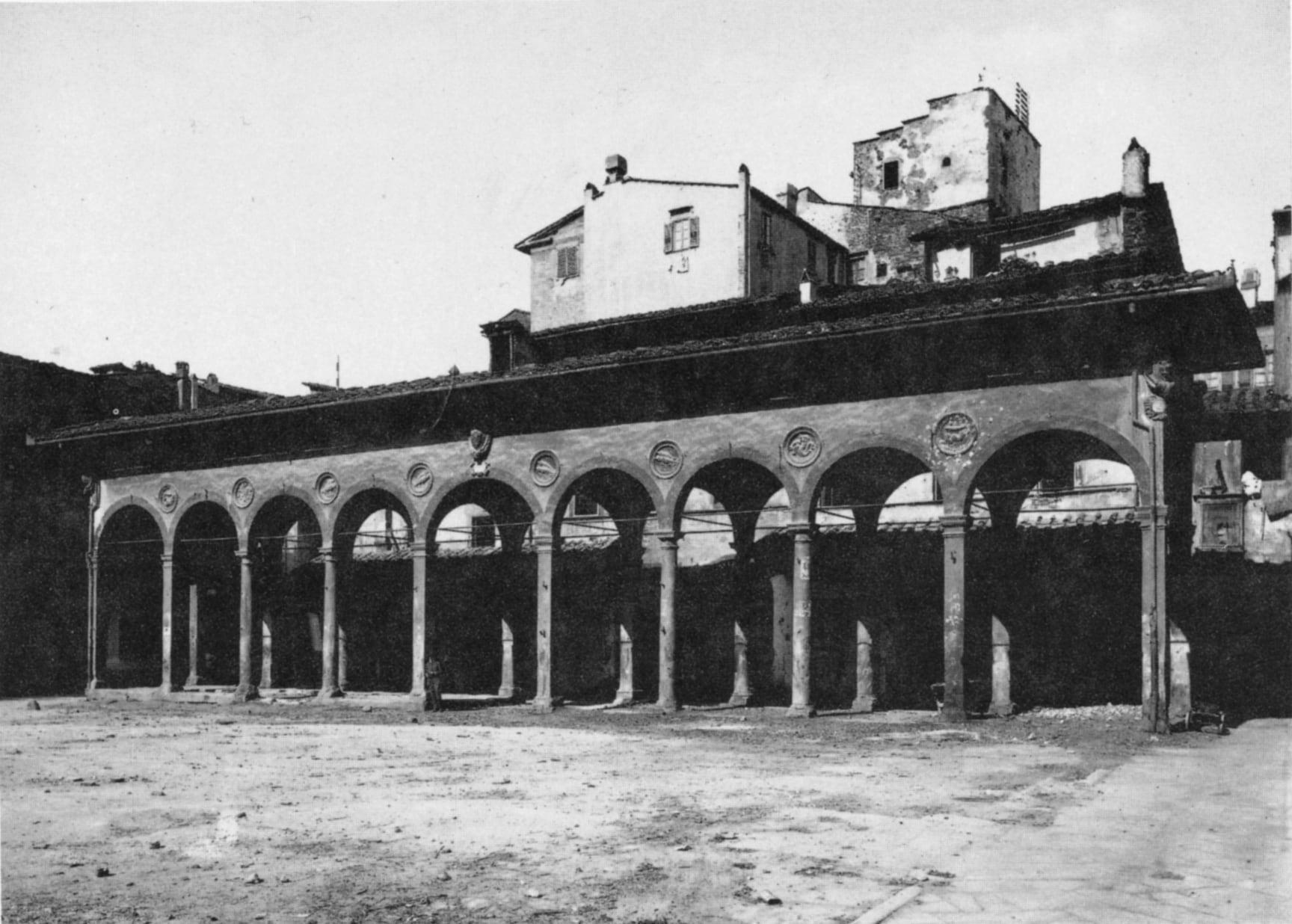
Piazza dei Ciompi: Vasari's Fish Loggia
A Renaissance fish market rebuilt in another square. Vasari built the loggia in 1568 for the old market; it came down at the end of the 1800s and the city rebuilt it here in 1955.
- 4
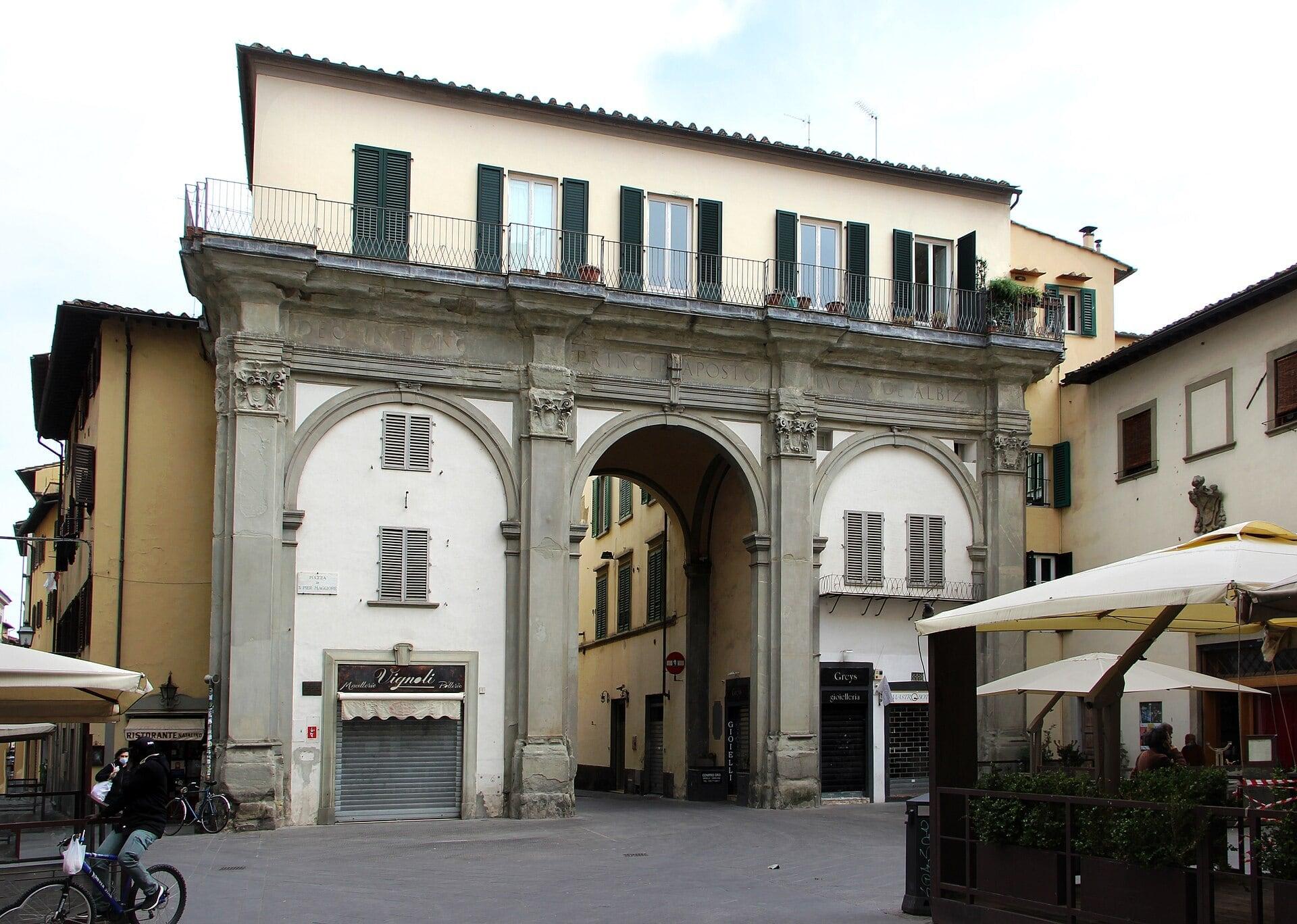
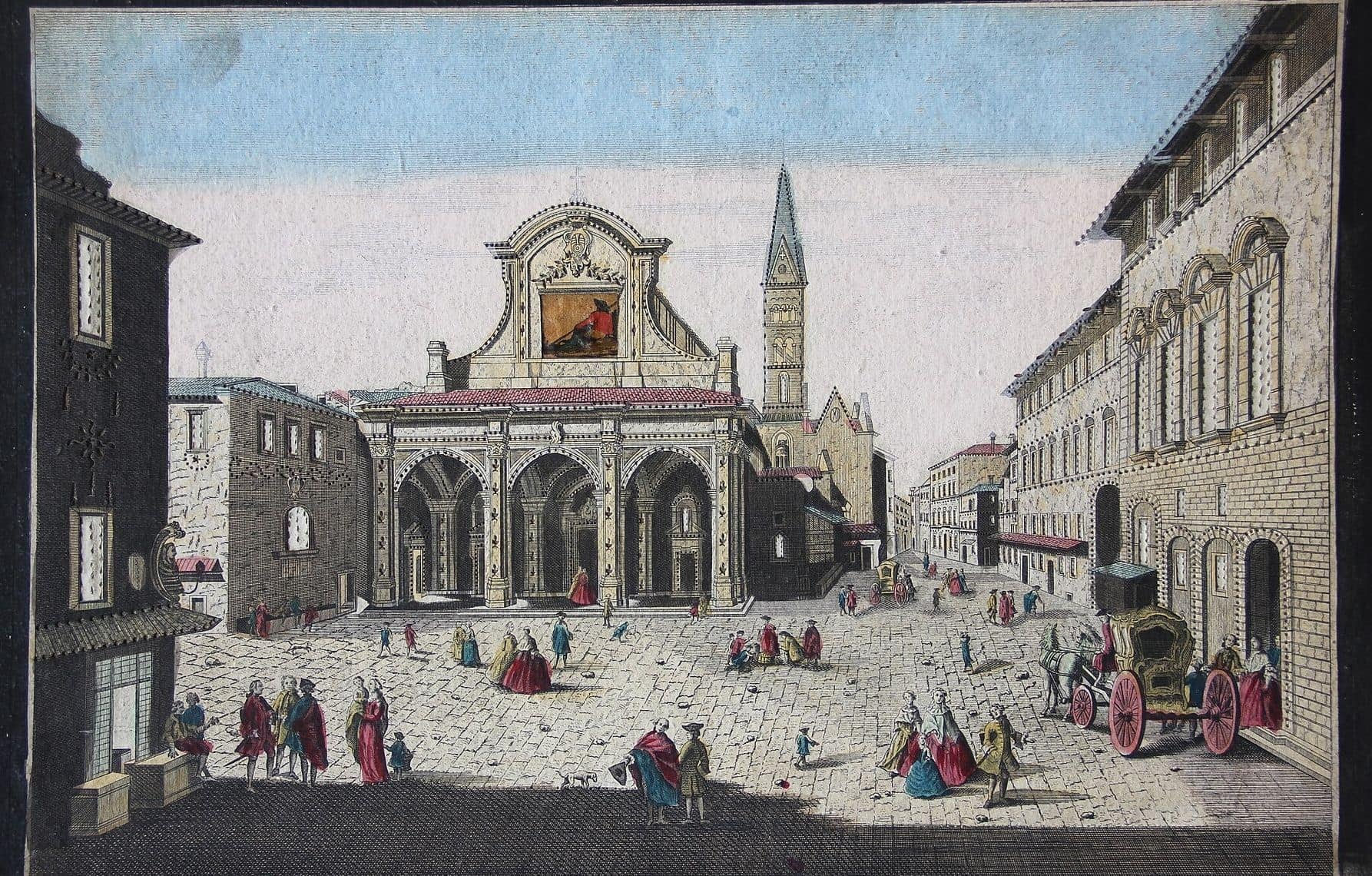
Piazza San Pier Maggiore: A Porch Without a Church
The porch of a church pulled down in 1783. Its middle arch now opens onto a little street that runs where the nave once stood.
- 5
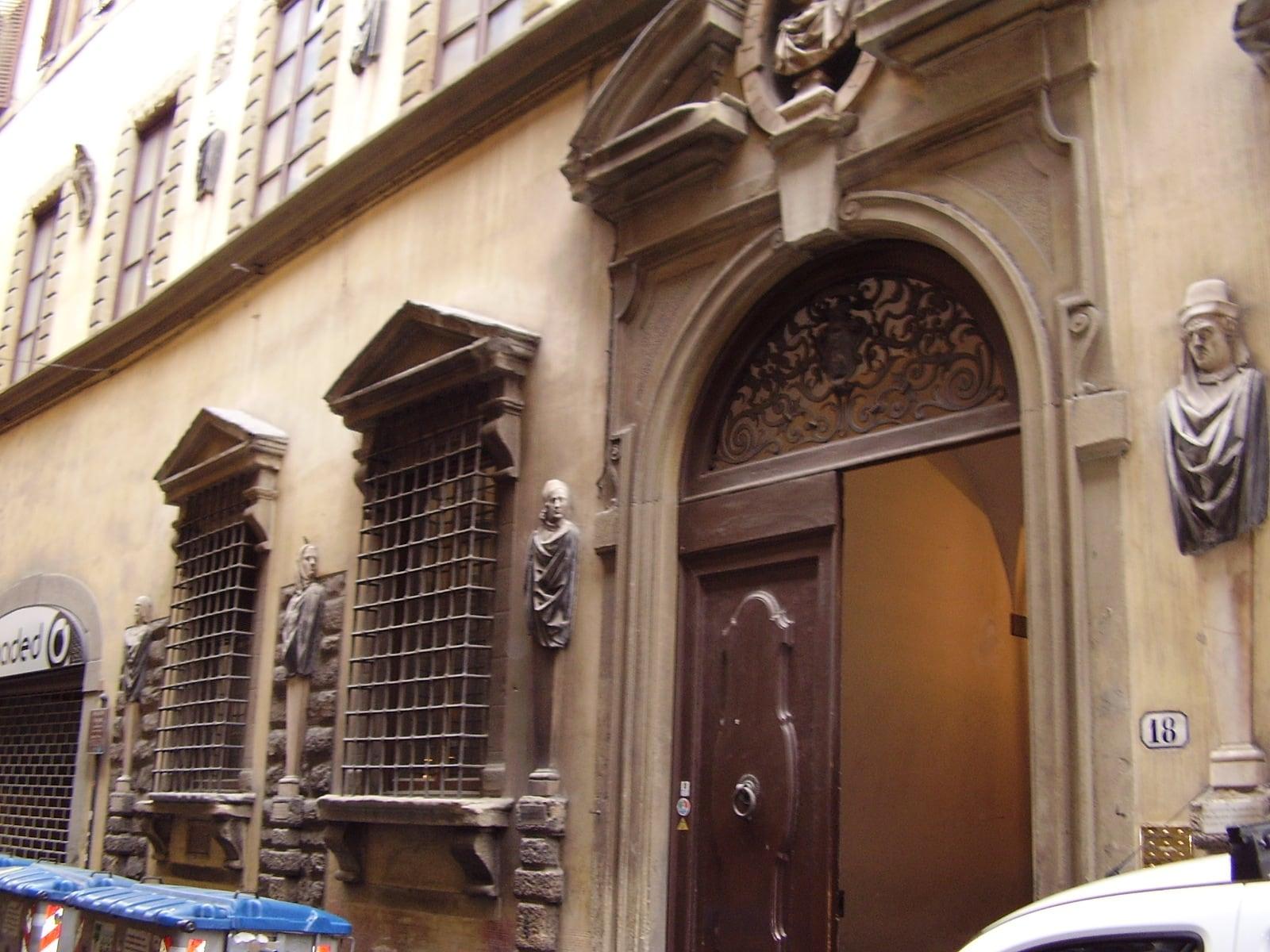
Borgo degli Albizi: The Palace of Ugly Faces
Fifteen stone faces stare down from one house front. A senator's hall of fame, finished in 1604, with Dante, Petrarch and Boccaccio on the top row; Florentines call it the palace of the ugly mugs.
- 6
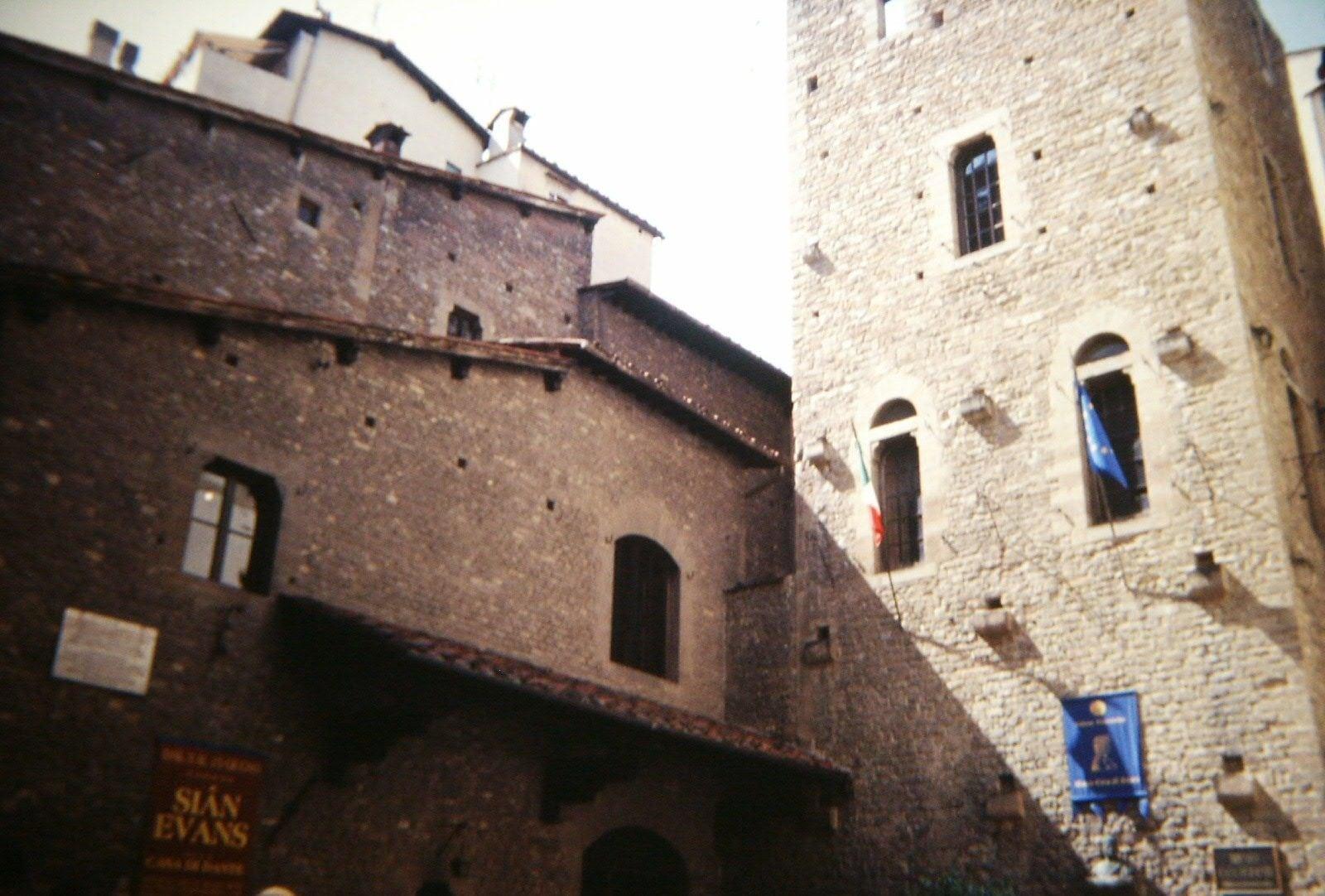
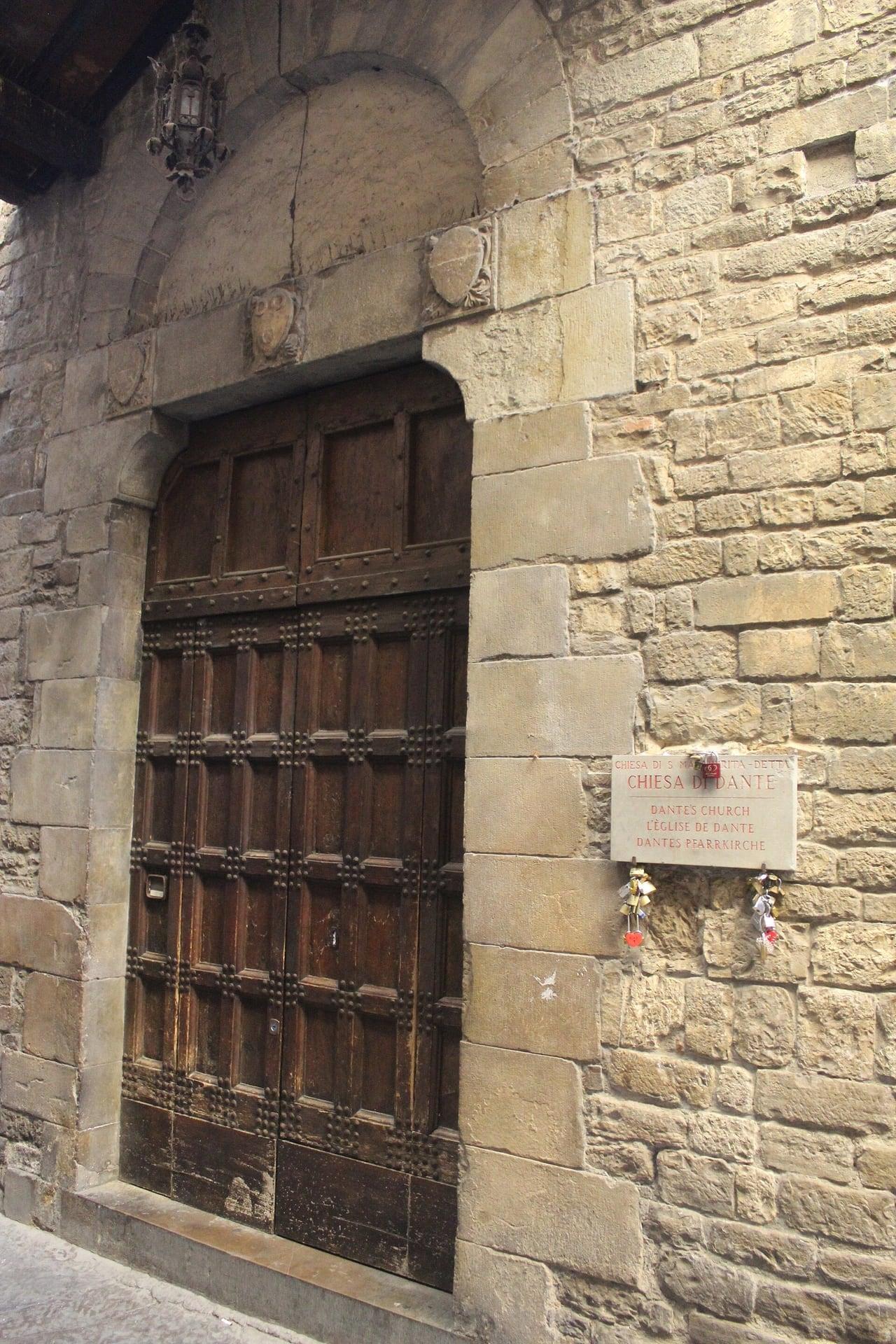
Dante's Quarter: Piazza San Martino
The tower where the city's priors met in 1282. In the Alighieri family's lanes stand the Torre della Castagna and the Casa di Dante, a 1911 reconstruction, as its own museum says.
- 7
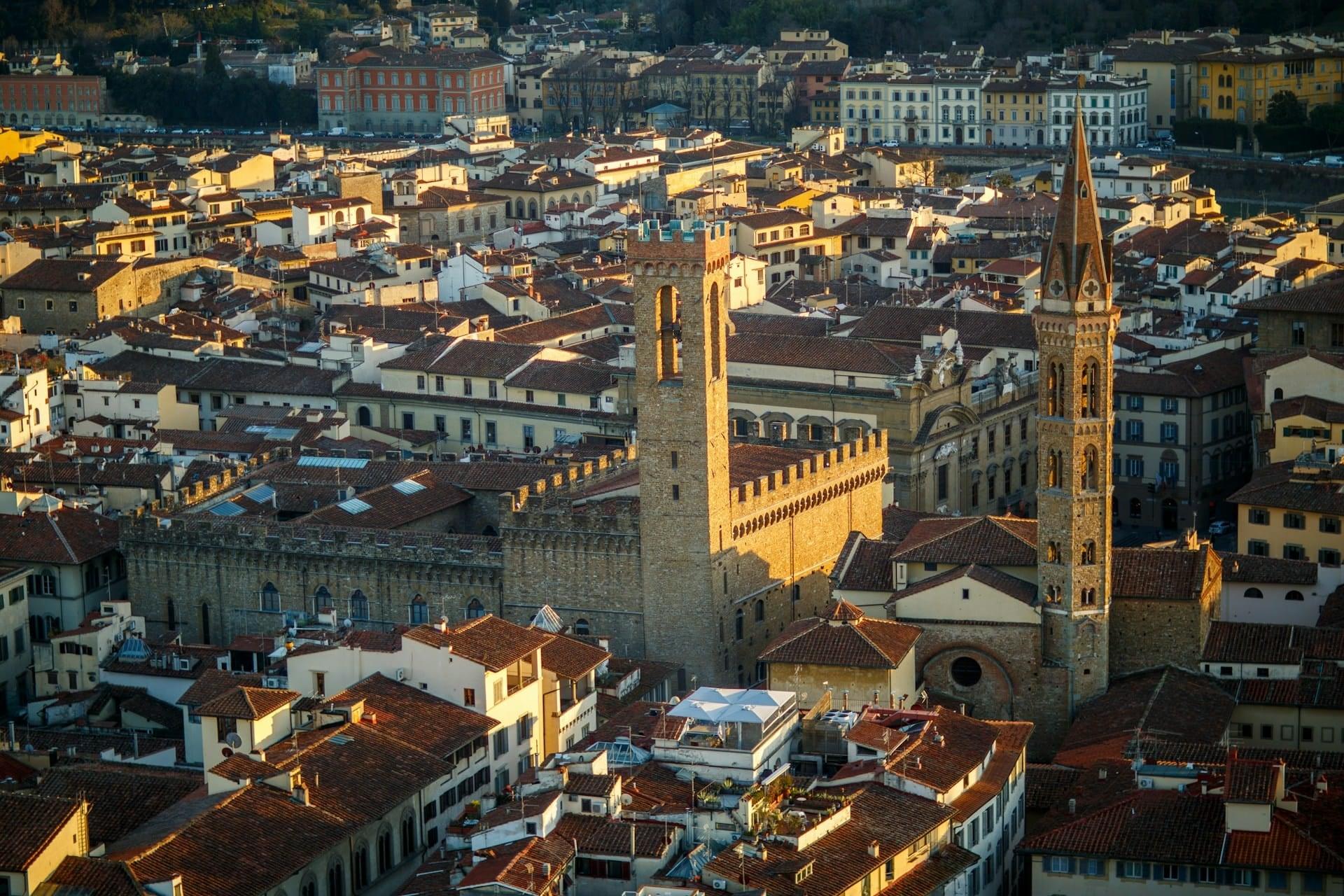
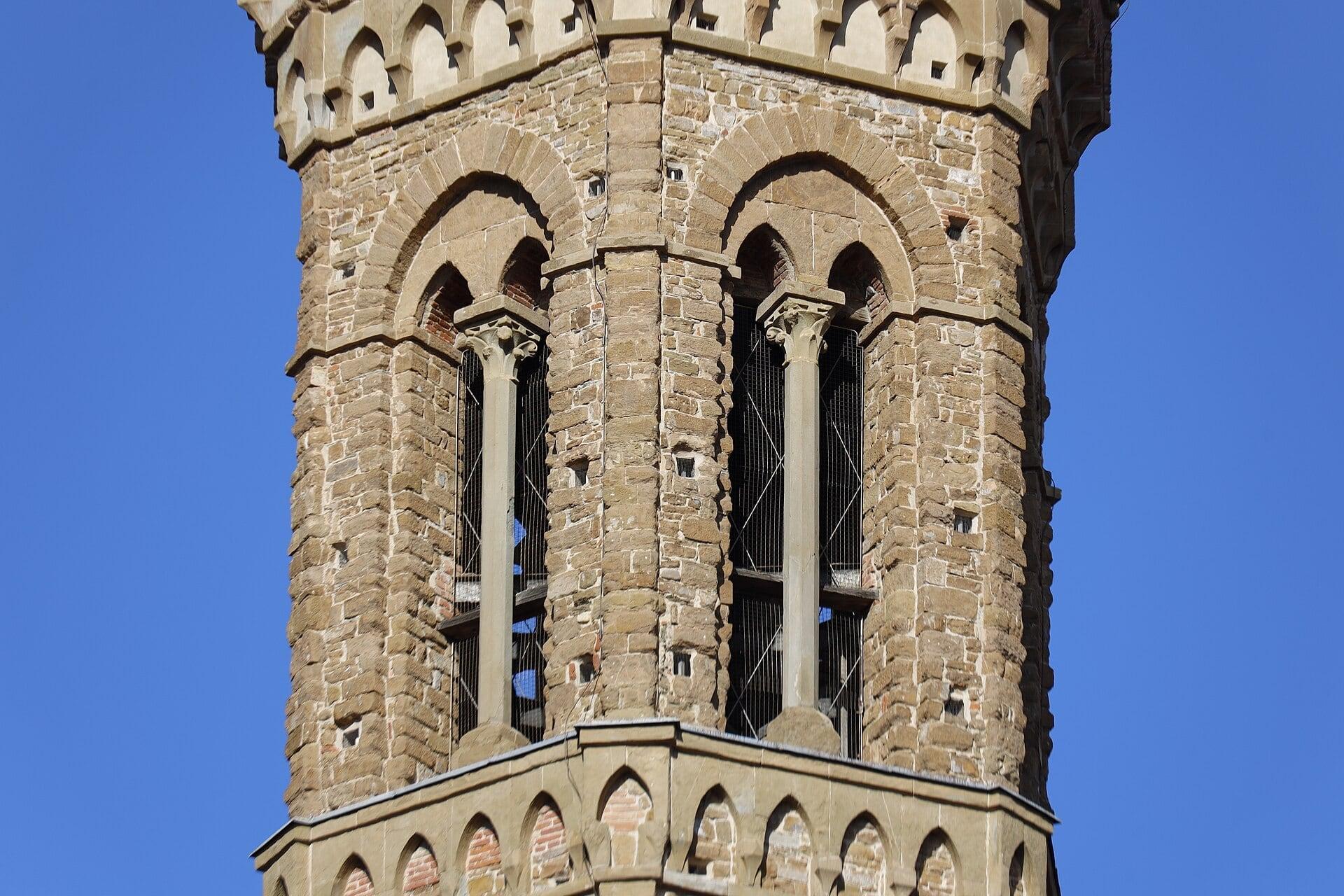
Bargello and Badia: From Piazza San Firenze
The commune's first public palace and an abbey tower. From Piazza San Firenze, the Bargello, founded in 1255, and the Badia's slim bell tower, which Dante alludes to in the Paradiso.
- 8
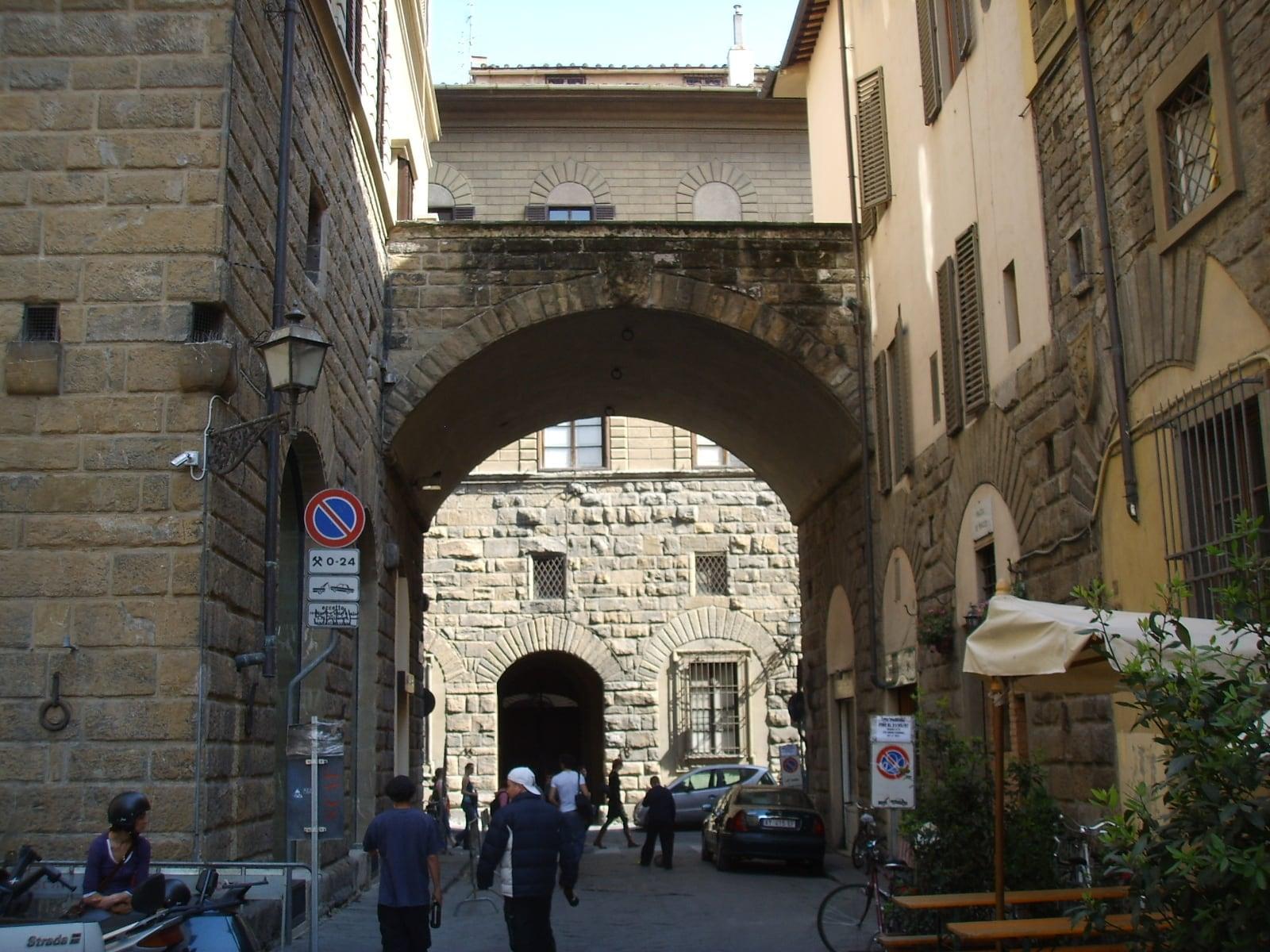
Piazza dei Peruzzi: The Roman Arena's Curve
A Roman arena kept in the curve of the houses. Medieval families built on the amphitheater's walls and seats, and the streets still follow its oval.
- 9
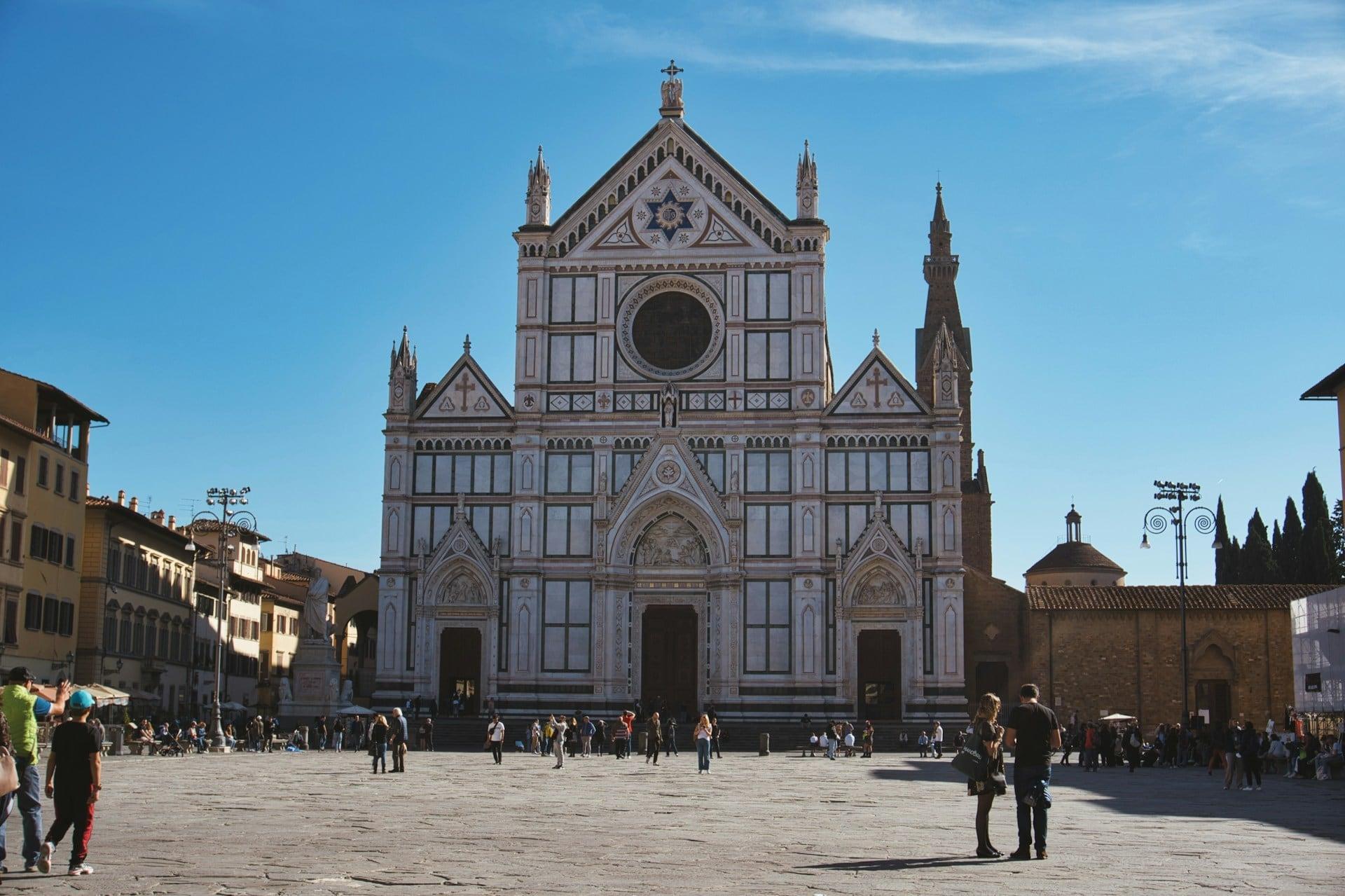
Piazza Santa Croce: The Field and the Flood
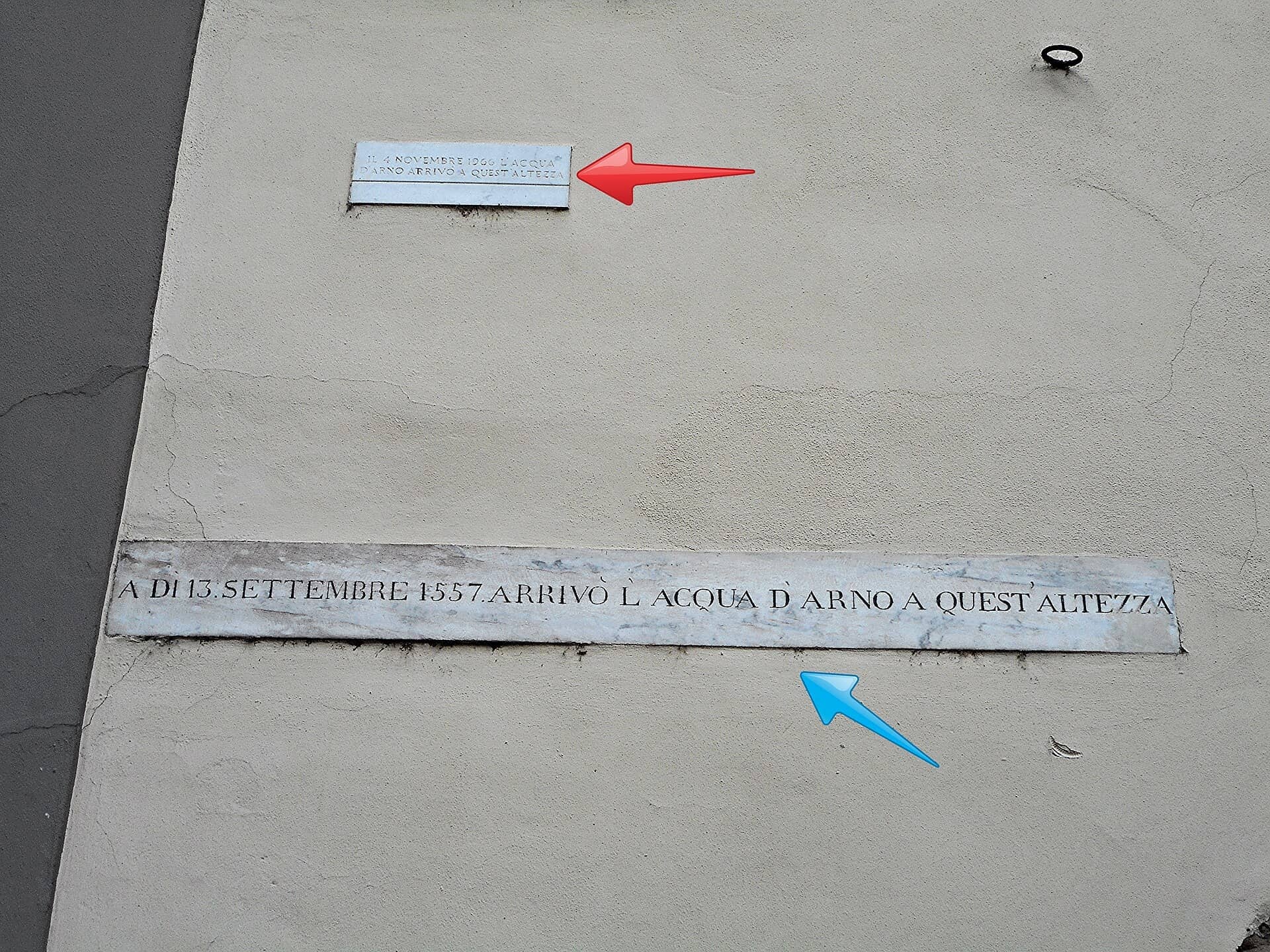
The square where Florence plays its old ball game. A painted palace marks the halfway line, and a corner house carries the flood lines of 1557 and 1966.
- 10
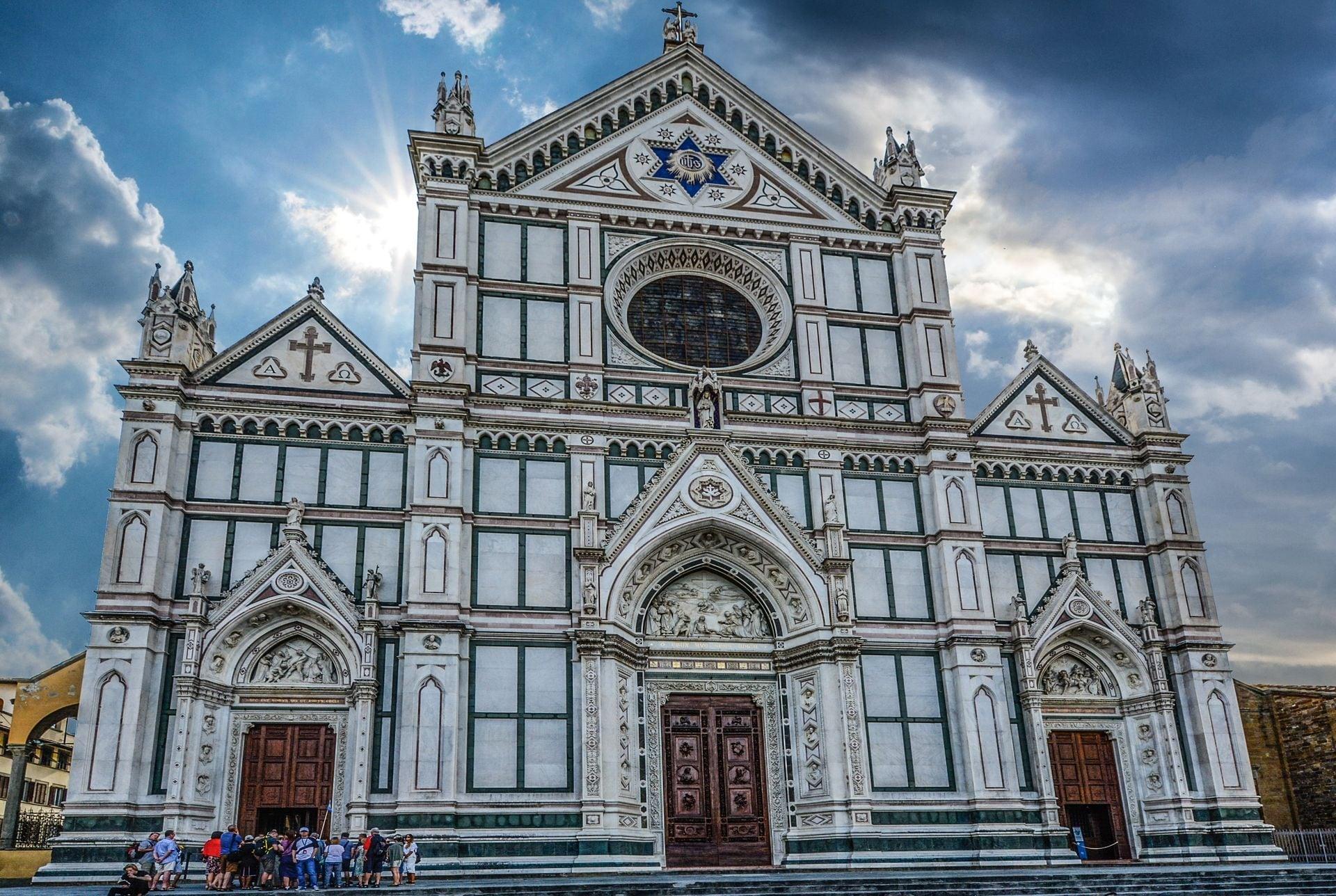
Basilica of Santa Croce: The Marble Front
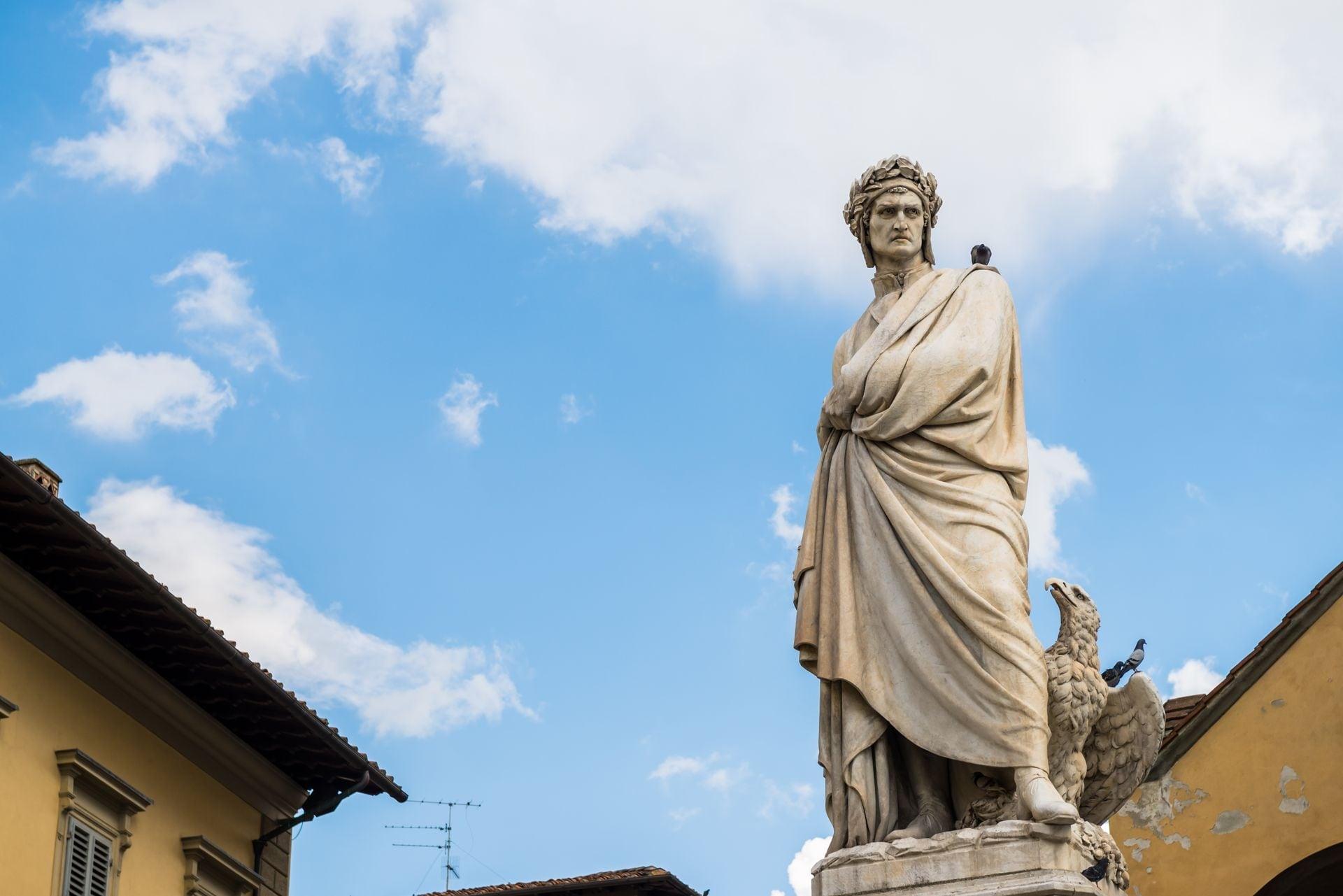
A medieval church wearing an 1860s marble front. Santa Croce was begun in the 1290s; its front was unveiled in 1863, and Dante's statue was moved beside it in 1971.
Details
Best Time to Visit
Tuesday to Friday, starting at about 10:00: the synagogue opens at 10:00 (closed Saturdays and Jewish holidays), the Sant'Ambrogio market trades until 14:00 (closed Sundays), the Bargello is closed on Mondays and Santa Croce opens only in the afternoon on Sundays. On a Monday afternoon the Badia is open to visitors and the Bargello is not. Avoid mid to late June if you want Piazza Santa Croce open: the calcio storico stands fill it (2026 games 13, 14 and 24 June). The streets work after dark; only the interiors close. Checked 8 November 2026.
Pro Tips
- •Getting to the start: the synagogue's gate is at Via Luigi Carlo Farini 6, under a kilometer on foot east of the cathedral. The Jewish Community's page gives buses 6, 14, 23 and 31 to the stop Colonna 01 (not checked at Autolinee Toscane; confirm in the transit app). No tram serves this quarter. Piazza Massimo d'Azeglio, a tree-filled square a few minutes from the start, has shade and benches. Checked 8 November 2026.
- •Getting away from the end: buses stop beside the basilica (stops Magliabechi and Verdi; check lines in the transit app). The Ponte alle Grazie, where our Piazzale Michelangelo walk begins, is about 460 meters on foot down Borgo Santa Croce and Via de' Benci.
- •Synagogue and Jewish Museum (stop 1): 9 EUR full, 5 EUR reduced; October to May Sunday to Thursday 10:00 to 17:30, Friday 10:00 to 15:00; June to September Sunday to Thursday 10:00 to 18:30, Friday 10:00 to 17:00; closed Saturdays and Jewish holidays; security check at the gate. Checked 8 November 2026.
- •Sant'Ambrogio market (near stop 2, about 100 meters down Via de' Macci): Monday to Saturday 07:00 to 14:00, closed Sundays and holidays; stalls outside in the mornings. Checked 8 November 2026.
- •Casa di Dante museum (stop 6): daily 10:00 to 18:00, closed 24 and 25 December; 8 EUR full, 5 EUR reduced. Expect a queue in Via Santa Margherita late in the morning. Checked 8 November 2026.
- •Bargello (stop 7): Tuesday to Sunday 08:15 to 18:50, closed every Monday; 12 EUR, or 26 EUR for 48 hours with the Accademia. The Badia next door is open to visitors only on Monday afternoons, 15:00 to 18:00; on other days it is open for prayer. Checked 8 November 2026.
- •Santa Croce (stop 10): Monday to Saturday 09:30 to 17:30, last entry 17:00; Sundays and holy days 14:00 to 17:30; closed 25 December; 10 EUR full, 6 EUR reduced. The entrance and ticket office are in Largo Bargellini, along the side of the church. Checked 8 November 2026.
- •For a rest after the walk, the small public garden Giardino Wanda Lattes e Alberto Nirenstein is on Borgo Allegri, a few minutes from the end; check its hours at the gate.
Safety & Precautions
- •Several streets that look pedestrian carry small electric minibuses, taxis and residents' cars. On Via della Condotta (before stop 7) the minibus comes toward you; on Borgo degli Albizi and Borgo de' Greci permit vehicles come from behind; on Via dei Bentaccordi and Via Torta (after stop 8) there is hardly any sidewalk. Keep to the side.
- •Crossings: Via Giuseppe Verdi and Via Pietrapiana at traffic lights (after stop 3); Via del Proconsolo with no lights and parked cars hiding traffic from the right (after stop 5); the minibus lane in Piazza San Firenze on a zebra (before stop 7); the bus lane along Piazza Santa Croce where Via Torta comes out, with no crossing at all (traffic from the right; after stop 8); and the minibus lane between stop 10 and the church steps.
- •The synagogue's gate is guarded and bags are checked: keep the gate clear and do not photograph the guards. One of its side towers needs urgent repair work, so part of the front may be under scaffolding.
- •The stone slabs of the old streets are slippery when wet, especially on the Via Torta curve.
- •Piazza Santa Croce and Borgo de' Greci are crowded by day, with groups and street sellers: keep bags closed and in front of you.
- •People live in Via Torta, Via dei Bentaccordi and Piazza dei Peruzzi: keep voices low.
- •In June the calcio storico stands and field fill Piazza Santa Croce, and the square can be fenced for other events.
- •Eating or standing about on the forecourts of Santa Croce and Sant'Ambrogio was banned by a city ordinance of 31 May 2022 (whether it is still in force was not confirmed on 8 November 2026). Sant'Ambrogio and the Badia are working churches: keep quiet during services.
Travel advisory: Exercise Increased Caution (Level 2).
Gallery
Related Reading
Go deeper on what you'll see, hear, and walk through.
Thematic
Best History Walking Tours in Florence (2026)
2 min
Companion
Santa Croce Walking Tour: The Florence Quarter That Keeps What It Lost
6 min
Deep dive
Loggia del Pesce: Vasari's Fish Market in the Wrong Florence Square
5 min
Deep dive
San Pier Maggiore: The Florence Church Porch With No Church Behind It
5 min
Read the walk
The full story of Santa Croce and the Bargello: Dante and the Flood Line, in words. Prefer to listen? Play it narrated, from home or on location.
Introduction
Florence, in the heart of Tuscany, keeps what it loses. In the quarter around Santa Croce, almost everything you will see was pulled down, moved or rebuilt, and then kept on purpose: a fish market's loggia standing in the wrong square, a church porch with no church behind it, a medieval house rebuilt in nineteen eleven, a Roman arena that survives only as the bend of a street, and two flood lines on one corner house.
Three people shape the walk. Dante, the poet Florence sent into exile and later honored with a statue, whose streets you will cross. Giorgio Vasari, who built the fish loggia. And Baccio Valori, a senator who covered his house front with the faces of the city's great minds.
The walk is ten stops over about one point eight kilometers, a little over a mile, and takes about seventy-five minutes. It is flat, with no steps. The synagogue, the Casa di Dante, the Bargello and Santa Croce charge to go in, and every stop works from outside. The one thing to watch is traffic in streets that look pedestrian: small electric buses, taxis and residents' cars use several of them, and a few stretches have hardly any sidewalk. The walk begins at the synagogue on Via Farini and ends in front of the basilica of Santa Croce. When you arrive at the Synagogue of Florence, begin with stop one.
1. Synagogue of Florence: The Green Dome
Welcome to the Synagogue of Florence, where this walk begins. Stay on the sidewalk beside the garden gate, not in front of it: the gate is guarded, so please keep it clear and do not photograph the guards. The synagogue and its Jewish Museum charge to go in, through a security check, and they are closed on Saturdays and Jewish holidays. The details are on this stop's card.
Look up over the garden trees at the great dome. It is covered in copper, once gilded and now gone green, and the front below it is faced in white travertine and pink limestone. The community calls the style Moorish, with Arab and Byzantine touches. It was finished in eighteen eighty-two.
That date is the point. In fifteen seventy, under pressure from the Pope, a Medici duke shut Florence's Jews into a ghetto in the center of town, where Piazza della Repubblica is now. In eighteen sixty-one the Jews of Tuscany became full citizens. Free at last to build where they chose, the community debated for years and chose this place: garden land inside the old walls, away from the old center. One of its members left his fortune for a monumental temple, in his words, worthy of Florence. The ghetto itself was demolished in the eighteen nineties.
Then the war. In November nineteen forty-three the Nazi occupiers, helped by Italian Fascists, began rounding up the city's Jews. The community counts more than five hundred deported to the extermination camps; almost none came back. The deportation is remembered in this garden. In August nineteen forty-four, as it retreated, the German army mined the synagogue. The charges went off, but the building survived.
Follow the route along the quiet street to a small square with a plain church front. Next is the parish of the neighborhood market.
2. Sant'Ambrogio: The Market Parish
Walk on into the small paved triangle of Piazza Sant'Ambrogio and stop facing the plain church front. Several streets meet here, and in the morning it fills with people carrying shopping bags.
This is Sant'Ambrogio, one of the city's old parish churches. Its front looks plain because it is new: it was rebuilt in eighteen eighty-seven and eighty-eight, at the parish priest's own expense. The city's tourist office calls it plain and unadorned, and it is right. The interest is inside. If the door is open, step in quietly: this is a working parish, with people at prayer. In a side chapel stands a marble tabernacle whose sculptor is buried here in the church, and on its walls are frescoes that show Florence as it looked in the late fourteen hundreds.
Now the shopping bags. About a hundred meters down Via de' Macci, out of sight from here, is the Sant'Ambrogio market, a covered hall on a frame of cast iron. It opened in eighteen seventy-three, about a year before the better-known central market at San Lorenzo. It is open every morning except Sunday, from seven until two, and in the mornings the stalls spill outside into the street.
The market was built on a big vegetable garden on this side of Santa Croce, toward the old walls. Think back to the synagogue: it too went up on garden land inside the walls, land the city had not yet built over. Both are signs of a city filling in its own edges.
Follow the route along Via Pietrapiana to the next square, where a Renaissance market building stands somewhere it was never meant to be.
3. Piazza dei Ciompi: Vasari's Fish Loggia
Walk on along the long arcade to its far end and stop there, looking back along it. This is the Loggia del Pesce, the fish loggia, in Piazza dei Ciompi.
It is in the wrong place, on purpose. Giorgio Vasari designed it in fifteen sixty-seven for the Medici duke Cosimo the First, and it went up in fifteen sixty-eight and sixty-nine. It was built for the fish sellers. They had sold on the bank of the Arno until the Vasari Corridor, built along the river, took their place.
The loggia stood in the old market square, the Mercato Vecchio, where Piazza della Repubblica is now. In sixteen ninety-nine it grew by one arch at each end. At the end of the eighteen hundreds the city cleared the old market, and the loggia came down with it. The ghetto you heard about at the synagogue stood in that same center and went in the same years. Pieces of the loggia were saved and stored, and in nineteen fifty-five the city put it up again, here.
Now test it. On the side that faces Via Pietrapiana, find the coats of arms: the Medici rulers and their wives, and a bushel heaped with grain. Those are original, though repainted. Then look at the round panels between the arches, each with a fish. There were sixteen. Twelve crumbled, because they were modeled in lime, and the four that were saved have long been missing. The fish you see are modern copies made on the old model. The shields are old; the fish are new.
The square is named for the Ciompi, the rebels of a famous uprising in thirteen seventy-eight.
Follow the route around the end of the loggia to Via Pietrapiana. You cross a quiet side street, then two busy streets at traffic lights, one with city buses: wait for the green. Next is a church porch with no church behind it.
4. Piazza San Pier Maggiore: A Porch Without a Church
Walk on to where the street opens into a small square, Piazza San Pier Maggiore, and stop there. You have just walked past what you came for: turn around, and at that end of the square stands a stone arcade of three great arches, with houses built on top of it. This was the…
Full narration for this stop unlocks with the tour.
5. Borgo degli Albizi: The Palace of Ugly Faces
Walk on along Borgo degli Albizi and stop at the house front covered in carved stone figures. Stand close to the houses opposite it and look up. This is a narrow street, and permit cars and taxis use it in the direction you are walking, so they come up behind you: keep to the…
Full narration for this stop unlocks with the tour.
6. Dante's Quarter: Piazza San Martino
Walk on down the lane, past the house with a bronze bust, into the small square at the foot of a tall, bare stone tower, and stop there. The lanes here are narrow and the houses tall, so take your bearings from the tower. The house with the bronze bust is the Casa di Dante, a…
Full narration for this stop unlocks with the tour.
7. Bargello and Badia: From Piazza San Firenze
Walk on down the sidewalk along the long Baroque front, then stop and turn around to look back past the zebra, up Via del Proconsolo. Two towers rise above the roofs: the battlemented tower of the Bargello, and the slim, pointed bell tower of the Badia. The Bargello is a museum…
Full narration for this stop unlocks with the tour.
8. Piazza dei Peruzzi: The Roman Arena's Curve
Walk on through the narrow passage into the small square at its end, Piazza dei Peruzzi, and stop just inside. Look at the house fronts. They do not run straight. They bend, in one long, smooth curve. You are standing on the rim of a Roman arena. In the second century the Roman…
Full narration for this stop unlocks with the tour.
9. Piazza Santa Croce: The Field and the Flood
Before you go on into the square, find the corner house by the mouth of Via Torta, at the corner of Via Giuseppe Verdi, just under the street sign that reads Piazza di Santa Croce. If you have already passed it, look back. Two marble plaques mark the river's floods. The long one…
Full narration for this stop unlocks with the tour.
10. Basilica of Santa Croce: The Marble Front
Walk on toward the church and stop on this side of the lane in front of it, near Dante's statue at the corner of the steps. A small electric bus uses that lane, so look before crossing. The church charges to go in; the entrance is along the side, in Largo Bargellini, not through…
Full narration for this stop unlocks with the tour.
- Sant'Ambrogio (Florence) — Yair Haklai, CC BY-SA 4.0 · source
- Piazza San Pier Maggiore — Francesco Bini, CC BY-SA 4.0 · source
- Visacci Palace in Florence, Italy — user:Sailko, CC BY-SA 3.0 · source
- Arco_dei_Peruzzi in Florence — Sailko, CC BY 2.5 · source
Images may be cropped or resized. Other photos via Unsplash and Pexels.