Fes el-Bali: Inside the World's Largest Living Medina
150 min · 2 km · moderate
Fez holds two cities inside one set of walls, and reading them in sequence is the through-line of any visit: the medieval medina of Fes el-Bali, founded in the ninth century and grown to its height under the Marinids, and beside it Fes Jdid, the royal citadel the same dynasty founded in 1276, with the oldest Jewish quarter in Morocco set against its palace. Walk them in order and Fez stops being a maze and becomes an argument, layer on living layer: a spiritual and intellectual capital built downhill toward its river, then an imperial city of golden gates, parade grounds, and dynastic tombs staged on the hill above. UNESCO inscribed all of it in 1981 as Morocco's first World Heritage Site, and the honest way to read it is on foot, at your own pace, because in much of the old city you genuinely cannot drive.
Start where the cars end. The two anchors of this reading are the Fes el-Bali medina walk and the Fes Jdid and Mellah walk, and together they let you hold the medieval and the imperial city in the same afternoon. For the full set, start from the Fez walking tours hub.
The medieval city reads downhill
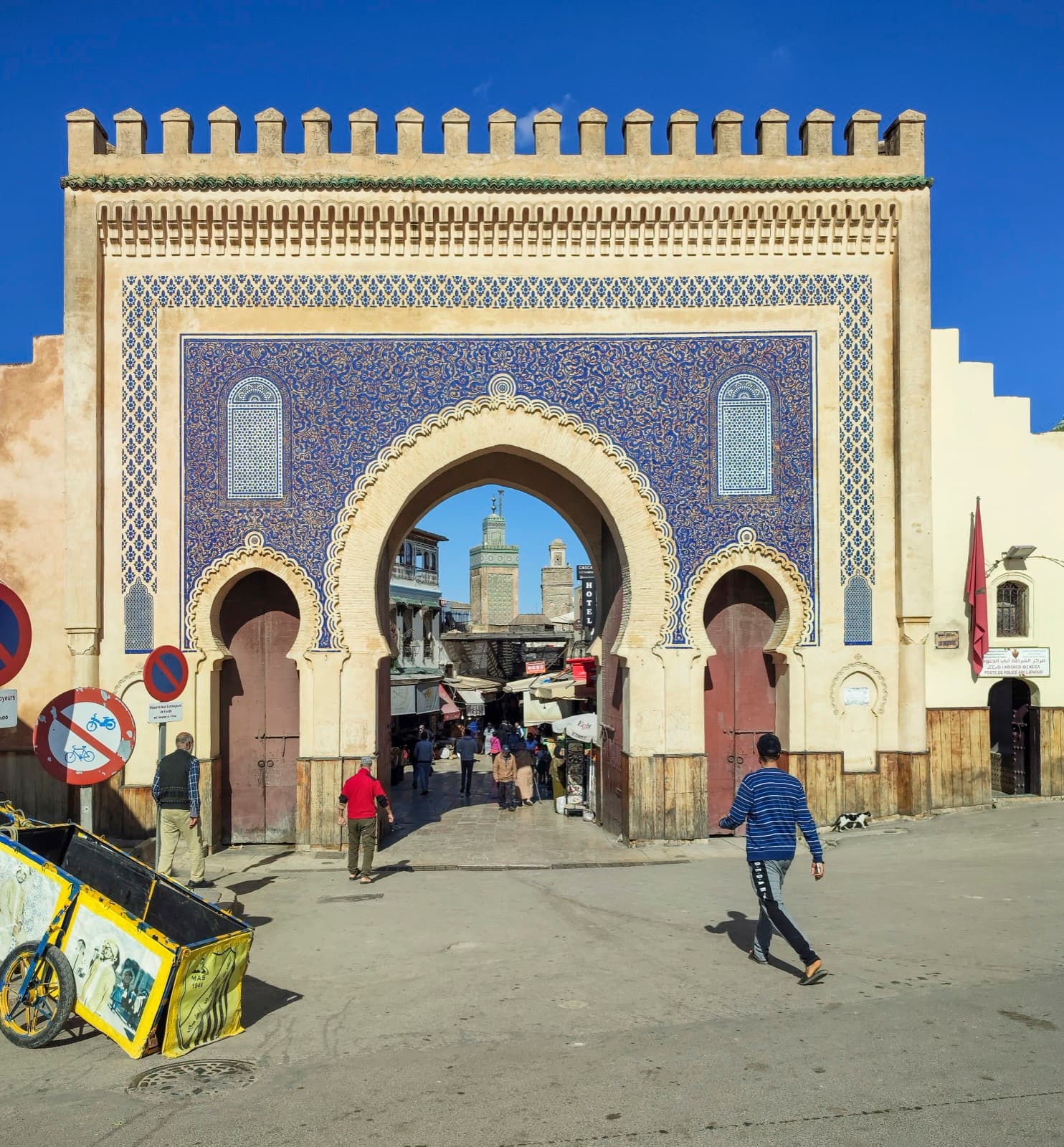
Fes el-Bali is one of the largest car-free urban areas on earth, and its logic is a single sloping street. Enter at Bab Bou Jeloud, the Blue Gate, whose outer face is clad in the blue tiles long associated with Fez and whose inner face turns green, the color of Islam. The gate itself is young, completed in 1913 under the French municipal administration, but it marks a hard line: step through the arch and the engines simply stop. What begins is the Talaa Kebira, the great artery that runs down through the medina like a spine, and everything that matters sits along it.
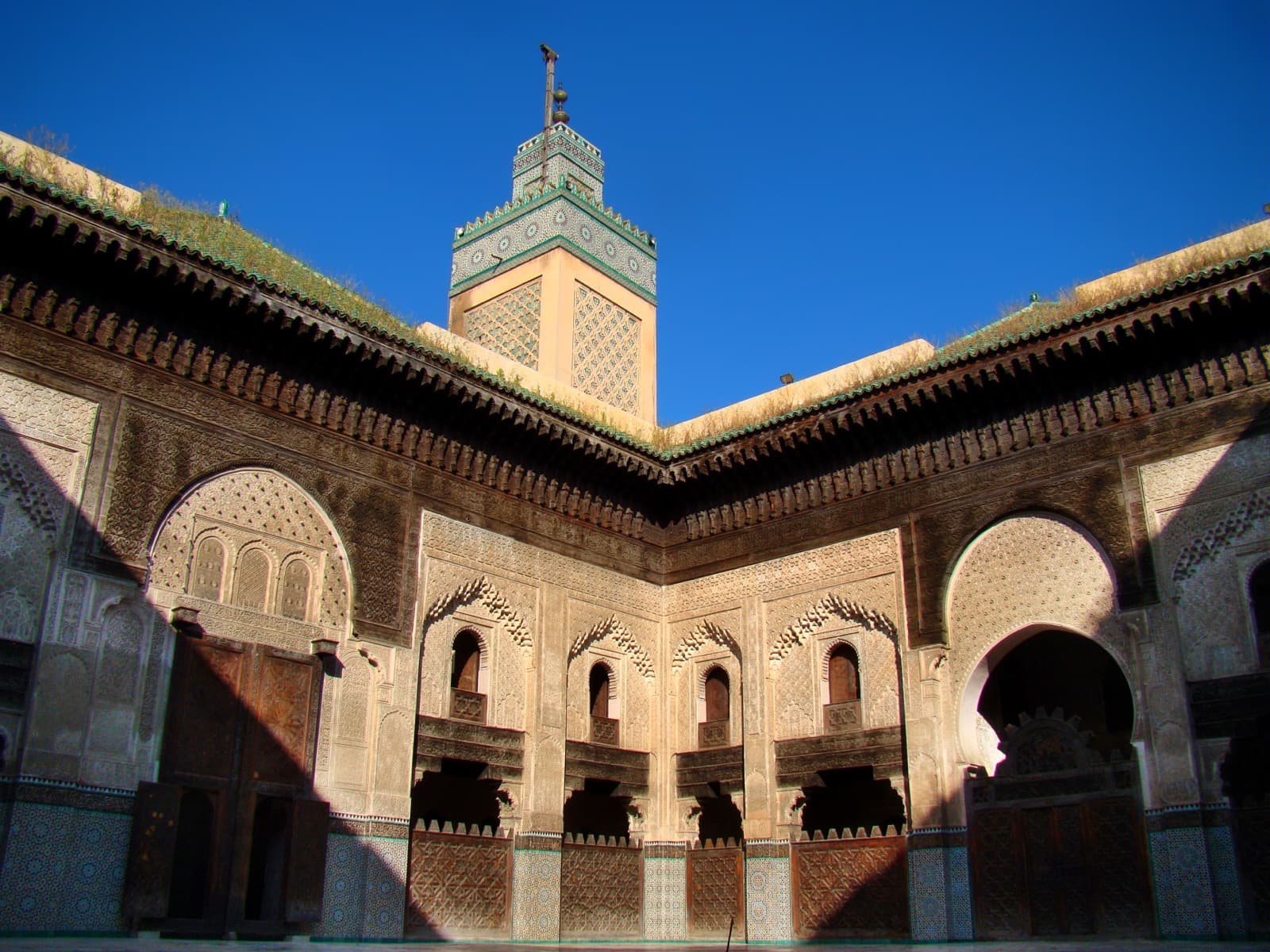
The first marvel is the Bou Inania Madrasa, built by the Marinid sultan Abu Inan Faris between 1350 and 1355, the only college in Morocco that also served as a full congregational mosque. Across the street, carved cedar beams are all that remain visible of the Dar al-Magana, a medieval water clock likely finished in 1357 whose mechanism scholars still cannot fully explain. Two Marinid masterpieces face each other across a street you can simply walk, a college that is also a mosque and a clock no one has decoded, both more than six hundred years old.
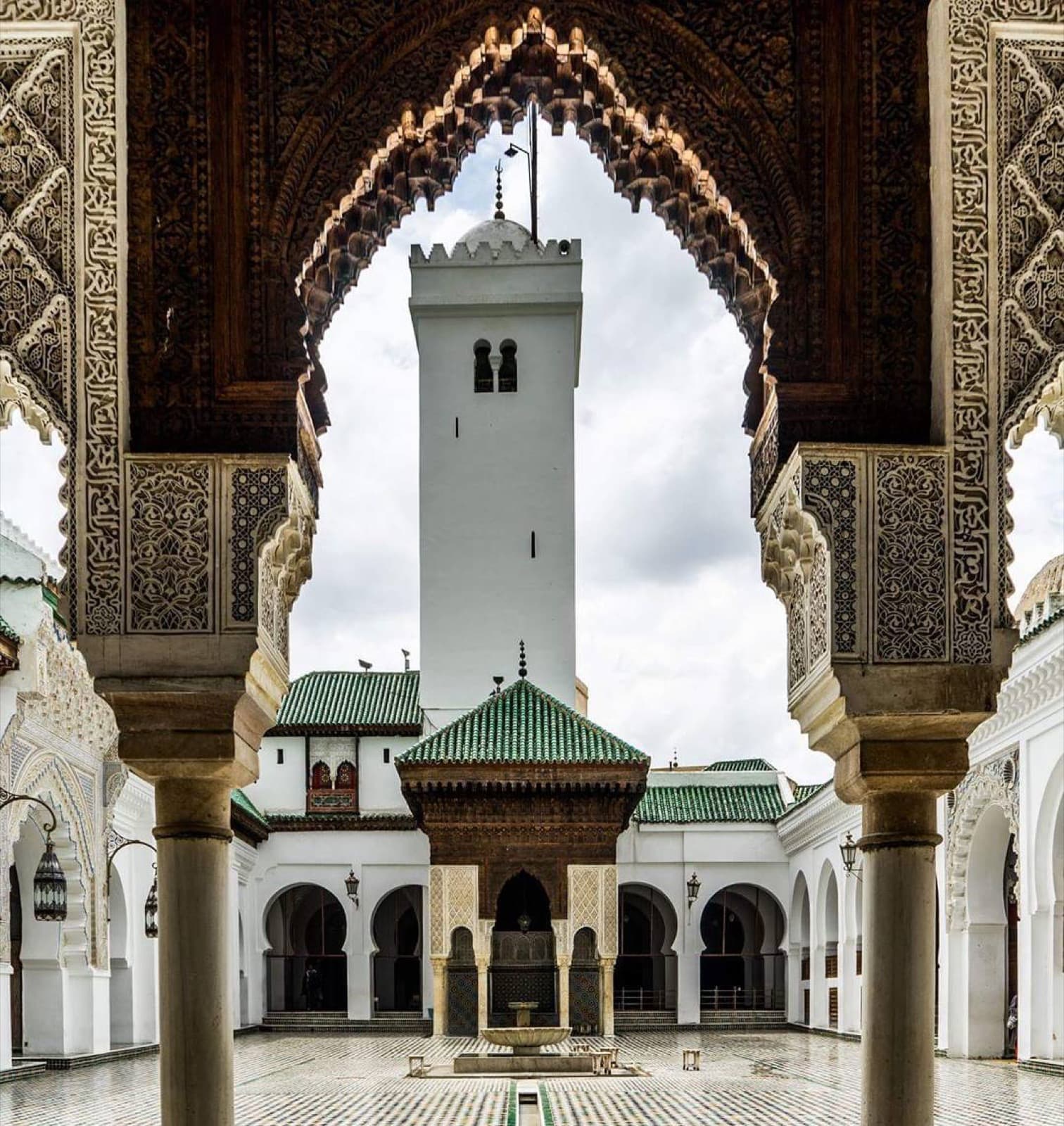
Farther down stands the reason many people come at all. The mosque and university of al-Qarawiyyin was established between 857 and 859 by Fatima al-Fihri, a woman whose family had come from Kairouan, which is where the name comes from: al-Qarawiyyin means the Kairouanese. UNESCO and Guinness World Records both recognize it as the oldest continuously operating degree-granting educational institution in the world, older than any university in Europe. It is a living mosque, so non-Muslims may not enter, but you can approach the great gates and glimpse the courtyard, and you can walk into its library, one of the oldest in the world, restored by the Moroccan-Canadian architect Aziza Chaouni and reopened to the public in 2016.
Beside it, the al-Attarine Madrasa (built between 1323 and 1325 by the sultan Abu Said Uthman the Second) proves the medina's other lesson: how much beauty fits into little space. Its plain outer wall hides a courtyard of zellij tilework, carved stucco worked into honeycombed muqarnas, and cedar, a jewel box set at the edge of the perfumers' market. The city's spiritual center is a few lanes on, at the Zawiya of Moulay Idriss the Second, the shrine of Idris the Second (791 to 828), traditionally counted as the founder and patron saint of Fez and a descendant of the Prophet Muhammad. Before 1912 neither non-Muslims nor even pack animals could pass the wooden bars that marked its sacred zone. Today you stand at the threshold and watch faith in motion.
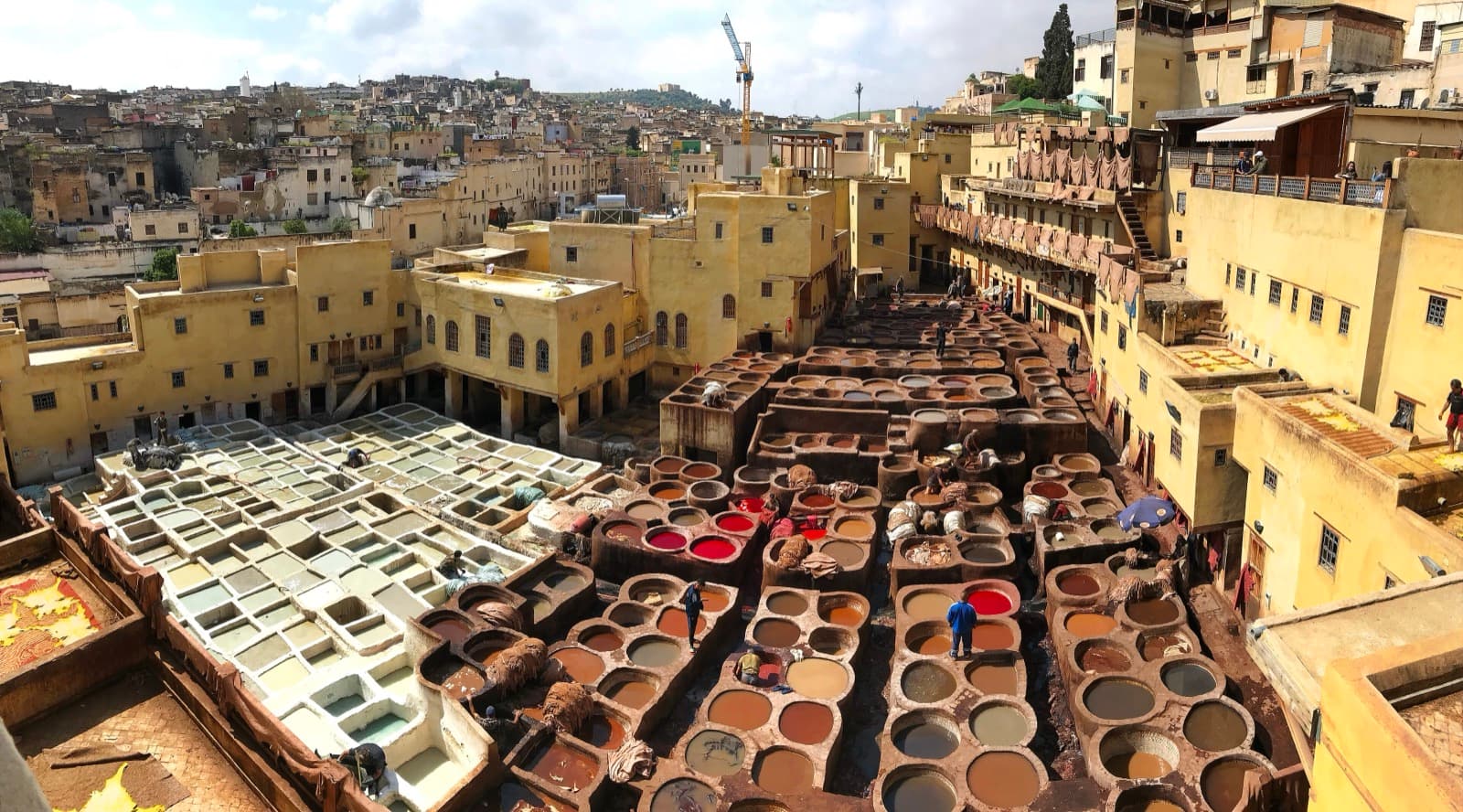
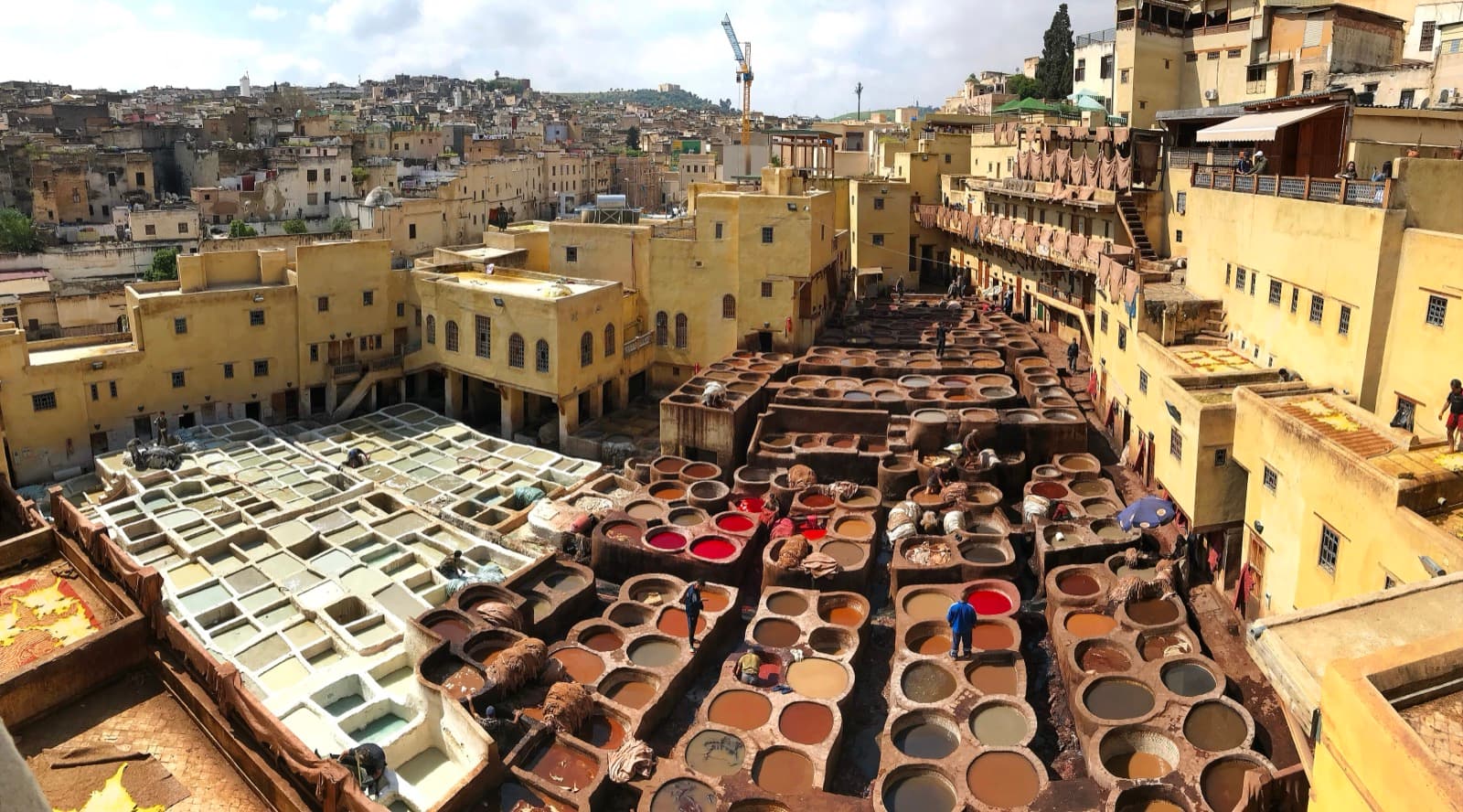
The walk closes at the Chouara Tannery, the largest and one of the oldest in Fez, worked entirely by hand: hides cured in white liquids of quicklime, pigeon droppings, salt, and water, then dyed in round stone vats with indigo, poppy, and henna. When Aziza Chaouni led its recent rehabilitation, the tannery was left in place rather than moved out. That is the honest last image of a medieval craft that never stopped working, in a city that never stopped being lived in.
The imperial city beside it
Hear a stop from this walk
The Chouara Tannery: The Craft That Stains the City's Hands
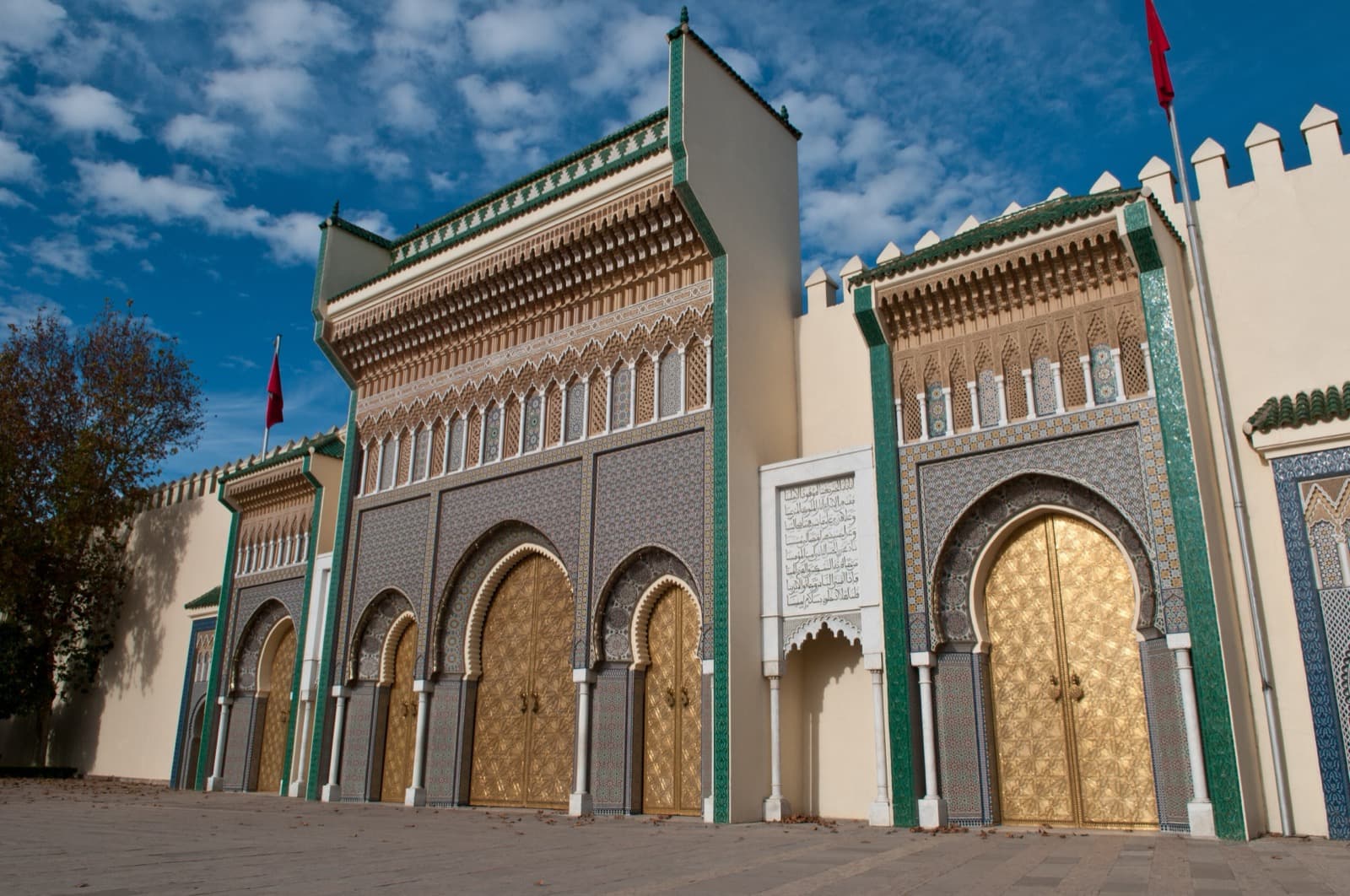
In 1276 the Marinid sultan Abu Yusuf Yaqub founded a second Fez next to the first: Fes Jdid, New Fez, a walled royal citadel of palaces, parade grounds, and gates. The Fes Jdid and Mellah walk begins at its ceremonial face, the gilded bronze gates of Dar el-Makhzen, the working Royal Palace whose grounds cover about eighty hectares, most of the New City itself. The gates that draw every camera are among the youngest things here, built between 1969 and 1971 under King Hassan the Second. The palace is still used by the King of Morocco, so the reward is the outside: the geometry that never repeats, the cedar and tile holding together at a scale meant to be read from exactly where you stand.
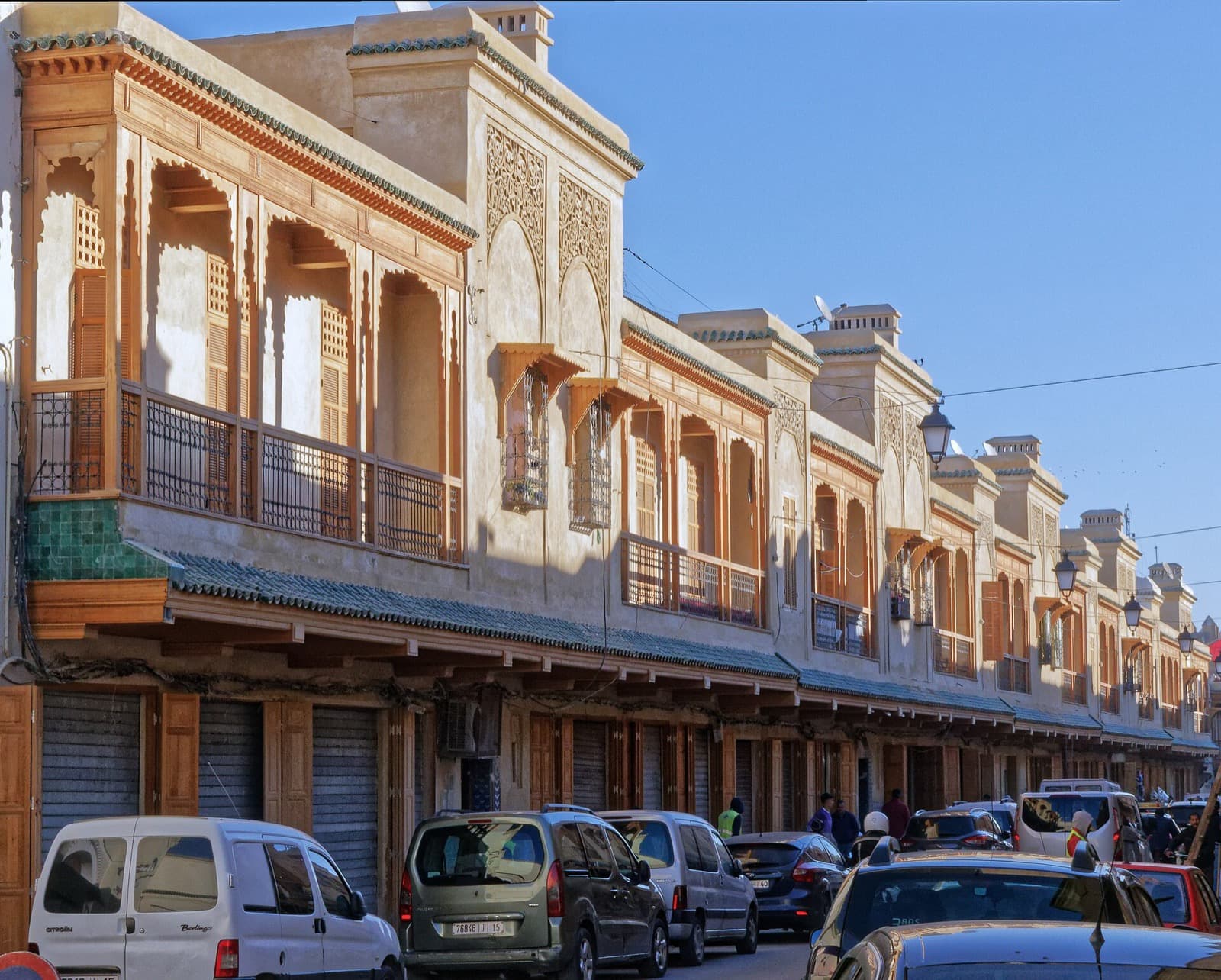
The Marinids placed a Jewish quarter directly beside their palace, and it was the first mellah in Morocco, a template later copied across the country. Scholars date the community's main move here to the mid-fifteenth century. The quarter reads differently from the rest of the old city: where traditional Moroccan houses turn inward around a private courtyard, mellah homes carry balconies and windows that face the street. The community was large and ancient, near fifteen thousand people in the late 1940s, but only about a hundred and fifty Jews remained in all of Fez by 1997, most having emigrated. What survived is the Ibn Danan Synagogue, one of the oldest in Morocco, dated to the seventeenth century and built by the merchant Mimon Boussidan. Its late-1990s restoration, funded through the World Monuments Fund with American Express and Morocco's Ministry of Culture, uncovered a mikveh, a ritual bath, hidden beneath the reading platform. Below the quarter, the whitewashed Jewish cemetery is still tended, holding centuries of the community's dead and the venerated grave of Sol Hachuel, known as Solica, a young woman from Tangier executed in Fez in 1834 for refusing to renounce her faith.
The dynasty that outlived its own tombs
From the mellah the walk turns imperial, into the mechouars, the walled parade grounds where sultans held public audiences, dispensed justice, and massed their armies, stitched together by monumental Marinid gates like Bab Dekkaken. The Marinids were overthrown in a revolt in 1465, and New Fez declined until the Alaouites, who rule Morocco still, made it the political heart again. A cooler seam follows, Jnan Sbil, one of the oldest gardens of Fez, created in the nineteenth century by Sultan Moulay Hassan the First and opened to the public in 1917, its pool fed by the Oued Fes that also runs beneath the parade grounds.
The reading ends on the hill. The Marinid Tombs, attributed to the fourteenth century, are the ruined mausoleums of the dynasty that founded the New City, once crowned with green-tiled pyramidal roofs, now stone shells where five sultans lie, including Abd al-Haqq the Second, the last Marinid ruler. From here the whole of old Fez spreads out in one sweep, the dense medieval weave, the minarets, the Qarawiyyin at its center, everything you cannot see from within the lanes. It closes the circle: you begin at the golden gates the Marinids built and end at the broken tombs their kings raised for themselves, looking down on the city that outlasted them both.
Sources
- UNESCO World Heritage Centre, Medina of Fez inscription (1981).
- University of al-Qarawiyyin history and Fatima al-Fihri, recognized by UNESCO and Guinness World Records.
- Nejjarine Museum of Wooden Arts and Crafts and the Funduq al-Najjarin history.
- Ibn Danan Synagogue restoration records, World Monuments Fund.
- Roamer self-guided tour research files for Fes el-Bali and Fes Jdid (fact-audited transcripts).
Frequently asked questions
- Why is Fez called two cities in one?
- Fez contains the medieval medina of Fes el-Bali, founded in the ninth century, and Fes Jdid, a royal citadel the Marinid dynasty founded in 1276 beside it. The medieval city holds the university, madrasas, and shrines, while the imperial city holds the Royal Palace, parade grounds, and the Jewish mellah. UNESCO inscribed the whole of it in 1981 as Morocco's first World Heritage Site.
- What is the oldest university in the world in Fez?
- The University of al-Qarawiyyin, established between 857 and 859 by Fatima al-Fihri, a woman whose family came from Kairouan. UNESCO and Guinness World Records both recognize it as the oldest continuously operating degree-granting educational institution in the world. Its mosque is a living place of worship closed to non-Muslims, but its library, restored by architect Aziza Chaouni, reopened to the public in 2016.
- Is Fes el-Bali really car-free?
- Fes el-Bali is one of the largest car-free urban areas on earth. The Blue Gate, Bab Bou Jeloud, marks the western threshold beyond which motor traffic generally cannot pass. Inside, movement is on foot, with handcarts and mules carrying goods through the maze of lanes.
- What is the mellah in Fez?
- The mellah was the first Jewish quarter of its kind in Morocco, with the community's main move dating to the mid-fifteenth century. Unlike the inward-facing courtyard houses of the rest of the old city, mellah homes turned toward the street with balconies and windows. It preserves the seventeenth-century Ibn Danan Synagogue and a still-tended hillside cemetery, though the community itself largely emigrated in the twentieth century.
- Where is the best view of the whole medina of Fez?
- The Marinid Tombs on the al-Qula hill north of Fes el-Bali offer the classic panorama over the entire medieval city. The ruined fourteenth-century mausoleums belong to the dynasty that founded Fes Jdid, and from the hill you can read the dense weave of lanes, the minarets, and the Qarawiyyin at its center in a single sweep.
Ready to experience it?
Fes el-Bali: Inside the World's Largest Living Medina
150 min · 2 km · moderate
More from Fez
Explore more at your own pace.
Fez Travel Guide: Days, Transport, Season, Safety, Budget
One Day in Fez: A Walkable Medina-to-Sunset Itinerary
The Mellah of Fez: The Jewish Quarter That Faced the Street
The Qarawiyyin: Walking Into the World's Oldest University in Fez's Living Medina
The Chouara Tannery in Fez: How Leather Is Still Dyed by Hand