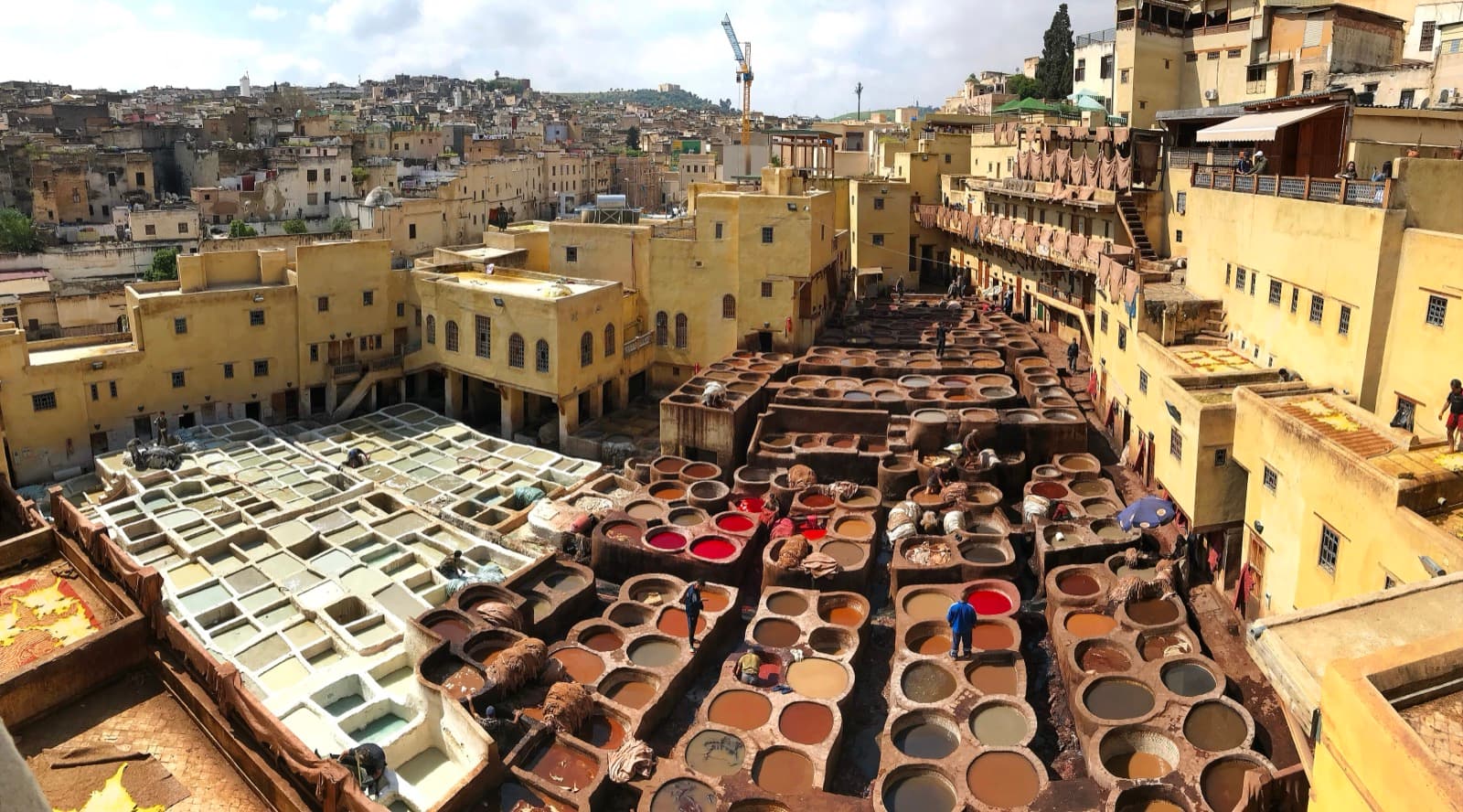
The Chouara Tannery in Fez is a medieval leather works where hides are still cured and dyed entirely by hand, in round stone pits, with no machinery of any kind. From the terraces of the leather shops that ring it, you look down onto a honeycomb of vats, some pale with curing liquids, some brilliant with color, and men standing waist-deep in them working the skins by foot and hand. Understanding that process, what is in each pit and why, is the difference between photographing a curiosity and reading a craft that has changed very little in centuries. This is the place where the walk down through Fes el-Bali ends, and it is the honest last image of a living city.
What you are looking at
Chouara sits near the Saffarin Madrasa along the Oued Fes, the river that runs through the old city. It is the largest of the three tanneries of Fez, alongside Sidi Moussa and Ain Azliten, and one of the oldest. The layout you see from above is not decorative. It is a working sequence, and the hides move through it in stages.
The first stage is curing. Fresh skins are soaked for a couple of days in the white liquids, mixtures that include quicklime, pigeon droppings, salt, and water. This is the part that produces the smell that reaches you before the sight does. The caustic bath loosens hair and flesh and softens the skin so it can take dye and last. The pale pits you see are this stage.
The second stage is the color. The cured hides are moved into the round stone vats and dyed with natural colorants: indigo for blue, poppy for red, henna for orange, and others. The bright pits, the ones that make the photographs, are these. The men in the vats are not posing. They are treading and turning the skins so the dye takes evenly, and the labor is exactly as hard as it looks. After dyeing, the leather is dried, and it ends up in the shops whose terraces you are standing on.
Why it matters that nothing is mechanized
Hear a stop from this walk
The Chouara Tannery: The Craft That Stains the City's Hands
The reason this site is worth crossing a whole medina to reach is not that it is picturesque. It is that the process is essentially unchanged. There is no machinery here. The curing, the dyeing, the drying, and the finishing are done by hand, by people, using materials a tanner in this quarter would have recognized many centuries ago. Most crafts that survive into the present survive as demonstrations, staged for visitors and detached from any real economy. Chouara is not that. It is a functioning production site inside a functioning city, and what you smell and see is a supply chain, not a show.
That distinction matters when you stand on the terrace. The shopkeeper who lets you up there expects the terrace access to lead to a look at the merchandise, and that is a fair trade for the view. A firm, polite no keeps you free to simply watch if you would rather not buy, and you can linger as long as you like. Many of the terraces hand you a sprig of mint to hold to your nose against the ammonia. Take it. The smell is part of the honesty of the place, but it can be genuinely overwhelming.
What is true, and what is only tradition
There is a story you will hear at the tannery and read on postcards: that these pits go all the way back to the founding of Fez by Idris the Second, in the early ninth century. It is a good story, and it may even be broadly true of tanning in this quarter. But it is worth being careful. Historians note that the earlier history of the Fez tanneries is not firmly established, and there is no clear evidence for exactly where the earliest ones stood or precisely how old Chouara itself is. So the ninth-century claim is best held as tradition rather than documented fact. What is documented is what is in front of you: a very old craft, still working, still hard.
The more recent history is better recorded, and it is the reason the tannery still exists in this spot at all. The Oued Fes had become badly polluted, and the tanneries were a major source. A wide rehabilitation project led by the Moroccan-Canadian architect Aziza Chaouni set out to clean up the river and control that pollution. An early proposal considered ending or curtailing the tannery's operations and moving the industry out of the medina. Crucially, that is not what happened. The tanneries were restored and left in place. Had they been relocated, Chouara would have become a memory and a plaque. Instead it is still here, still dyeing, which is why you can watch the real thing rather than a reconstruction of it. Chaouni's name is worth remembering, because she also led the restoration of the Qarawiyyin library a short walk away, which reopened to the public in 2016. Two of the medina's most important survivals owe their continuity to the same hand.
The last stop on the walk down
Chouara is deliberately placed at the end of the route through Fes el-Bali, and the placement is not an accident of geography alone. The whole walk runs downhill from the ceremonial Blue Gate along the great sloping main street, past a college that is also a mosque, past the university a woman founded in the ninth century, past the shrine of the city's founder-saint. Those are the medina at its most refined. The tannery is the medina at its most physical: the labor underneath the beauty, the craft that literally stains the hands of the men who do it. Ending here is the point.
To reach the terraces you thread the deepest part of the maze, where phone signal is weak and the lanes narrow to shoulder width, dodging handcarts and loaded mules. That is why a downloaded map and a route you can follow at your own pace matter more here than almost anywhere. If you want the whole descent, from the gate where the cars end to the pits along the river, with each stop narrated as you stand in front of it, walk the Fez walking tours route through Fes el-Bali, or start from the Fez city page and take it downhill on foot, which is the only way this city can be taken at all.
Sources
- Chouara Tannery, Wikipedia. Confirms Chouara as the largest of the three Fez tanneries (with Sidi Moussa and Ain Azliten), the curing and dyeing materials, the no-machinery process, the Aziza Chaouni river rehabilitation, the relocation proposal that was not carried out, and the unresolved dating of its origins.
- University of al-Qarawiyyin, Wikipedia. Background on the neighboring institution, its traditional ninth-century founding attributed to Fatima al-Fihri, and its library.
- Aziza Chaouni, Wikipedia. Biography of the Moroccan-Canadian architect behind the Fez River rehabilitation and the Qarawiyyin library restoration.
- Restoring the world's oldest library, TED Ideas. Documents Chaouni's Qarawiyyin library restoration, commissioned in 2012 and reopened to the public in May 2016.
Ready to experience it?
Fes el-Bali: Inside the World's Largest Living Medina
150 min · 2 km · moderate
More from Fez
Explore more at your own pace.
Fez Travel Guide: Days, Transport, Season, Safety, Budget
One Day in Fez: A Walkable Medina-to-Sunset Itinerary
Fez, Two Cities in One Wall: Reading the Medieval Medina and the Imperial City
The Mellah of Fez: The Jewish Quarter That Faced the Street
The Qarawiyyin: Walking Into the World's Oldest University in Fez's Living Medina