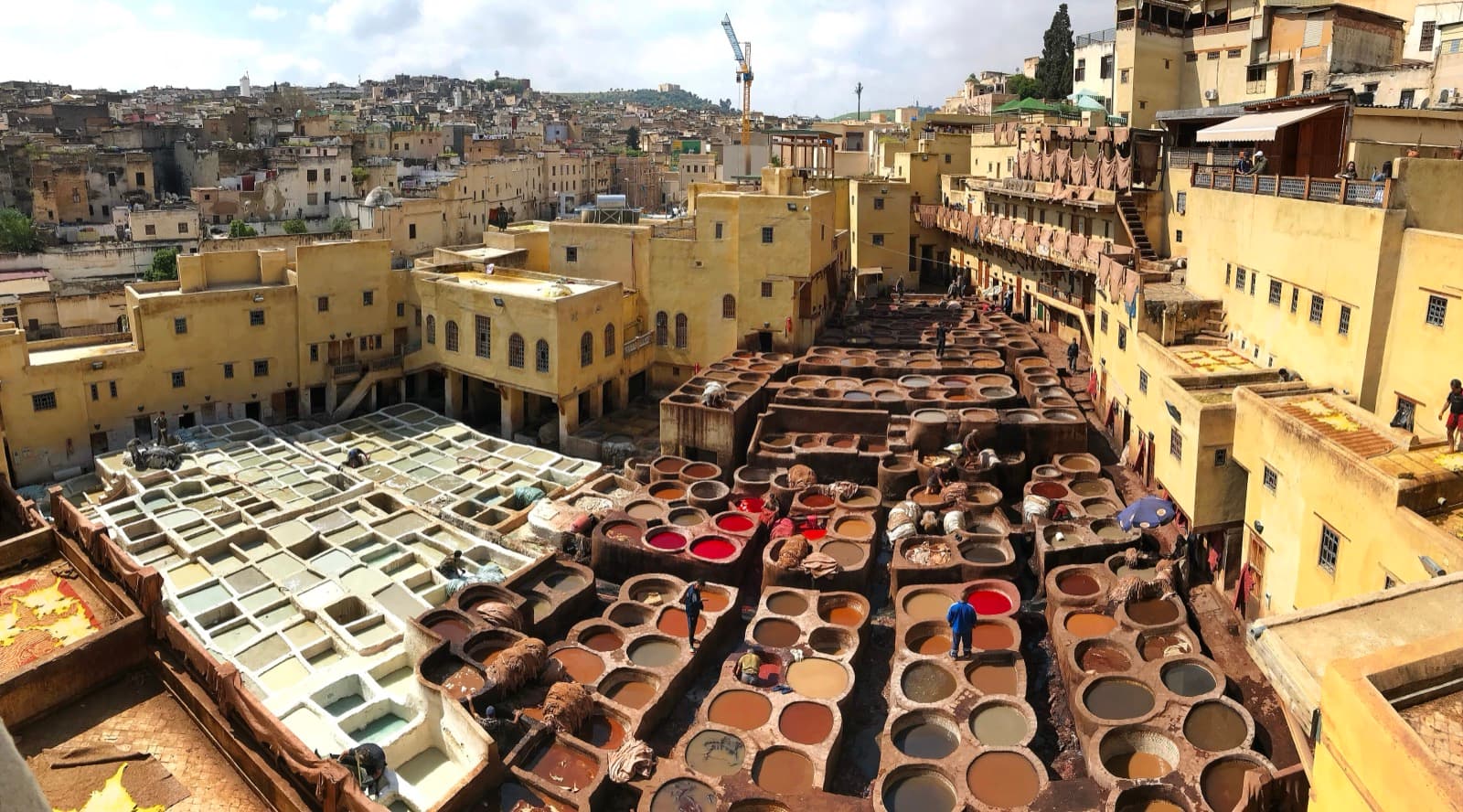
A walk down the great sloping artery of Fez's medieval old city, from the ceremonial Blue Gate to the hand-worked tanneries, threading a thousand years of a car-free city that still works.
Start · Bab Bou Jeloud: Where the Cars End
DirectionsStops
- 1
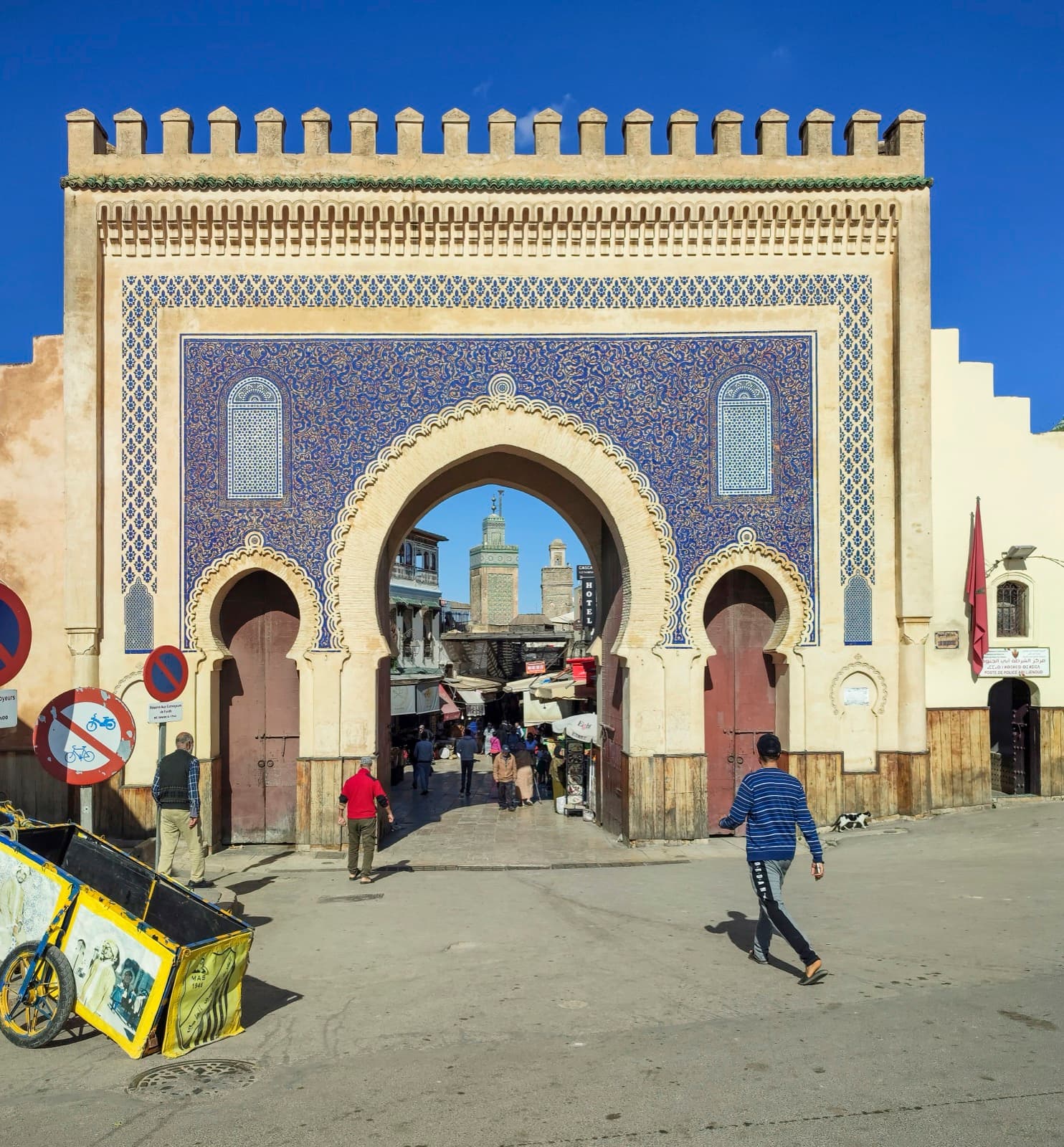
Bab Bou Jeloud: Where the Cars End
The grand blue-tiled western gate into Fes el-Bali, the threshold where the road ends and the medieval city begins.
- 2
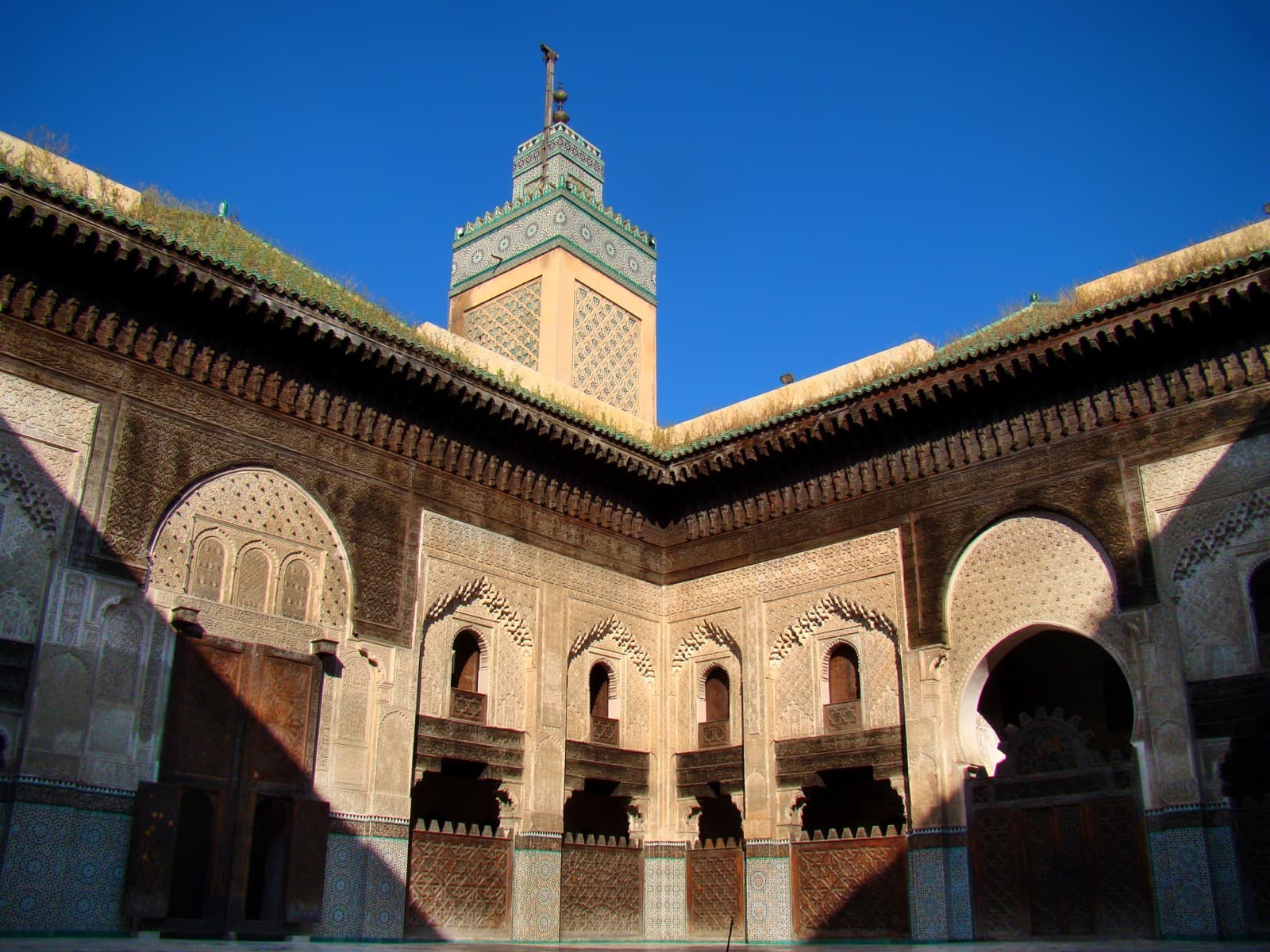
The Bou Inania Madrasa: A College That Is Also a Mosque
A masterpiece of Marinid craft on the great main street, the only Moroccan college that also served as a congregational mosque, facing a medieval water clock no one fully understands.
- 3
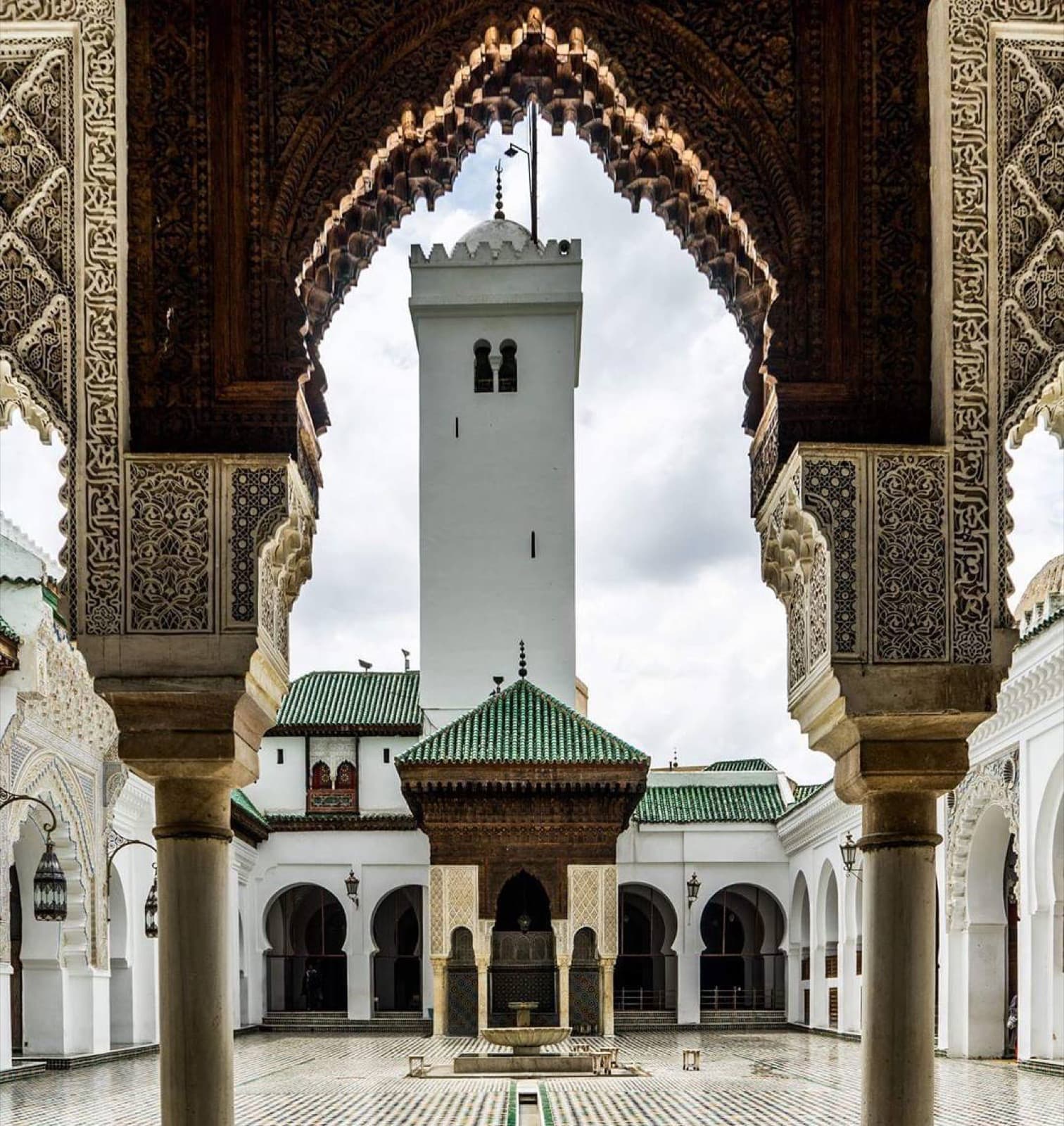
The Qarawiyyin: The University a Woman Founded
The mosque and university established in the ninth century by Fatima al-Fihri, recognized as the oldest continuously operating degree-granting institution in the world, viewed from its gates.
- 4
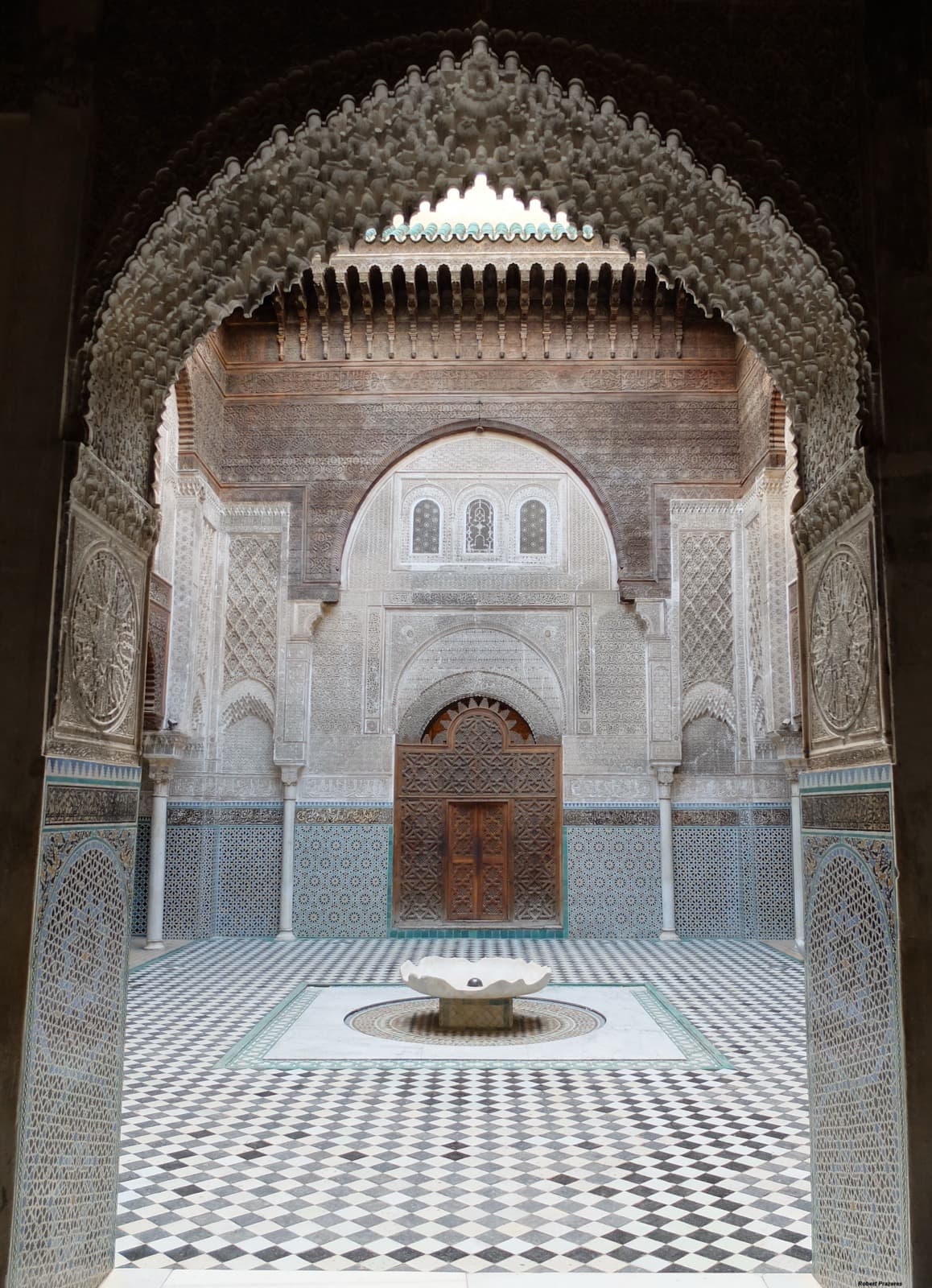
The al-Attarine Madrasa: A Jewel Box in the Perfume Market
A small, exquisite Marinid college on the edge of the spice and perfume market, prized as one of the highest achievements of its era's craft and open to enter.
- 5
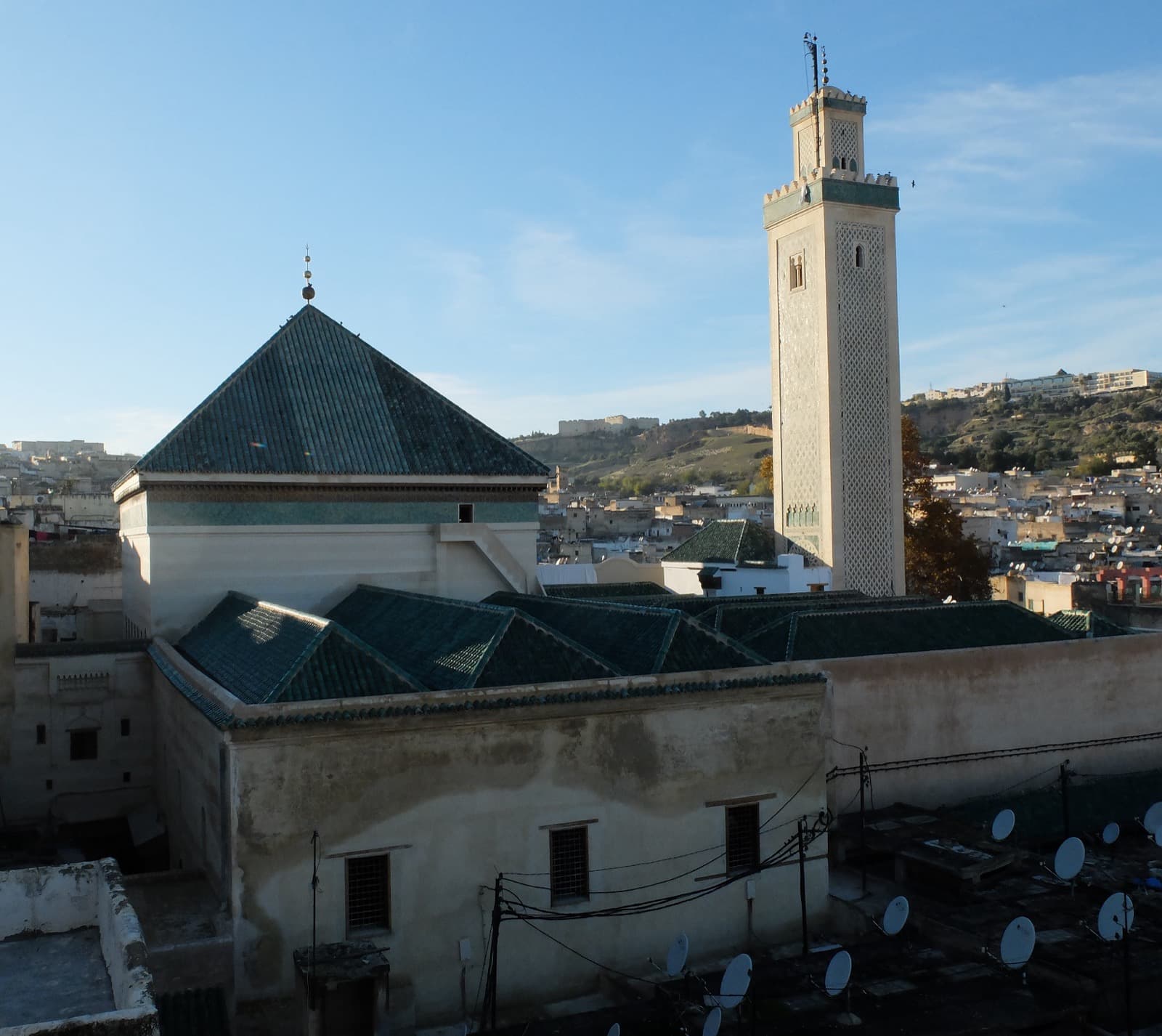
The Zawiya of Moulay Idriss the Second: The Saint at the Center of the Maze
The shrine and tomb of the founder-saint of Fez, one of the holiest places in Morocco and a place of living pilgrimage at the very heart of the medina, approached from its threshold.
- 6
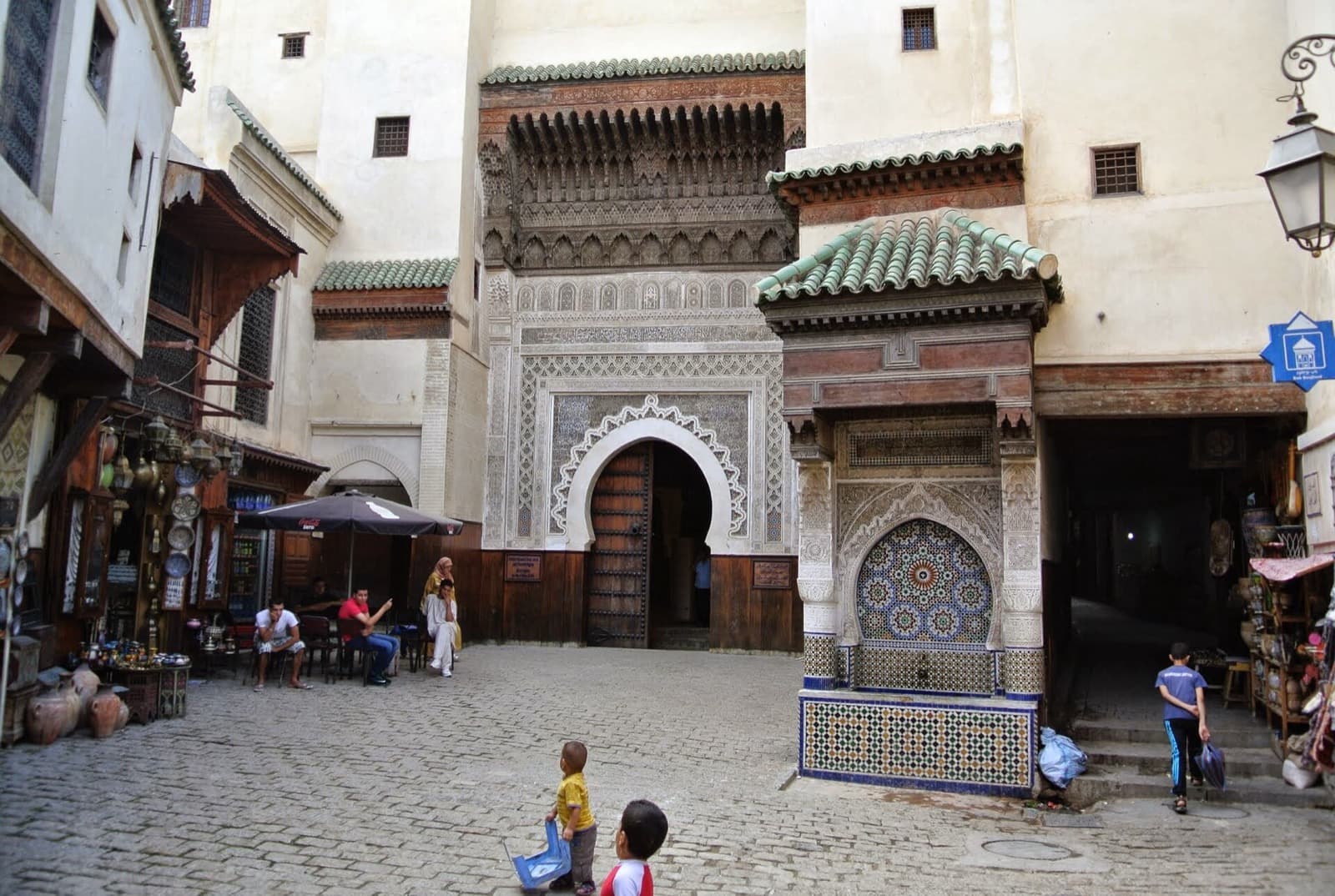
The Nejjarine Funduk: The Inn Where the Caravans Slept
An early-eighteenth-century caravanserai in the carpenters' quarter beside a carved cedar fountain, now the museum that safeguards the medina's ancient craft of wood.
- 7
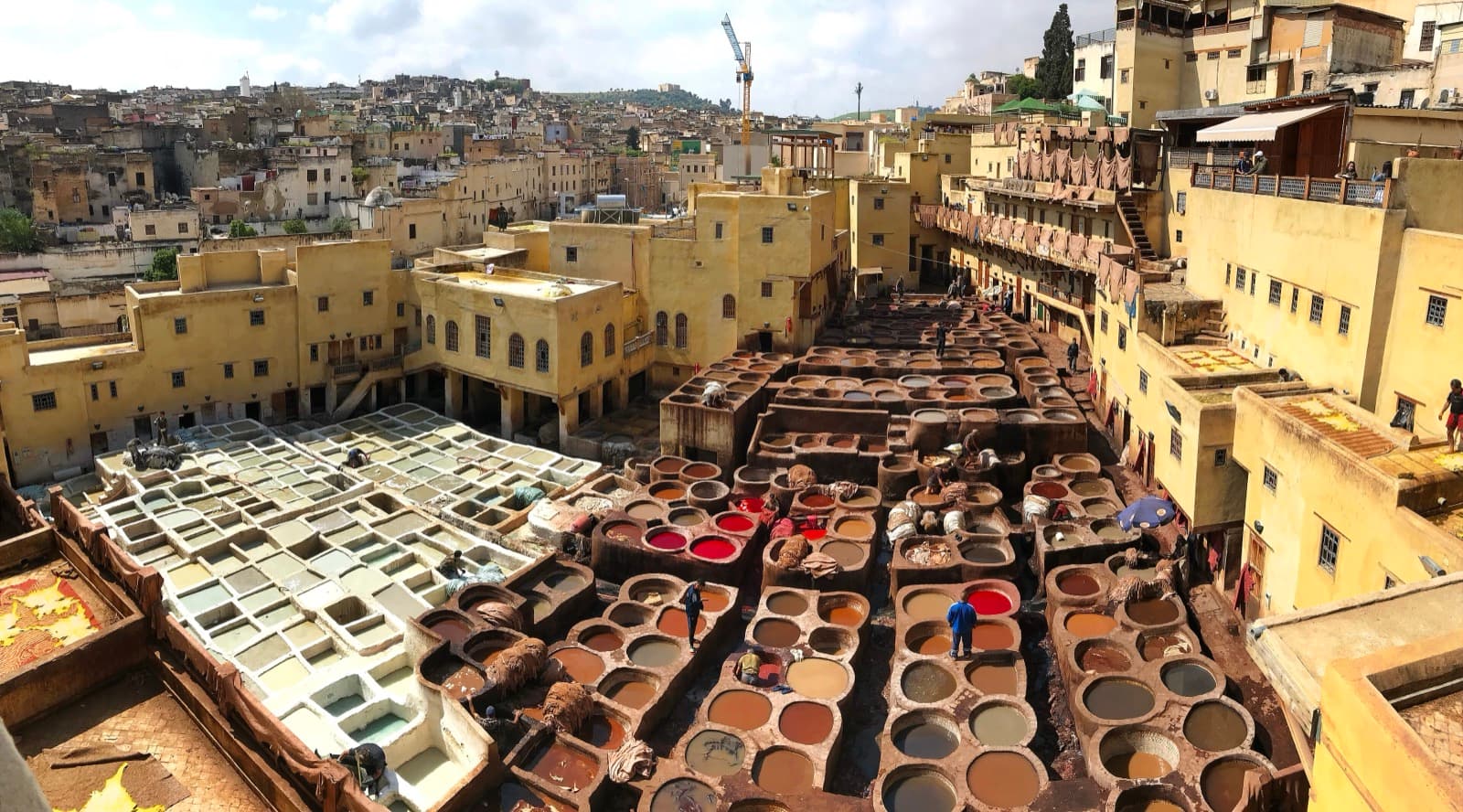
The Chouara Tannery: The Craft That Stains the City's Hands
The largest and one of the oldest tanneries of Fez, a honeycomb of stone dye-pits worked entirely by hand, viewed from the terraces above along the river.
Details
Best Time to Visit
Come in the morning, ideally soon after the shops open, when the light falls into the medina lanes and the tannery vats are best seen from the terraces before the midday sun and crowds build. Spring and autumn are the most comfortable seasons, since Fez summers are hot and the medina holds the heat. Note that Fridays and the daily prayer times change the rhythm of the mosque quarters around the Qarawiyyin and the Moulay Idriss shrine, so plan a slightly quieter, more reverent pace then.
Pro Tips
- •Download or screenshot your route before you go: the medina is a genuine maze with weak phone signal in the deep lanes, and having your own quiet map is what lets you move at your own pace instead of being steered.
- •The great sloping Talaa Kebira is your spine: the walk runs downhill from the Blue Gate toward the river, so when in doubt about direction, follow the slope down.
- •Carry small cash in Moroccan dirham for madrasa and museum tickets and small tips, since the Bou Inania and al-Attarine madrasas and the Nejjarine museum each charge a modest entry fee.
- •You may enter the two madrasas and the Nejjarine museum, but not the Qarawiyyin mosque or the Moulay Idriss shrine: treat the courtyard glimpse and the threshold as rewards in themselves, not as a lesser experience.
- •Dress modestly, covering shoulders and knees, especially near the Qarawiyyin, the Moulay Idriss shrine, and any mosque threshold, and keep your voice low around the shrine.
- •At the tanneries you view from the shop terraces above; a firm, polite no keeps you free if a shopkeeper expects you to browse, and you can linger on the terrace as long as you like.
Safety & Precautions
- •Non-Muslims may not enter active mosques such as the Qarawiyyin or the Zawiya of Moulay Idriss the Second: view them from the outside, the gate, the courtyard glimpse, or the threshold, and keep a respectful distance from worshippers and pilgrims.
- •Insistent faux-guides, touts, and shopkeepers work the medina gates and the busy lanes and may offer to lead you or pull you toward a shop: a firm, polite no and your own map keep you moving freely and at your own pace.
- •The medina lanes are a true maze with uneven, sometimes slick footing, steps, and crowds, so wear sturdy shoes, watch for handcarts and loaded mules squeezing past, and take it slowly.
- •The Chouara Tannery is a working site with a strong smell that can be overwhelming; shopkeepers on the terraces sometimes offer mint to hold to your nose, and dress modestly throughout, especially near shrines and mosque thresholds.
- •Where the lanes are tightest and most crowded, a bump or a staged jam can cover a hand: keep valuables zipped away and wear your bag across your front, and be wary of anyone who crowds or distracts you.
- •Terraces and shops around the tannery may wave you up as a free look, then expect a purchase or a tip for a viewing you never asked for: enjoy the view, and if you do buy leather, agree the exact item and price before anything is wrapped.
Travel advisory: Exercise Increased Caution (Level 2).
Gallery
Related Reading
Go deeper on what you'll see, hear, and walk through.

Overview
Best Self-Guided Walking Tours in Fez (2026)
3 min
Overview
Fez Travel Guide: Days, Transport, Season, Safety, Budget
7 min
Overview
One Day in Fez: A Walkable Medina-to-Sunset Itinerary
7 min
Thematic
Best History Walking Tours in Fez (2026)
2 min
Thematic
Fez, Two Cities in One Wall: Reading the Medieval Medina and the Imperial City
7 min
Companion
The Qarawiyyin: Walking Into the World's Oldest University in Fez's Living Medina
7 min
Deep dive
The Chouara Tannery in Fez: How Leather Is Still Dyed by Hand
6 min
Read
What to Eat in Fez: A Local Food Guide
5 min
Read the walk
The full story of Fes el-Bali: Inside the World's Largest Living Medina, in words. Prefer to listen? Play it narrated, from home or on location.
Introduction
Fes el-Bali is the old walled city of Fez, in Morocco, and it is one of the largest car-free urban areas on earth. Founded in the ninth century by the Idrisids and grown to its height under the Marinid dynasty of the thirteenth and fourteenth centuries, it is among the best-preserved medieval cities in the Islamic world, a place UNESCO records inscribed in its entirety in nineteen eighty-one. This tour has seven stops and covers a little under two kilometres, though the medina rewards slowness, so give it two to three hours. The route runs downhill along the great artery of the old city, from the ceremonial gate near the top toward the river below. Along the way you pass a college that is also a mosque and a water clock no one can fully explain, the oldest continuously operating university in the world, founded by a woman, a jewel-box college in the perfume market, the shrine of the city's founder-saint at the very heart of the maze, an old caravanserai now guarding the craft of cedar, and the medieval tanneries still dyeing hides by hand. This is not a museum. A thousand years stands packed shoulder to shoulder here and still working, and because you truly cannot drive, the only way through is on foot. That is the gift of it. This is your own quiet map, your own pace, no group, no schedule, no one steering you into a shop. Linger at a threshold, read a facade, and move on when you choose. When you arrive at the outer face of Bab Bou Jeloud, the Blue Gate, begin with stop one.
1. Bab Bou Jeloud: Where the Cars End
This is Bab Bou Jeloud, the Blue Gate, the grand ceremonial western entrance into Fes el-Bali. Bab simply means gate. Its facade is a wall of tilework, and the blue you see on the outer face is the color long associated with the city of Fez. Turn and look back once you pass through, and the inner face is predominantly green, the color of Islam. The gate is younger than almost everything beyond it. It was completed in nineteen thirteen by the French colonial administration, whose chief of municipal services, Captain Mellier, laid out plans in December of nineteen twelve to open a new, larger entrance in the old city walls. During the French Protectorate, which ran from nineteen twelve to nineteen fifty-six, the French built their new city beside the medina rather than over it, and the Blue Gate is one of their additions, executed in Moroccan craft: pointed horseshoe arches, a crenelated top, arabesques and geometric motifs. Through the main arch, framed like a picture, you can see the silhouettes of two minarets. One belongs to the Bou Inania Madrasa, your next stop, and the other to the Sidi Lazzaz Mosque. This gate still marks the main western way in, and it marks something else: the limit beyond which cars generally cannot pass. Fes el-Bali is the largest car-free urban area in the world. Step through the arch and the honking, the engines, the whole machinery of the modern street simply ends. What begins is a medieval city that never stopped being lived in. From here it is all on foot, and that is exactly why you can take it at your own pace.
2. The Bou Inania Madrasa: A College That Is Also a Mosque
You are on the Talaa Kebira now, the great sloping main street that runs down through the medina like a spine. Rising beside it is the Bou Inania Madrasa. A madrasa is a religious school or college, and this one is a masterpiece of Marinid architecture, built by Sultan Abu Inan Faris between thirteen fifty and thirteen fifty-five. What makes it unique is simple: it is the only madrasa in Morocco that also functioned as a congregational mosque. You may enter the madrasa as a monument, and you should, but the prayer-hall portion remains a working mosque and is off-limits to non-Muslim visitors, so this is where reverence draws a quiet line. From the courtyard you can take in the rest: marble paving around a central fountain, walls of zellij, the cut-tile mosaic that Fez is famous for, carved stucco worked as fine as lace, and warm cedar wood overhead. A brick minaret rises at the northwestern corner. Then step back out onto the Talaa Kebira and look directly across the street. Those carved cedar beams and brackets high on the wall opposite are all that remain visible of the Dar al-Magana, the house of a famous medieval water clock, likely completed in thirteen fifty-seven. It once told the hours by some hydraulic mechanism, and here is the strange part: the mechanism is famous, and yet it is not fully understood. Scholars still cannot say for certain exactly how it worked. So you stand between two Marinid marvels, a college that is also a mosque, and a clock no one can fully explain, both more than six hundred years old, both still standing on a street you can simply walk at your own pace.
3. The Qarawiyyin: The University a Woman Founded
This is the Qarawiyyin, and it is the reason many people come to Fez at all. The mosque and university here was established between eight hundred and fifty-seven and eight hundred and fifty-nine, in the ninth century, by Fatima al-Fihri, a woman of a family that had come from Kairouan. That origin is right there in the name: al-Qarawiyyin means the Kairouanese. UNESCO and Guinness World Records both cite it as the oldest continuously operating degree-granting educational institution in the world, older than any university in Europe. Sit with that. A university a woman founded, in the ninth century, still teaching. The mosque itself covers about half a hectare and can hold around twenty-two thousand worshippers, among the largest in Africa. It is a living mosque, so non-Muslims may not enter, and there is no disappointment in that. Approach the great gates, look through, and you can glimpse the courtyard, the arches, the fountains, the students crossing. That glimpse, offered from the threshold, is its own reward, and it costs nothing. There is one interior here you can enter. The Qarawiyyin library is one of the oldest libraries in the world, holding priceless manuscripts, including a copy of the work of the historian Ibn Khaldun. It was restored by the Moroccan-Canadian architect Aziza Chaouni, commissioned in twenty twelve by the Moroccan Ministry of Culture, and reopened to the public in twenty sixteen. So you stand at a place that has been teaching for more than eleven hundred years, and you can move at your own pace between what you may only glimpse and what you may walk right into.
4. The al-Attarine Madrasa: A Jewel Box in the Perfume Market
Just beside the Qarawiyyin, at the edge of the market called Souk al-Attarine, stands the al-Attarine Madrasa. The name tells you where you are: attarine are the perfumers and spice sellers, so this is the school of the perfumers, and around it drifts the smell of the trade. A…
Full narration for this stop unlocks with the tour.
5. The Zawiya of Moulay Idriss the Second: The Saint at the Center of the Maze
You have reached the spiritual heart of the medina. This is the Zawiya of Moulay Idriss the Second, and a zawiya is a shrine and religious lodge. It holds the tomb of Idris the Second, who lived from seven hundred and ninety-one to eight hundred and twenty-eight and is…
Full narration for this stop unlocks with the tour.
6. The Nejjarine Funduk: The Inn Where the Caravans Slept
Step into the Nejjarine square and the noise drops for a moment. Nejjarine means the carpenters, and this has been their quarter since the Marinid era. The first thing you meet is the fountain, a beautiful thing of tilework and carved cedar. It was commissioned in the nineteenth…
Full narration for this stop unlocks with the tour.
7. The Chouara Tannery: The Craft That Stains the City's Hands
Here is where the walk ends, and where the smell reaches you before the sight does. This is the Chouara Tannery, the largest and one of the oldest of the tanneries of Fez, set down near the Saffarin Madrasa along the Oued Fes, the river. You view it from the terraces of the…
Full narration for this stop unlocks with the tour.