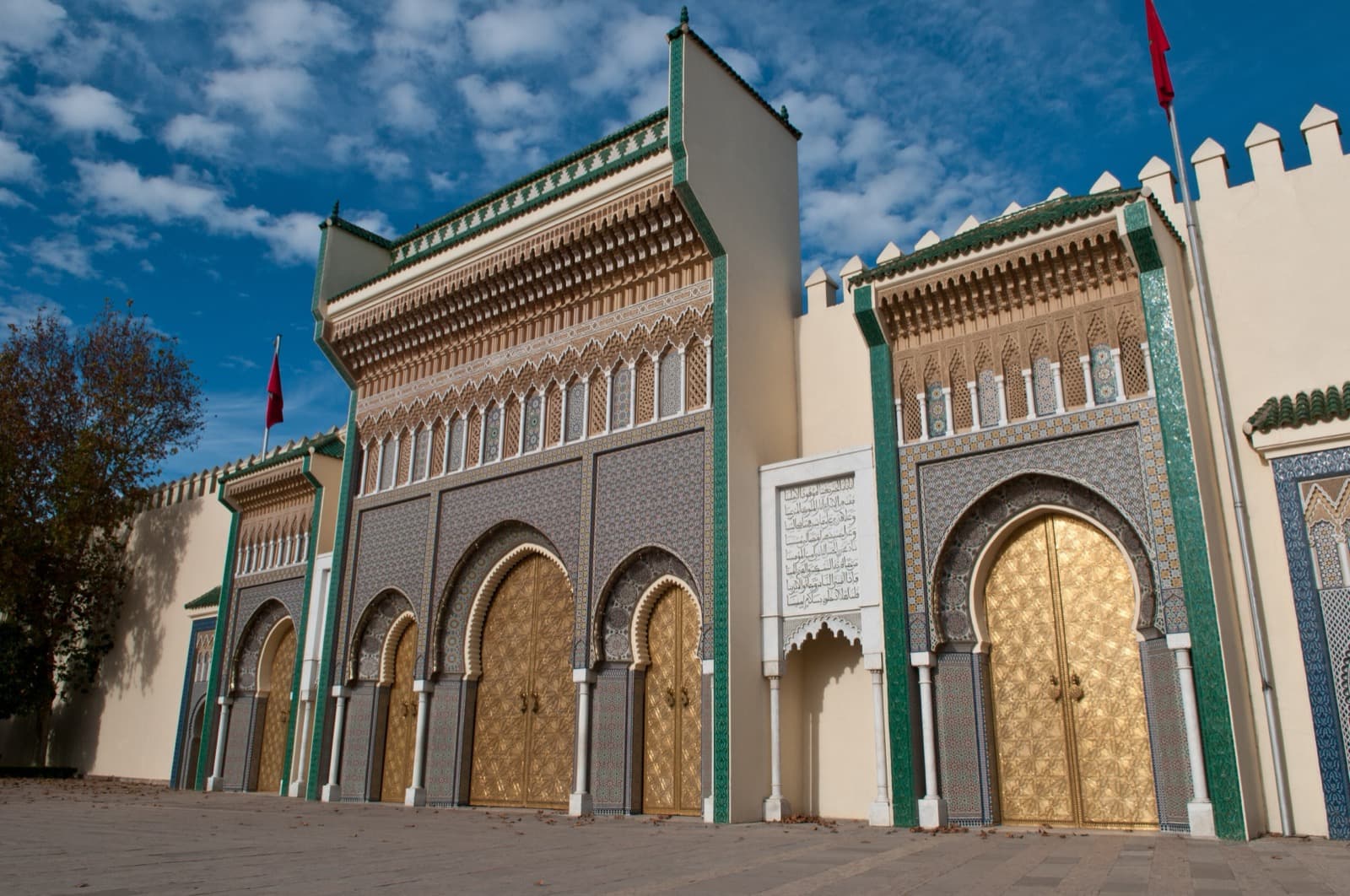
The Royal Palace Gates on Place des Alaouites are the ceremonial front of Dar el-Makhzen, the working Royal Palace of Fez, and they stand on the exact ground where a second Fez began. Behind the gilded bronze doors lies a palace still used by the King of Morocco, closed to visitors, spreading across roughly eighty hectares. In front of them opens a broad public square built to give the palace a face. Understand one thing standing here and the rest of the walk falls into place: this is not the medieval medina most travelers come to see. It is New Fez, a royal citadel the Marinid dynasty founded in twelve hundred and seventy-six, and these doors are its front entrance.
A city within a city
Most people arrive in Fez expecting the famous maze: the Qarawiyyin, the tanneries, the thousands of narrow lanes of Fes el-Bali, the old town. That city is real, and it is a short walk from where you stand. But Place des Alaouites belongs to a different Fez with a different logic. In the year twelve hundred and seventy-six, the Marinid sultan Abu Yusuf Yaqub founded Fes Jdid, meaning New Fez, as a fresh royal citadel and seat of government beside the older town. The court moved in soon after, within about a year. From that point Fez was two cities, not one: the crowded medina where people lived and traded, and the walled imperial quarter where power sat, guarded and apart.
The palace has occupied most of that new quarter ever since. The eighty hectares behind these gates take up much of the entire Fes Jdid the Marinids laid out, forming the largest single division of the walled city, which is why the citadel and the palace are so hard to separate. When you look at the gates, you are looking at the door of a compound that is, in effect, most of the neighborhood. This is the useful thing to carry with you: New Fez was built to be a government, and its scale still reflects that. The medina grew from markets and mosques. This place was designed from the top down, as a stage for rule.
The gates are newer than they look
Hear a stop from this walk
The Mellah of Fez: The Quarter That Faced the Street
Here is the detail that surprises careful visitors. The golden doors that draw every camera are among the youngest things at this site. They were built between nineteen sixty-nine and nineteen seventy-one, under King Hassan the Second, in a period when Morocco was investing in the traditional crafts that define its monuments. They are doors of gilded bronze worked in fine geometric patterns, framed by carved cedar and bands of zellij, the cut-tile mosaic that Fez is known for above all other Moroccan cities.
That modern date does not diminish them. It clarifies what you are seeing. The workmanship is old, the doors are recent, and the two facts together tell you how Moroccan craft has continued unbroken into the present rather than surviving only as ruins. The geometry never repeats. Stand at the right angle and watch the light move across the metal, and you can read how the cedar, the tile, and the bronze were composed to be seen from exactly the spot the square places you. The whole square, Place des Alaouites, was laid out in the nineteen sixties to frame this view. It is a piece of ceremonial design, and you are meant to stand in it and look.
Marinid ground, Alaouite palace
The site carries two dynasties. The Marinids founded the citadel in the thirteenth century, but the Marinid line was overthrown in a revolt in fourteen hundred and sixty-five, when the last Marinid sultan was killed in Fez, and Fes Jdid slipped into a period of decline afterward. Most of what stands inside the palace today is the work of the Alaouites, the dynasty that has ruled Morocco since the seventeenth century and rules it still. When the Alaouites took hold, they made these grounds the political heart of Fez once more, which is why the modern King of Morocco still uses the palace and why the gates, the guards, and the protocol out front are entirely real and entirely current.
That layering is the honest picture of the place. A Marinid foundation, an Alaouite palace, and a set of gates from the late nineteen-sixties, all reading as one monument. It is worth resisting the instinct to date the whole thing to a single golden age. Fez rarely works that way. The city keeps building on its own past, and Place des Alaouites is a compact lesson in exactly that habit.
What to do standing here
There is no interior to tour. This is a functioning royal residence, the doors do not open for the public, and the reward is entirely on the outside. That is not a disappointment once you know it going in. It frees you to slow down. Read the patterns in the bronze, find where the cedar meets the tile, notice how the scale of the square holds the gates at a distance meant to be admired rather than entered. Around the palace and the nearby medina gates, faux-guides and shopkeepers can be insistent, and a firm, polite refusal keeps you free to linger here as long as the light rewards it. Morning is best, when the quarter is quiet and the light on the metal is soft.
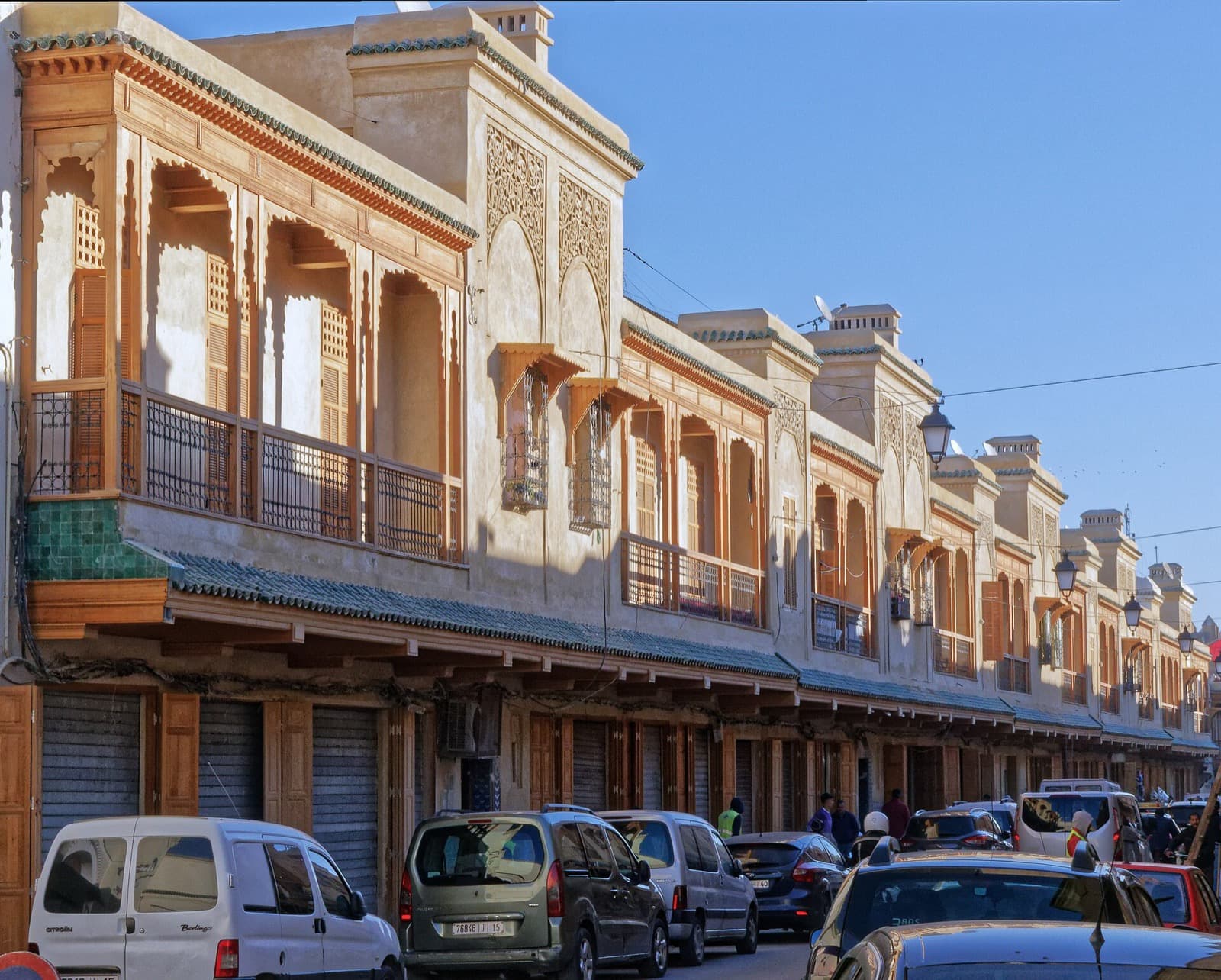
From these gates the ground story continues. A few streets on lies the mellah, the first Jewish quarter established in Morocco, whose houses famously turned their windows and balconies out toward the street. The imperial parade grounds, a cool royal garden in the seam between the two Fezes, and the ruined tombs of the very Marinid dynasty that founded this citadel all thread together from here. The full route reads that imperial and layered city across seven stops, and it begins at the doors in front of you.
If you want to walk it in order, at your own pace and on your own schedule, start with the Fes Jdid and the Mellah tour on Roamer, which opens right here at Place des Alaouites and carries the story of the New City through to the dynasty's broken tombs above the medina. For more routes through the old and new cities, see our Fez walking tours.
Sources
- Royal Palace of Fez, Wikipedia. Overview of Dar el-Makhzen, its founding under the Marinids, the eighty-hectare grounds, the Alaouite-era construction, and the gates built between 1969 and 1971 on Place des Alaouites.
- Fes Jdid, Wikipedia. History of New Fez as a Marinid royal citadel founded in 1276, the court's relocation about a year later, the palace as the largest division of the walled city, and the Alaouite revival.
- 1465 Fez revolt, Wikipedia. The uprising in which the last Marinid sultan, Abd al-Haqq II, was overthrown and killed, ending Marinid rule.
- UNESCO World Heritage Centre, Medina of Fez. Inscription record covering Fes el-Bali and Fes el-Djedid, inscribed in 1981 as Morocco's first World Heritage Site and one of the best-conserved historic towns of the Arab-Muslim world.
- Roamer tour transcript, "Fes Jdid and the Mellah: The Imperial and Jewish City." Fact-audited on-site narration for the Royal Palace Gates and the surrounding imperial quarter.
Ready to experience it?
Fes Jdid and the Mellah: The Imperial and Jewish City
150 min · 5 km · moderate
More from Fez
Explore more at your own pace.
Fez Travel Guide: Days, Transport, Season, Safety, Budget
One Day in Fez: A Walkable Medina-to-Sunset Itinerary
Fez, Two Cities in One Wall: Reading the Medieval Medina and the Imperial City
The Mellah of Fez: The Jewish Quarter That Faced the Street
The Qarawiyyin: Walking Into the World's Oldest University in Fez's Living Medina