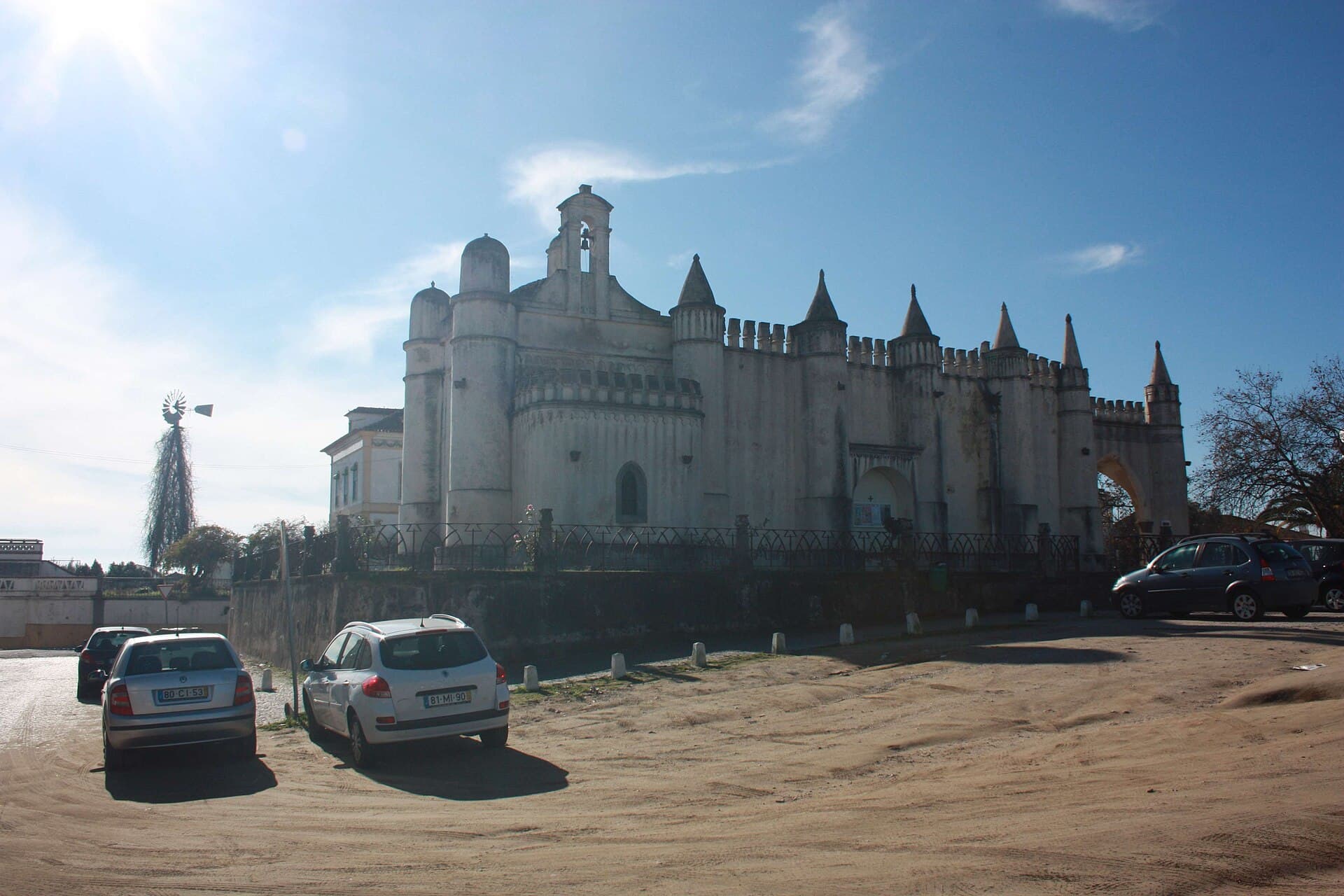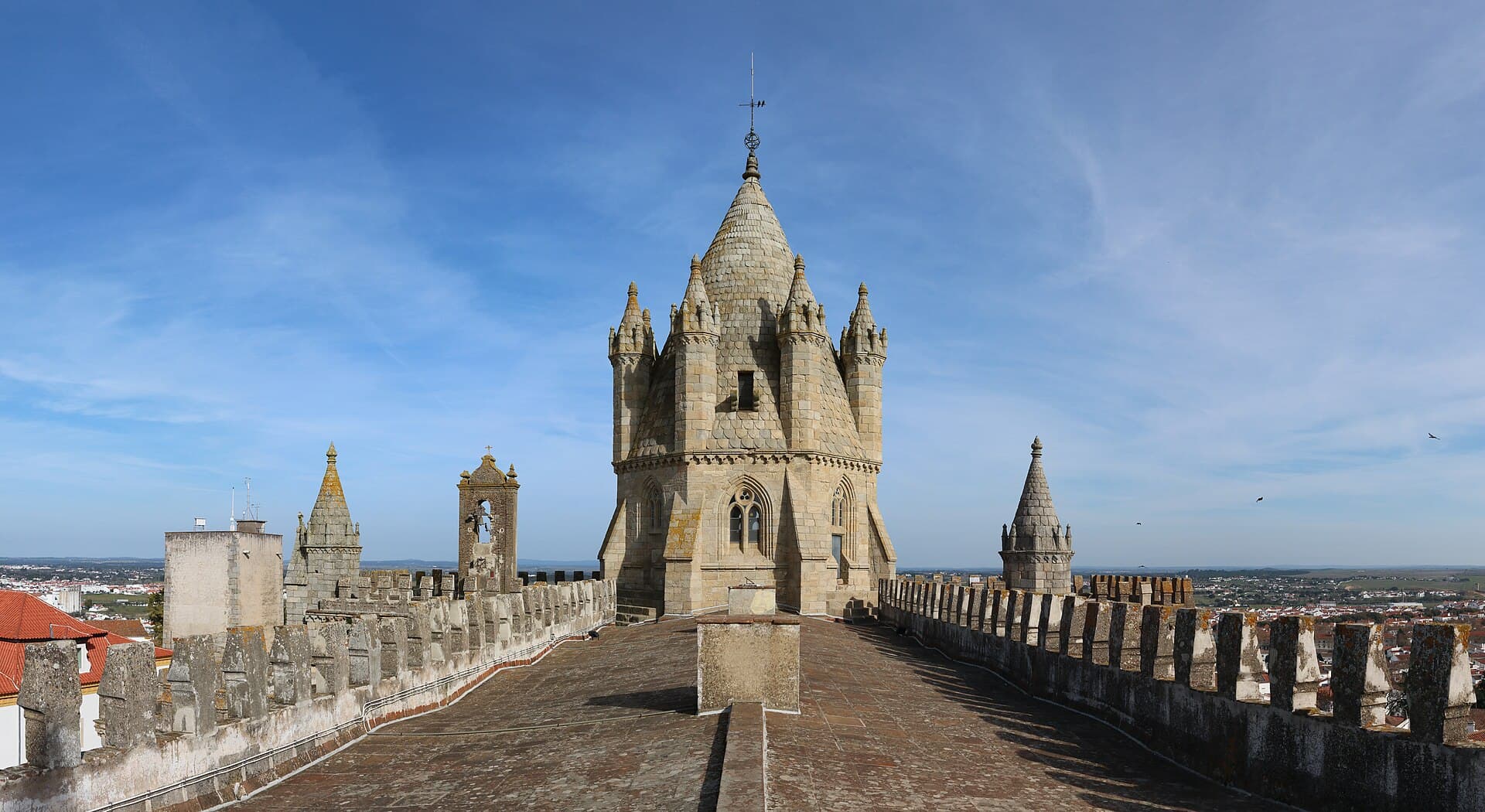
Evora's cathedral was built to be defended, not just prayed in. The Se de Evora is a granite fortress with an altar inside, begun in the year eleven eighty-six and enlarged into the largest of Portugal's medieval cathedrals. Standing in front of it, the one thing to understand is that its battlements, corbels, and two spired towers are not decoration borrowed from a castle. They are the honest architecture of a frontier church raised on ground that had recently changed hands, in a century when a house of God on a border still had to look like it could hold that border.
A fortress that happens to hold an altar
Look at the west front before you buy a ticket. Two massive towers frame the entrance, each finished with a conical spire that went up in the sixteenth century, and the walls between and around them carry battlements and stone corbels of the kind you would expect on a defensive wall. The material is granite, quarried from the same hard rock that Evora's hill is made of. Nothing here reaches for lightness. Where a French Gothic cathedral of the same era dissolved its walls into glass, the Se keeps its mass and lets the mass do the talking.
That solidity is not an accident of taste. The record shows groundbreaking in eleven eighty-six, with the principal Gothic enlargement running roughly from twelve eighty to thirteen forty. Sit with that span for a moment. While masons were still shaping this cathedral in the years around thirteen hundred, a Venetian named Marco Polo had just returned from the long overland road toward China, the two worlds of a single medieval century running in parallel. Evora had passed from Moorish to Portuguese control only a couple of decades before the first stones were laid, and the Alentejo remained contested ground. A cathedral begun in that setting was a statement of permanence as much as of faith, and its fortress silhouette says so plainly.
The largest of Portugal's medieval cathedrals
Hear a stop from this walk
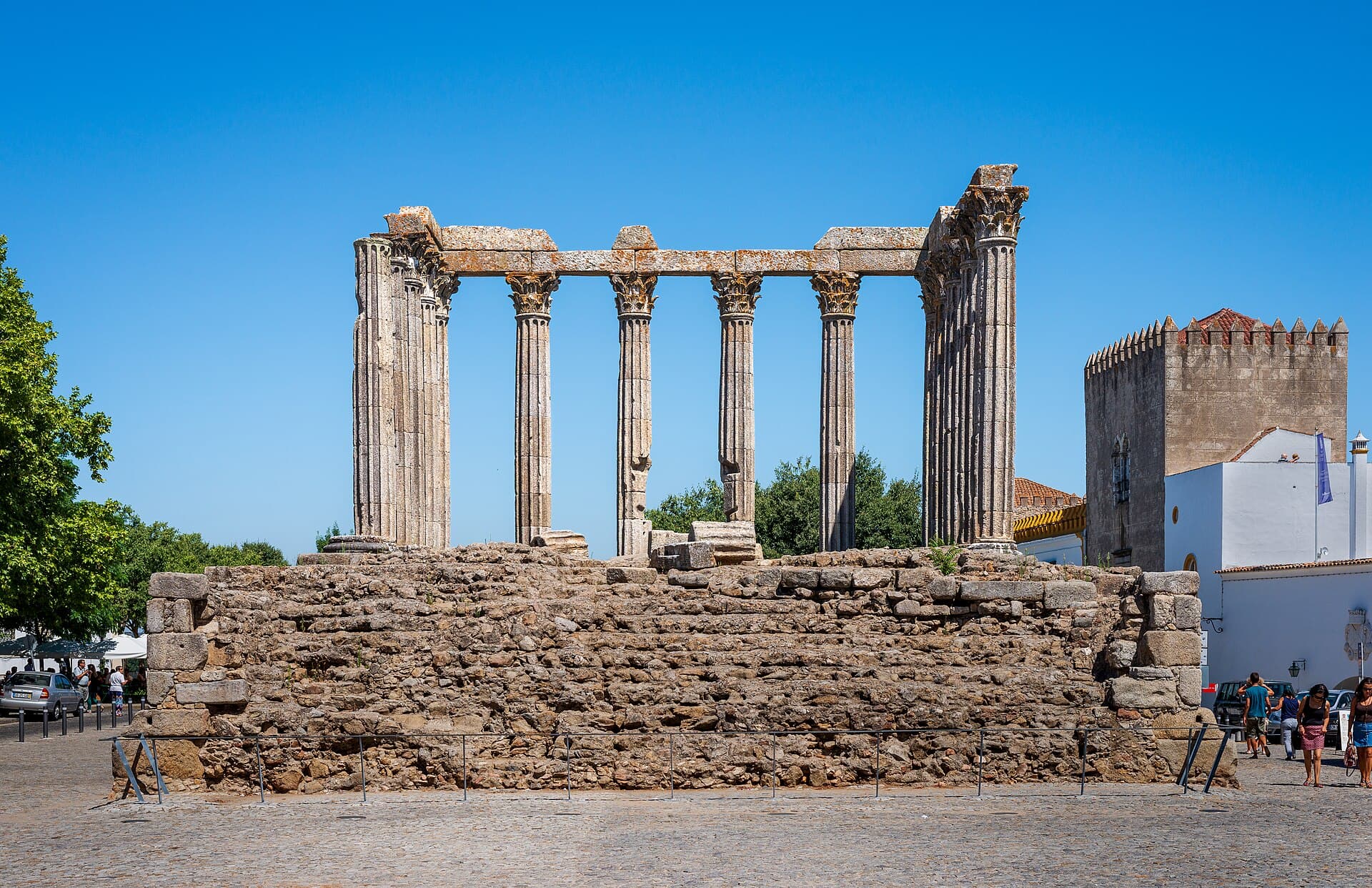
Templo Romano de Evora: The Crown of the Hill
The Se is the largest of Portugal's medieval cathedrals, and the claim is easy to feel rather than measure. The nave is long, the granite is cool even in Alentejo summer, and the whole interior settles a certain weight onto you the moment you step out of the sun. Later centuries added their own layers, Manueline stonework and Baroque interventions, without softening the essential heaviness of the twelfth- and thirteenth-century bones. This is a building that absorbed new styles the way the hill it sits on absorbed new occupants: it took them in and kept its shape.
If your legs are willing, the reason to pay for the higher ticket tier is the rooftop terrace. It is reached by a spiral stair of about one hundred and thirty-five steps, and from the top the whole walled town spreads out beneath you, roofs and lanes and the far edge where the plain begins. Standing up there you understand the Roman logic that put a temple on this same crown of the hill: whoever holds the high ground sees everyone coming. The cathedral inherited that ground and that logic.
The da Gama story, held at arm's length
Every good cathedral collects a story, and this one has a famous one. It is commonly believed that in fourteen ninety-seven the standards of Vasco da Gama's fleet were blessed here before he sailed to find the sea route to India. It is a lovely image, the banners of the voyage that would reroute the world's trade raised in this granite nave. It is also tradition rather than documented fact, so the honest thing is to carry it as a possibility and not a certainty. Part of the pleasure of reading Evora carefully is learning where the pretty story ends and the record begins, and the cathedral is a good place to practice that discipline. You lose nothing by admitting the uncertainty. The building is astonishing enough on the confirmed facts alone.
What is documented is the Se's real weight in Portuguese life. A cardinal named Henrique, who would later briefly wear the Portuguese crown himself, served as archbishop here, tying this provincial cathedral directly to the top of the kingdom's church and, for a moment, its throne. And in the right transept lies the humanist scholar Andre de Resende, a Renaissance figure of Evora buried inside the very building his city had raised centuries before he was born. A cathedral is a long conversation between the people who built it and the people who are eventually laid to rest in it, and the Se has been holding that conversation for over eight hundred years.
Where the cathedral sits in the stratigraphy of the hill
The Se is the second stop on a walk that reads Evora's hill from top to bottom, and its position is deliberate. Just uphill stands the first-century Roman temple, the crown of the town. Just beside that temple sits a Renaissance church wrapped in blue-and-white tiles and a palace still lived in by the Dukes of Cadaval. Downhill lies the reconquest square named for Gerald the Fearless and, at the bottom, the Jesuit university where the city's golden age turned from power toward learning. The cathedral is the medieval hinge in that sequence, the century of faith and fortification set between Roman stone above and Renaissance ambition below.
That is why standing in front of the Se rewards a slow look rather than a quick photo. You are not just looking at a big old church. You are looking at the moment a frontier town decided it was permanent and built accordingly, in granite, with battlements, for keeps. UNESCO inscribed the whole historic center on the World Heritage List in nineteen eighty-six, and the cathedral is one of the anchors of that inscription.
To walk the Se in sequence with the temple above it and the university below, follow the evora-roman-temple route, a roughly two-kilometre reading of the hill that puts the cathedral in its rightful place between the Roman crown and the Renaissance town. You can browse the full set of Evora walking tours to see how this stop connects to the rest of the old town, or head straight to the city hub for Evora itself. Buy the tiered cathedral ticket with the terrace if you have the legs, arrive before the coaches if you want the granite to yourself, and let the sheer solidity of the place settle on you before you continue down the hill.
Sources
- Evora Cathedral, Wikipedia. Groundbreaking in 1186, Gothic enlargement circa 1280 to 1340, twin sixteenth-century spires, granite walls with battlements and corbels, and its standing as the largest of Portugal's medieval cathedrals.
- UNESCO World Heritage Centre, Historic Centre of Evora. The 1986 inscription and the cathedral's role within the museum-city ensemble.
- Roamer tour transcript, "Two Thousand Years on One Hill" (evora-roman-temple), fact-audited stop on the Se de Evora, covering the da Gama tradition, Cardinal Henrique, Andre de Resende, and the rooftop terrace.
- Evora Cathedral visitor information, ticket tiers and the roughly 135-step spiral stair to the rooftop terrace.
Ready to experience it?
Roman Temple of Évora: Two Thousand Years on One Hill
85 min · 2.2 km · easy
More from Evora
Explore more at your own pace.
Evora Travel Guide: Days, Transport, Best Time, Safety, and Budget
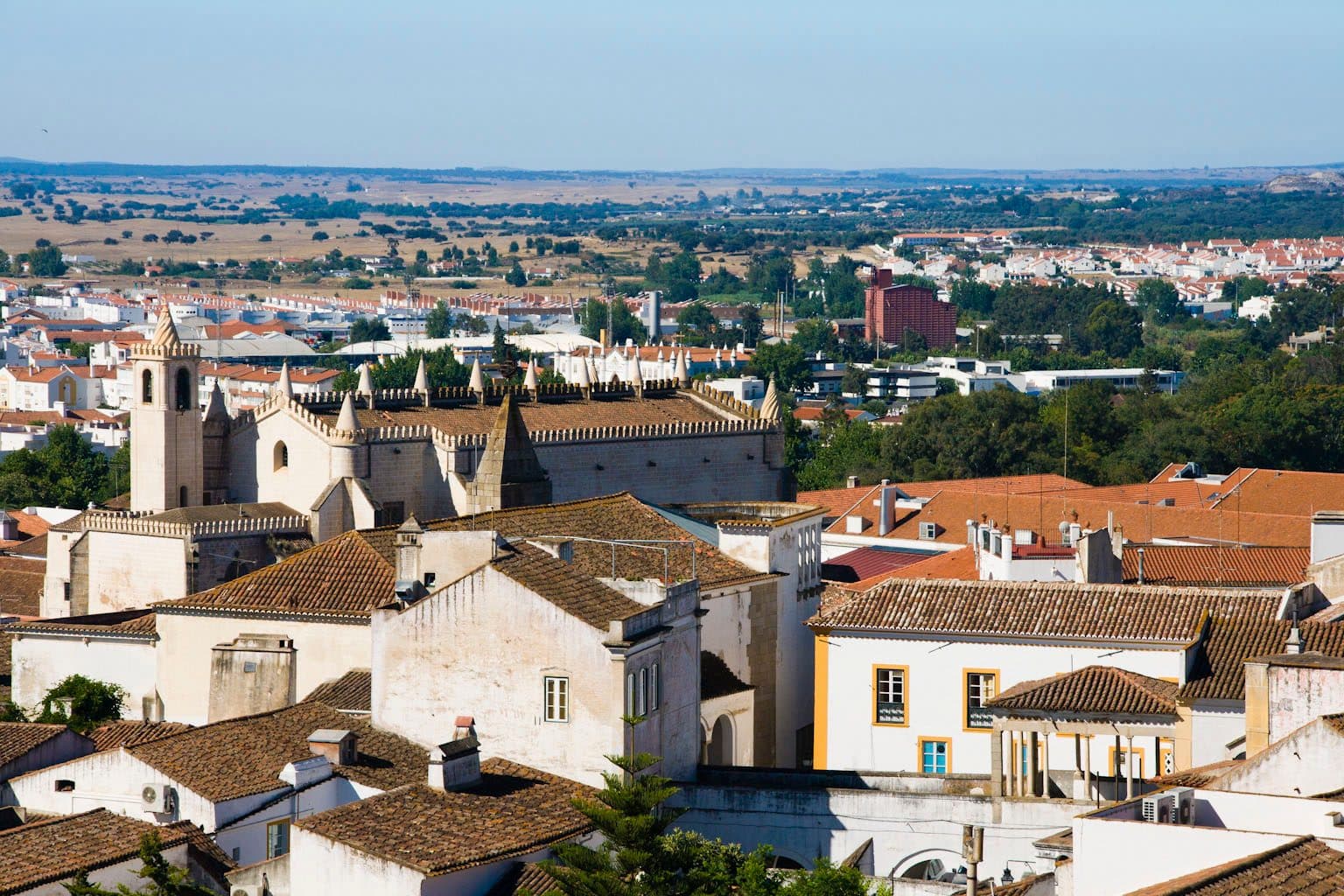
Evora: The Museum City That Never Stopped Being Lived In
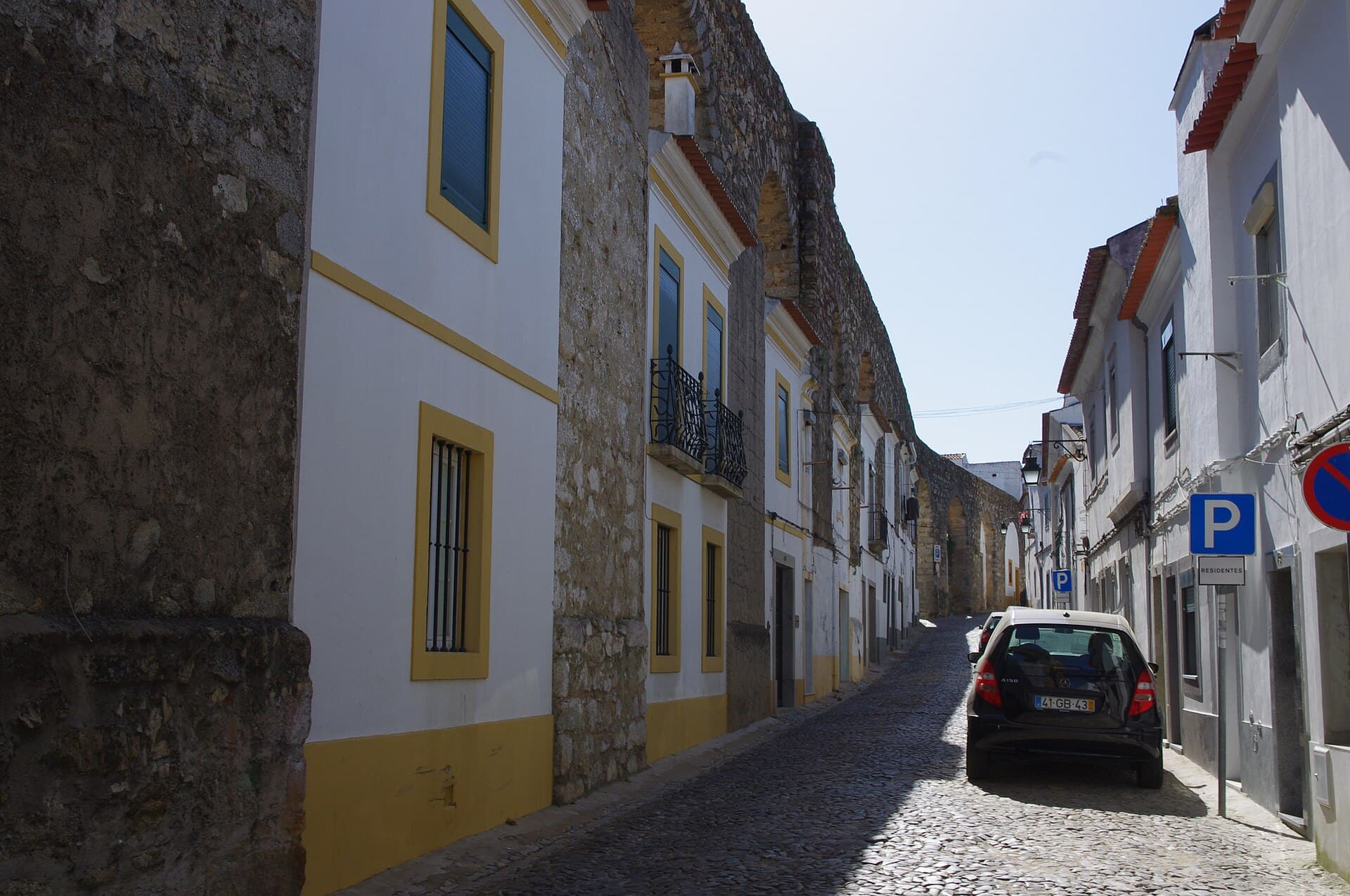
Rua do Cano: How Evora Moved Into a King's Aqueduct
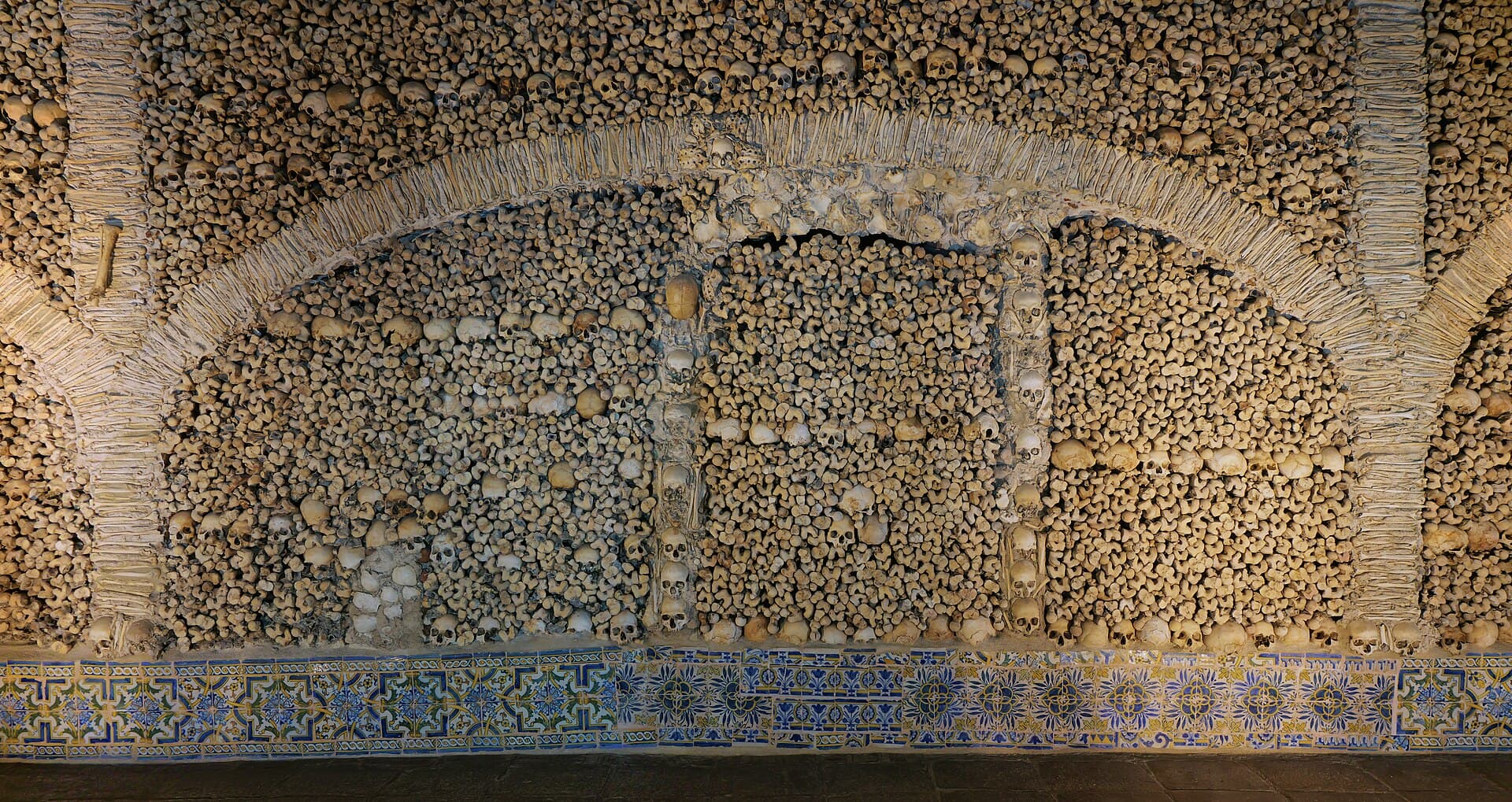
The Chapel of Bones in Evora: Why a City Lined a Wall With Its Dead
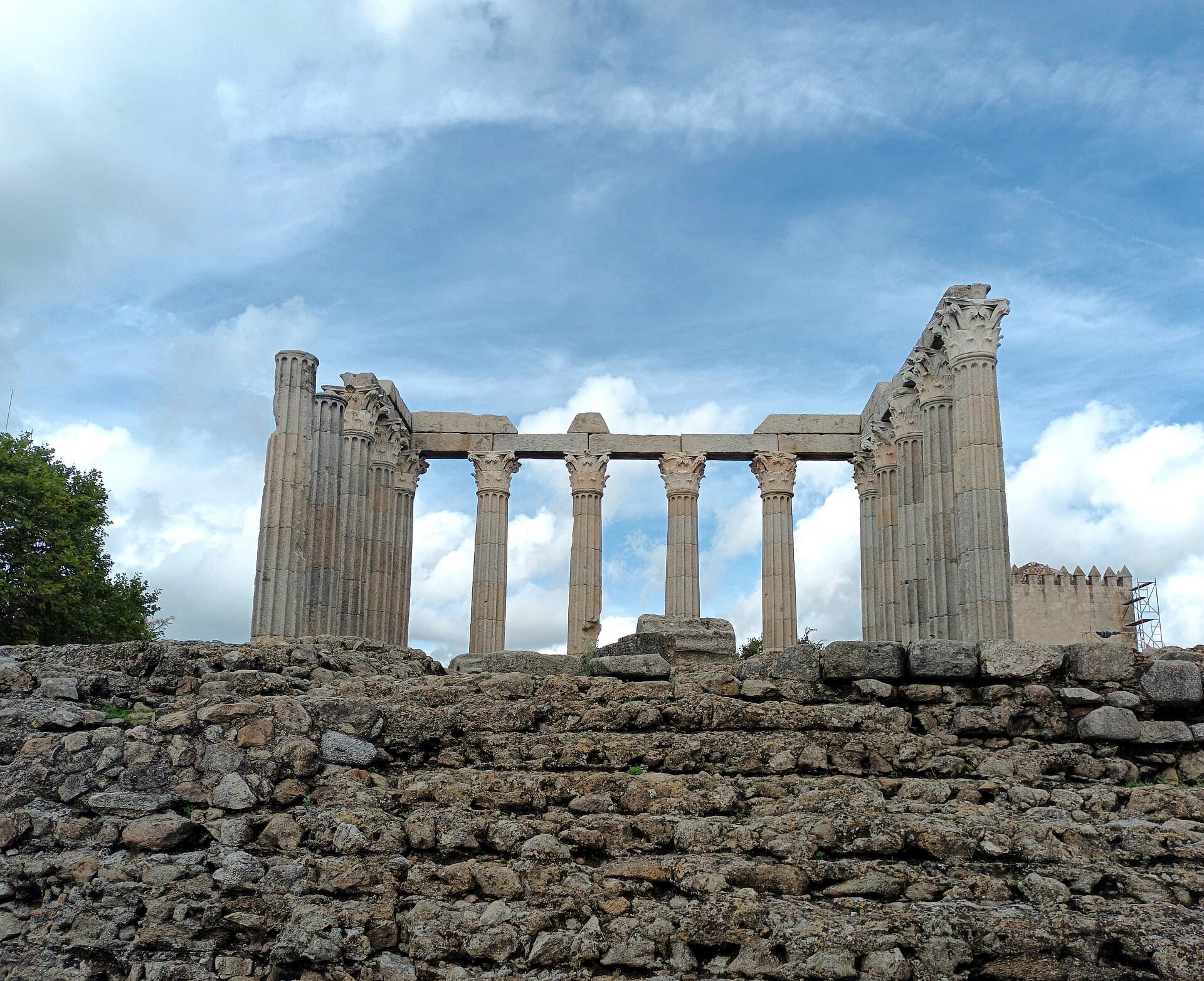
Why Evora's Roman Temple Survived as a Butcher Shop