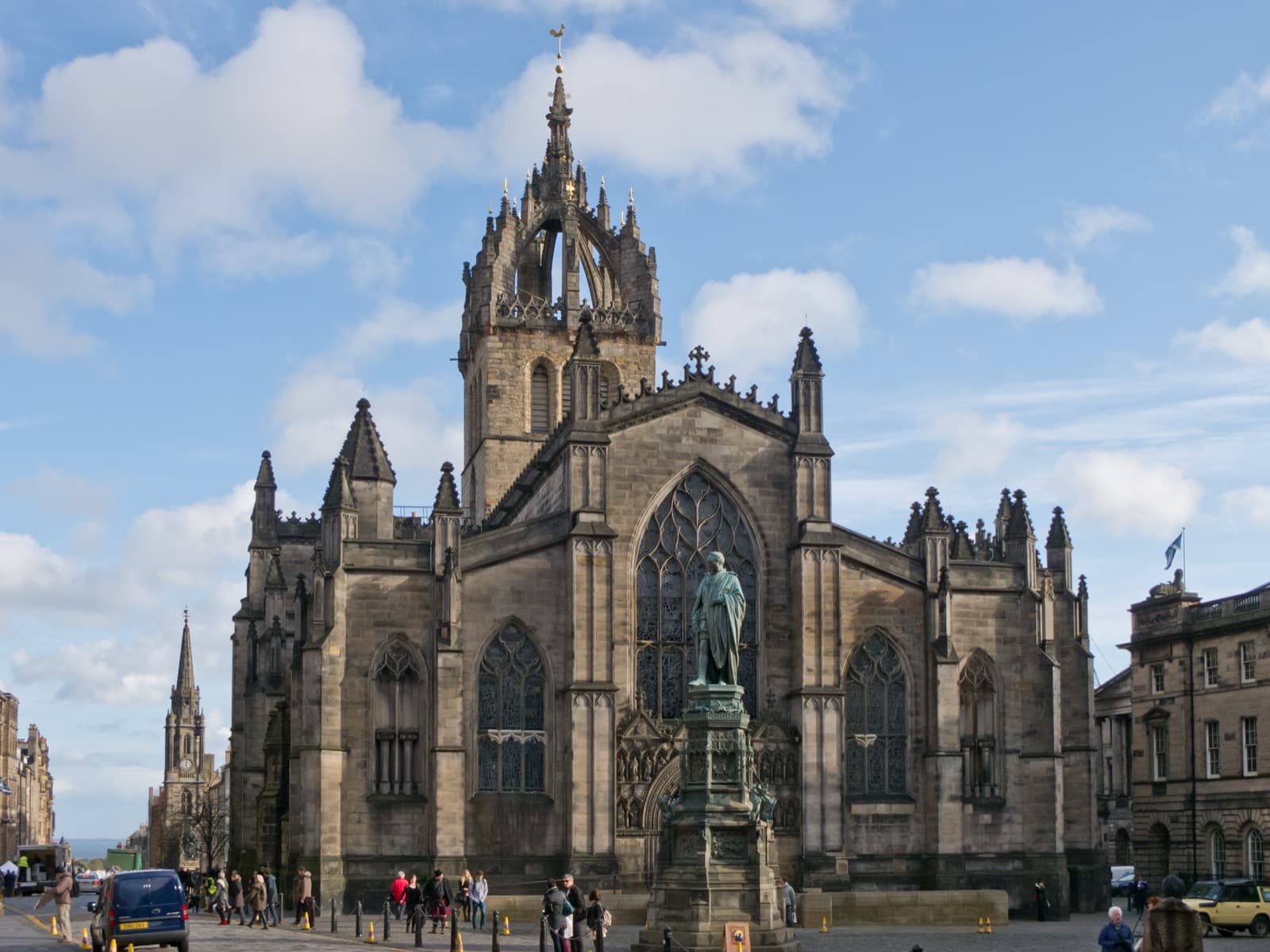
Saint Giles' Cathedral, the crown-steepled kirk where John Knox preached the Scottish Reformation and where the old Parliament of Scotland once met, is the hinge of the Royal Mile. Stand in Parliament Square, halfway down Edinburgh's medieval spine, and the whole walk turns around you: uphill lies the fortress on its dead volcano, downhill lies the royal palace, and here between them a nation changed its religion and argued its politics under one stone crown. If you understand this stop, you understand why the entire mile is worth walking.
The kirk that changed a nation
Saint Giles' is usually dated to around eleven twenty-four, a parish church dedicated to Saint Giles. Kirk is simply the Scots word for church, and this was the principal place of worship in the burgh. Its most famous feature rides the skyline overhead: the crown steeple, a stone crown of buttresses arched over the tower. The popular story dates it to around fifteen hundred, but dendrochronology, the dating of the steeple's timbers, points to a later medieval window. The felling dates of its oak run to the winters of fourteen fifty-three to fifty-four and fourteen fifty-nine to sixty, and the study places the crown's completion after fourteen sixty and probably by fourteen sixty-seven. The steeple is older than the guidebooks usually admit, and that small correction is a good lesson for the whole Old Town: the documented past is often sharper and stranger than the tourist version.
From this pulpit the whole country turned. John Knox first preached at Saint Giles' on the twenty-ninth of June, fifteen fifty-nine, was elected minister the following week, and served until his final sermon on the ninth of November, fifteen seventy-two, days before his death later that month. Under his leadership Scotland became Protestant, and the Scots Confession of fifteen sixty, adopted by the Scottish Parliament, set the Reformed faith as the establishment of the land and gave Scottish Presbyterianism its founding statement. Saint Giles' is, in the plainest sense, the mother church of that movement. When people call it the birthplace of the Scottish Reformation, they are pointing at a real pulpit, a real man, and a documented sequence of dates, not at a legend.
A church that was also a parliament
Hear a stop from this walk
Edinburgh Castle and the Esplanade: The Fortress on the Dead Volcano
Here is the detail that makes this stop the true centre of the tour. Saint Giles' was never only a church. In fifteen sixty-two and fifteen sixty-three its western bays were partitioned off by a wall to serve the town's courts, the Court of Session, and the Parliament of Scotland. For a stretch of its history the building held both God and government under a single roof. That partition eventually gave way to something grander. In sixteen thirty-nine Scotland's Parliament moved into a purpose-built chamber, Parliament House, raised just behind the kirk in what is now Parliament Square, and it sat there until the Union of seventeen oh seven folded the Scottish and English parliaments into one at Westminster.
Hold that fact and walk the mile again in your head. At the top of the ridge, Edinburgh Castle guards the Honours of Scotland, the oldest crown jewels in Britain, and the Stone of Destiny, the inauguration stone of Scottish kings. At the very bottom, the modern Scottish Parliament, which reconvened Scotland's legislature in nineteen ninety-nine for the first time since that same Union of seventeen oh seven, sits in a daring new building opened in two thousand four. The two ends of the walk are a question and an answer separated by nearly three centuries, and Parliament Square is where the old chamber actually sat. The Royal Mile is not a row of attractions. It is one continuous argument about power, and this kirk is its pivot.
Read the ground, not just the skyline
Step to the cobbles just outside the west end and look down. Set into the setts is the Heart of Midlothian, a heart-shaped mosaic of coloured stones. It marks the doorway of the old Tolbooth, the town's jail and council house, which stood from the late fourteenth century until it was demolished in eighteen seventeen. The mosaic has marked the spot since eighteen sixty. You will see passers-by spit on it, a habit inherited from open contempt for the jail that once stood there. It is one of the few places in the city where you are invited to aim at the pavement.
That instinct, to look down as often as up, is the key to the entire Old Town. On this cramped volcanic ridge Edinburgh could not spread outward, so it built into the sky in tall tenement lands and dropped its poorer streets into the closes, the narrow alleys that duck off the High Street toward the valley. One of those closes, Mary King's Close, was sealed and buried when the Royal Exchange was built over it from seventeen fifty-three, and its lower streets survive underground to this day. Parliament Square gives you the grand version of the city's history, the kirk and the courts. The closes a few steps away give you the buried, vertical version. The full walk is designed to move you between the two.
Why walk the whole spine
Saint Giles' is stop three of seven, and it earns its place by connecting everything around it. Uphill, the Lawnmarket shows how these people lived, stacked into towering lands with hidden closes between them. Downhill, the Canongate was for centuries a separate burgh, not part of Edinburgh at all, incorporated only in eighteen fifty-six, and its kirkyard holds the grave of Adam Smith, author of The Wealth of Nations. Further down still, the Palace of Holyroodhouse, once home of Mary Queen of Scots, ends the mile beside the roofless ruin of Holyrood Abbey, founded in eleven twenty-eight. Every one of those stops answers to the theme you meet at Saint Giles': crown and kirk, old power and new, the sacred and the civil sharing a single street.
This is one of the most guided streets in Britain, thick with lanyard tours by day and costumed ghost groups after dark. The advantage of walking it yourself is simple. You can stand in Parliament Square as long as you like, read the Heart of Midlothian without a group at your shoulder, and slip into a close whenever the noise of the High Street gets too loud. The route runs downhill nearly the whole way, on cobbles, so sturdy shoes help and gravity does the work. The esplanade, Parliament Square, the Canongate kirkyard and the Parliament building are all free to walk, so you decide which interiors are worth their ticket.
If you are planning the day, start with the full list of Edinburgh walking tours, and use the Edinburgh city page to line up where the Old Town route begins. Then walk the mile from the castle down, and give Saint Giles' the time it deserves. It is the point where the whole story turns.
Sources
- Historic Environment Scotland Blog, "Dendrochronology of St Giles Cathedral tower." Dates the crown steeple's oak timbers to felling dates of 1453 to 1454 and 1459 to 1460, with completion after 1460 and probably by 1467.
- St Giles' Cathedral, Wikipedia. Records the 1124 foundation, John Knox's first sermon on 29 June 1559 and final sermon on 9 November 1572, and the 1562 to 1563 partition of the western bays for the courts and Parliament of Scotland.
- Parliament House, Edinburgh, Wikipedia. The purpose-built chamber beside St Giles' that hosted the Scottish Parliament from 1639 until the Union of 1707.
- Adam Smith, Wikipedia. Records his burial in the Canongate Kirkyard, cross-referenced on the tour route.
- Scottish Parliament Building, Wikipedia. The 1999 reconvening of the Scottish Parliament and the 2004 opening of the new building at the foot of the mile.
Ready to experience it?
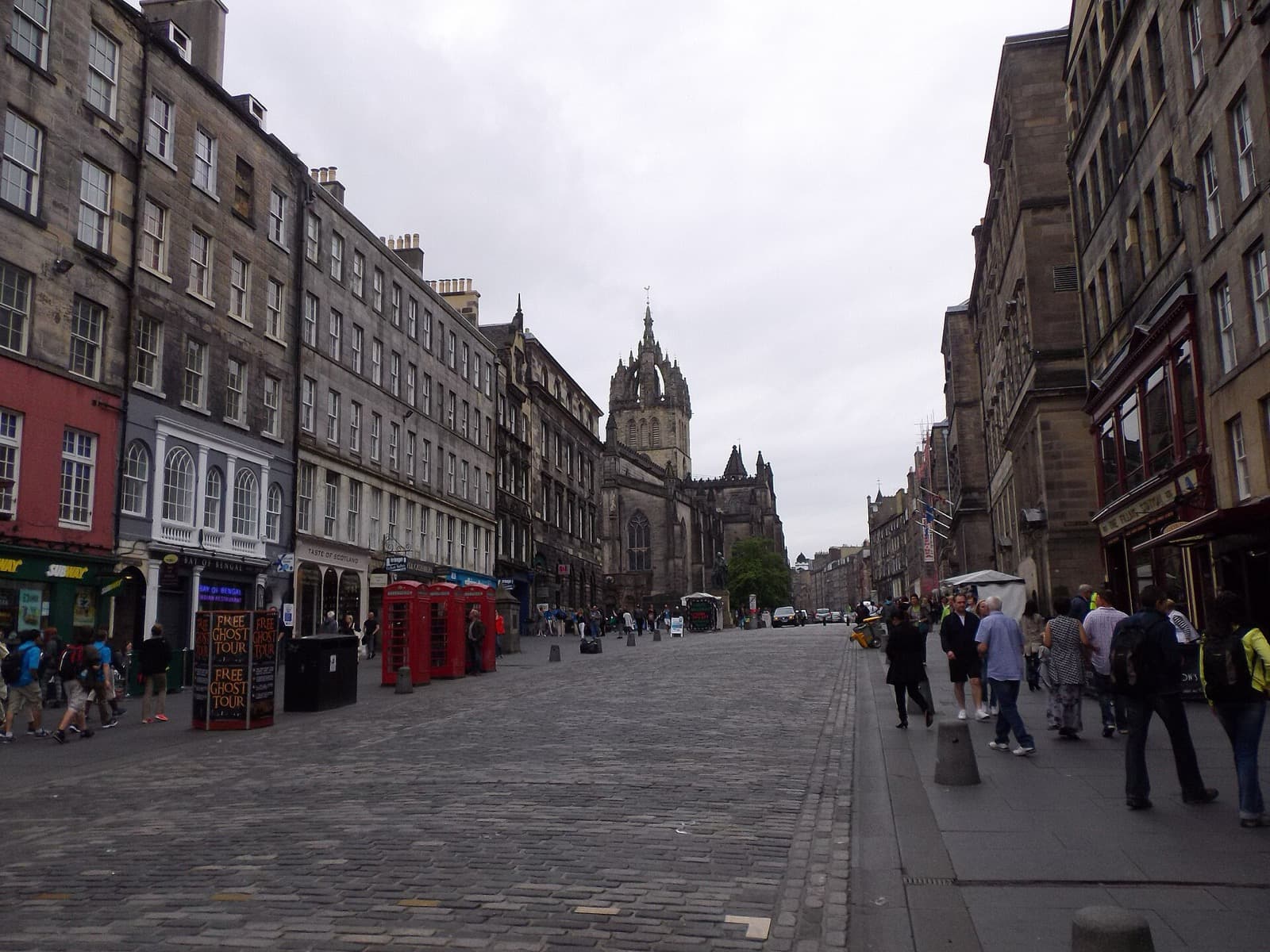
Old Town: The Royal Mile
100 min · 2 km · moderate
More from Edinburgh
Explore more at your own pace.
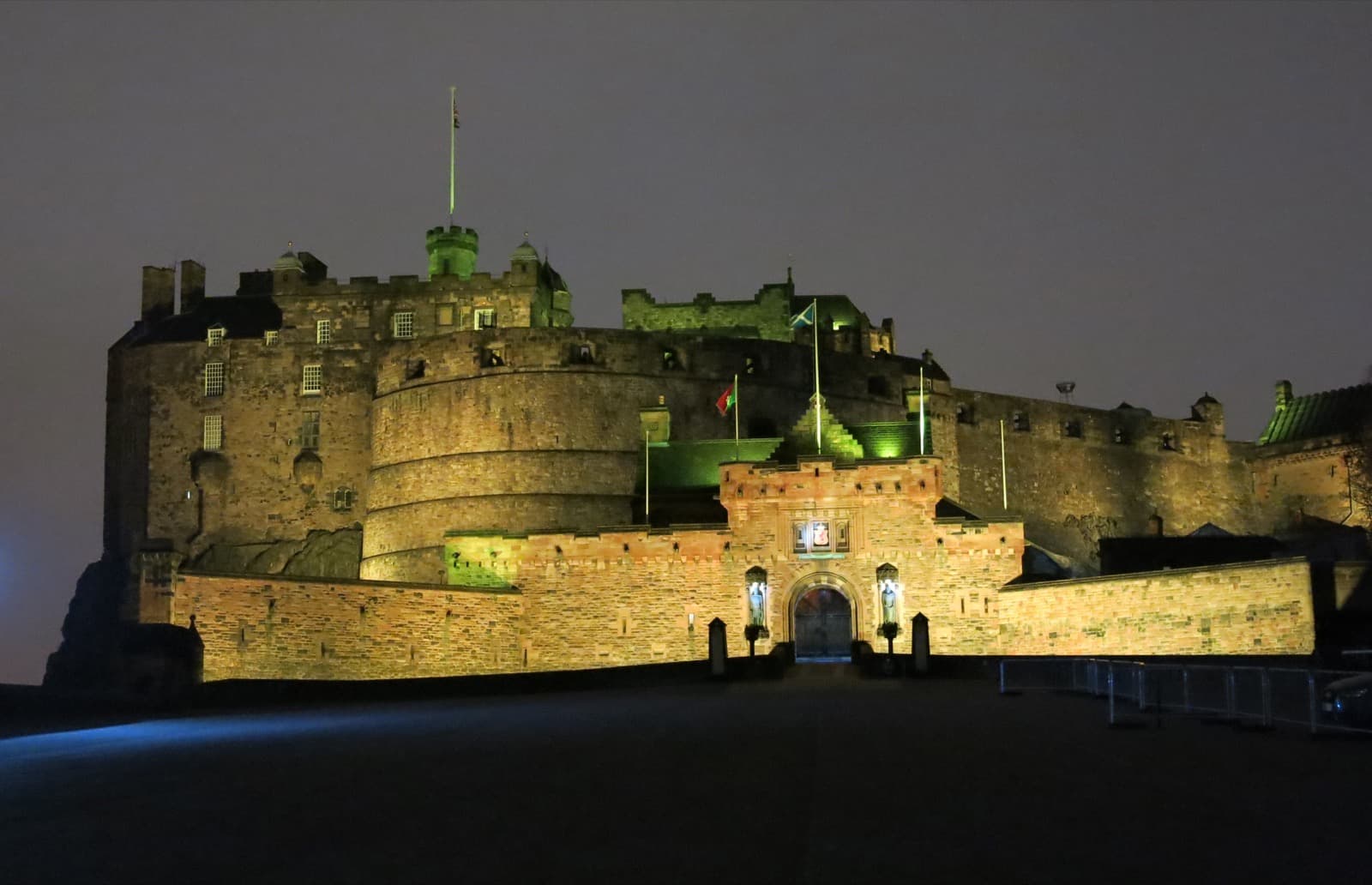
Two Cities on Two Ridges: How to Read Edinburgh's Old and New Towns
Charlotte Square: The Palace Front Where Edinburgh's Grid Resolves
The Grassmarket: Edinburgh's Execution Square and the Old Town Underworld
Greyfriars Bobby: The Legend, the Monument, and What the Record Actually Says
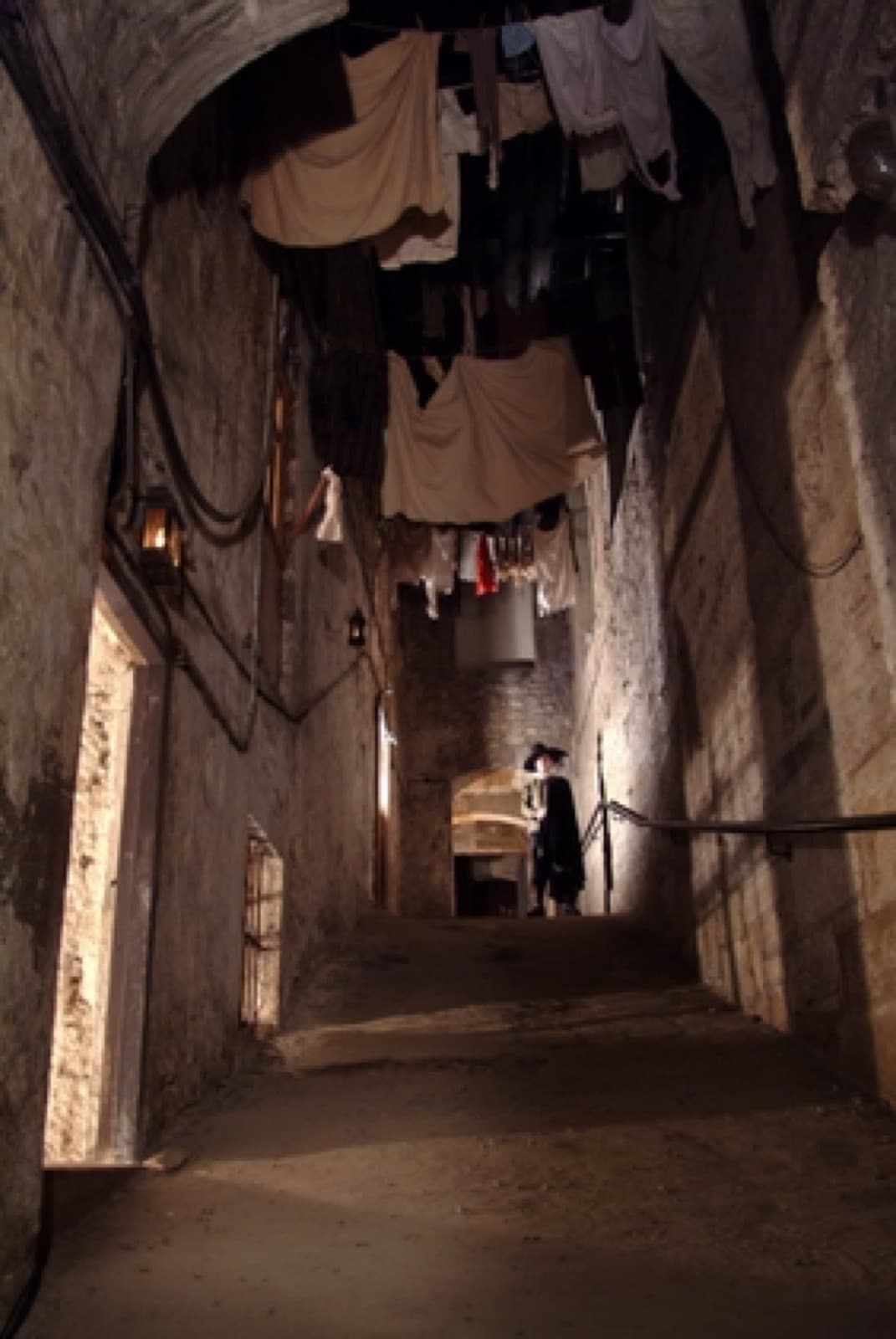
The Real Mary King's Close: The Edinburgh Street That Was Buried Alive