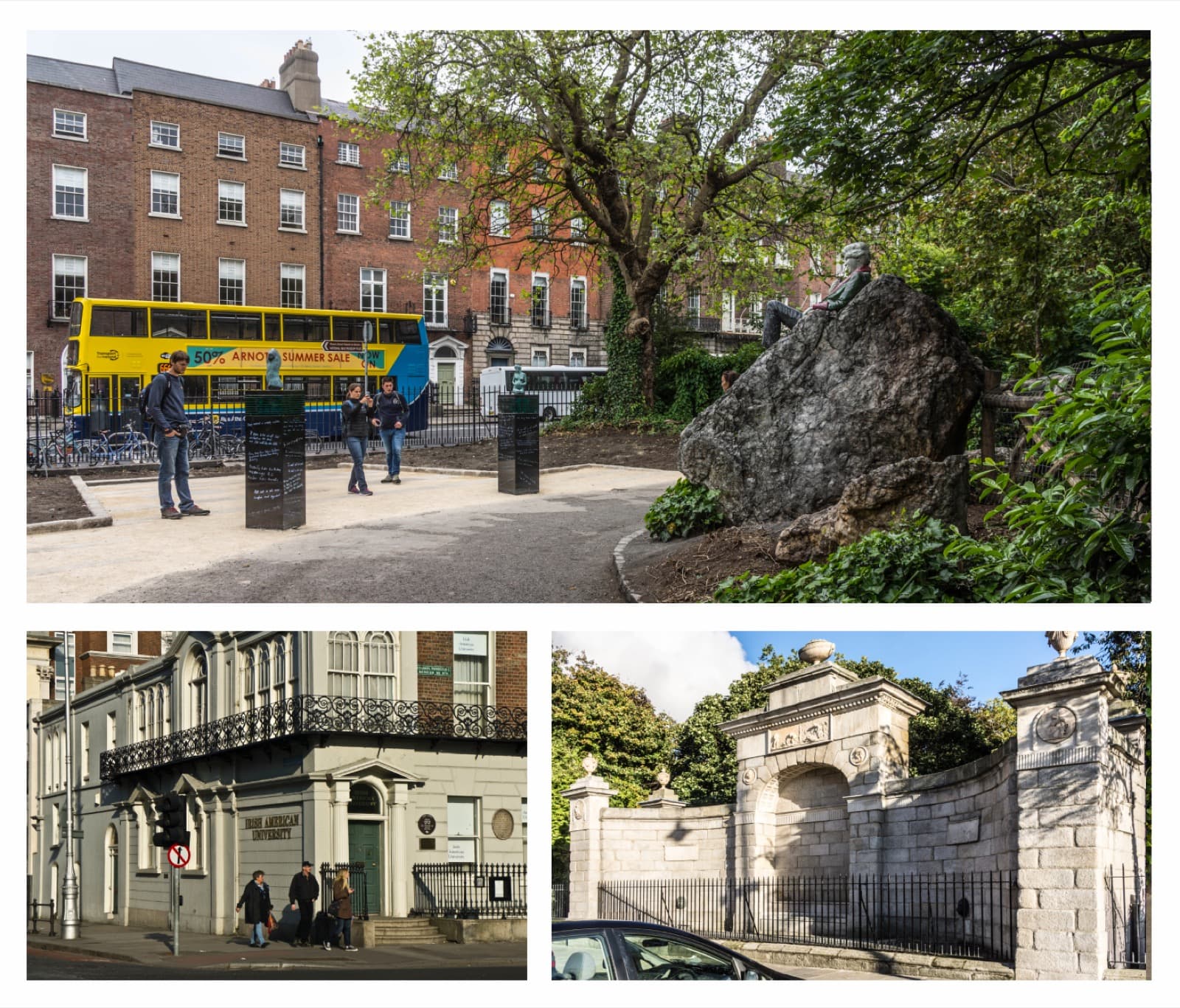
Merrion Square is where Georgian Dublin becomes fully legible. Laid out from seventeen sixty-two for the Fitzwilliam estate, its three residential sides are lined with tall red-brick townhouses whose fanlit, brightly painted doors have become an emblem of the entire city. The doors are the point. By the time you reach this square on foot, you can read a single door and its fanlight the way you read a sentence: the proportion, the brick, the arch of glass above the lintel catching the light, repeated house after house into an ordered whole. That is the argument of this walk, and Merrion Square is where the argument closes.
The self-guided route that ends here treats the eighteenth-century city as a text with a recurring grammar. Its recurring units are the door, the fanlight, the terrace and the square. Once you have seen how those four pieces combine, the whole ordered city opens up, and Merrion Square is the passage where the grammar is written out most completely. To understand why it lands so hard as a finale, it helps to trace the sentences that come before it.
Reading the city from Trinity outward
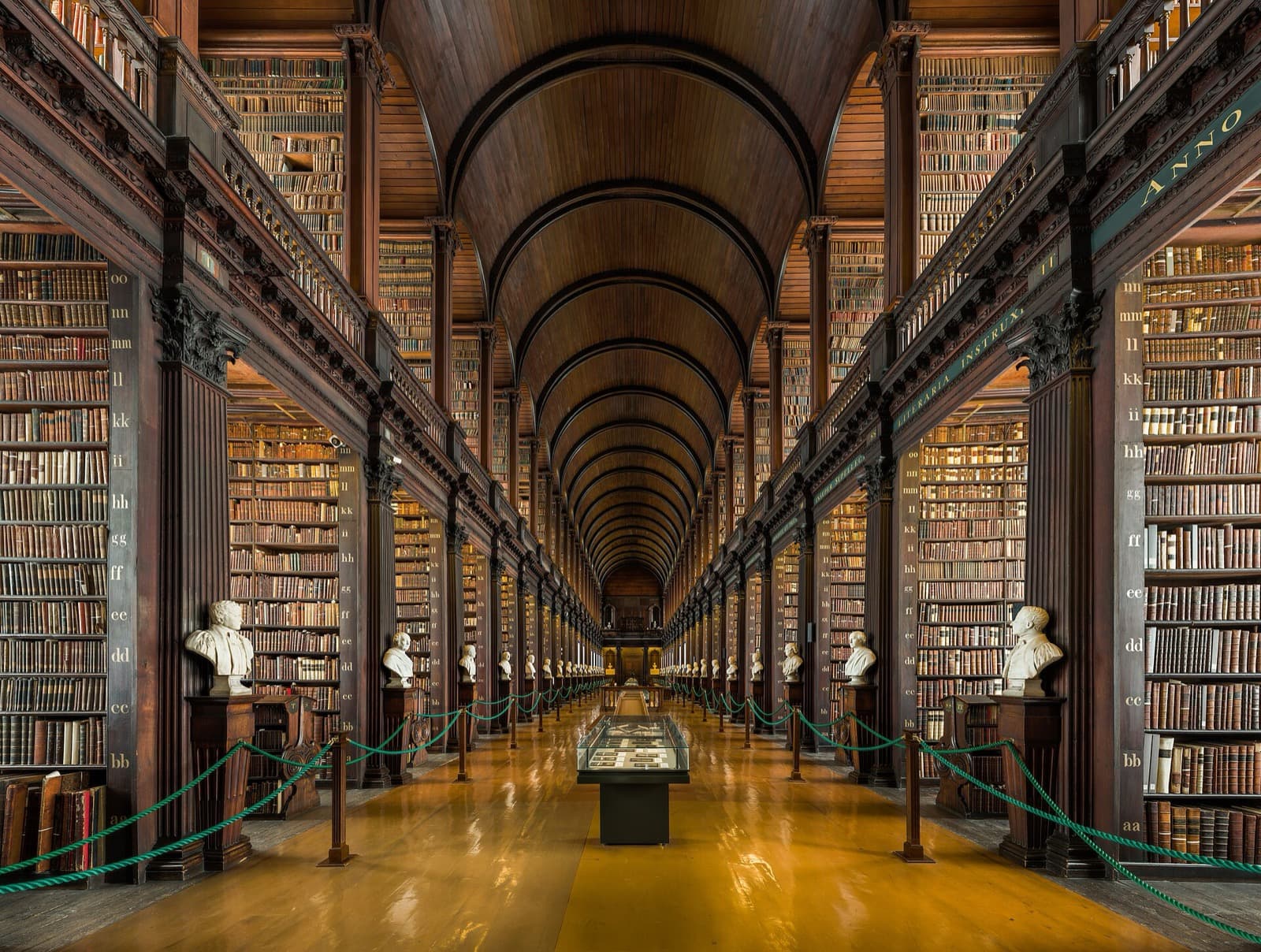
The walk begins where learning met empire, at the front gate of Trinity College. Founded by royal charter of Queen Elizabeth the First in fifteen ninety-two, Trinity is Ireland's oldest university, built inward into calm cobbled squares gathered around a bell tower. Its Old Library, begun around seventeen twelve, holds the Book of Kells, the four Gospels in Latin written close to the year eight hundred and based on the text Saint Jerome completed in three eighty-four. The manuscript reached Trinity in sixteen sixty-one, and Trinity's own library records it as one of the finest achievements of early medieval Irish art. This is the deepest root of the walk, a native golden age of Irish art sitting inside a college tied to the Crown.
Cross College Green and the grammar begins in stone. The long curved colonnade of the former Parliament House was begun in seventeen twenty-nine to a design by Edward Lovett Pearce, and it was the world's first purpose-built two-chamber parliament house, the first building anywhere raised specifically to hold a legislature of two chambers. Its confidence proved fragile. Under the Act of Union of eighteen hundred the Irish parliament ceased on the first day of eighteen oh one, and in eighteen oh three the Bank of Ireland acquired the building. The world's first purpose-built parliament became a place to keep money within a single lifetime of its founding. Grandeur and fragility read from one facade.
From there the route climbs Grafton Street, Dublin's fashionable pedestrian spine, past the bronze figure of Molly Malone, honestly a folk figure rather than a documented person, the work of sculptor Jeanne Rynhart unveiled for the city's millennium in nineteen eighty-eight. Grafton Street opens onto Saint Stephen's Green, a public park of about twenty-two acres re-opened to the public on the twenty-seventh of July, eighteen eighty, at the expense of Arthur Guinness, Lord Ardilaun. The Green carries a harder memory too. During the Easter Rising of nineteen sixteen, a garrison of the Irish Citizen Army under Commandant Michael Mallin, with Constance Markievicz as his second-in-command, dug trenches into its flower beds before withdrawing to the Royal College of Surgeons under fire.
On the Green's south side stands Newman House, a pair of Georgian townhouses at numbers eighty-five and eighty-six. Read them as a lesson in the grammar itself: brick, proportion, fanlit door, the confident rhythm of the street. The Catholic University of Ireland opened at number eighty-six on the third of November, eighteen fifty-four, with only about twenty registered students. Its first rector was John Henry Newman. The poet Gerard Manley Hopkins was Professor of Classics here and died in an upstairs room in eighteen eighty-nine, and a young James Joyce studied in these houses and graduated in nineteen oh two. Newman House is where the grammar acquires people.
Where the grammar is written out in full
Hear a stop from this walk
Leinster House and the National Museum: The Duke's Mansion and Ireland's Gold
Then, east through quiet Georgian streets, Merrion Square. This is the finest and best-preserved of Dublin's Georgian squares, and it is the climax of everything the walk has taught you to see. The three residential sides give you the pattern at full length: proportion, brick, and the arch of glass above each lintel, repeated door after door until the individual house dissolves into an ordered rhythm you can now read fluently. The painted doors reflect a Georgian taste for individual colour within a uniform architectural frame, personality permitted inside strict rules. The fourth, western side breaks the pattern deliberately, opening onto the mansions and cultural institutions of the nation.
Number one, on the corner, was the childhood home of Oscar Wilde, who lived there from eighteen fifty-five to eighteen seventy-eight. In the square's central garden, on a natural boulder, reclines a colourful statue of Wilde by the sculptor Danny Osborne, watching over the doors of his boyhood. That garden was long a private, key-holder space for residents before it passed into public hands in the nineteen seventies, which is part of why the square survived so intact when other Georgian streets were lost.
Standing under one of these doorways, unhurried, is the whole point of doing this walk at your own pace. There is no fee to look and no group to move you along. You can walk one side, then another, and let the doors teach you their rhythm on your own clock. Reading a single fanlit door slowly is not a detour from the tour. It is the lesson the tour was built to deliver, and Merrion Square is where you finally have the vocabulary to receive it.
The route closes a short step away on Kildare Street, at Leinster House, built between seventeen forty-five and seventeen forty-eight for the Earl of Kildare and, since nineteen twenty-two, the seat of the Oireachtas. Beside it the National Museum of Ireland, Archaeology, opened in eighteen ninety, holds the finest collection of prehistoric Irish gold in western Europe, along with the Tara Brooch of about seven hundred and ten to seven hundred and fifty. So the walk rhymes: it opens with the gospel book and closes among the gold of the same native golden age, the Georgian city admired but did not make.
This is a gentle, level walk of about two hours over roughly three and a half kilometres, on pavement with some cobbles at Trinity, free to walk in daylight hours end to end. If you want a fuller sense of how it fits with the rest of the city, see our Dublin walking tours guide, and the Dublin city page for what else is nearby. Then load the audio, start at the front gate of Trinity, and walk out to the painted doors at your own pace.
Sources
- Trinity College Dublin, Old Library and Long Room pages: founding date, Old Library history, and the Book of Kells provenance.
- Merrion Square (Wikipedia) and Oscar Wilde House, One Merrion Square (Buildings of Ireland): square layout from seventeen sixty-two, preservation, and Wilde's residence from eighteen fifty-five to eighteen seventy-eight.
- Parliament House, Dublin (Wikipedia) and Bank of Ireland, College Green (Archiseek): the world's first purpose-built two-chamber parliament and its sale to the bank in eighteen oh three.
- Saint Stephen's Green (Wikipedia) and Arthur Guinness, First Baron Ardilaun (Wikipedia): the eighteen eighty re-opening and the Easter Rising garrison.
- National Museum of Ireland, Archaeology: the prehistoric gold collection, the Tara Brooch and the Ardagh Chalice.
Ready to experience it?
Trinity College: The Book and the Georgian City
110 min · 3.4 km · easy
More from Dublin
Explore more at your own pace.
Dublin Travel Guide: Days, Transport, Weather, Safety, and Budget
Dublin in Layers: The Viking Town Beneath the Georgian Mask
Dublin Castle and the Black Pool: A Medieval City Under the Georgian Mask
The GPO on O'Connell Street: How One Post Office Became the Birthplace of a Republic
Saint Patrick's Cathedral, Dublin: Swift's Furious Epitaph