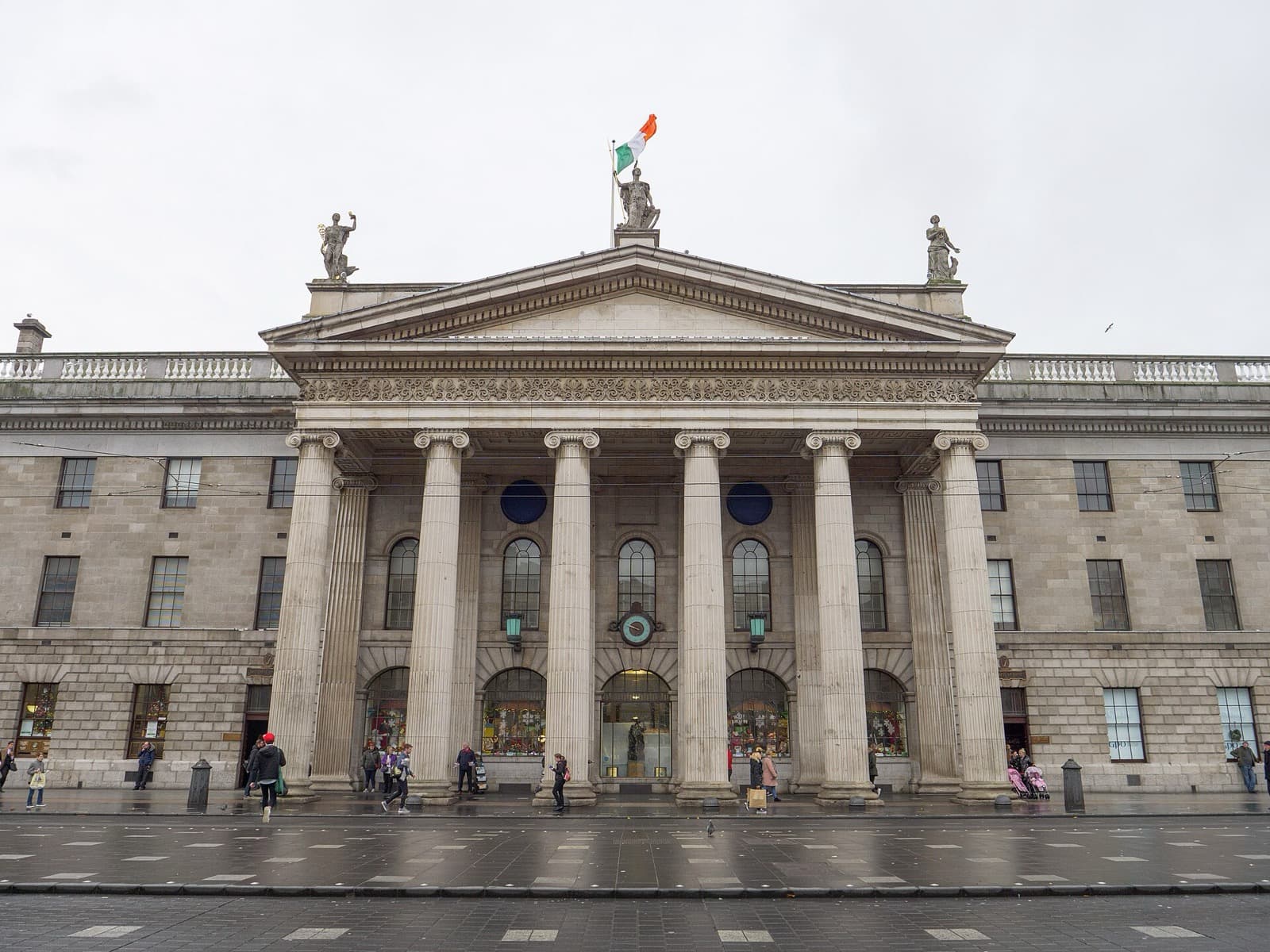
The General Post Office on O'Connell Street is where the Easter Rising of 1916 proclaimed a republic and began to burn, and once you learn to read that single granite building you can read the whole boulevard of pride and ruin around it. Almost everything the street has to say about Ireland's fight for independence is written on and near this one facade: a republic declared, a city gutted, and its leaders sent to a firing squad. Start here, and the rest of the walk falls into order.
A post office that was simply a post office
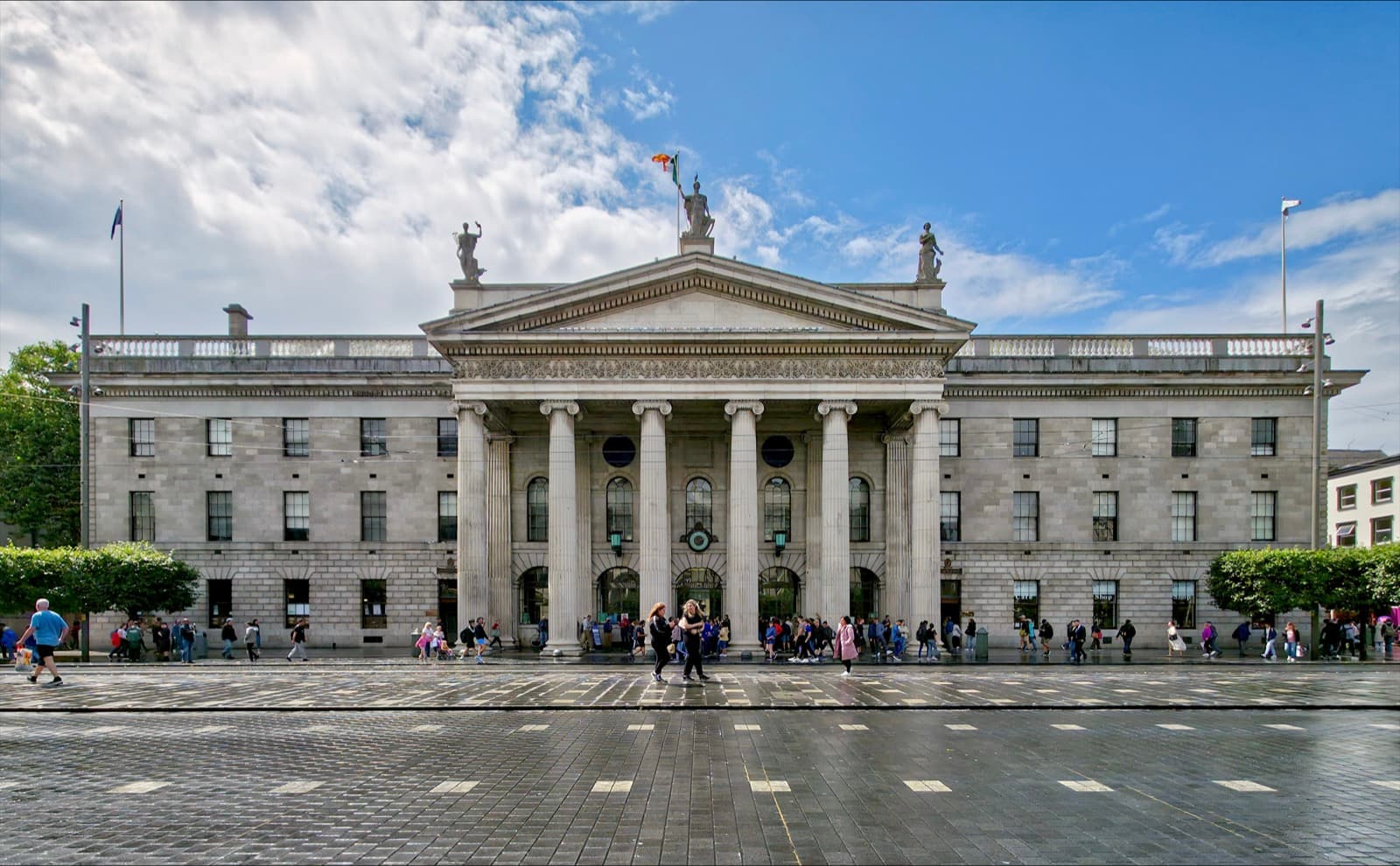
For most of a century, the building at the center of this story was ordinary. The architect Francis Johnston completed it, and it opened for business in 1818. Its front runs about sixty-seven metres along the street, with a portico about twenty-four metres wide carried on six fluted Ionic columns, and above them stand three figures: Mercury, Fidelity, and Hibernia. Dubliners posted letters and bought stamps under those statues for nearly a hundred years. Nothing about it announced what it would become.
That is worth holding onto, because the drama of the place can make you forget it was a working civic building first. The Rising did not choose a fortress or a barracks. It chose the post office on the city's widest street, a piece of everyday state machinery, and turned it into the headquarters of a revolution.
Easter Monday, 1916
Hear a stop from this walk
The Custom House: Gandon's River Palace, Burned and Raised
On Easter Monday, the twenty-fourth of April 1916, Irish Volunteers and the Irish Citizen Army, led by Patrick Pearse and others, seized the building. From outside it, Pearse read aloud the Proclamation of the Irish Republic. The fighting lasted six days. British shellfire and the fires that followed gutted the GPO, and by the end only the granite facade still stood. It was not rebuilt until 1929.
Stand close to the stone today and you can still find the marks of gunfire in it. This is the detail that makes the building do double duty. It is both a monument to the Rising and a piece of physical evidence from it, scarred by the exact event it now commemorates.
The cost came after the surrender. In May 1916, fourteen of the leaders were executed by firing squad at Kilmainham Gaol, among them the seven men who had signed the Proclamation that Pearse had read from this spot. Inside the building, sheltered from the weather, stands the bronze figure of the dying warrior Cu Chulainn, sculpted by Oliver Sheppard and unveiled here at Easter 1935 as the official memorial to the Rising. It was cast in Brussels and unveiled by Eamon de Valera. The GPO Museum records the full story for those who want to go inside, though the facade tells you most of it for free.
The street reads outward from here
Once the GPO teaches you its lesson, that this street holds pride and ruin at the same time, the other stops on the walk start answering to it.
A few steps south, at the river end of the street, stands the O'Connell Monument, unveiled on the fifteenth of August 1882. At the top is Daniel O'Connell, born in 1775 and died in 1847, the Liberator, who won Catholic Emancipation in 1829, the law that let Catholics sit in Parliament. The street, once called Sackville Street, was renamed in his honor. At the four corners of the base sit winged bronze victories, and here is the thread back to the GPO: those angels still carry bullet holes from 1916. The same fighting that gutted the post office scarred the Liberator's memorial down the street. The nineteenth-century constitutional hero and the twentieth-century rebels share the same wounds in the same bronze.
Opposite the post office rises the Spire of Dublin, the Monument of Light designed by Ian Ritchie Architects, one hundred and twenty metres of stainless steel completed on the twenty-first of January 2003. It stands on the exact site of Nelson's Pillar, a column to the British admiral Horatio Nelson raised in 1809 and blown up in 1966. An imperial statue gave way, over a century, to a nameless spike that belongs to the city alone.
The hardest stop, and the head of the street
West of the GPO runs Moore Street, one of the oldest working street markets in Dublin, and it holds the hardest part of the story. When the fires drove the garrison out of the burning post office, they broke through the internal walls of the terraced houses, moving from one to the next behind the brick. At number sixteen Moore Street, the leaders held their final council around the bed of James Connolly, who was gravely wounded and could not stand. On the twenty-ninth of April 1916, they chose to surrender, to spare the civilian people of the city more death. Numbers fourteen to seventeen were declared a national monument in 2007.
Walk north to the head of the street and you meet the Parnell Monument, designed by the American sculptor Augustus Saint-Gaudens and unveiled on the first of October 1911. Charles Stewart Parnell, born in 1846 and died in 1891, led the movement for Home Rule before a divorce scandal broke his party and his health. His inscription reads: no man has a right to fix the boundary to the march of a nation. That claim was cut in bronze five years before the men at the GPO answered the same national question with gunfire.
Just off Parnell Square lies the Garden of Remembrance, opened in 1966 by President de Valera on the fiftieth anniversary of the Rising, dedicated to all who died in the cause of Irish freedom. Some of the Rising's prisoners were held overnight here after the surrender. Its bronze Children of Lir sculpture, by Oisin Kelly and added in 1971, casts an old myth of children turned to swans as a symbol of rebirth.
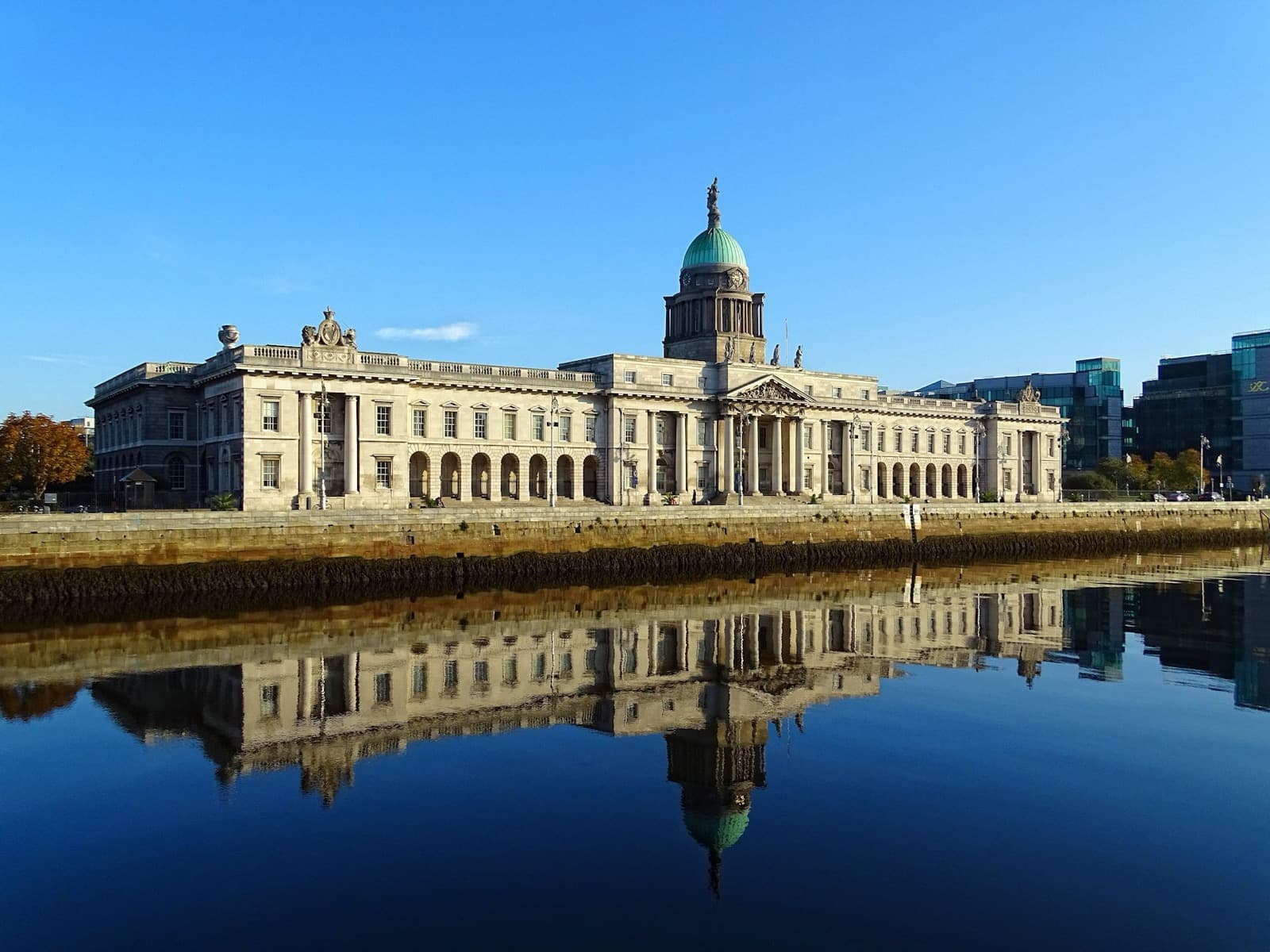
The walk ends by the water at the Custom House, James Gandon's river palace built between 1781 and 1791 and burned by the Irish Republican Army on the twenty-fifth of May 1921, during the War of Independence, to destroy the records of British administration. When the gutted dome was rebuilt, the restorers used a darker Irish limestone, raising the palace again in the new state's own stone.
That is the arc: a republic proclaimed at the GPO, paid for in executions, followed by a war that burned an empire's paperwork, and a state that rebuilt its palaces in Irish stone. You can walk it at your own pace, linger at the facade in your own silence, and read the Proclamation on your own clock, with no group at your shoulder. For more routes across the city, see our guide to Dublin walking tours, and browse everything on offer in Dublin.
Sources
- General Post Office, Dublin (Wikipedia): the 1818 Johnston building, its 1916 seizure, and the 1929 rebuild behind the surviving facade.
- Buildings of Ireland, "The General Post Office, O'Connell Street": heritage record of the portico, Ionic columns, and Mercury, Fidelity, and Hibernia figures.
- Heritage Ireland, "14-17 Moore Street": the national monument and the site of the Rising's final council and surrender.
- Burning of the Custom House (Wikipedia): the IRA attack of the twenty-fifth of May 1921 and the destruction of British administrative records.
- Garden of Remembrance, Dublin (Wikipedia): the 1966 dedication and the 1971 Children of Lir sculpture by Oisin Kelly.
Ready to experience it?
O'Connell Street: The Rising of 1916
90 min · 2.6 km · moderate
More from Dublin
Explore more at your own pace.
Dublin Travel Guide: Days, Transport, Weather, Safety, and Budget
Dublin in Layers: The Viking Town Beneath the Georgian Mask
Dublin Castle and the Black Pool: A Medieval City Under the Georgian Mask
Merrion Square and the Grammar of Georgian Dublin
Saint Patrick's Cathedral, Dublin: Swift's Furious Epitaph