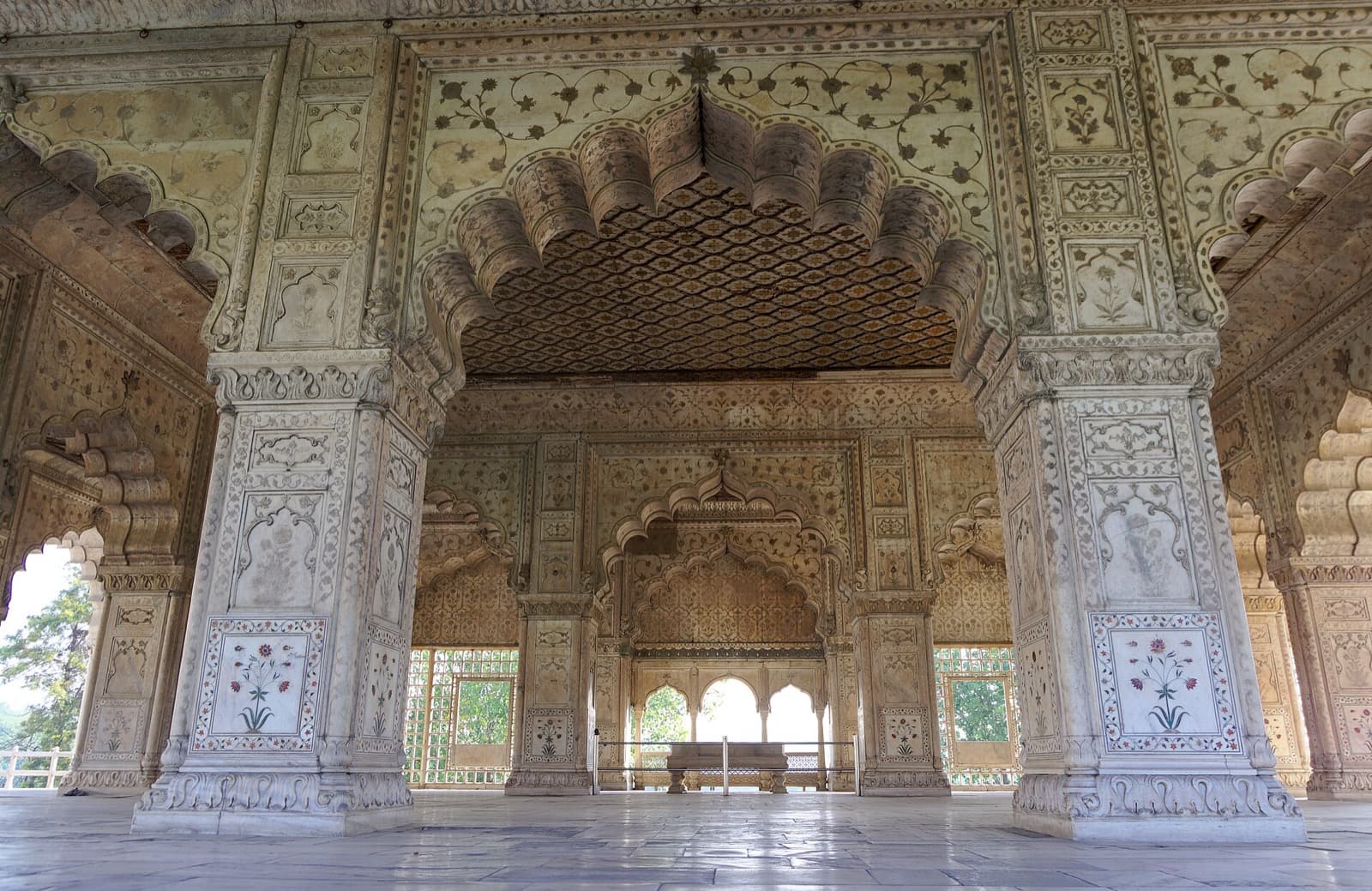
The Diwan-i-Khas is a white marble hall at Delhi's Red Fort, built around 1648 for Shah Jahan and inscribed with a Persian couplet attributed to Amir Khusrow declaring paradise on earth. By tradition it held the jewelled Peacock Throne, which the Persian ruler Nadir Shah carried off to Persia in 1739. It never returned.
The Diwan-i-Khas condenses the whole argument of the Red Fort into one white marble room: a hall inscribed with a couplet promising paradise on earth, built to hold the jewelled Peacock Throne, then stripped by invasion and revolt until only the shell of its splendour remained. Everything the fort was about, wealth, ceremony, water, calligraphy, and eventual loss, is legible in this single pavilion if you slow down long enough to read it. That is the reason to walk the Red Fort as a chronicle rather than a photo stop, and the Diwan-i-Khas is where the chronicle turns.
A room built to dazzle
The hall stands about halfway along the fort's eastern range, the private, residential side where the emperor and his household actually lived. It is a pillared hall of white marble, roughly ninety feet by sixty-seven feet, built around 1648 for Shah Jahan and also called the Shah Mahal. Its ceiling was originally inlaid with silver and gold. That is not decorative exaggeration. The precious metal was real, and it was eventually stripped away during later imperial financial crises. The ceiling you look up at today was put in place in 1911, a modern replacement standing in for what the empire spent when it ran short of money.
Through the centre of the marble floor ran the Nahr-i-Behisht, the Stream of Paradise, a channel of water threaded through the whole eastern row of buildings to cool the air. In a hot city, moving water was the true luxury, quieter and more expensive than gold. The Diwan-i-Khas was the point where that stream, that marble, and that calligraphy all reached their highest pitch.
The couplet, read plainly
Hear a stop from this walk
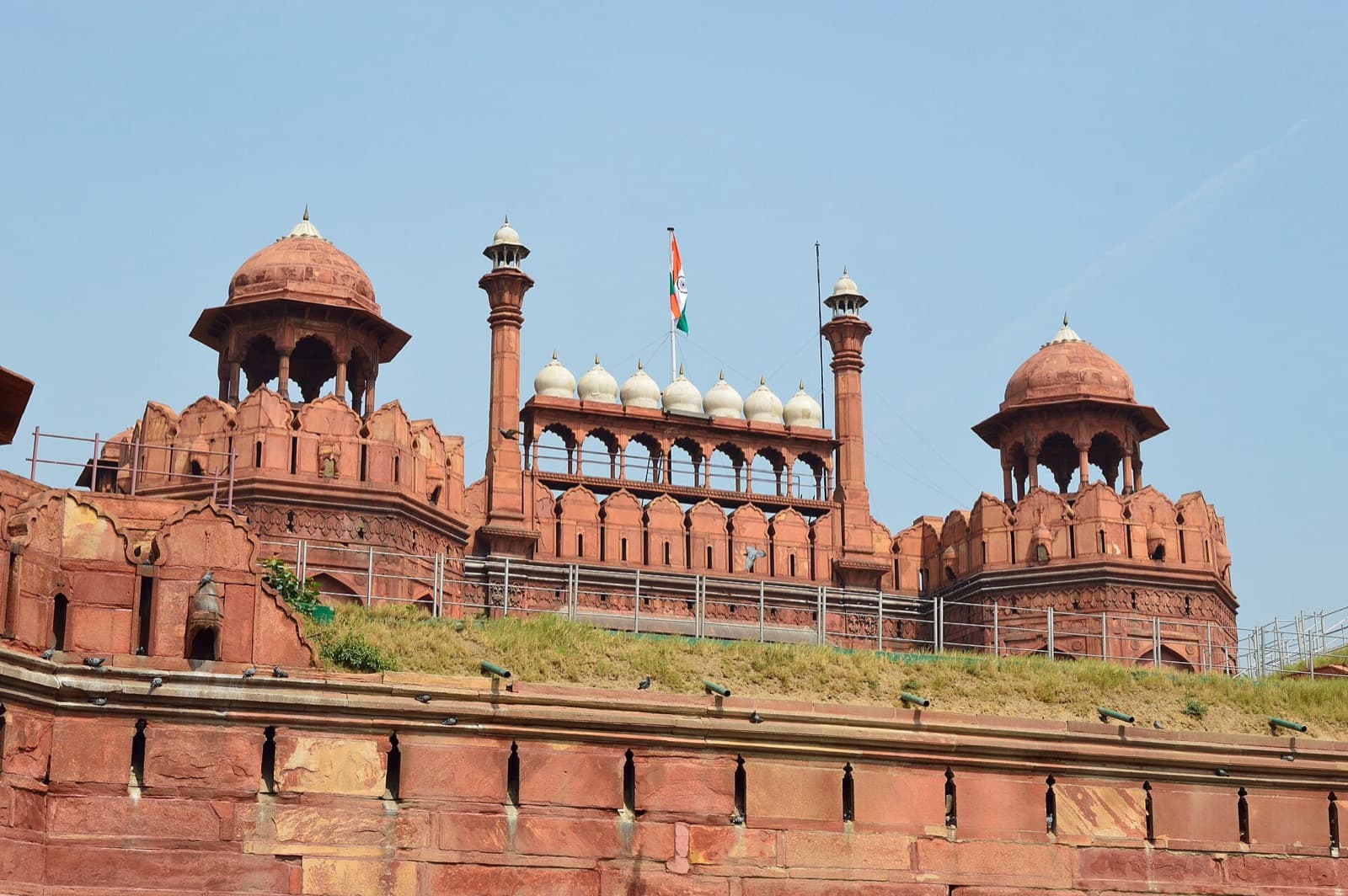
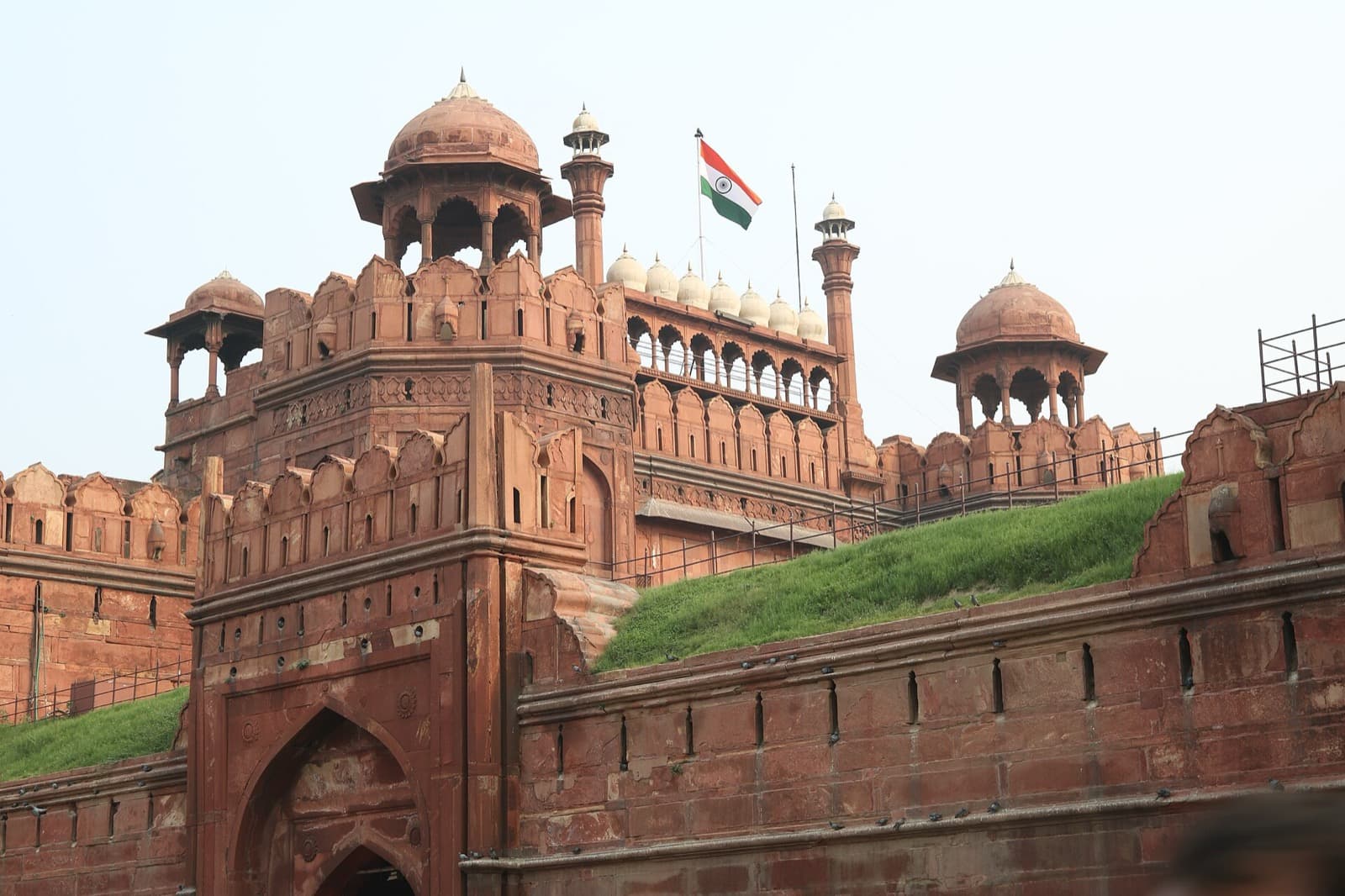
The Lahori Gate and the Ramparts
Look up to the corner arches of the northern and southern walls. Inlaid there is a Persian couplet, and its wording is worth hearing exactly: if there be a paradise on earth, it is this, it is this, it is this. The verse is attributed to the poet Amir Khusrow. It is a bold thing for a hall to say about itself, and it sets up the reversal that gives this room its weight. A pavilion that inscribed its own perfection into its walls would, within a century, be emptied of the very throne that perfection was built around.
The narration on the tour names dates and figures plainly and tells you clearly when a claim is tradition rather than settled fact. That matters here more than anywhere. Much of what makes the Diwan-i-Khas famous is a mix of documented history and inherited legend, and the honest thing is to keep the two apart while you stand in the room.
The throne that left
This is the hall associated with the fabled Peacock Throne, which by tradition stood here in the emperor's private audience. Its story is one of loss. In 1739 the Persian ruler Nadir Shah sacked Delhi and carried the Peacock Throne off to Persia. It never returned. More than a century later, after the Revolt of 1857, the interior was plundered again, so what remains is a shell of the original splendour, the marble stripped of much of its jewel-work.
Two blows, then, roughly 120 years apart. The first was a foreign invasion that took the single most valuable object in the empire. The second was the collapse of Mughal rule itself, which took most of what the first had left behind. A hall that called itself paradise lost its throne, then lost the empire that made the throne mean anything. Standing under the 1911 ceiling, reading a couplet about heaven on earth, is a strange and specific feeling. That feeling is the whole tour compressed into one stop.
Why the anchor stop needs the walk around it
The Diwan-i-Khas only lands with full force if you have walked the sequence that leads to it. That is the case for taking the whole route rather than pushing straight to the marquee hall. You enter through the Lahori Gate, the western entrance that faces toward Lahore, where the Prime Minister of India raises the national flag every Independence Day since 1947. You pass through the Chatta Chowk, the emperor's covered bazaar of about thirty-two arched shop bays, once trading only silk, gold, and gems for the imperial household. You reach the Naubat Khana, the drum house, where all but princes of royal blood had to dismount, which earned it the nickname Elephant Gate.
Then comes the Diwan-i-Am, the public hall where the emperor heard grievances each morning from a throne balcony, its back wall inlaid with pietra dura panels including one of Orpheus, work attributed to the artist Austin de Bordeaux. The red sandstone there was once shell-plastered to imitate marble. That detail is the key to the whole hierarchy: the public hall only pretended to be white stone, while the Diwan-i-Khas deeper inside was the real thing. The fort was built as a deliberate gradient from crowd to court to private jewel, and the Diwan-i-Khas sits at its summit. Reaching it in order is how you feel that gradient rather than just reading about it.
After the anchor, the walk descends to the riverside palaces, the Rang Mahal with its lotus fountain and the Khas Mahal, then closes at Aurangzeb's white marble Moti Masjid and the Hayat Bakhsh Bagh garden, where the Zafar Mahal recalls Bahadur Shah Zafar, the last Mughal emperor, tried and exiled in 1858 after the British demolished much of the palace for barracks.
Walking it at your own pace
The Red Fort is one of the most guide-crowded, tout-thick monuments anywhere, and the quiet advantage of a self-guided audio walk is your own map and your own clock. No group van, no schedule, no one steering you toward a shop. At the Diwan-i-Khas that freedom is the whole point. You can read the couplet twice, stand where the throne once stood, and let the silence do the work while the crowds move past you. Go clockwise from the Lahori Gate along the central axis, then loop the eastern palaces, and save your unhurried time for this hall rather than the busy rooms near the entrance.
For the full self-guided route and the other stops mapped out, see the Red Fort tour on our Delhi page, and browse more Delhi walking tours to plan a longer day in the old city.
Sources
- Diwan-i-Khas (Red Fort), Wikipedia. Background on the hall's dimensions, the paradise couplet, and its silver-and-gold ceiling.
- Diwan-i-Khas, Archaeological Survey of India. Official record of the pavilion and its history within the World Heritage Red Fort.
- Red Fort, Wikipedia. Overview of Shah Jahan's fortress, Nadir Shah's 1739 sack of Delhi, and the post-1857 demolitions.
- Diwan-i-Am (Red Fort), Wikipedia. Detail on the pietra dura panels and the Orpheus inlay attributed to Austin de Bordeaux.
Ready to experience it?
Red Fort: The Peacock Throne's Fortress
80 min · 1 km · easy
More from Delhi
Explore more at your own pace.
Delhi Travel Guide: How Many Days, Getting Around, Best Time, and Safety
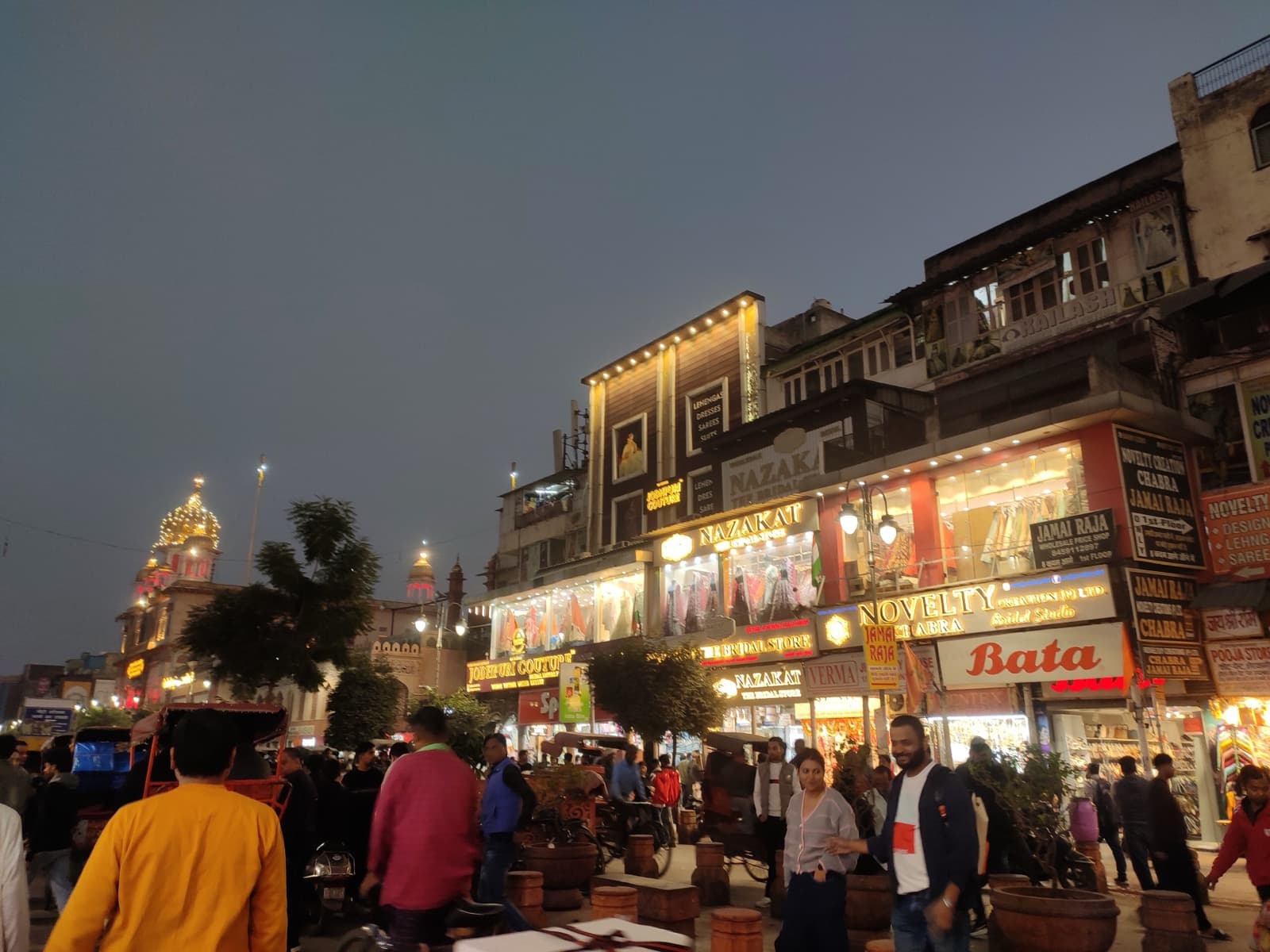
Chandni Chowk: How Delhi's Moonlit Avenue Holds an Entire Mughal Capital
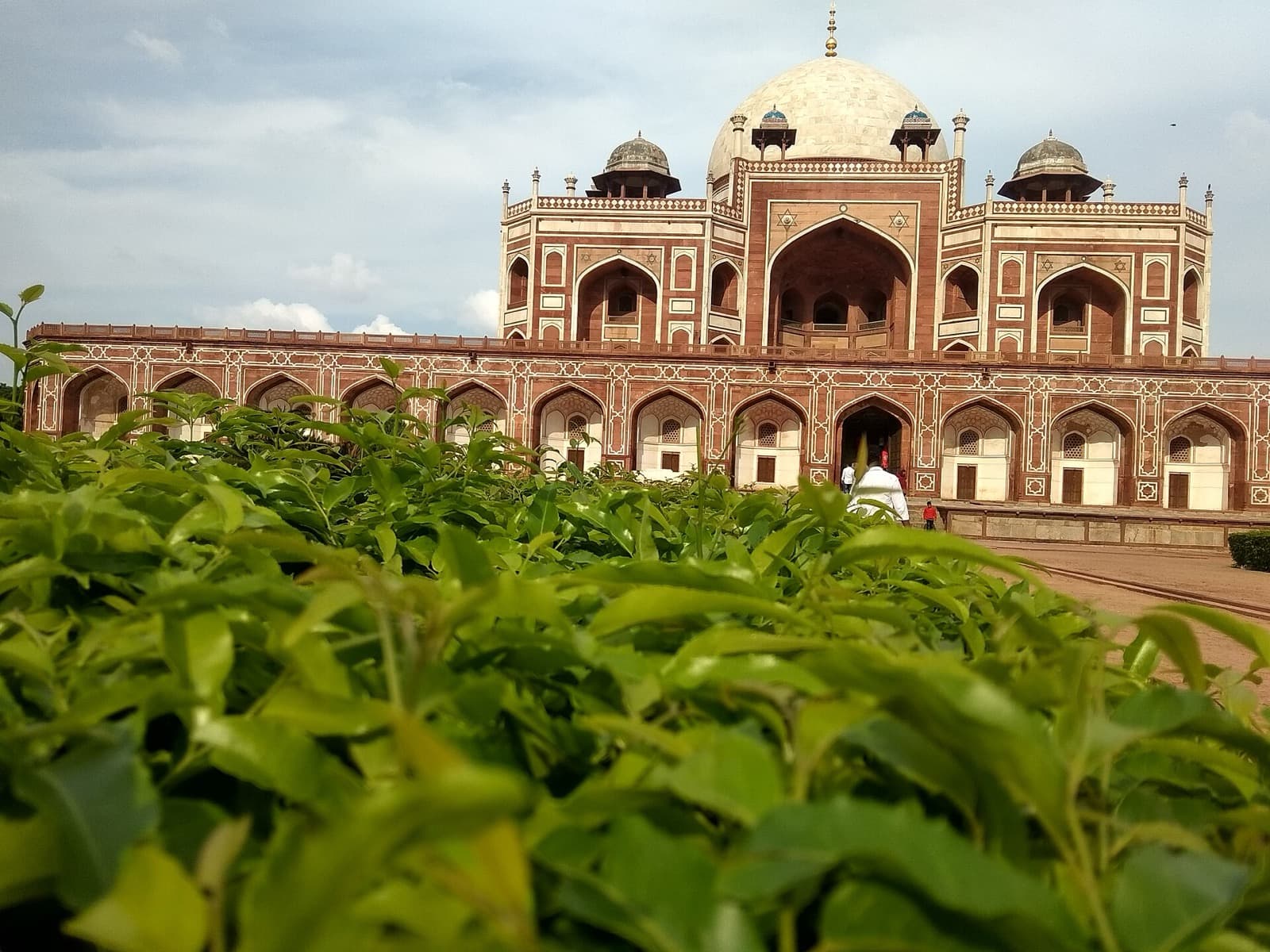
How Humayun's Tomb Drafted the Taj Mahal a Century Early
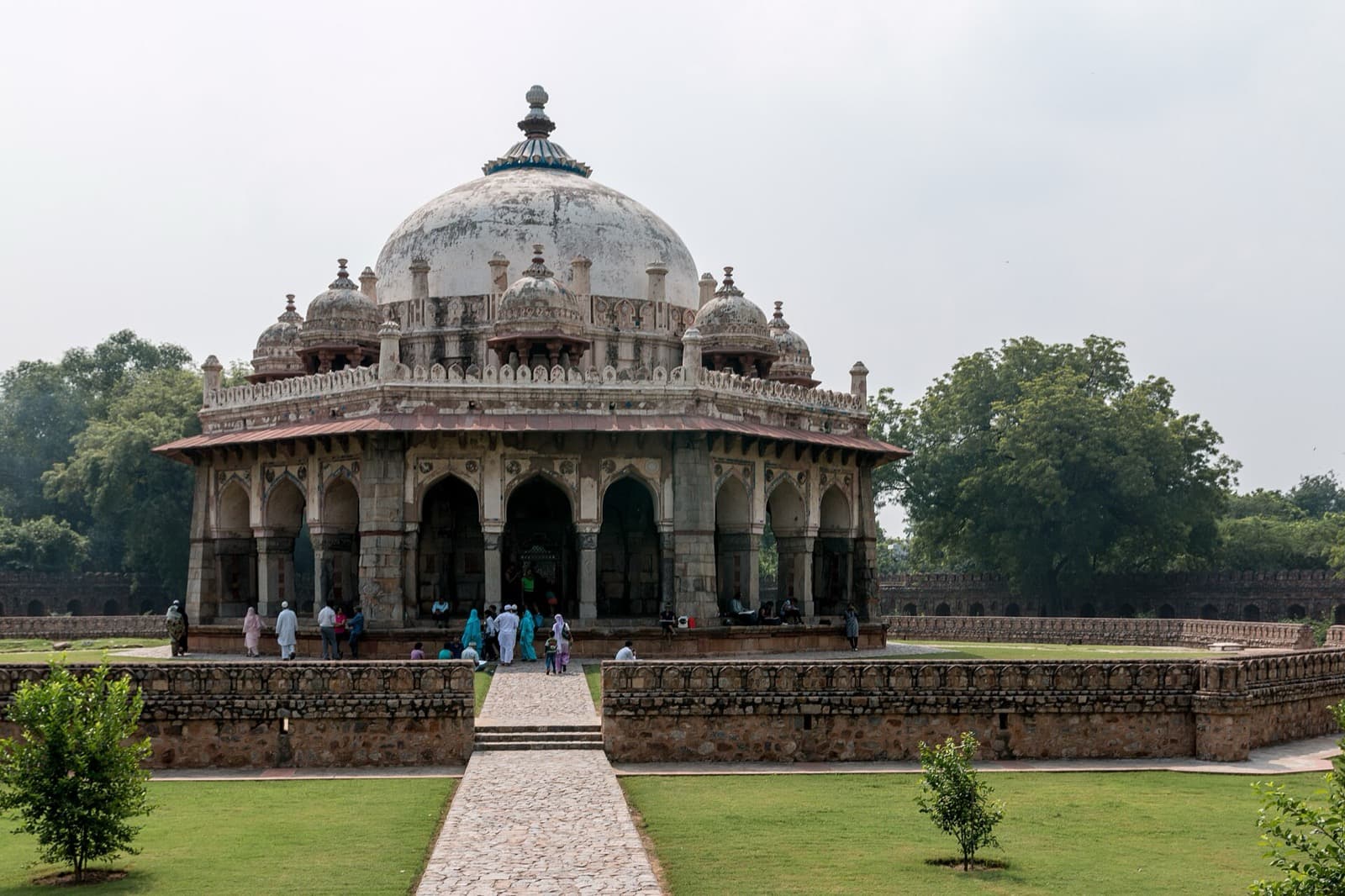
Isa Khan's Tomb and Mosque: The World Just Before the Mughals
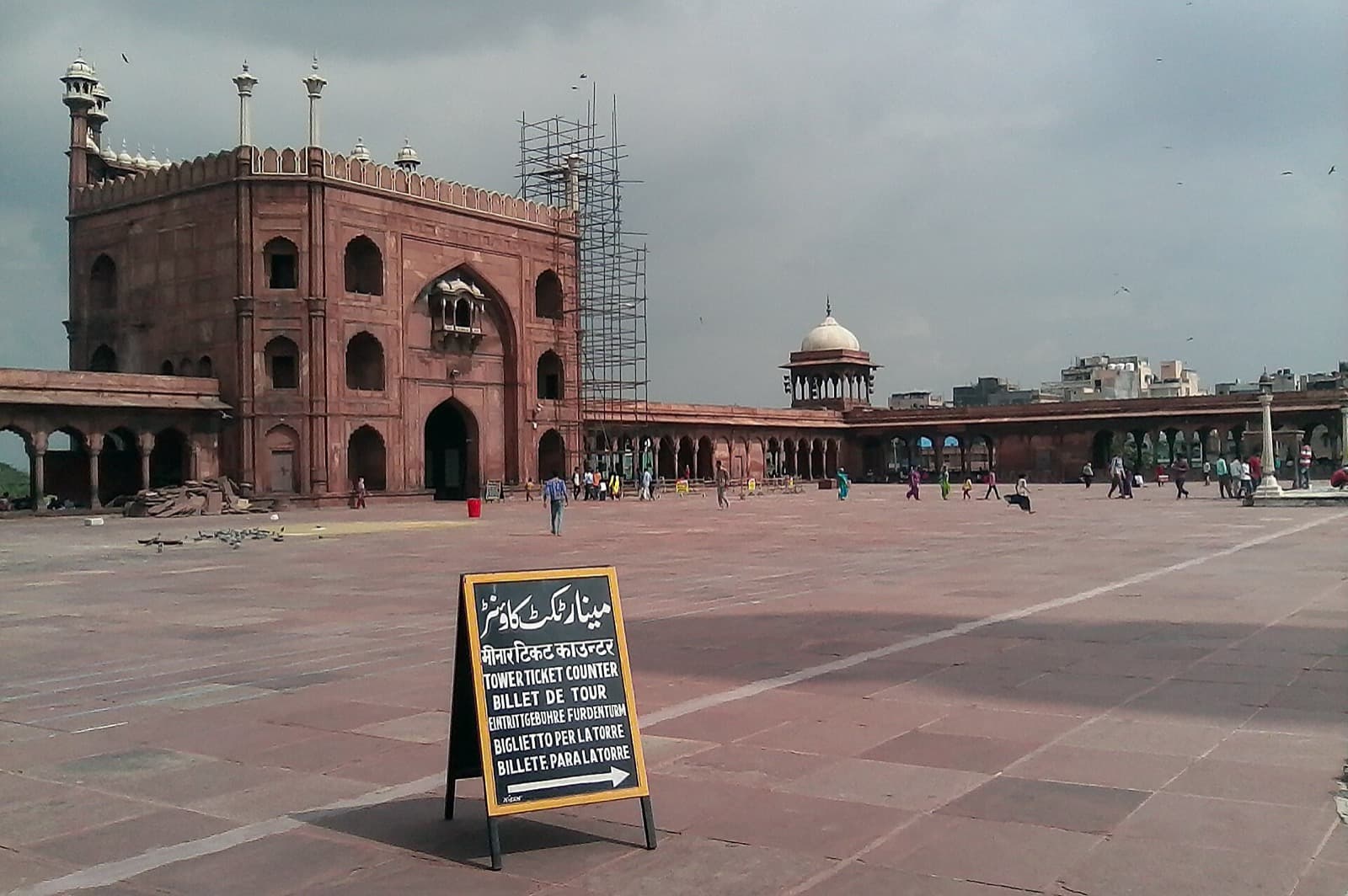
Jama Masjid: The Mosque Shah Jahan Built to Crown His Capital