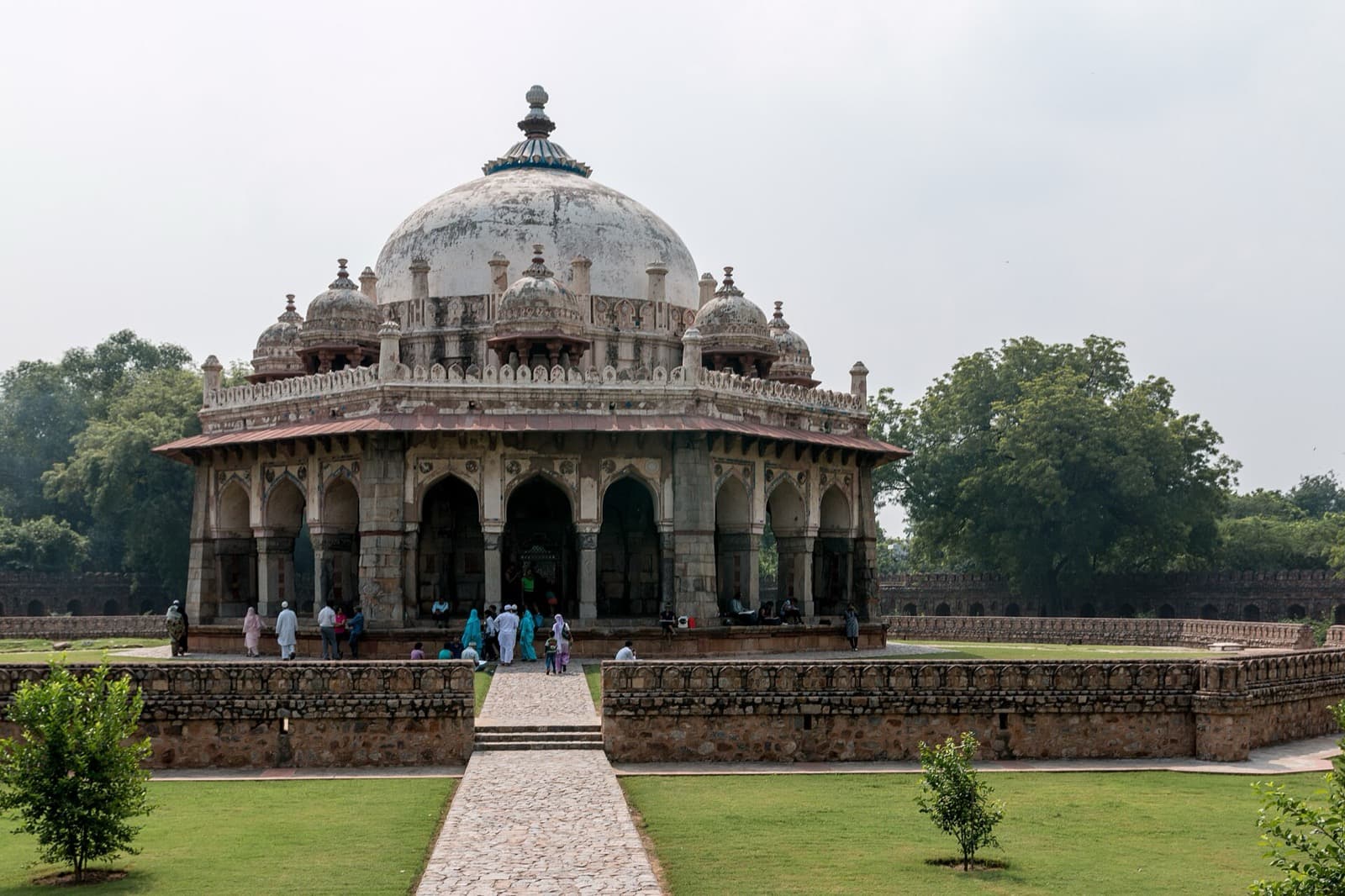
Isa Khan's octagonal, single-domed tomb, built in 1547 by a noble of the Sur dynasty, preserves the older Indian tomb form in the exact moment before the Mughals reinvented it a few steps away. Walk through the entrance of the Humayun's Tomb complex in Delhi and this low grey-and-red building is the first thing you meet, and that order is the whole point. Before you reach the great paradise-dome at the center of the garden, you pass what an Indian tomb looked like just before that dome changed everything. Hold this shape in your mind, because the rest of the site measures its distance from it.
A noble of the losing dynasty
Isa Khan Niyazi was a noble at the courts of Sher Shah Suri and his son Islam Shah Suri, rulers of the Sur dynasty. That name matters. The Surs were the line that briefly pushed the Mughals out of Delhi in the middle of the sixteenth century, an interruption in what we now remember as a smooth Mughal story. Sher Shah Suri drove the second Mughal emperor, Humayun, into exile in Persia. For a short window, the Surs, not the Mughals, ruled northern India.
So the man buried here served the empire that beat the Mughals. His tomb was raised between about 1547 and 1548, during Sher Shah Suri's reign, roughly twenty years before the widowed empress Bega Begum began Humayun's own tomb on the same ground. When you stand in front of Isa Khan's grave, you are looking at the confident architecture of the side that was, for a moment, winning. History then reversed. Humayun returned, retook Delhi, and his dynasty went on to build the marble monuments the world crowds to see. Isa Khan's tomb stayed exactly where it was, and the Mughals built their masterpiece next door.
Reading the older grammar
Hear a stop from this walk
The Nila Gumbad and the Arab Serai: The Blue Dome and the Court of the Makers
Look at the building itself. It is eight-sided, an octagon, ringed by a low arcaded verandah and crowned by a single central dome. Around it sit small pillared kiosks, the chhatris, and the whole thing is grey quartzite dressed with red sandstone. This is the vocabulary of the Lodi dynasty, the rulers who came before the Surs, part of a continuous Indo-Islamic building tradition that Delhi had been refining for generations. The octagonal, verandah-ringed, single-domed tomb was the established idea of what a great man's grave should be.
Everything about it is inward-looking and grounded. There is no high drum lifting the dome into the sky, no double shell, no soaring vertical drama. The dome sits close over the chamber. If you look up under the eaves, you can still find patches of glazed tile in blue and green, the surviving color of a surface nearly five centuries old. Inside are six cenotaphs, two large and four smaller, including Isa Khan's own in red sandstone and marble. To the west of the tomb stands a small attached mosque, a single prayer chamber in three bays, its central bay faced in red sandstone. Together the tomb and mosque form a complete, self-contained enclosure, a walled world for the dead.
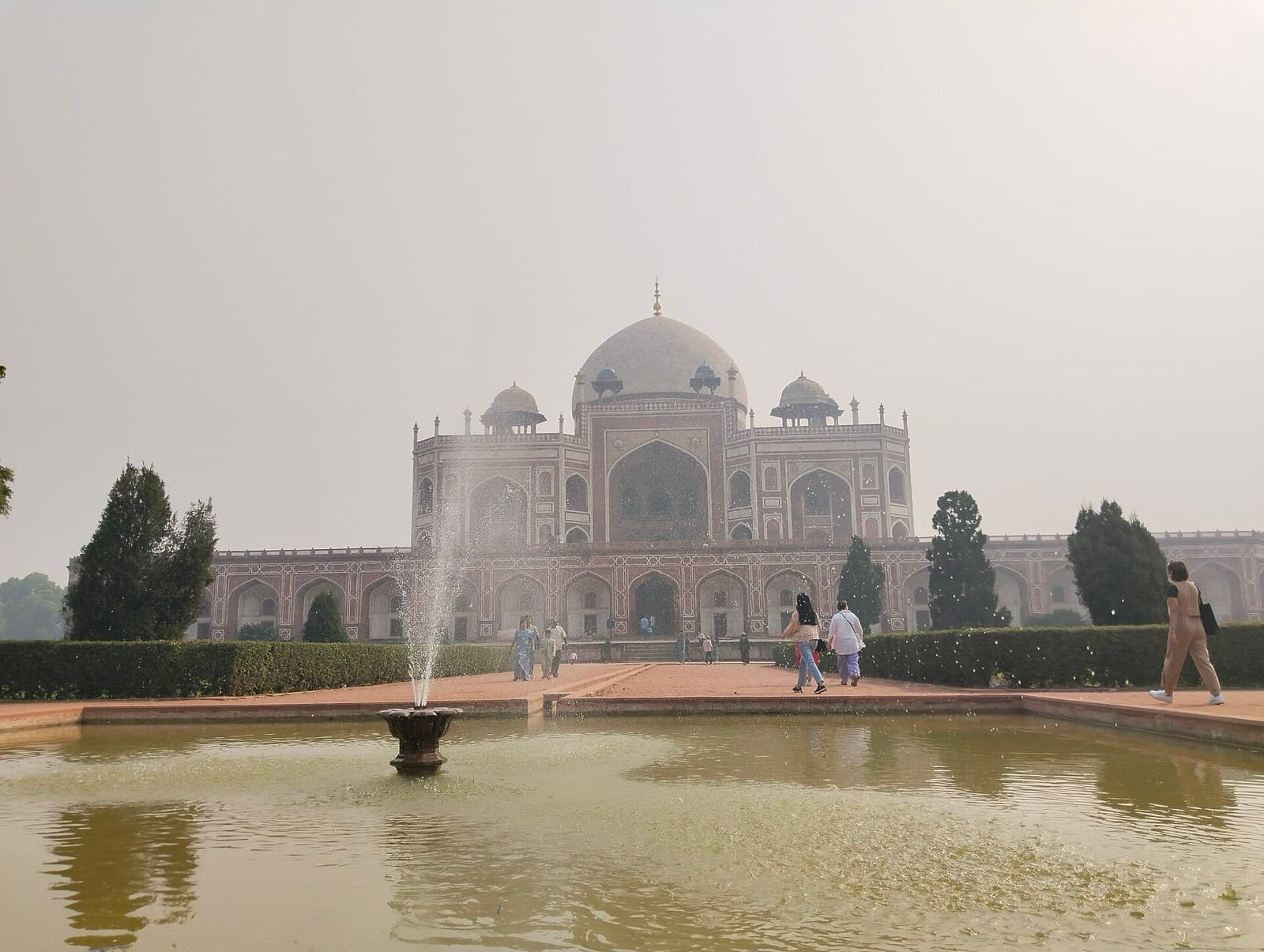
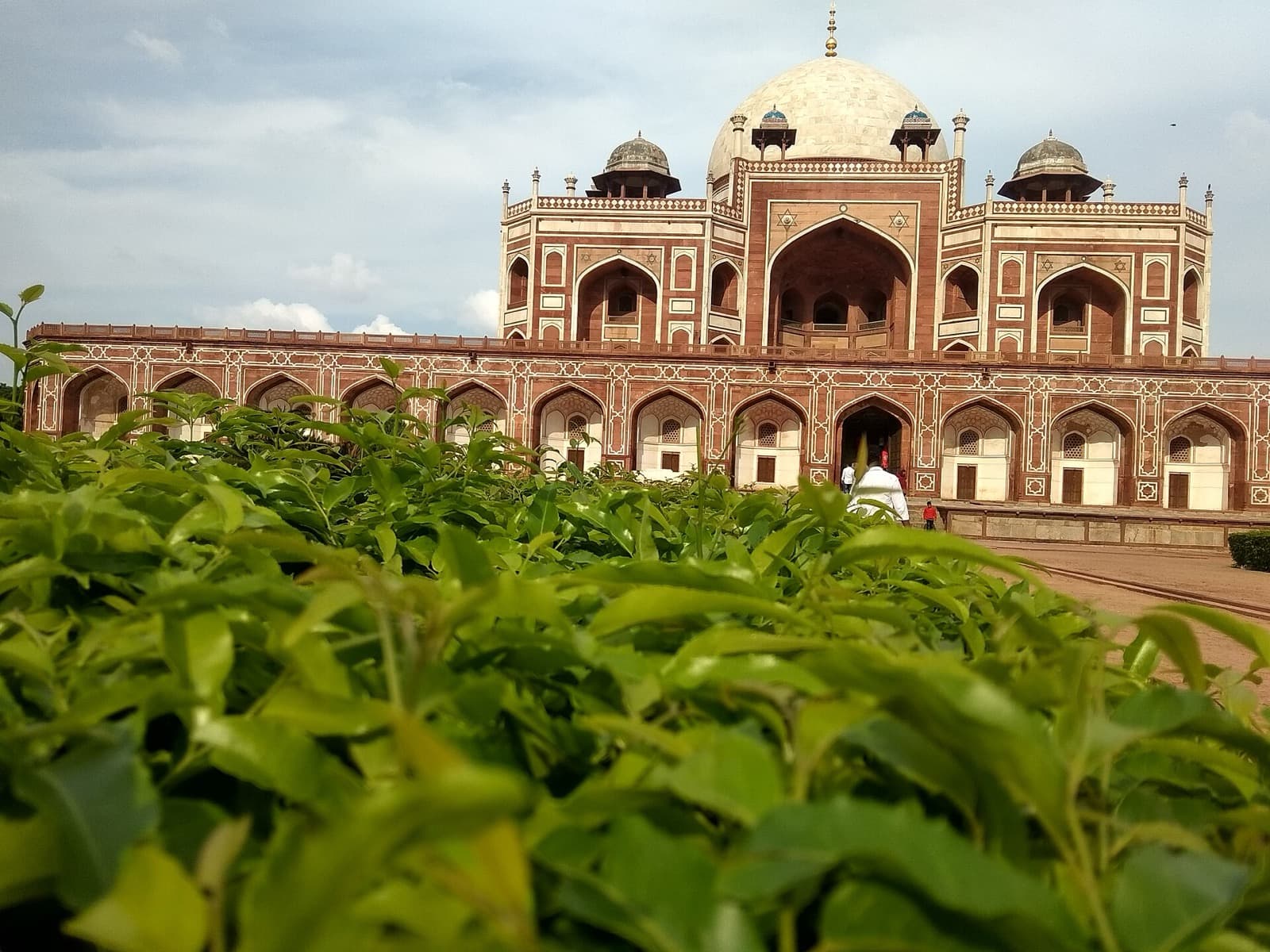
The contrast with Humayun's Tomb, when you reach it, is total. There the Persian architect Mirak Mirza Ghiyas of Herat lifted a high double dome on a drum for the first time in India, on a body of red sandstone inlaid with white marble, all set at the center of a fourfold water-garden. That building leads directly to the Taj Mahal a century later. Isa Khan's tomb leads nowhere; it is a terminus, the last full statement of a form about to be eclipsed. Reading the two in sequence, first the octagon, then the domed giant, is the closest thing Delhi offers to watching one architectural era hand off to another.
The earliest sunken garden
There is one more thing to understand while standing here, and it took modern conservation to recover it. When the Aga Khan Trust for Culture, working with the Archaeological Survey of India, restored this tomb between 2011 and 2015, the work reached below ground as well as above it. Isa Khan's Tomb holds the distinction of being the first monument in India to be restored by a private organization, funded by the Aga Khan Trust for Culture and the World Monuments Fund alongside the Archaeological Survey of India. Part of that effort involved the manual removal of thousands of truckloads of earth that had accumulated over centuries, and beneath it the original sixteenth-century ground levels reappeared. What surfaced is now read as the earliest surviving sunken garden of the Persian tradition in India, the enclosure set deliberately below the surrounding grade so that the tomb rises from within its own recessed court.
That detail rewards a slow look. The garden you walk in was not always at the level under your feet today. Decades of debris had buried its geometry, and the calm, ordered enclosure you see is a reconstruction of an idea that had been physically lost. It is a useful reminder for the whole complex: much of what reads as timeless here was, until recently, ruined, silted, and half-forgotten, then patiently brought back.
Standing in front of it
The one thing to carry away, standing before this quiet grey octagon, is that it is the deliberate before-image of everything ahead. It is not a lesser version of Humayun's Tomb. It is a different and complete idea of a tomb, made by the confident enemies of the Mughals, in the last years before Mughal architecture leapt somewhere new. Everything you see next on this walk, the paradise garden, the drum-lifted dome, the marble screens, becomes legible precisely because you looked at this first.
From here the path leads on to the West Gate, the char bagh garden, and Humayun's mausoleum at its center, then out to the anonymous Barber's Tomb and the blue-tiled Nila Gumbad at the garden's edge. You can walk the full sequence, at your own pace and on your own clock, with the Humayun's Tomb: The Blueprint for the Taj self-guided audio tour, which begins right here at Isa Khan's tomb. If you are planning a wider day in the city, browse the rest of our Delhi walking tours to string this quiet Nizamuddin necropolis together with the noise and crowds of Old Delhi.
Sources
- Tomb of Isa Khan, Wikipedia: construction dates (1547 to 1548), Isa Khan's role at the Sur courts, octagonal Lodi-style plan, six cenotaphs, attached mosque, and the 2011 to 2015 Aga Khan Trust restoration.
- Nizamuddin Urban Renewal Initiative (Aga Khan Trust for Culture): the sunken garden recovery, removal of thousands of truckloads of earth, and Isa Khan's Tomb as the first Indian monument restored by a private organization.
- Delhi Tourism, Government of NCT of Delhi: overview of Isa Khan's Tomb within the Humayun's Tomb precinct.
- Archnet, Isa Khan Niyazi Tomb Complex: architectural documentation of the octagonal chamber, verandah, kiosks, and glazed tilework.
- Roamer tour "Humayun's Tomb: The Blueprint for the Taj" (fact-audited transcript): Sur dynasty context, tile colors, cenotaph count, and the tomb's role as the "before" image on the walk.
Ready to experience it?
Humayun's Tomb: The Blueprint for the Taj
75 min · 1.5 km · easy
More from Delhi
Explore more at your own pace.
Delhi Travel Guide: How Many Days, Getting Around, Best Time, and Safety
Chandni Chowk: How Delhi's Moonlit Avenue Holds an Entire Mughal Capital
How Humayun's Tomb Drafted the Taj Mahal a Century Early
The Diwan-i-Khas at Delhi's Red Fort: The Hall That Called Itself Paradise and Lost Its Throne
Jama Masjid: The Mosque Shah Jahan Built to Crown His Capital