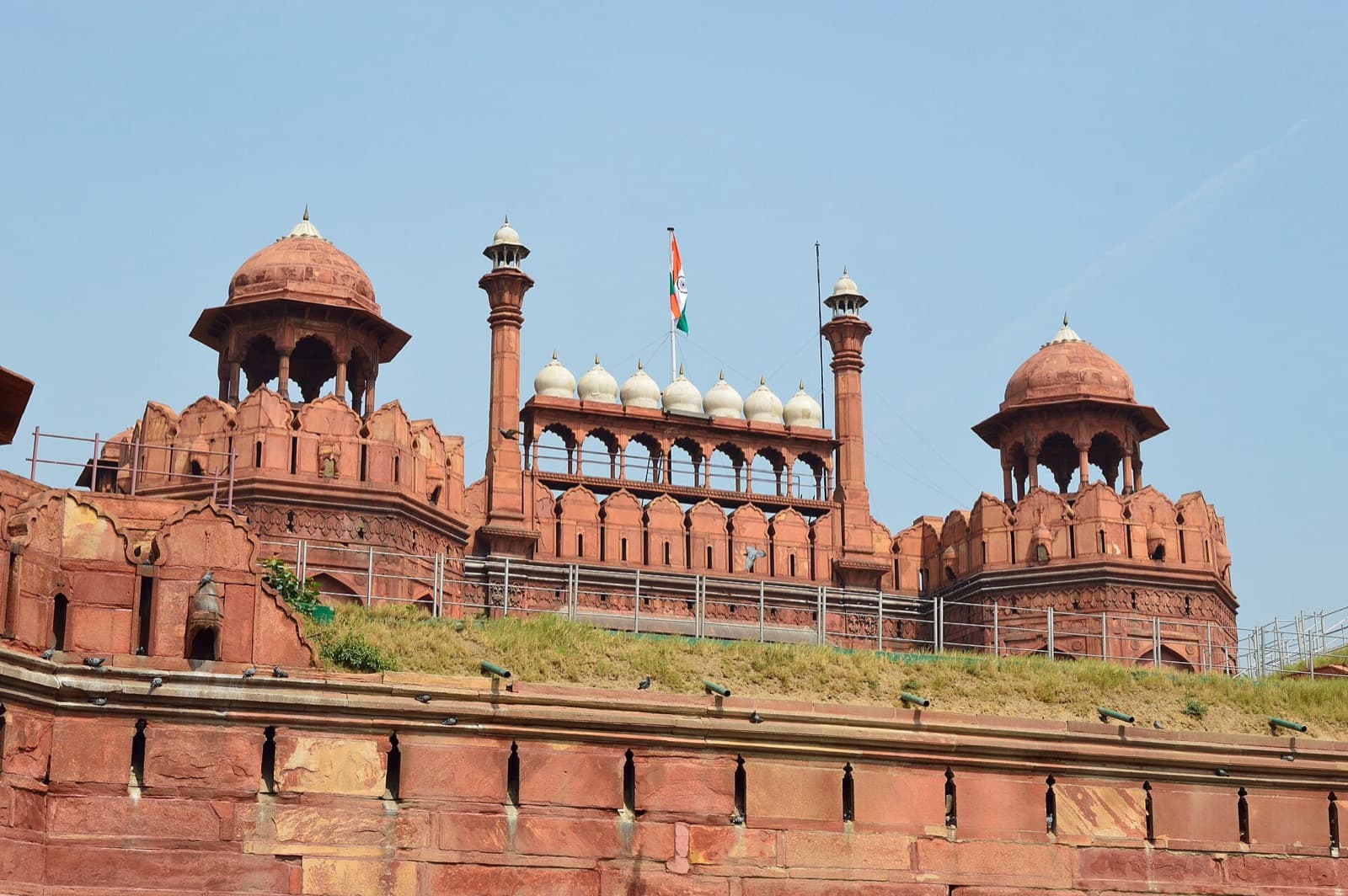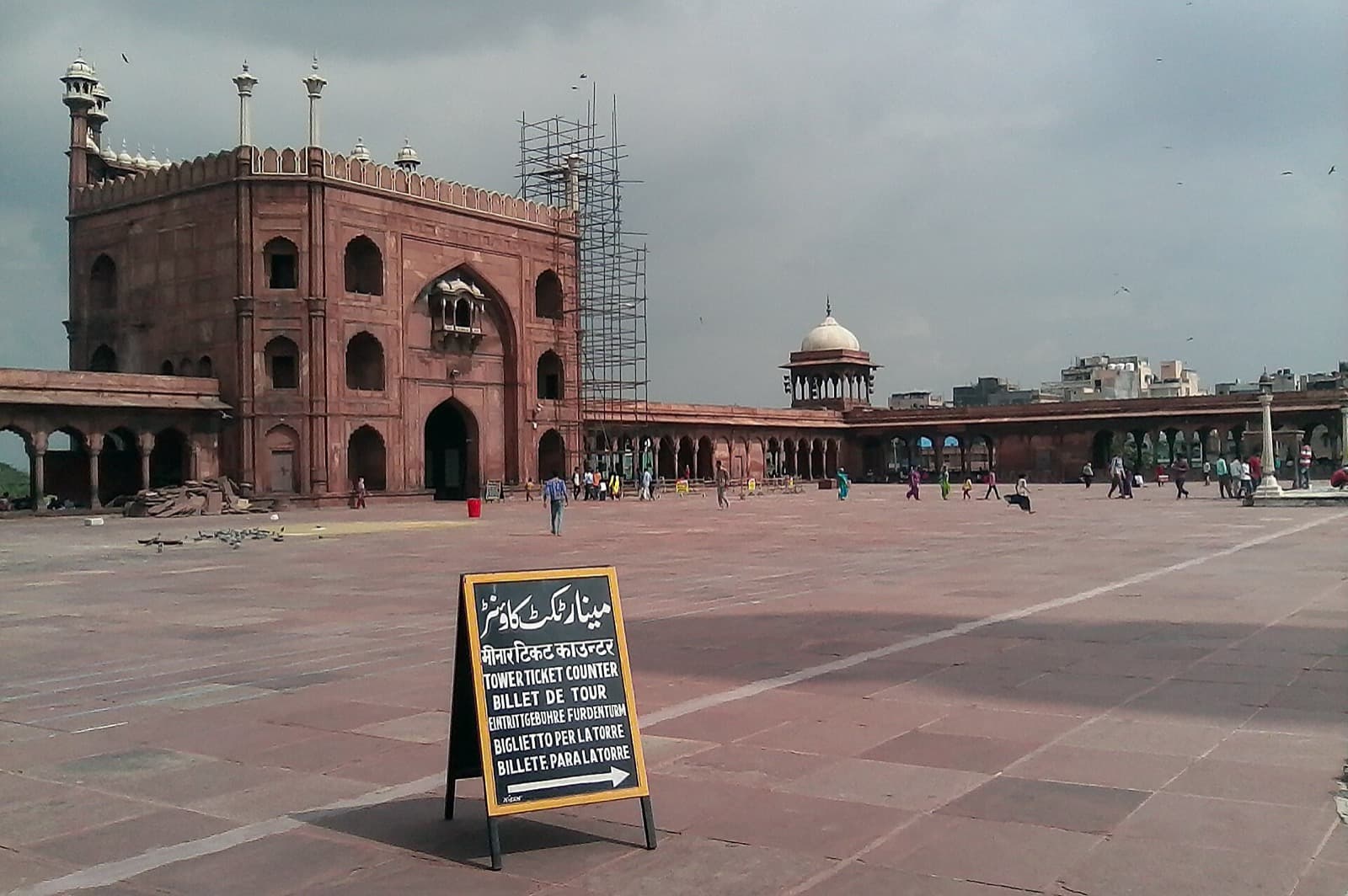
Delhi's Jama Masjid is the great congregational mosque Shah Jahan built between 1650 and 1656 to crown Shahjahanabad, the new walled capital he founded around 1650. He raised it at the same moment he was raising the Red Fort and the city itself, and everything about the mosque, from its stepped platform down to the courtyard that holds tens of thousands, was designed to anchor the capital both spiritually and visually. If you understand only one thing while standing in front of it, understand that: this was not a mosque added to a city. It was a mosque built as part of the act of making a city.
A mosque and a capital, raised together
Most great buildings arrive one at a time, slotted into a place that already exists. The Jama Masjid did the opposite. Shah Jahan was assembling an entire imperial capital in the middle of the seventeenth century, and the mosque was one of its founding gestures, planned in concert with the Red Fort down the road and the ceremonial avenue of Chandni Chowk that runs between them. Construction ran from 1650 to 1656. According to the mosque's Wikipedia entry, roughly five thousand workers built it, at a cost of ten lakh, one million rupees, in the money of the day, with the work supervised by the nobles Saadullah Khan and Fazil Khan.
The name tells you the ambition. Its original name was Masjid-i Jahan-Numa, which carries the sense of a mosque that commands, or reflects, a view of the world. That is a large claim for any building, but it was made by an emperor who had already commissioned the Taj at Agra and clearly did not think in small terms. When you read the title next to the scale of the thing, the two match.
Reading the platform, the stone, and the courtyard
Hear a stop from this walk
Jama Masjid: The Mosque Built to Crown the Capital
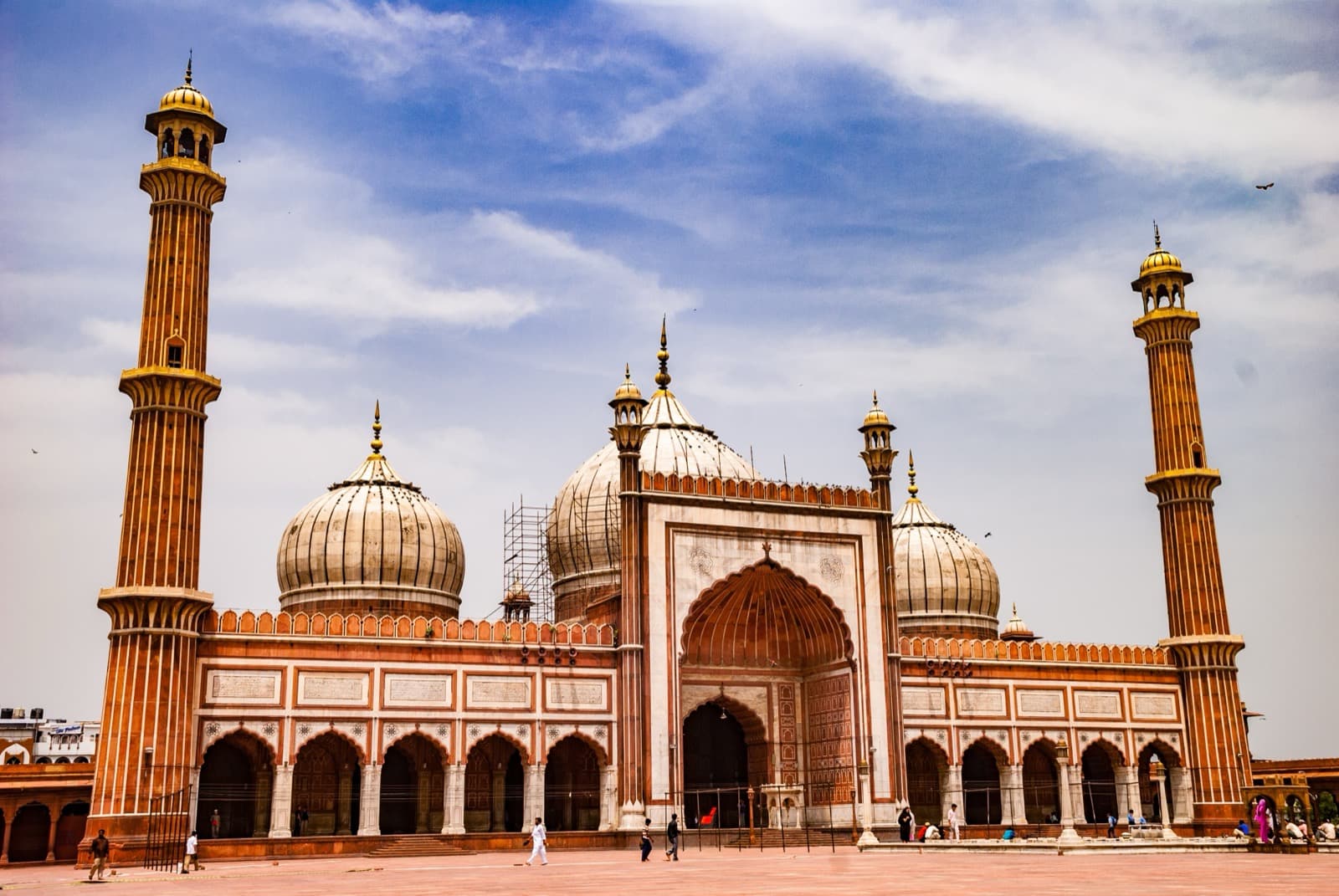
Stand at the base of the eastern steps and look up. The first thing the design does to you is lift the mosque out of the street. It sits on a stepped platform above the surrounding lanes, so you climb toward it rather than simply walking in. That elevation is deliberate. It separates the sacred enclosure from the market noise below and gives the mosque command of the skyline of the old city, exactly the dominance its builder wanted.
The material is the second thing to read. The mosque is built of red sandstone banded with white marble, the same palette Mughal architects used across their imperial works, and up close you can watch the two stones play against each other in the light. Three marble domes crown the prayer hall. Two sandstone minarets rise about forty-one metres, roughly one hundred thirty-five feet, and each of them climbs internally by one hundred thirty steps, which is why a small fee and a fair amount of stamina are involved if you want the view from the top.
Then there is the courtyard, and this is where the scale finally lands. The vast open square is enclosed by arcades on three sides, with a broad ablution tank at its centre, and it is said to hold about twenty-five thousand worshippers at one time. Numbers like that are hard to feel on a page. Standing inside the empty morning courtyard, watching a handful of people cross a space built for a crowd fifty times larger, you feel it immediately. This is a gathering place first. The architecture exists to hold people at the scale of a whole city's Friday prayer.
The gates and the hierarchy built into stone
One detail rewards a slow look: the three gateways are not identical, because they were never meant to be used by the same people. The most prominent is the eastern gate, three storeys high, which historically served as the shahi, or royal, entrance, reserved for the emperor and his associates. The northern and southern gates, two storeys high, were for everyone else. So the building quietly encoded the social order of the capital into its own walls. The emperor arrived one way; the city arrived another. When you enter today, you are almost certainly walking through a gate that was, for most of its history, not for people like you at all, and there is something worth pausing on in that.
Standing in front of it
The single most useful thing to grasp here is the double role the mosque was built to play. It was the religious counterpart to the Red Fort, the spiritual half of a paired imperial project, and it remains a working centre of Muslim worship nearly four centuries on. Both of those are true at once. You are looking at a founding monument of a lost capital and at a living mosque where people pray five times a day.
That second fact shapes how you should visit. This is an active place of worship, not a ruin. Dress modestly, remove your shoes before stepping onto the platform, and defer to prayer times, when the mosque belongs to the faithful and is not a sightseeing space. A fee may apply to bring a camera in or to climb a minaret, and access to the towers can be limited, so treat the climb as a maybe rather than a plan.
What you can always do is take your time. The mosque was designed to be experienced from its courtyard and its exterior, in the interplay of red stone and white marble and the movement of light across a very large open space. Sit at the edge of the courtyard. Watch the domes catch the sun. Read the scale slowly, on your own clock, which is the one thing a hurried group tour cannot give you at the largest gathering space in the old city.
The Jama Masjid is stop three on Roamer's self-guided audio walk through Old Delhi, which threads the whole spine of Shahjahanabad along Chandni Chowk: the Jain temple facing the fort, the silver and spice lanes, the Sikh shrine, and the second mosque that bookends the avenue at its western end. You walk it at your own pace, pausing where a place holds you and pressing on when you are ready. Browse the full route and the rest of the old city among the Delhi walking tours, or start planning from the Delhi city page.
Sources
- Jama Masjid, Delhi (Wikipedia): construction dates, cost of ten lakh rupees, approximately 5,000 workers, the eastern royal gate, minaret height and 130 steps, and 25,000 capacity.
- Jami Masjid, mosque, Delhi (Encyclopaedia Britannica): overview of the mosque as Shah Jahan's principal congregational mosque and its place in Shahjahanabad.
- Roamer tour "Old Delhi: The Last Mughal Capital" (fact-audited tour text): the original name Masjid-i Jahan-Numa, the red sandstone and white marble construction, the three marble domes and central ablution tank, and the mosque's role as the crown of the capital.
Ready to experience it?
Old Delhi: The Last Mughal Capital
80 min · 3.3 km · moderate
More from Delhi
Explore more at your own pace.
Delhi Travel Guide: How Many Days, Getting Around, Best Time, and Safety
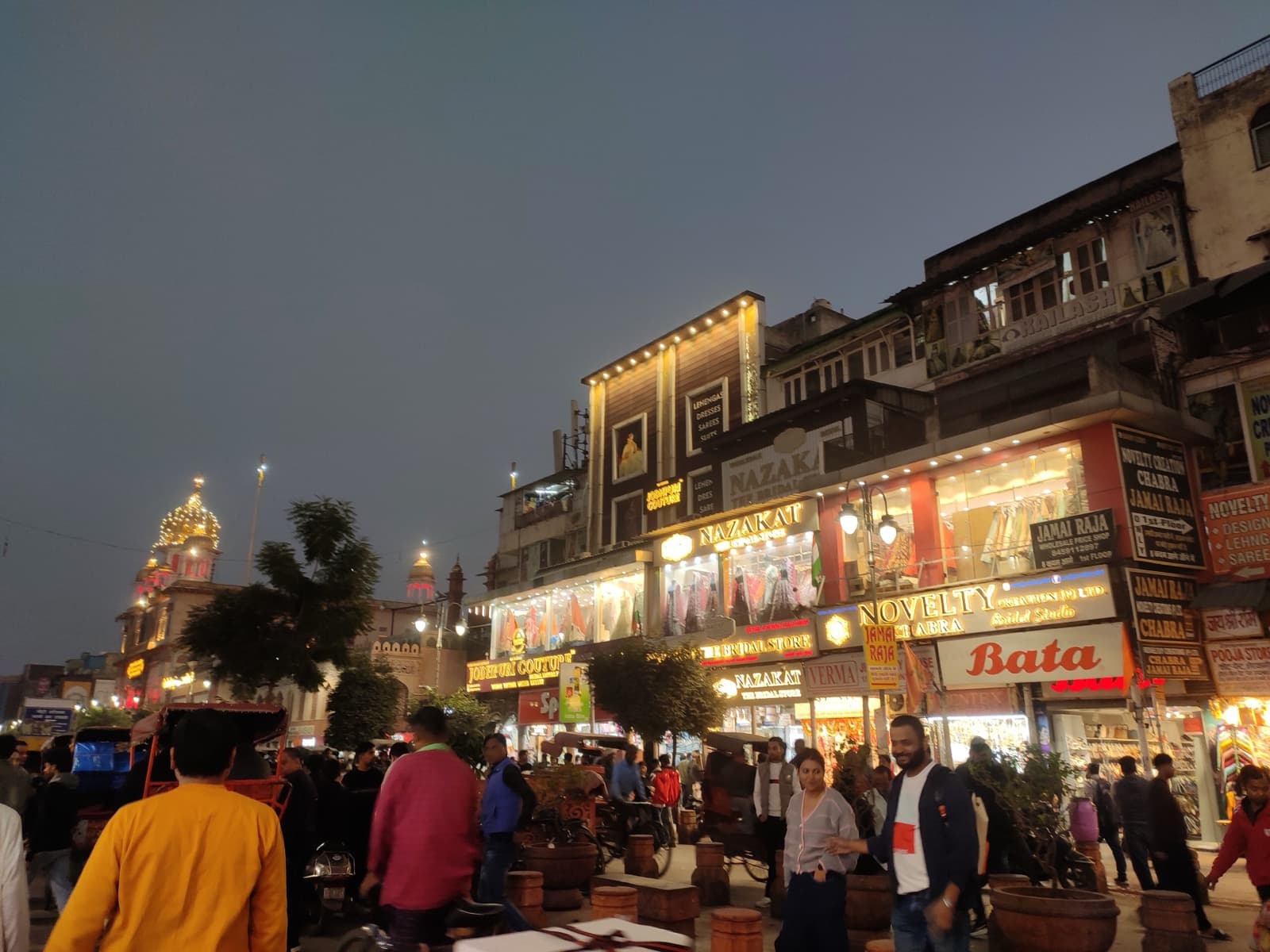
Chandni Chowk: How Delhi's Moonlit Avenue Holds an Entire Mughal Capital
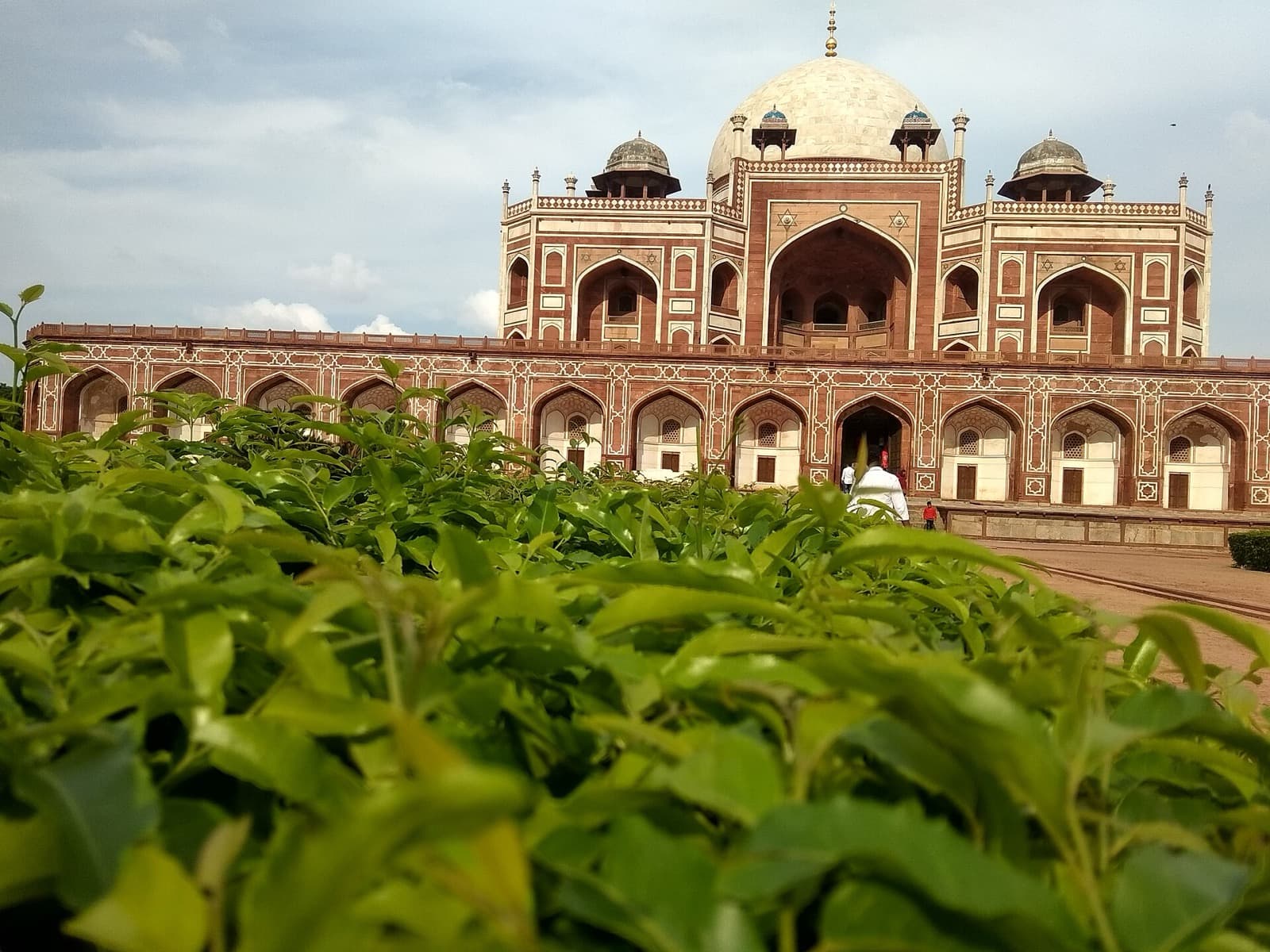
How Humayun's Tomb Drafted the Taj Mahal a Century Early
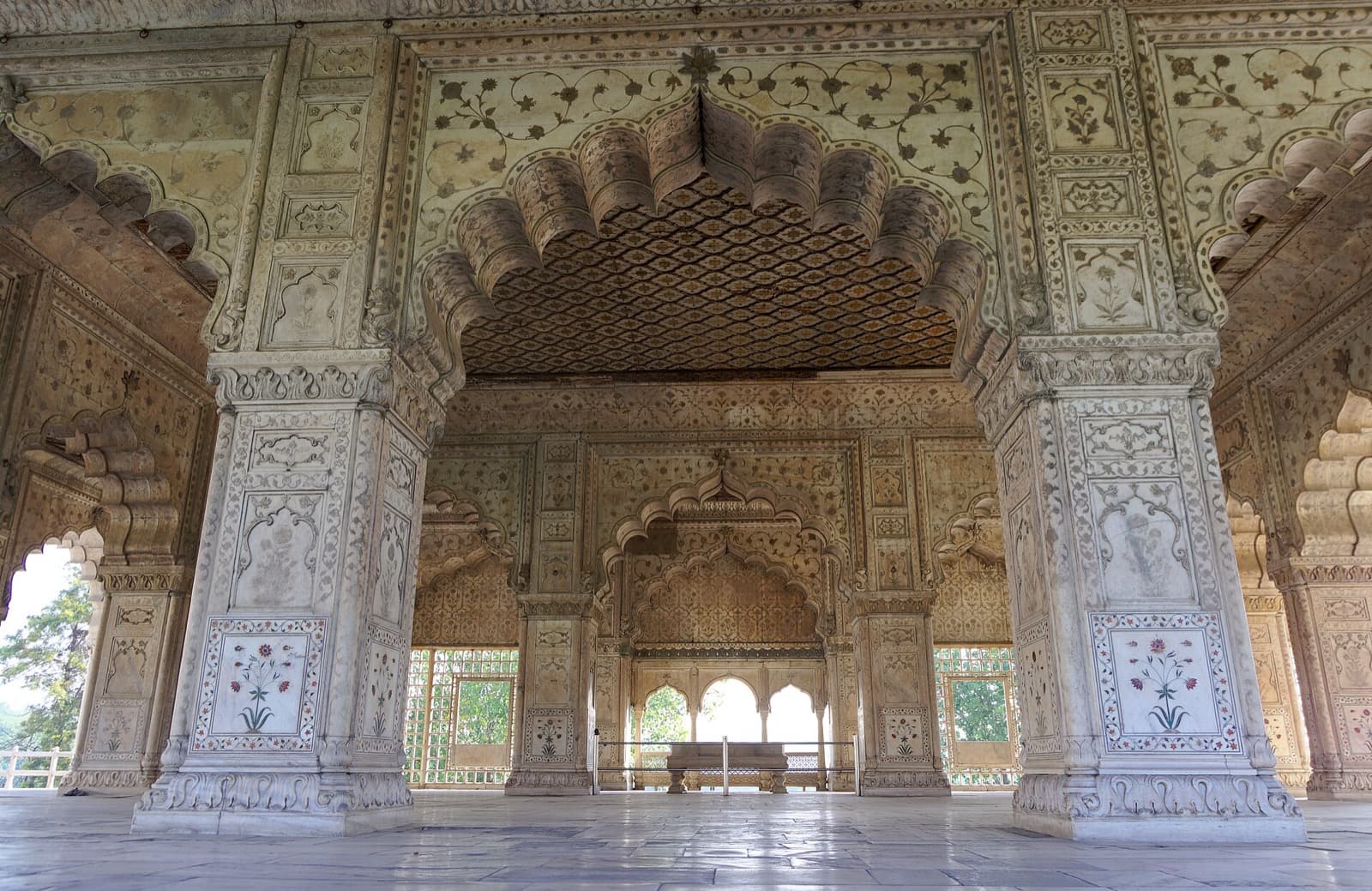
The Diwan-i-Khas at Delhi's Red Fort: The Hall That Called Itself Paradise and Lost Its Throne
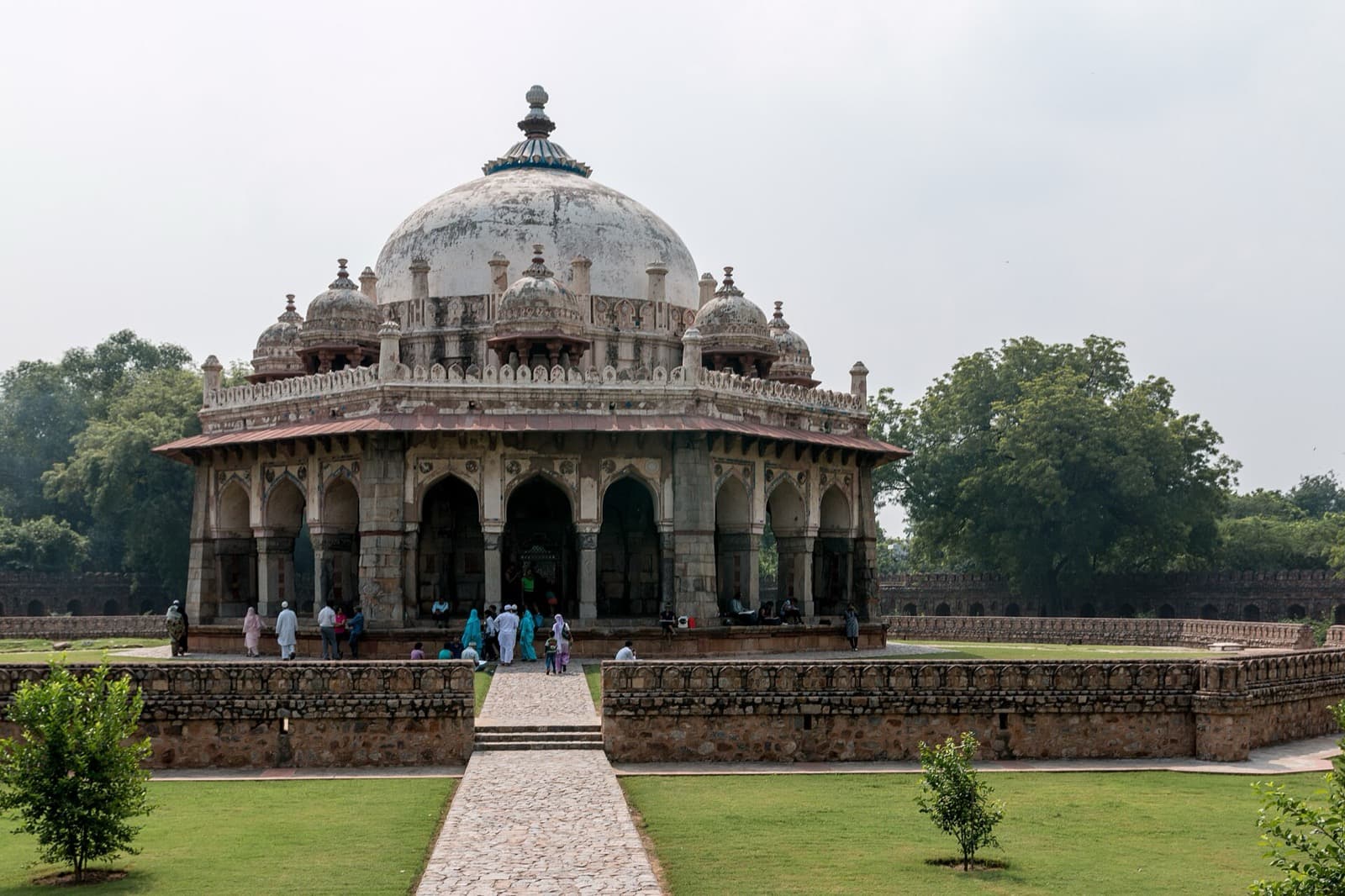
Isa Khan's Tomb and Mosque: The World Just Before the Mughals