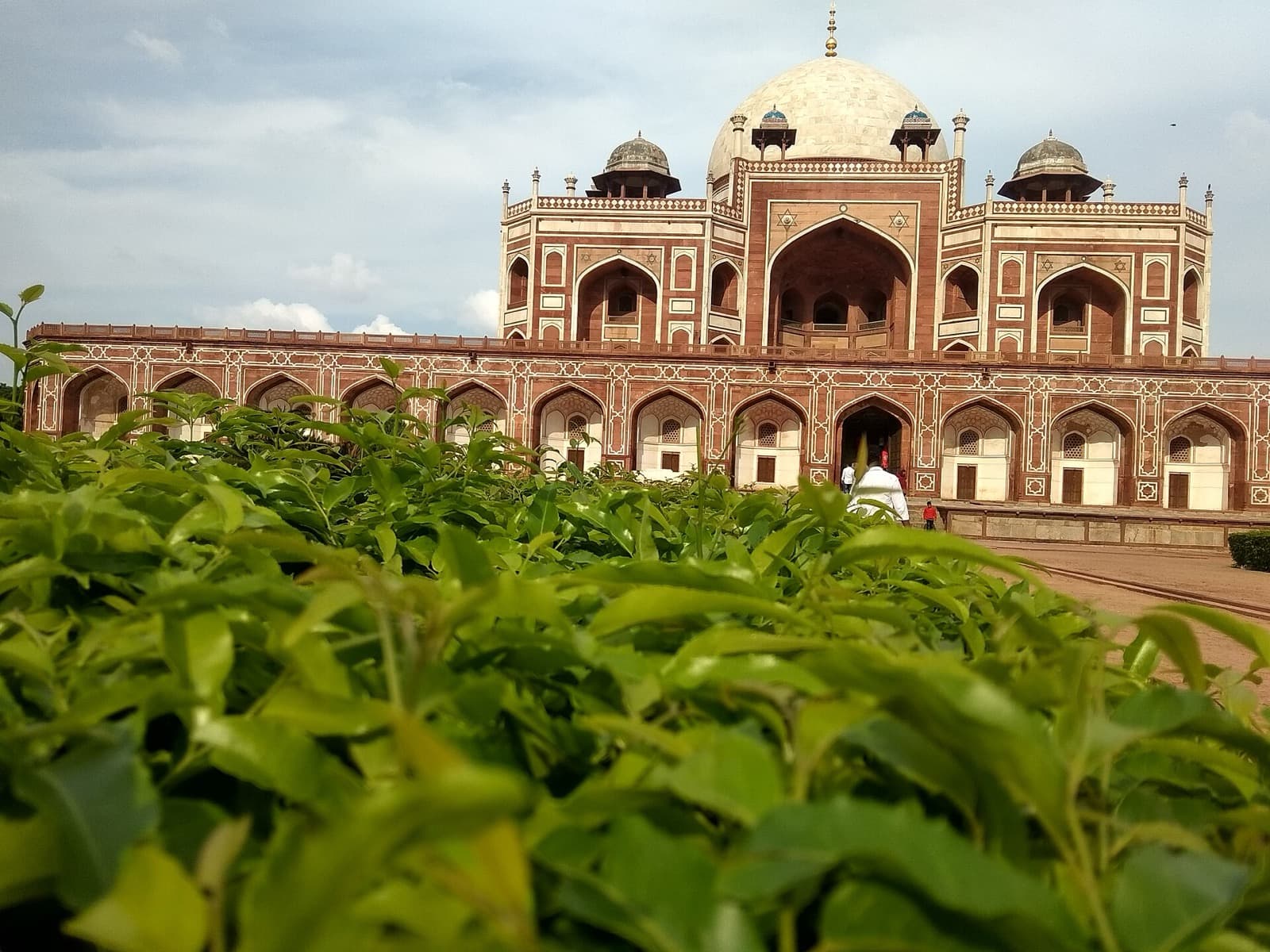
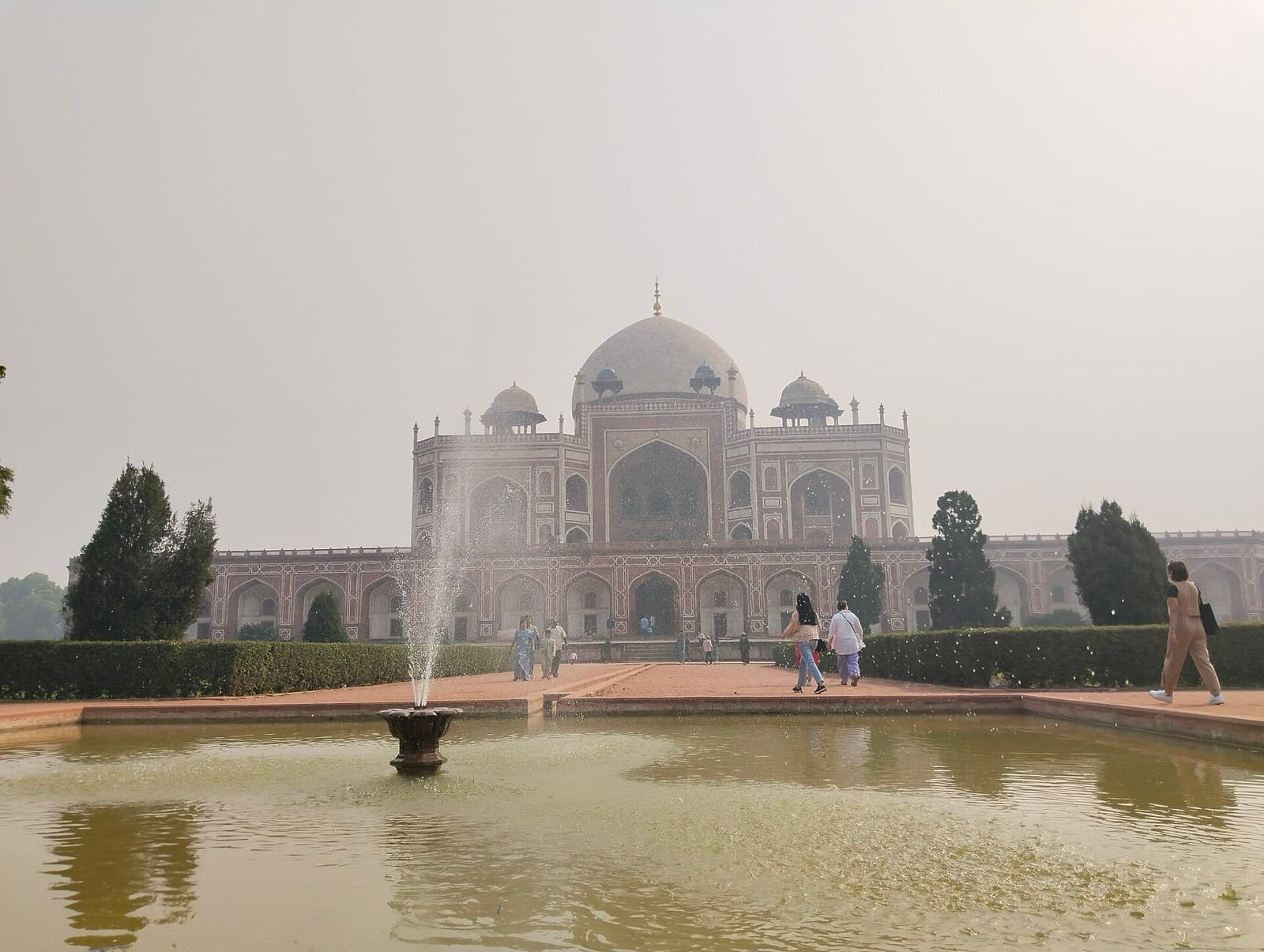
Humayun's Tomb in Delhi is the origin building where India first fused a Persian double dome with a fourfold paradise garden, and where the Taj Mahal was, in effect, first drafted a century before Agra perfected it. Walk the garden slowly and you can read the whole argument in stone: a red sandstone mausoleum faced with white marble, lifted on a high drum, sitting at the exact center of a square garden cut by shallow water channels. Every element that would later make the Taj famous was raised here first. The tomb is not a smaller cousin of the more celebrated monument down the road. It is the prototype, and the century that separates the two is the story this walk tells.
The Grave That Started a Pattern
The tomb was commissioned in the decade after 1556, the year the second Mughal emperor Humayun died. His senior widow, the empress Bega Begum, also called Haji Begum, funded the work herself. The Archaeological Survey of India records her paying about one and a half million rupees, and it names the designers: Mirak Mirza Ghiyas, a Persian architect from Herat, and his son Sayyid Muhammad. Construction ran roughly from 1565 to 1572. What they raised had never been built in India before.
Two firsts matter. This was the first garden-tomb on the subcontinent, and it was the first Indian building to lift a high Persian double dome on a drum. The structure rises about 47 metres, roughly 154 feet, on a plinth about 91 metres wide, and the Archaeological Survey of India records the marble double dome itself at 42 and a half metres. Stand at the platform and take the measure of that dome, because you are looking at a blueprint. The chamfered corners, the deep arched recesses, the marble lattice screens called jaalis, the pillared rooftop kiosks known as chhatris: this vocabulary set the precedent for mature Mughal mausoleum architecture, and it leads directly to the Taj Mahal, raised a century later in Agra. UNESCO inscribed the complex as a World Heritage Site in 1993.
A Garden Built Around a Grave
Hear a stop from this walk
The Nila Gumbad and the Arab Serai: The Blue Dome and the Court of the Makers
The tomb does not stand alone. It sits at the center of a char bagh, a fourfold Persian garden divided into four main plots by raised causeways, with water channels running down each. Each quarter is subdivided again into smaller squares, more than thirty in all, across roughly thirty acres. The channels stand for the four rivers of paradise described in the Quran. Watch the water as you cross: it slips out of sight beneath the tomb's platform and reappears in a straight line on the far side, staging the image of rivers flowing beneath the Garden of Paradise.
This fusion, a monumental central tomb set inside a paradise garden, is what the Archaeological Survey of India credits as the first garden-tomb built in India. It is also the exact layout that would be perfected at the Taj Mahal. The reveal is deliberate. Enter today through the West Gate, the one in use, pause under its arch, and the mausoleum appears framed at the far end of a long central axis, growing larger as you approach. That framed first sight is not an accident of the path. It is the point of the whole plan.
The Before-Image, and the End of an Empire
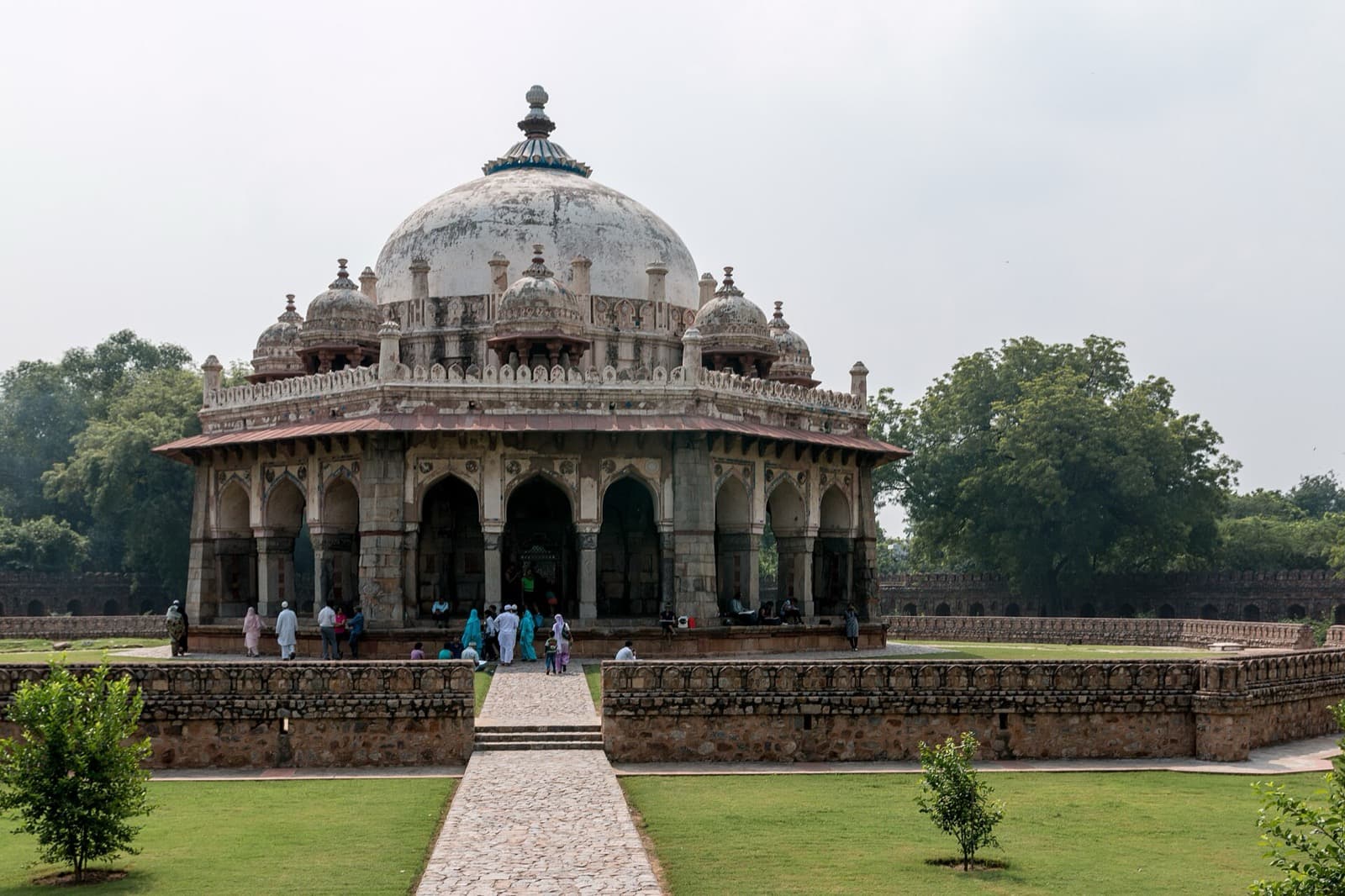
To understand how radical the tomb was, the walk starts before it. Just inside the complex stands the tomb of Isa Khan Niyazi, built around 1547 and 1548, roughly twenty years earlier. Isa Khan served the Sur dynasty, the line that briefly pushed the Mughals out of Delhi. His grave belongs to an older tradition: an eight-sided chamber ringed by a low verandah, a single central dome, sunk into its own walled garden, in the style of the earlier Lodi dynasty. Low, octagonal, inward-looking. Hold that shape in mind. It is the deliberate before-image, and everything that follows measures its distance from it.
The same great tomb also holds an ending. Read from the inside, the mausoleum is honeycombed into 124 vaulted chambers holding more than a hundred graves, which earned it the sober nickname the Dormitory of the Mughals. Later royalty crowded in around the emperor, among them the prince Dara Shikoh, a son of Shah Jahan. And it was here, at what was then the edge of Delhi, that the dynasty reached its end. During the Rebellion of 1857, the last Mughal emperor Bahadur Shah Zafar took refuge in this tomb. Company forces led by Major William Hodson surrounded it, and on the twentieth of September 1857 Zafar was captured here, then exiled to Rangoon, in Burma, where he died. The form was born a few feet above the graves, at the center of the dome, and the line that built it was extinguished in the same walls three centuries later.
The Quieter Corners
The garden keeps two puzzles for the end. In the southeast quarter stands the Barber's Tomb, or Nai ka Gumbad, dated by an interior inscription to 1590 and 1591. It is the only tomb besides the emperor's own built inside the walled garden, an extraordinary honor. Yet no inscription names the occupant. Tradition holds it was Humayun's royal barber, a trusted attendant, but that is a story handed down, not documented fact. Stand with the mystery rather than the legend.
Past the eastern wall sits the Nila Gumbad, the Blue Dome, once sheathed entirely in turquoise glazed tiles, a few of which survive on its northern face. Its date is genuinely disputed: one account ties it to an attendant who died in 1626, another argues it may predate Humayun's Tomb itself. Nearby, the Arab Serai, a walled enclosure with a gateway about twelve metres high, was built around 1560 by Haji Begum, the same empress. The whole complex, from center to rim, was restored in recent years by the Aga Khan Trust for Culture working with the Archaeological Survey of India.
This is one of Delhi's calmest great monuments, a garden of the dead where you set your own pace, linger at the marble screens, or press on to the graves. If you want to see where the Taj Mahal began, walk this one first. For more routes across the capital, see our Delhi walking tours, or browse everything on offer in Delhi.
Sources
- Humayun's Tomb, Delhi, UNESCO World Heritage Centre (site 232): official inscription record and dating of the 1993 listing.
- Humayun's tomb, Wikipedia: consolidated history of the mausoleum, its architects, dimensions, and the Dormitory of the Mughals.
- Tomb of Isa Khan, Wikipedia: the Sur-era octagonal tomb and its Lodi-dynasty form, restored 2011 to 2015.
- Bahadur Shah II, Britannica: the last Mughal emperor, his capture in 1857, and exile to Rangoon.
- Nila Gumbad and Arab Serai, Wikipedia: the disputed dating of the Blue Dome and the empress Haji Begum's walled enclosure.
Ready to experience it?
Humayun's Tomb: The Blueprint for the Taj
75 min · 1.5 km · easy
More from Delhi
Explore more at your own pace.
Delhi Travel Guide: How Many Days, Getting Around, Best Time, and Safety
Chandni Chowk: How Delhi's Moonlit Avenue Holds an Entire Mughal Capital
The Diwan-i-Khas at Delhi's Red Fort: The Hall That Called Itself Paradise and Lost Its Throne
Isa Khan's Tomb and Mosque: The World Just Before the Mughals
Jama Masjid: The Mosque Shah Jahan Built to Crown His Capital