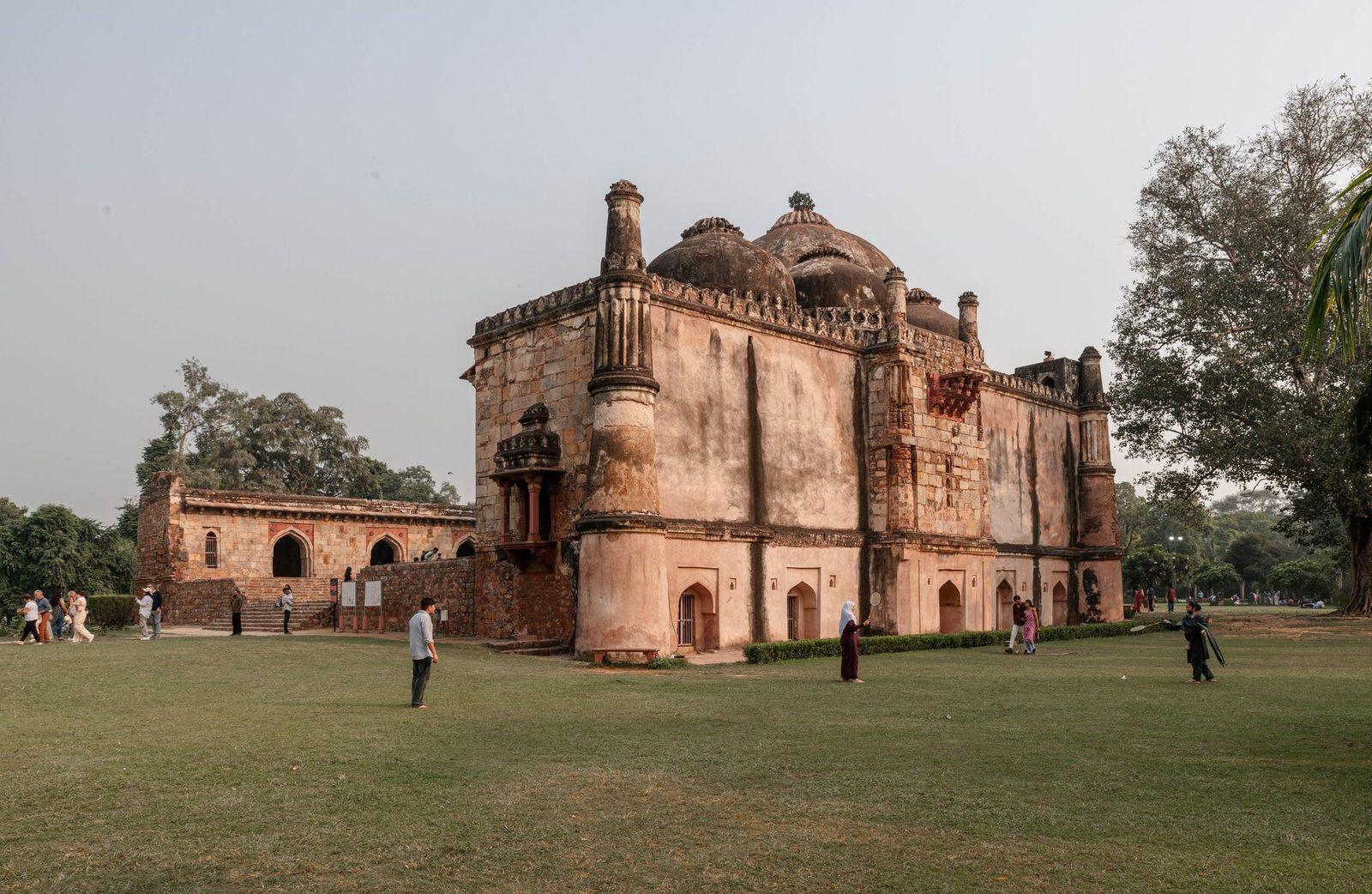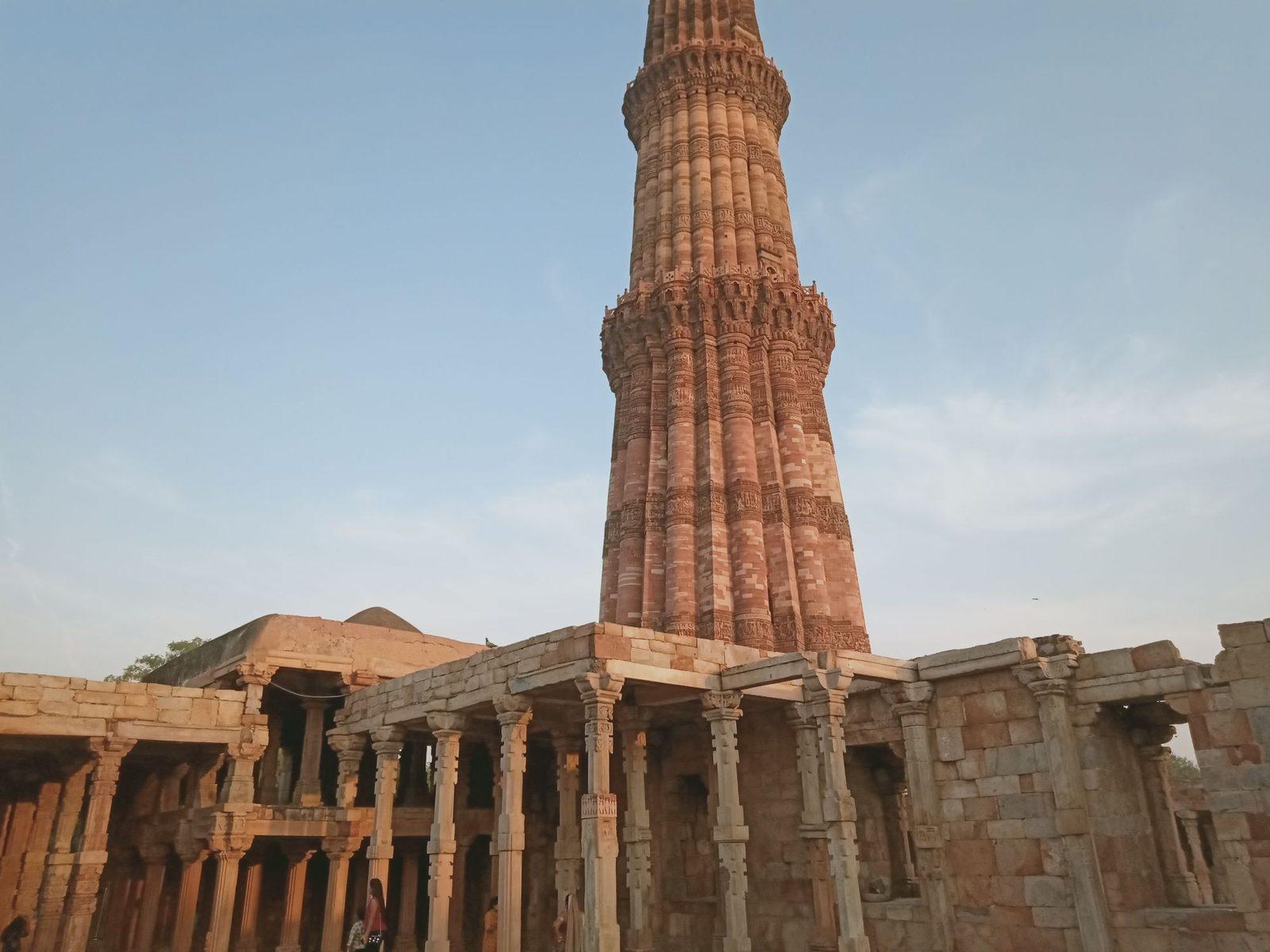
Around the Qutub Minar, seven centuries of builders reused, finished, rivaled, repaired and re-dressed the same ground. One commander began a mosque here in 1192 and a tower in 1199. His successor finished the tower and doubled the mosque. A sultan a century later built a great gate and began a rival tower twice the size, and died before it rose past one story. Later rulers repaired the minar after lightning, and a British engineer put a cupola on top that his own government took down. In the middle of it all stands an iron pillar older than any of them. The walk inside the ticketed complex reads those layers in turn.
The tower, and who finished it
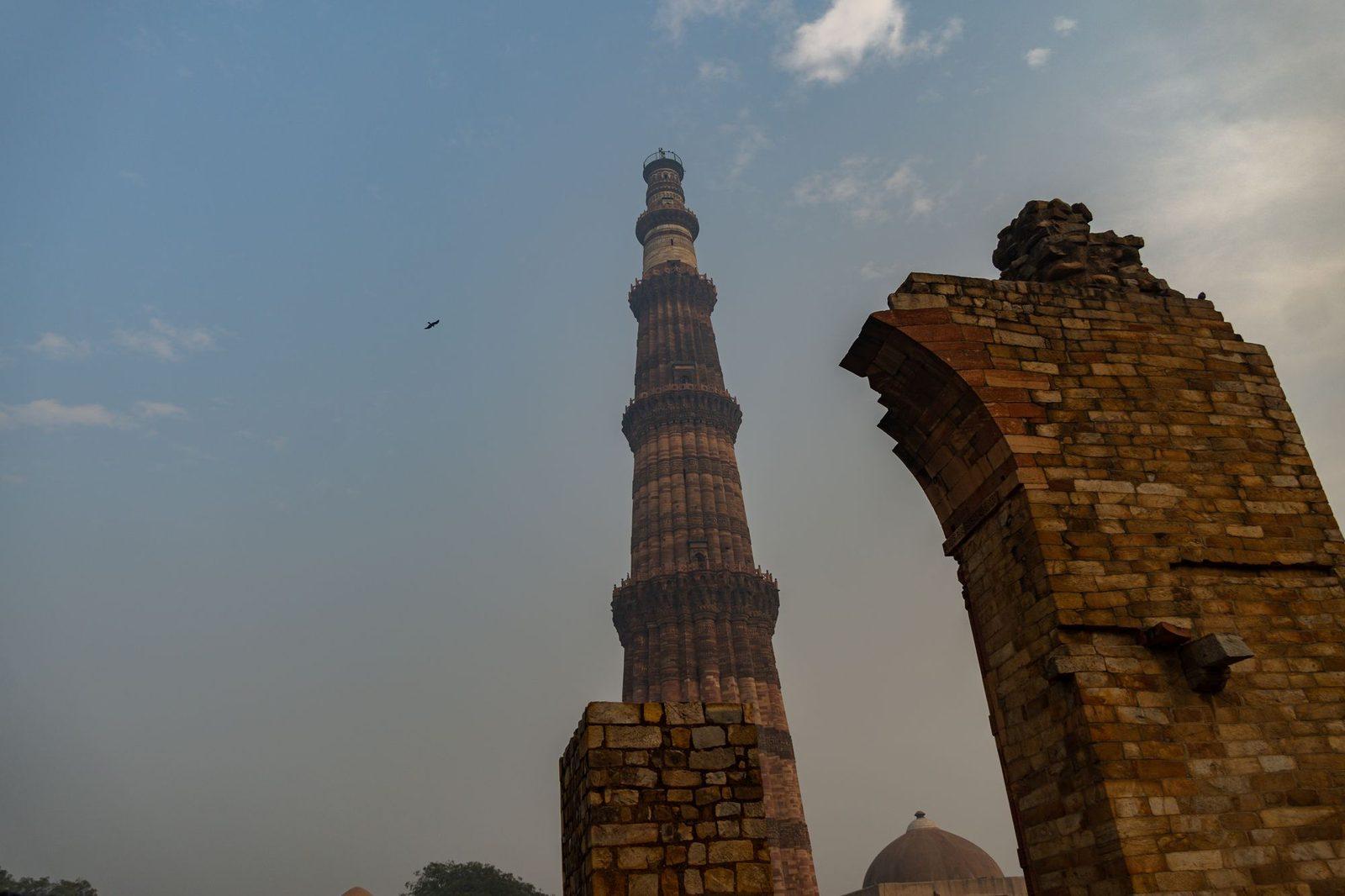
The Archaeological Survey of India gives the minar's height as 72.5 meters and calls it the highest tower in India; UNESCO calls it the tallest masonry tower in India. Qutbuddin Aibak, the army commander who took Delhi for his sultan, laid its foundation in 1199 and raised the first story. His successor and son-in-law, Iltutmish, added three more. The Survey says it was built for the muezzin to give the call to prayer, and was possibly raised as a tower of victory too. Its three lower stories are each fluted differently, one with alternate angular and round flutes, one round, one angular. Lightning struck it in 1326 and again in 1368, and Firoz Shah Tughlaq replaced the damaged top story with two, faced in white marble; Sikandar Lodi's inscription records a repair in 1503. Climbing it has been closed since 1981.
Iltutmish's own tomb, built about 1235, is on the walk: plain red sandstone outside, carved over every surface within, and now open to the sky. UNESCO says it marks the beginning of the tradition of constructing royal tombs. In 1230 he doubled the mosque, extending its great arched screen so that the minar stood inside the enlarged enclosure.
A rival that stopped at one story
Hear a stop from this walk
Iron Pillar
Ala-ud-din Khalji, who reigned from 1296 to 1316, doubled the mosque again and began the Alai Minar, meant, the Survey says, to be twice the size of the earlier tower. He completed only the first story, now about 25 meters of rough rubble core: the facing never came. Close by are the ruins of a madrasa, a college, believed to be his, with a domeless chamber that was perhaps his tomb. Y. D. Sharma, in the Archaeological Survey's handbook, notes that a college and tomb combined appears here in India for the first time.
His finished work is the Alai Darwaza, the domed southern gateway he added in 1311. Its pointed arches are built with radiating voussoirs, the wedge-shaped stones of a true arch, and the Survey calls it the first building employing Islamic principles of construction and ornamentation. Set it against the screen's arches, which are corbelled, built up in overlapping courses with true voussoirs only at the top. Beside the gate, the saint Imam Zamin, who came from Turkestan, built his own small tomb in 1537 and 1538.
The cupola that came down
The earthquake of 1 August 1803 threw down the minar's old cupola. Major Robert Smith of the Royal Engineers repaired the tower in the late 1820s and crowned it with a new red sandstone cupola, which was judged out of place and taken down in 1848. It stands on the lawn today, known as Smith's Folly, and the walk uses it for the best full view of the tower.
The founder's words, and the oldest object
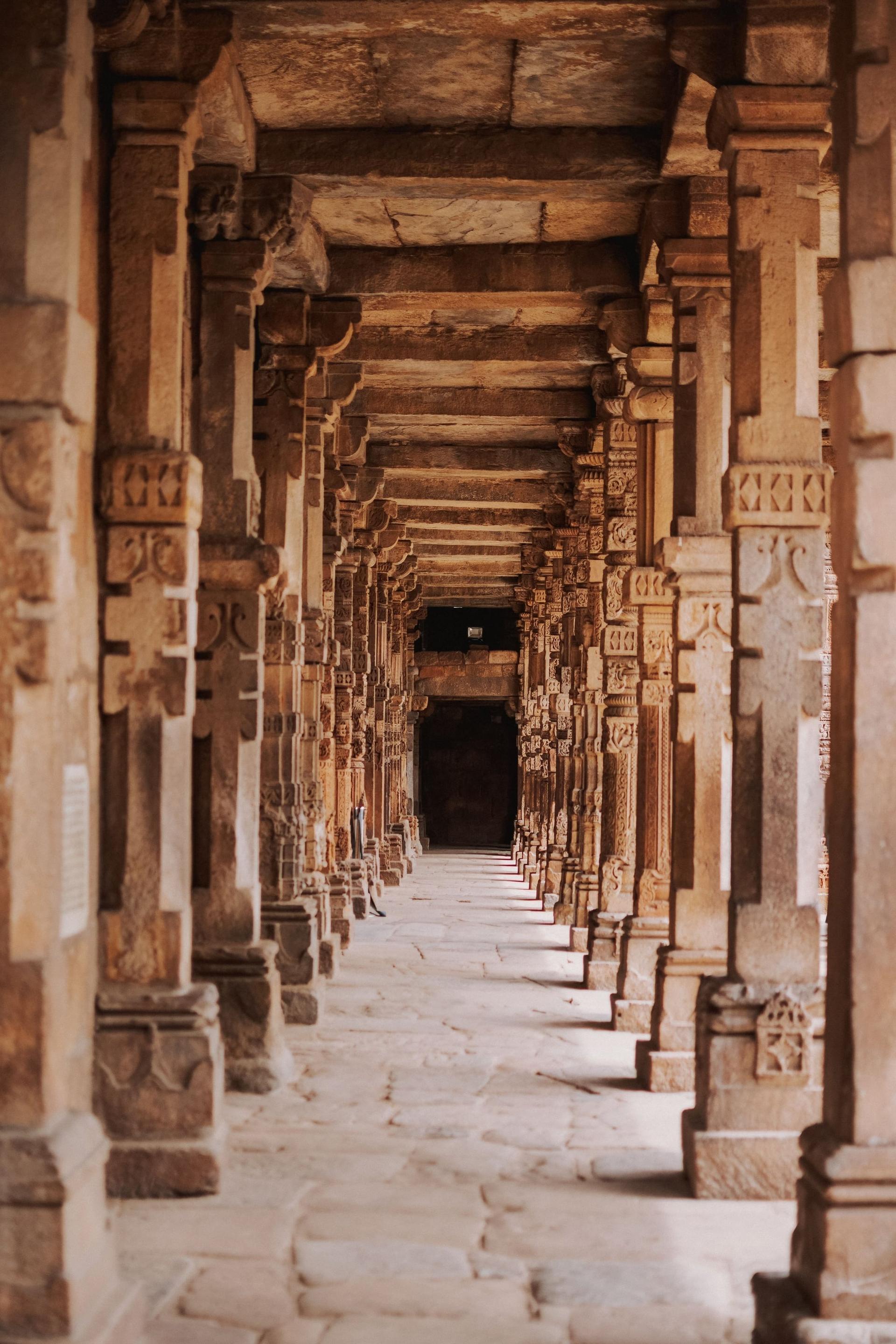
The mosque, which Aibak called simply the Jami Masjid and which later came to be known as the Quwwat-ul-Islam, the Might of Islam, was begun in 1192; the Survey calls it the earliest extant mosque built by the Delhi sultans. On the inner lintel of its eastern gateway an Arabic inscription records its founding. In the Archaeological Survey's published translation, one sentence reads: "The materials of 27 temples, on each of which 2,000,000 Deliwals had been spent, were used in (the construction of) this mosque." The carved columns of its cloisters are that material.
In the court stands the iron pillar. Its Sanskrit inscription, in a script of the fourth century, says it was set up as a standard of the god Vishnu in memory of a mighty king named Chandra, whom historians identify with Chandragupta II; it was brought here from elsewhere. It does rust, very slowly. The metallurgist R. Balasubramaniam showed in 2000 that the iron's phosphorus, with alternate wetting and drying, builds a thin protective film next to the metal. A railing now keeps hands off it.
Before you go
The walk has eleven stops inside the complex. The entry ticket is not included: on the Archaeological Survey's page (checked 11 November 2026) it is 600 rupees in cash or 550 online for foreign visitors, 50 or 35 for SAARC and BIMSTEC visitors, free under fifteen, and the complex is open daily from sunrise to 8 pm. The India Art, Architecture and Design Biennale is scheduled at the complex from 4 December 2026 to 21 March 2027, so expect installations and crowds. Qutab Minar metro station on the Yellow Line is about 1.4 km away, an auto-rickshaw ride to the car park. Next door, the free Mehrauli Archaeological Park is open from sunrise to sunset. For where this complex sits in Delhi's long list of capitals, read Delhi's seven cities, a tradition and not a count, then walk it at your own pace with Qutub Minar: Seven Centuries of Builders, One Tower.
Ready to experience it?
Qutub Minar: Seven Centuries of Builders, One Tower
60 min · 0.8 km · easy
More from Delhi
Explore more at your own pace.
Delhi Monument Tickets, Hours and Closures (Checked November 2026)
Delhi's Garden Tombs: From the Lodis to Humayun, in Four Steps
The Seven Cities of Delhi: A Tradition, Not a Count
Chandni Chowk: Reading Shah Jahan's Planned City on Foot
India Gate and Kartavya Path: Who Is Named Where on the Axis