Petra: The Siq, the Treasury, and the Rose-Red City
165 min · 4 km · hard
Petra is a desert city carved from rose-red sandstone, the rock-cut capital of the Nabataeans, an Arab caravan people who grew rich on the incense and spice trade and then cut their wealth into the mountains of southern Jordan. Almost nothing here was built up block on block. It was carved down, hollowed straight into the living cliff, from the tombs at the gate to the great facades on the summits. Read Petra slowly, on foot and at your own pace, and you read a whole city that a people quarried out of stone: the main trail through the Siq to the Treasury and out to the one temple raised by hand, and the high country above, where the Nabataeans cut their holiest sanctuaries into the tops of the mountains.
The through-line that ties the two Petra walking tours together is this idea of subtraction. Petra is a city made by taking stone away, and the deeper you walk into it, the more literal that becomes.
The approach is a designed suspense
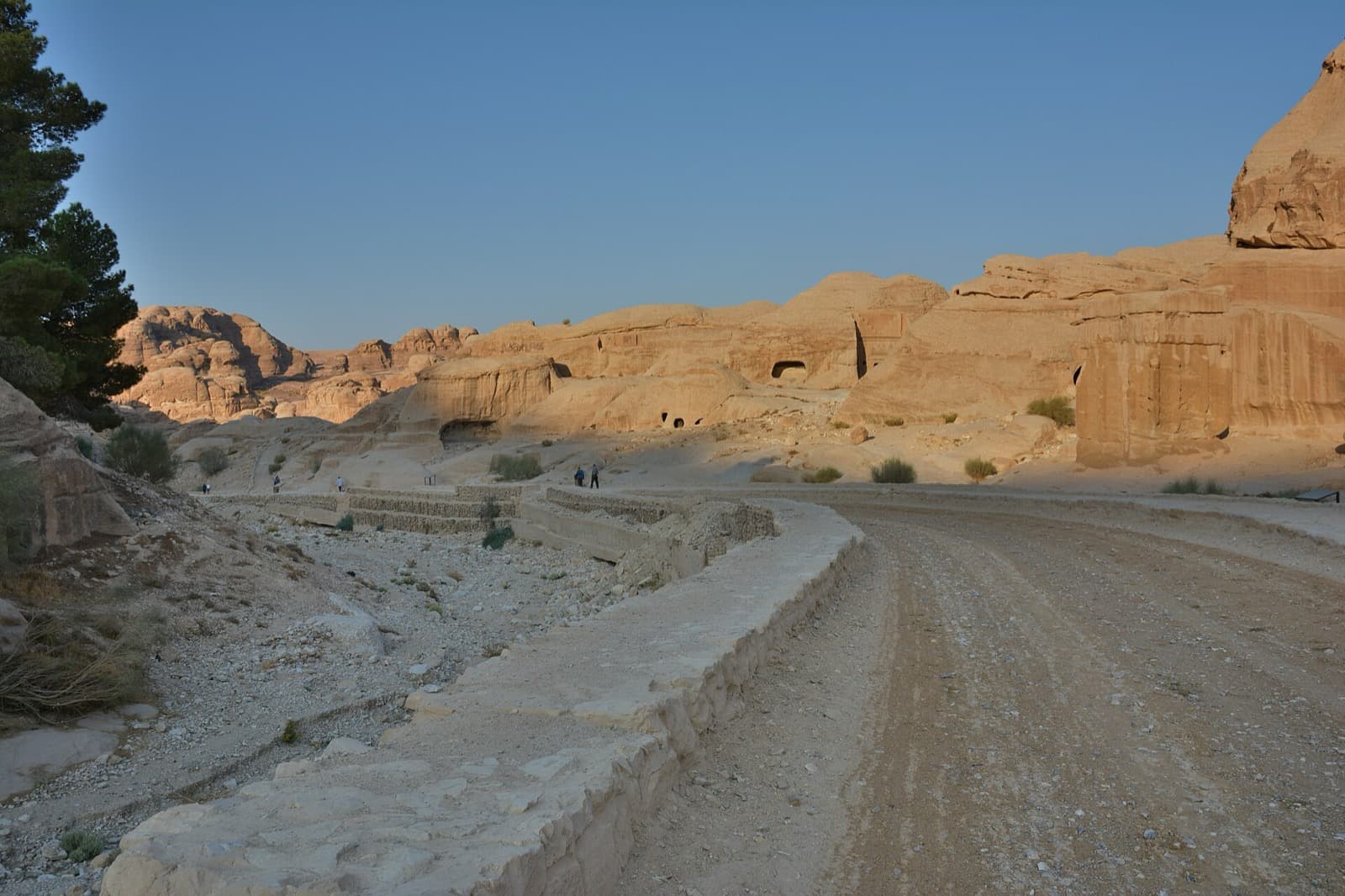
The main trail begins in the open. The Siq, the Treasury, and the Rose-Red City opens at Bab as-Siq, the gateway to the gorge, a wide bright valley the Nabataeans lined with their first monuments about four hundred metres from the visitor centre. The three Djinn Blocks stand here, massive cubes carved free on all four sides, which recent study suggests may be among the earliest monumental tombs at Petra, possibly cut in the second century B C. Opposite them the Obelisk Tomb rises, its facade about sixteen metres wide, crowned by four tall pyramid-shaped obelisks that are nefesh, Nabataean markers of the dead.
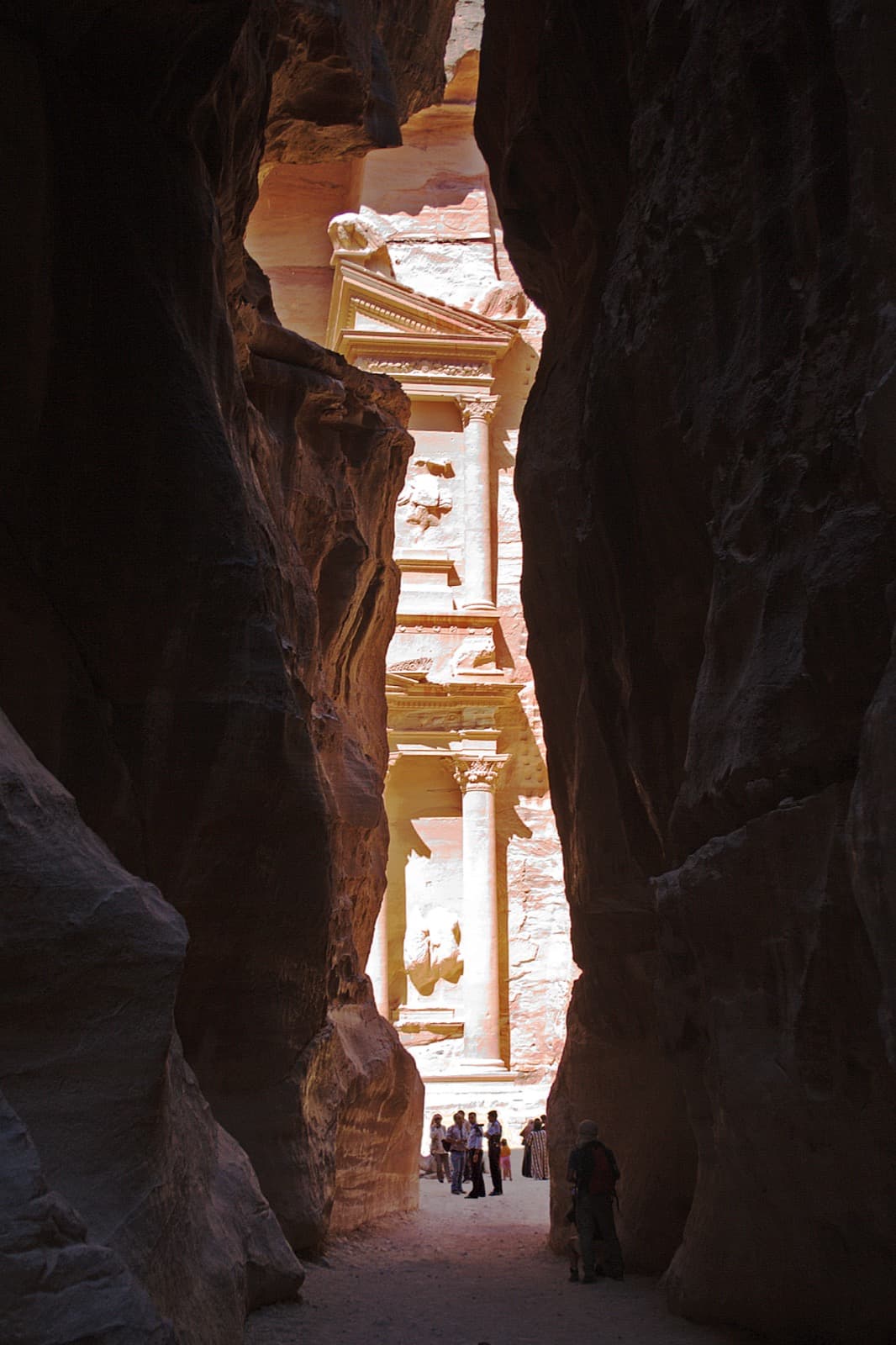
Then the walls close over you. The Siq is a natural gorge, a winding cleft about one and a fifth kilometres long and in places no more than three metres wide, its walls climbing between about ninety and one hundred and eighty metres so the sky becomes a thin ribbon. This is not a tunnel cut by hand. It is a fracture in the rock, but the Nabataeans engineered it: rock-cut water channels run low along both walls, piping spring water from Wadi Musa into the city, and a dam at the mouth once rerouted floodwater away. Carved niches held baetyli, sacred standing stones, which tells us the approach itself was holy ground. A relief of two merchants leading camels, almost twice life size, was only uncovered on the wall in nineteen ninety-eight.
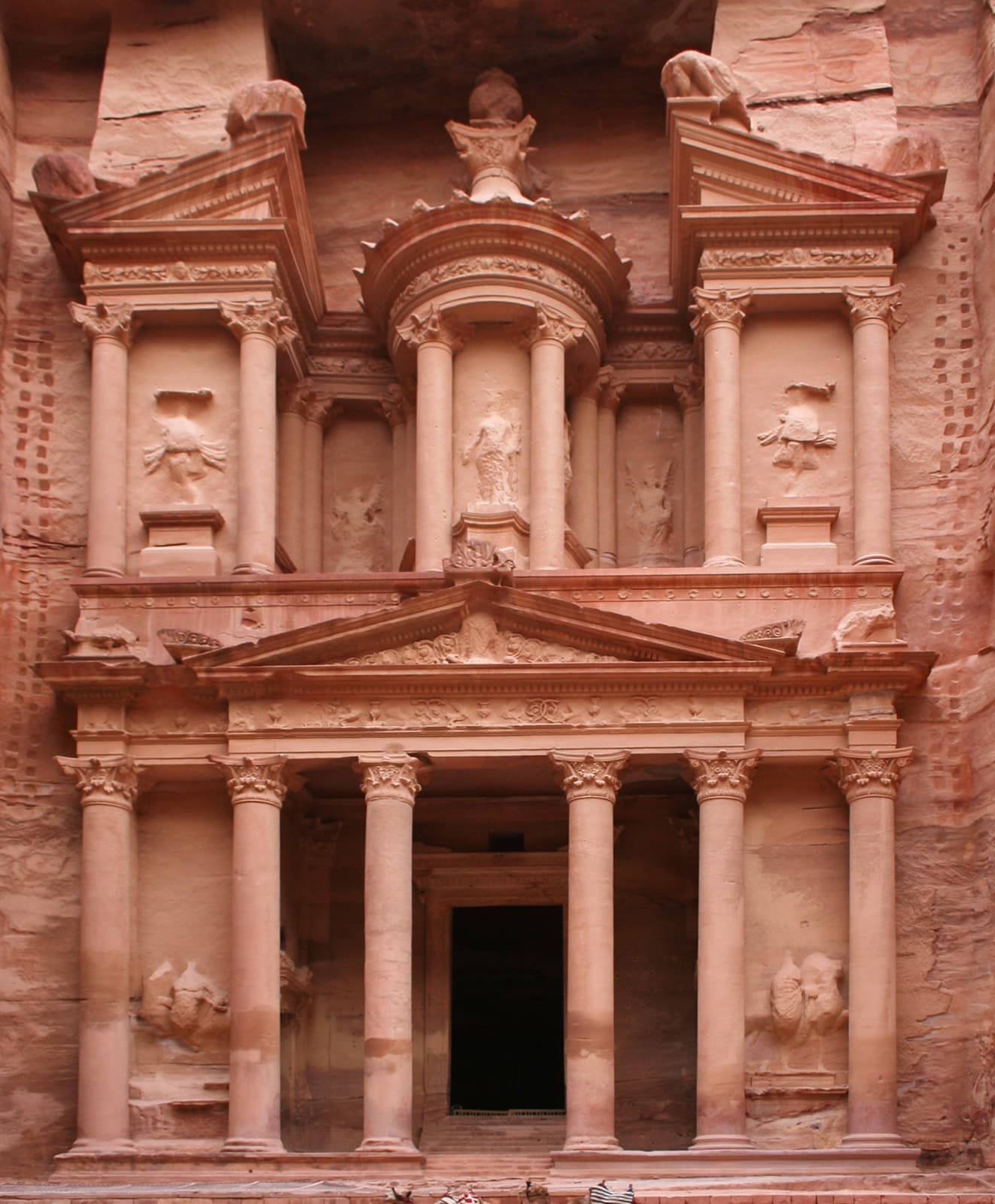
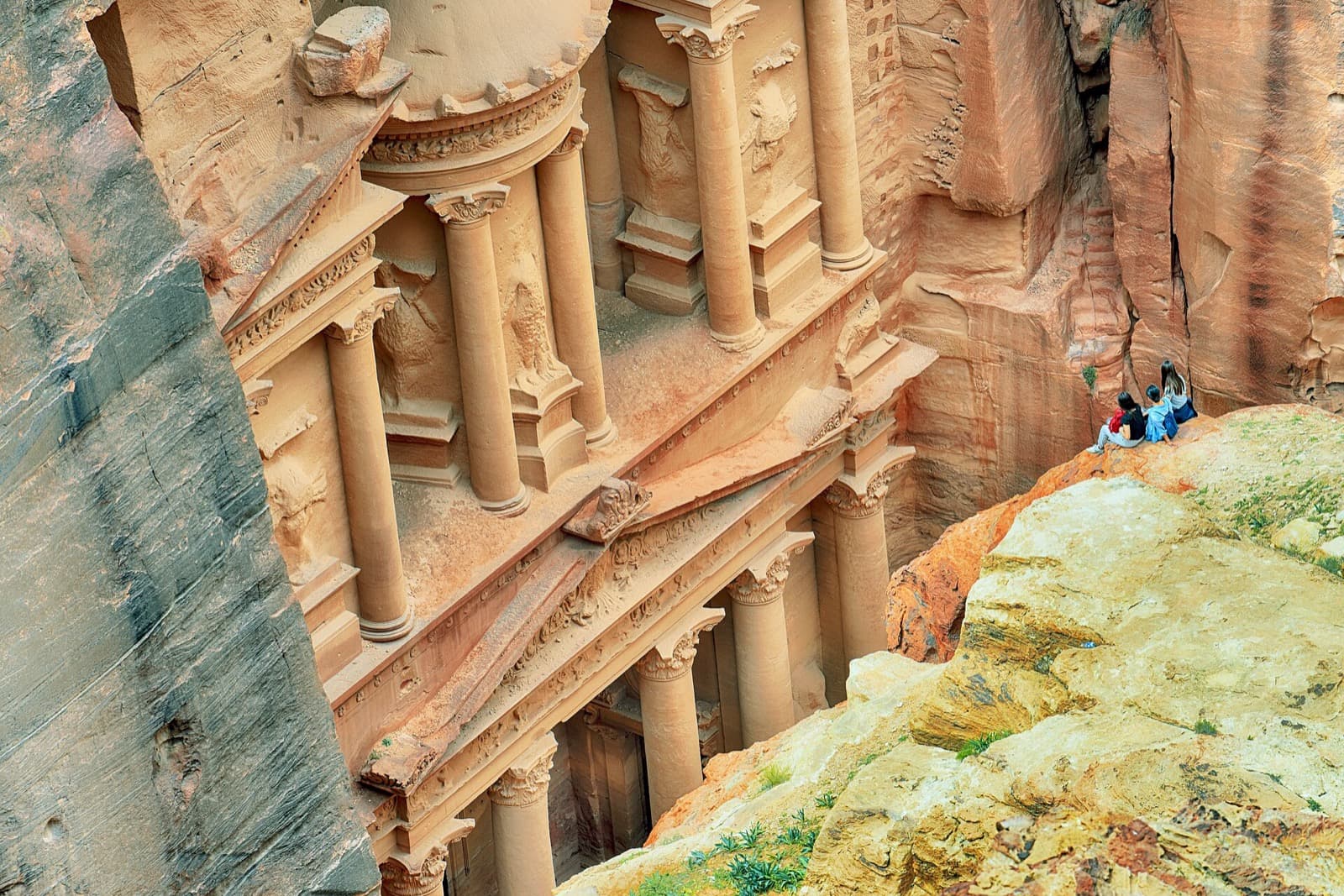
The suspense is the design. For a kilometre you cannot see what waits, and then the gorge parts on Al-Khazneh, the Treasury: a rock-cut facade about forty metres high and twenty-five metres wide, carved straight down into the cliff, columns and pediments and a great urn all cut from the living stone. Despite the name, it is a tomb, not a vault of gold, most likely raised in the early first century A D as a royal mausoleum during the reign of the Nabataean king Aretas the Fourth, who ruled from nine B C to forty A D. The treasury name comes from a Bedouin legend that a pharaoh hid gold in the urn high on the second level. You can still see the bullet marks where people fired at it, hoping to break it open. The urn is solid sandstone with nothing inside.
A city of the living carved through the dead
Hear a stop from this walk
Qasr al-Bint: The One Great Building Raised Block on Block
Beyond the Treasury the gorge widens and the walls fill with doorways: the Street of Facades, a whole avenue of Nabataean tomb fronts cut side by side. Then the ground opens on the Theatre, and here is one of Petra's strangest lessons. The Nabataeans carved it out of solid rock in the first century A D, in the reign of Aretas the Fourth, hollowing the seating straight from the mountainside rather than building it up. When Rome later enlarged it, the expansion cut straight through older rock-cut tombs, whose sliced-open interiors are still visible on the smoothed rock behind the top rows. In its final form it seated about eight thousand five hundred people. A theatre for the living, carved directly through the resting places of the dead.
North of here the western face of Jabal al-Khubtha carries the Royal Tombs, the grandest facades in Petra, cut around the first century A D. The Urn Tomb sits above a colonnaded forecourt on a base of arched vaults so massive that in four hundred and forty-six A D it was converted into a Byzantine church. The Silk Tomb runs in brilliant bands of rose and gold and grey. The Corinthian Tomb echoes the Treasury; the Palace Tomb, the largest, imitates a Hellenistic palace front. These walls face west and glow at the day's edge.
Down on the valley floor the wonder gives way to an ordinary city. The Colonnaded Street began as a Nabataean avenue and was rebuilt in Roman style after Rome annexed the Nabataean kingdom in one hundred and six A D, the civic spine of a place where some twenty thousand people once lived and traded. It ends at the Temenos Gate, about seventeen metres wide, marking the boundary between town and sacred precinct. The trail closes at Qasr al-Bint, the one great building at Petra not carved from a cliff but raised in ashlar blocks, most likely the temple of Dushara, the chief Nabataean god. It stands because its builders probably laid courses of Lebanese cedar into the walls, giving the stone flexibility to ride out the earthquakes that levelled Petra's other free-standing buildings.
The high country, where the carving becomes ambition
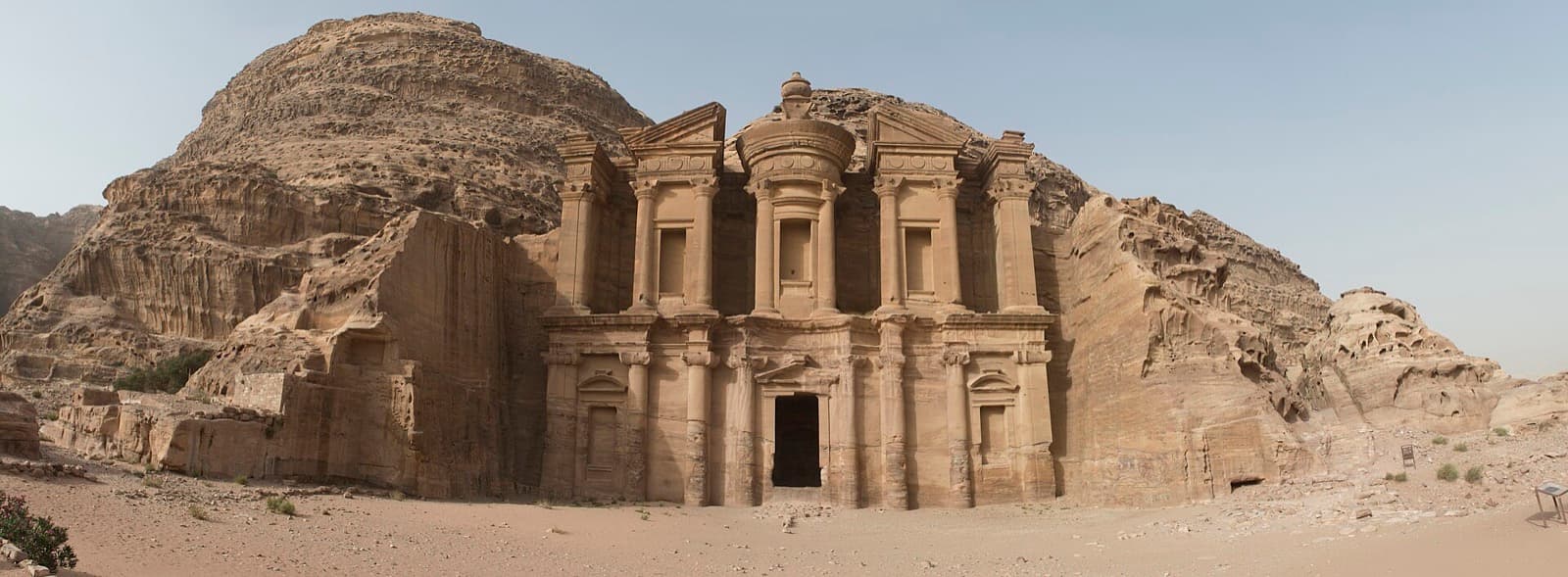
The second tour climbs above all of this. The Climb to Ad-Deir and the High Places reads Petra's summits by two great rock-cut stairways. One rises past the Lion Triclinium, a first-century banqueting chamber guarded by weathered lions, up nearly eight hundred steps to Ad-Deir, the Monastery. This is the largest carved monument in Petra, its facade about forty-seven metres high and forty-eight metres wide, taller than the Treasury, probably carved in the mid-first century A D. Despite the name, it was almost certainly not a monastery and probably not even a tomb: a single square chamber with a rear niche points instead to a Nabataean cultic monument, possibly linked through an inscription to the deified king Obodas. The Christian name came later, from small crosses incised inside when the space was reused as a place of worship. A few minutes west the ground simply ends at cliff-edge viewpoints over the Wadi Araba rift, looking south toward Jabal Haroun, the peak tradition holds to be the burial place of Aaron, brother of Moses.
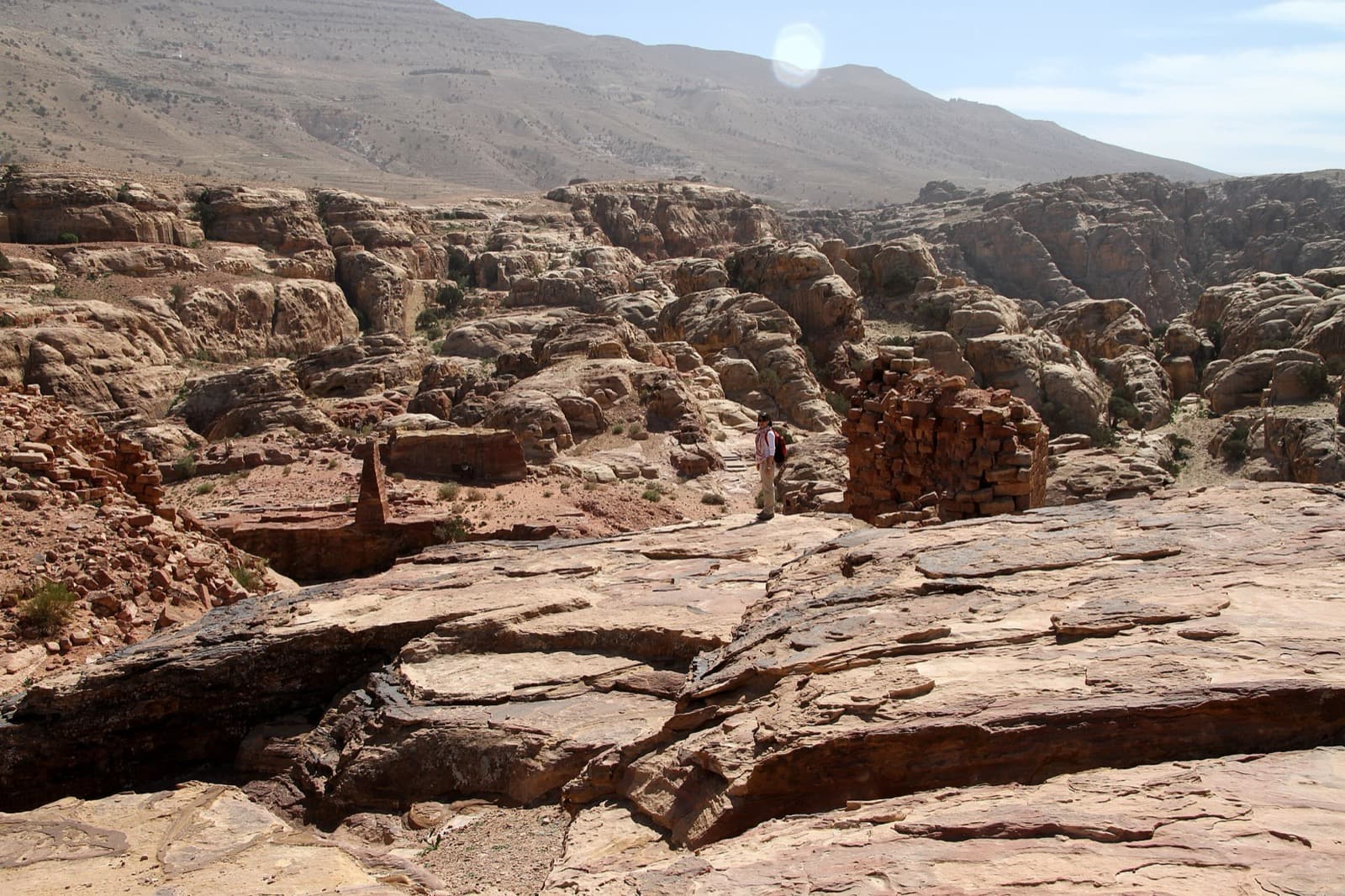
The other stairway climbs from near the theatre to the High Place of Sacrifice, called al-Madbah, the altar, the best-preserved Nabataean high place at Petra, cut into the summit of Jabal al-Madbah. Here the Nabataeans carved a rectangular courtyard with a triclinium, an altar that held baetyls, a circular basin for rainwater purification, and a channelled recess so the blood of sacrificed animals could drain away, with offerings made chiefly to Dushara. The cliffs fall some one hundred and seventy metres straight down to Wadi Musa.
Nearby stand the two obelisks of Zibb Atuf, each over six metres tall, and they make the whole city's method plain. They were not built up. To leave two pillars standing, the Nabataeans quarried away the entire surrounding summit by hand, levelling a mountaintop to keep a shape. The descent runs down Wadi Farasa, a quieter valley past a Lion Fountain that once fed water to climbing pilgrims, a Garden Triclinium keeping rare Nabataean frescoes, and the Tomb of the Roman Soldier facing the painted Coloured Triclinium.
Petra rewards the slow, self-paced walk more than any rushed visit. UNESCO inscribed it in nineteen eighty-five, and in two thousand seven it was named one of the New Seven Wonders of the World. Walk the main trail and the high places on your own clock, and you have read a whole desert city that a people carved, stone by stone taken away, out of the mountains.
Sources
- Petra: The Siq, the Treasury, and the Rose-Red City (Roamer tour)
- Petra Monastery: The Climb to Ad-Deir and the High Places (Roamer tour)
- Petra, UNESCO World Heritage List
- Petra, New7Wonders of the World
- Best walking tours in Petra (Roamer city hub)
Frequently asked questions
- Is the Treasury at Petra actually a treasury?
- No. Al-Khazneh, meaning treasury, is a rock-cut facade about forty metres high that was most likely built as a royal tomb in the early first century A D, during the reign of the Nabataean king Aretas the Fourth. Its name comes from a Bedouin legend that a pharaoh hid gold inside the great stone urn on its upper level, which people later fired at, leaving visible bullet marks. The urn is solid sandstone with nothing inside.
- How many steps is it to the Monastery in Petra?
- Reaching Ad-Deir, the Monastery, means climbing nearly eight hundred rock-cut steps, roughly a forty-minute ascent from the basin at the far end of the site. The Monastery is the largest carved monument in Petra, with a facade about forty-seven metres high and forty-eight metres wide, taller than the Treasury. It was probably carved in the mid-first century A D.
- What is the difference between the two main Petra walking routes?
- The main trail runs through the Siq to the Treasury and continues past the Street of Facades, the theatre, the Royal Tombs, the Colonnaded Street, and the temple of Qasr al-Bint, about four kilometres over two and a half to three hours. The high-country route climbs two separate stairways to Ad-Deir, the Monastery, and to the High Place of Sacrifice, a strenuous day of about five to seven hours over roughly six kilometres.
- Who built Petra and how old is it?
- Petra was carved by the Nabataeans, an Arab trading people whose kingdom grew rich on the caravan trade in incense and spice, more than two thousand years ago. Their monuments date largely to the first century B C and first century A D. UNESCO inscribed Petra as a World Heritage Site in nineteen eighty-five, and in two thousand seven it was named one of the New Seven Wonders of the World.
- What is the High Place of Sacrifice at Petra?
- The High Place of Sacrifice, called al-Madbah, is the best-preserved Nabataean open-air sanctuary at Petra, cut into the summit of Jabal al-Madbah and reached by a stair climb from near the theatre. It has a rectangular courtyard with stone benches, an altar that once held sacred stone blocks called baetyls, a circular basin for rainwater purification, and a channelled recess to drain sacrificial blood. Offerings were made chiefly to Dushara, the chief Nabataean god.
Ready to experience it?
Petra: The Siq, the Treasury, and the Rose-Red City
165 min · 4 km · hard
More from Petra
Explore more at your own pace.
One Day in Petra: A Walkable Morning-to-Evening Itinerary
Petra Travel Guide: Days, Transport, Tickets, and Safety
The Climb to Ad-Deir: Why Petra's Monastery Rewards the 800-Step Ascent
The Treasury at Petra: Why the Siq Was Built to Hide It
The High Place of Sacrifice: Petra's Altar in the Sky on Jabal al-Madbah