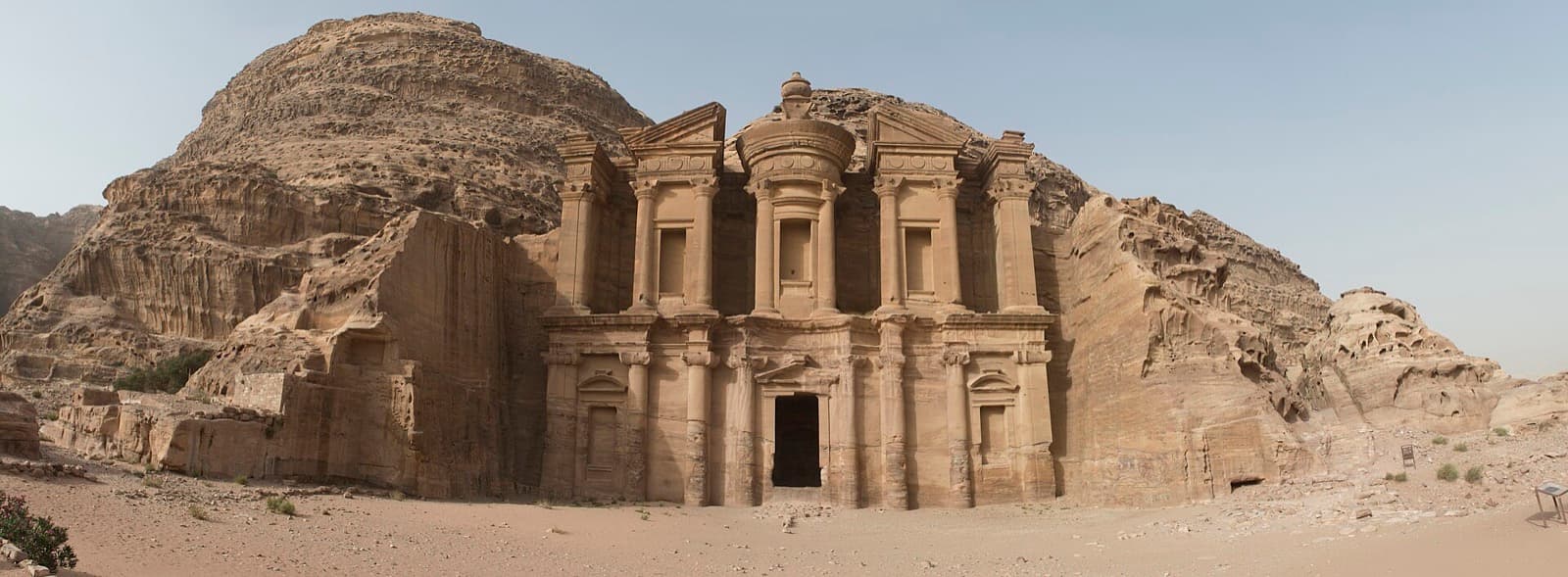
Ad-Deir, the monument travellers know as the Monastery, sits at the top of nearly eight hundred rock-cut steps, and reaching it is the whole point of walking Petra's high country. Most people never make the climb. They photograph the Treasury in the canyon below, ride a carriage back out, and leave. What they miss is the Nabataean pattern that this walk makes visible: the largest and holiest things this desert people carved were not down in the gorge with the crowds. They were up on the summits, reached only by stairs, and the climb to the Monastery is the clearest way to feel why that mattered.
A facade bigger than the Treasury
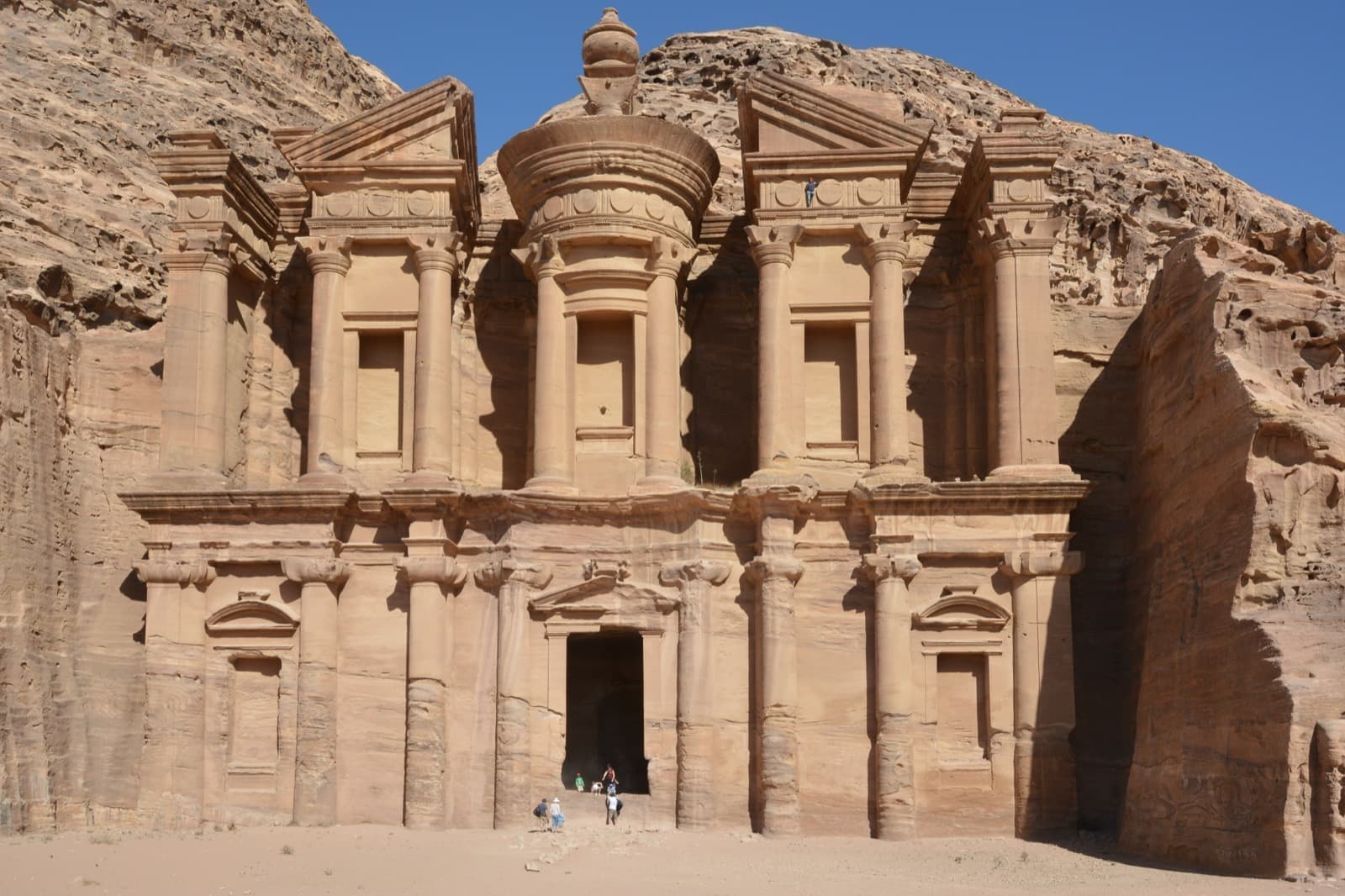
Start with the scale, because the numbers do the persuading. Ad-Deir rises to roughly forty-seven metres high and forty-eight metres wide, which makes it the largest carved monument in all of Petra. It is taller than Al-Khazneh, the Treasury, the facade every visitor knows from the narrow canyon. By the accounts of the site, the Monastery has the tallest facade in Petra and is the second most visited monument here after the Treasury. It was probably carved in the mid-first century A.D.
To stand in front of it, you climb a path of nearly eight hundred rock-cut steps, roughly a forty-minute ascent from the basin at the far end of the site. That climb is not incidental. It is the experience. The Nabataeans could have carved the Monastery anywhere. They chose a summit, and they cut a stairway to it, so arrival was always earned. When you reach the top and the broad pediment opens above you, its two halves flanking a round element called a tholos, the effort you just spent is part of what you are seeing.
Not a monastery, and probably not even a tomb
Hear a stop from this walk
The Monuments of Wadi Farasa: The Quiet Valley of Tombs on the Way Down
The name misleads, and the truth is more interesting. Despite being called the Monastery, Ad-Deir was almost certainly never one, and probably not even a tomb. The interior is a single square chamber with a broad rear niche, not the layout of a burial. Scholars read it instead as a Nabataean cultic monument. An inscription mentioning what is written as the marzeah of Obodat the god suggests it was dedicated either to a deity or to the deified Nabataean king Obodas, which points toward a temple or a royal cult.
So where does the name come from? From much later. Small crosses were incised inside the chamber when Christians reused the space as a church or hermitage, centuries after the Nabataeans finished carving. That layering, an Arab caravan people's sanctuary turned Christian worship space, is Petra in miniature: a city that absorbed and outlasted the styles that passed through it. You feel the same borrowing on the way up, at the Lion Triclinium, where a first-century Nabataean dining chamber wears a classical frieze of triglyphs and metopes and a carved head of Medusa at each end. An Arab people, in a Jordanian desert, quoting Greek mythology on a rock face. Petra was inscribed on the UNESCO World Heritage List in nineteen eighty-five, and in two thousand seven it was named one of the New Seven Wonders of the World, and both distinctions rest on exactly this kind of layered ambition.
What the summit gives you
A few minutes' walk west of the Monastery, the ground simply ends. A string of cliff-edge overlooks, marked by Bedouin tea tents and hand-painted signs like "Best View in the World" and "End of the World," looks out across the great rift of Wadi Araba, the arid valley running south toward the Gulf of Aqaba. On a clear day the view reaches to the mountains of the Negev in the distance. To the south stands Jabal Haroun, the peak that tradition holds to be the burial place of Aaron, the brother of Moses. That is a tradition, not a proven fact, but it has drawn pilgrims here for centuries.
The tea sellers up here belong to the Bdoul Bedouin, who once lived inside Petra's rock-cut tombs and caves themselves, until they were resettled in the nearby village of Umm Sayhoun in the nineteen eighties so the ancient site could be protected. They carry supplies up these heights every day. Buying a sweet tea in Jordanian dinars is both a good rest and a fair way to support the people who work this ridge.
Why the rest of the walk matters
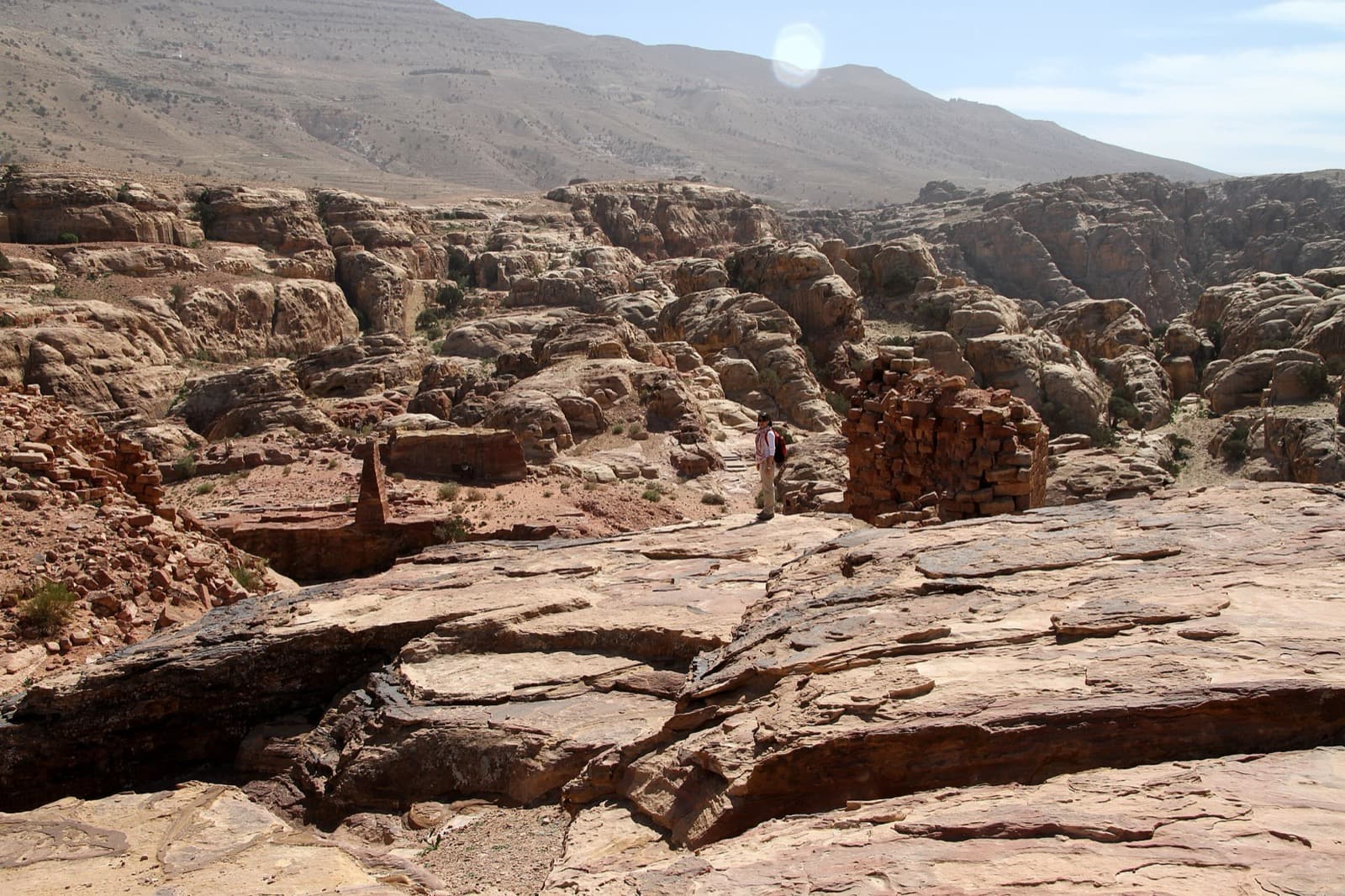
The Monastery is the climax, but it is not the whole argument. The full route reads Petra's high country by two great stairways, and the second climb, on the opposite side of the city, is a summit sanctuary the Monastery only hints at. The High Place of Sacrifice, called al-Madbah, is the best-preserved of all the Nabataean high places, cut into the top of Jabal al-Madbah above the theatre. There you find an open-air courtyard with three benches, an altar that once held sacred baetyl stones, a circular basin thought to have collected rainwater for purification, and a cup-shaped recess with a carved drainage channel cut to carry away the blood of sacrificed animals, offered chiefly to Dushara, the chief Nabataean god. The cliffs fall away some one hundred and seventy metres straight down to Wadi Musa below.
Just before it stand the Obelisks of Zibb Atuf, and they teach the same lesson as the Monastery in reverse. Each rises over six metres, and they were not built up. They were carved down. The Nabataeans quarried away the entire surrounding summit by hand and left the two pillars standing from the living rock. To make two pillars, they cut away a mountain. That is the scale of ambition the whole walk keeps returning to, and it is why the descent afterward, down the quiet valley of Wadi Farasa past the Lion Fountain and the painted Coloured Triclinium, feels like a proper ending rather than a shortcut out.
Walking it your way
This is famously tour-pressured ground. Down in the low canyon, guides, carriage touts, and stall-holders steer the crowds. A good local guide is genuine company at a site this vast, and nothing here argues against one. What a self-guided walk sets aside is only the fixed pace of a scheduled group. Up on the steps, you decide whether to press on, linger at a tea tent, or turn back. The heights reward a slow pace and frequent water, so let the scale surprise you.
Plan a full day of roughly five to seven hours over about six kilometres, start early before the sun turns the exposed rock into a furnace, and carry more water than you think you need. Many walkers do the Monastery one morning and the High Place another day rather than both at once. If you want the wider picture first, browse other Petra walking tours, or read up on the whole site at Petra. Then come climb the steps. The city was built for people willing to make them.
Sources
- Ed-Deir, Petra (Wikipedia): overview of the Monastery's dimensions, dating, and cultic interpretation, including the Obodas inscription and later Christian reuse.
- al-Deir Monastery, Petra (Madain Project): architectural description of the facade, the tholos and broken pediment, and the single interior chamber.
- Petra Tourism Development Region Authority (PDTRA): official site documentation for the Lion Triclinium, the Al Farsh and Wadi Araba viewpoint, and the High Place of Sacrifice.
- High Place of Sacrifice, Petra (Art Destination Jordan): detail on the altar courtyard, baetyls, rainwater basin, and drainage channel atop Jabal al-Madbah.
- National Geographic, "Meet the Man Living Inside Petra": background on the Bdoul Bedouin and their resettlement to Umm Sayhoun.
Ready to experience it?
Petra Monastery: The Climb to Ad-Deir and the High Places
300 min · 6 km · hard
More from Petra
Explore more at your own pace.
One Day in Petra: A Walkable Morning-to-Evening Itinerary
Petra Travel Guide: Days, Transport, Tickets, and Safety
Petra, the City Carved Down: How to Read a Nabataean Capital on Foot
The Treasury at Petra: Why the Siq Was Built to Hide It
The High Place of Sacrifice: Petra's Altar in the Sky on Jabal al-Madbah