The Siq is a natural sandstone gorge that the Nabataeans engineered into Petra's sacred processional entrance, and its entire design is to delay and conceal. Most visitors treat the shadowed kilometre as the walk they endure before the Treasury. That reading gets it backwards. The gorge is not the approach to the wonder. The gorge is the wonder's first act, a deliberate machine for suspense built by an Arab trading people more than two thousand years ago, and understanding that changes how you should stand inside it.
What the Siq actually is
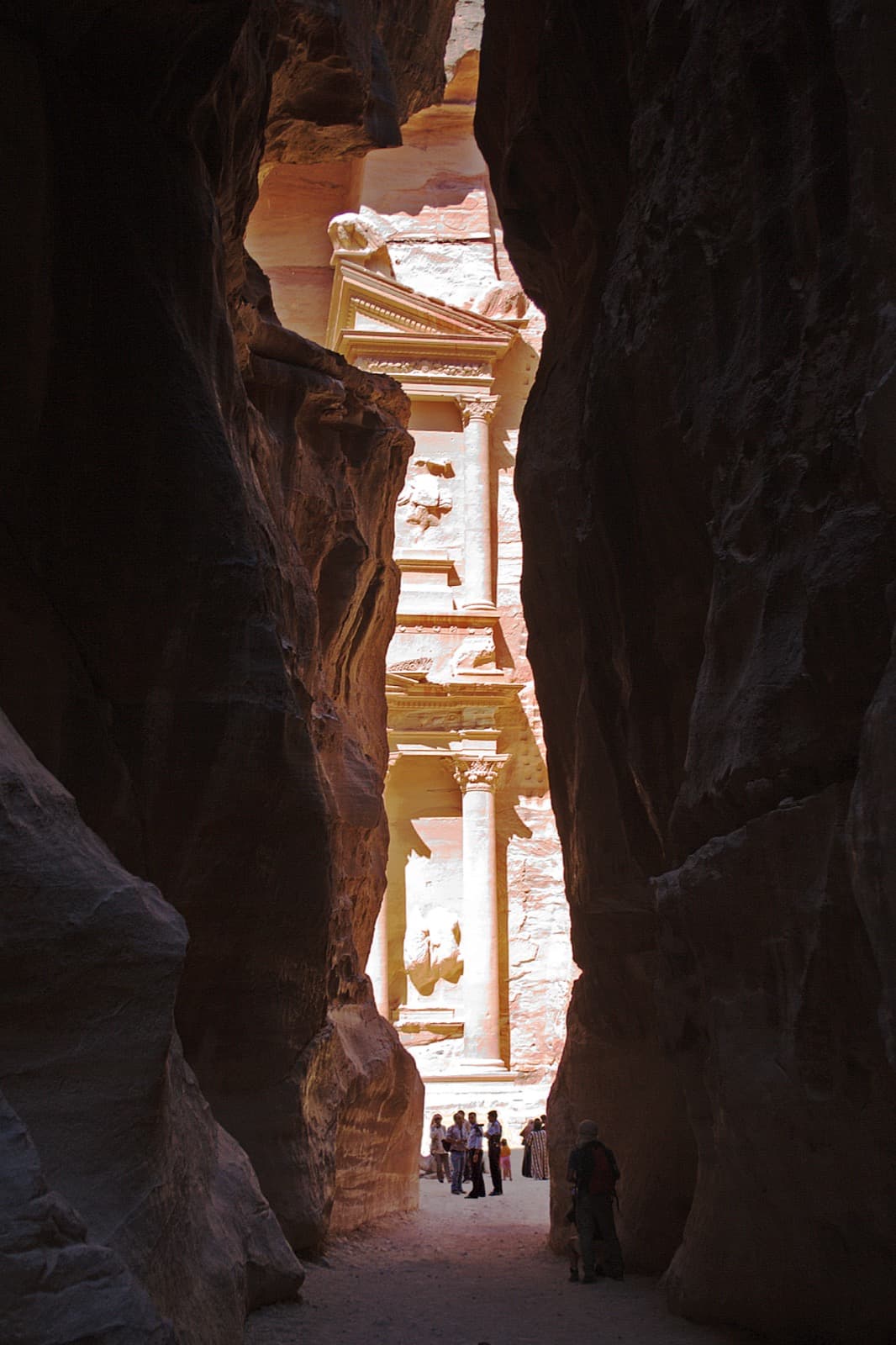
Start with the geology, because the Nabataeans did. The Siq is not a tunnel cut by hand. It is a fracture in the rock, a winding cleft in the sandstone about one and a fifth kilometres long, roughly three-quarters of a mile. In places it narrows to no more than three metres wide, while the walls climb between about ninety and one hundred and eighty metres on either side. The practical effect is total: the sky shrinks to a thin ribbon overhead, and the light that reaches the floor goes cool and blue even at midday. You are walking the bottom of a crack in a mountain.
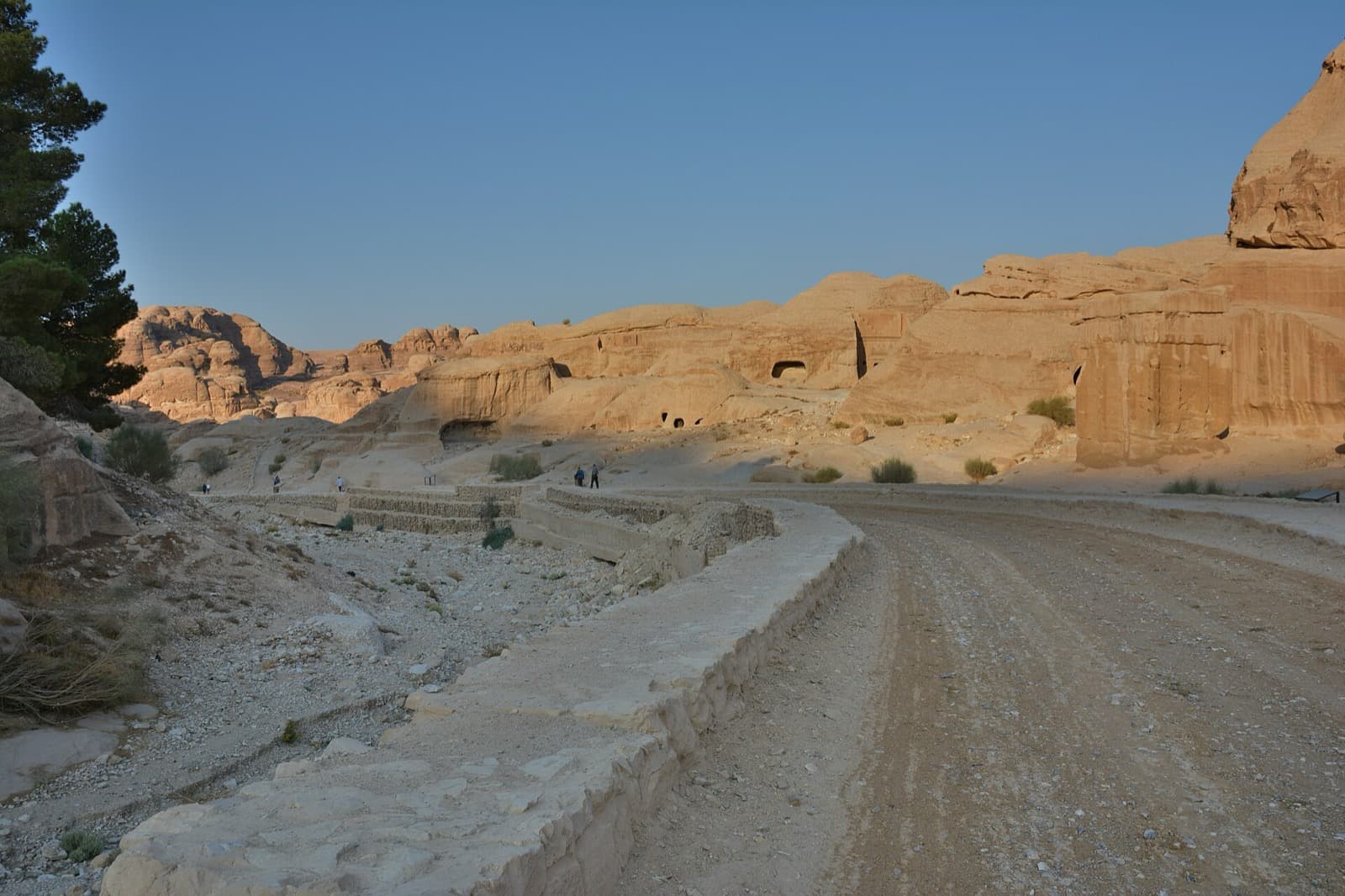
The word tells you where you are. In Arabic, siq means a narrow gorge, and the open valley just before it is called Bab as-Siq, the gateway to the Siq. So the naming itself frames the sequence: first the wide bright approach with its cube-shaped Djinn Blocks and the Obelisk Tomb, then the cleft that swallows you. The Nabataeans did not build the gorge. They found it, and then they made it theirs.
The engineering hiding along the walls
Hear a stop from this walk
Qasr al-Bint: The One Great Building Raised Block on Block
What the Nabataeans added is easy to miss because it sits low and worn, but it is the reason Petra existed here at all. Look along both walls near the ground and you can trace rock-cut water channels. These carried spring water from Wadi Musa, the valley of Moses, down through the gorge and into the heart of the city. Petra is a desert capital, and a desert capital lives or dies on water management. The Siq was its main artery, an early feat of hydraulic engineering that turned a dry canyon into a functioning supply line.
They protected it, too. At the mouth of the gorge the Nabataeans built a dam to reroute floodwater away from this passage, a structure later rebuilt in the twentieth century. That detail matters for a reason beyond history: in rare heavy rain, flash floods can still surge through the Siq very quickly, which is why the ancient builders diverted the water in the first place and why you should never enter the gorge if storms threaten.
Sacred ground, not just a road
Here is the shift that reframes the whole passage. The Siq was holy. Higher up on the walls, small carved niches once held baetyli, sacred standing stones that marked the gorge as consecrated space. That single fact tells you the Nabataeans did not experience this as a corridor between the ticket gate and the good part. It was a sacred approach, a processional way you entered with intent. When you walk it slowly, you are not killing time. You are doing something close to what its builders designed you to do.
Watch for one piece of evidence that people have always passed this way. On the wall survives a worn relief of a caravan, uncovered in nineteen ninety-eight: two merchants, each leading two camels, carved almost twice life size. The lower stone has weathered away, so the figures now seem to float where their feet once stood. That relief is Petra's economy made visible. This was a caravan city, and the Siq was the road that brought the trade home.
Why the suspense is the design
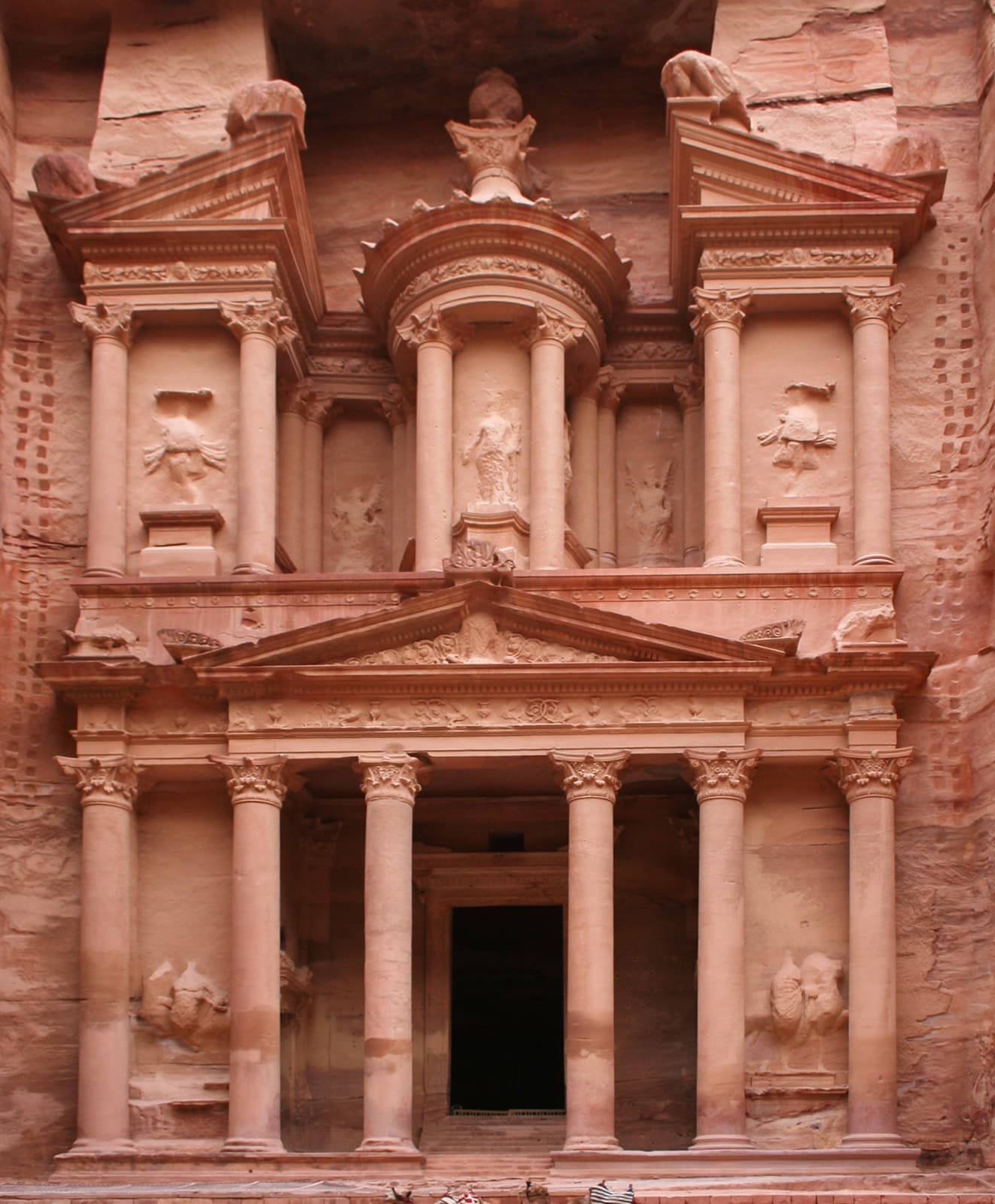
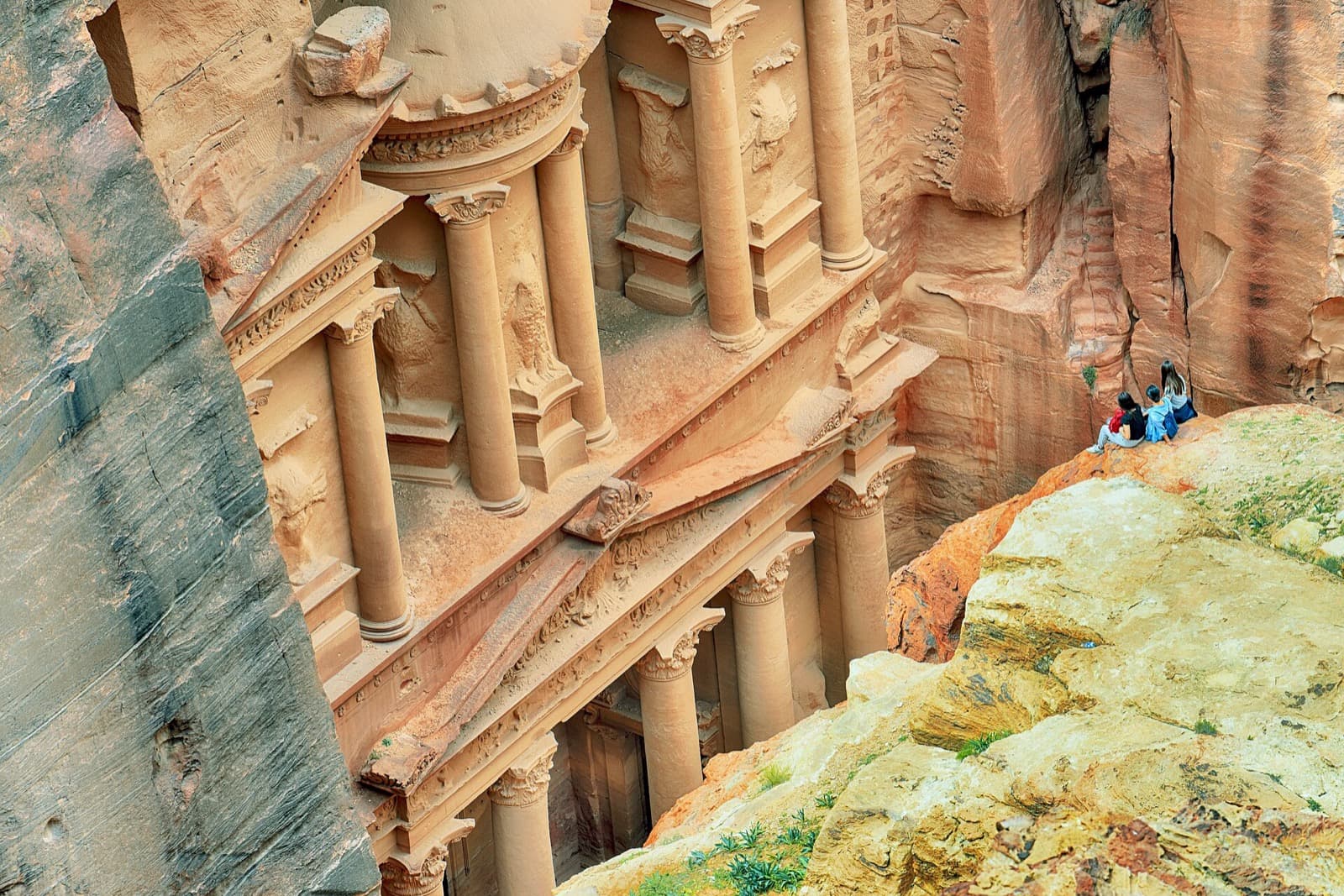
Now the payoff, and the argument for slowing down. For a full kilometre inside the Siq, you cannot see what waits at the end. The gorge bends and bends again, the walls never open, and there is no vantage that lets you cheat the surprise. Then, without any warning at all, the cleft parts and Al-Khazneh, the Treasury, appears framed in the last slot of rock. The roughly forty-metre facade steps out of the gorge whole.
That reveal only works because the approach hid it. The concealment is engineered, not accidental. A monument you see coming from a distance loses its shock. A monument that emerges from a slot in the stone after a kilometre of shadow does not. The Nabataeans, who carved columns and pediments straight down into living cliffs rather than building them up from blocks, understood theatre as well as they understood stone. The Siq is the long silence before the note.
There is a modern reason to embrace that pacing, too. Petra is famously busy. Carriage and horse touts gather near the entrance and along the approach, calling out rides, and the pressure to hurry is real. You do not need them. The way in slopes gently downhill, so gravity does the work if you let it. Walking the Siq at your own clock, cool in the shadow, watching the water channels and the niches and the caravan relief slide past, is how you feel the valley close in and the suspense build the way its builders intended.
What to understand standing inside it
If you take one idea into the gorge, take this: the Siq is not the distance to the Treasury. It is the first thing the Nabataeans built to move you. Everything about it, the narrowing walls, the failing light, the sacred stones, the hidden end, is aimed at the moment the rock finally parts. Read it as a threshold, and the kilometre stops feeling long.
You can walk this whole sequence yourself, from the first strange monuments at Bab as-Siq, down the shadowed gorge, to the reveal of the Treasury and the rose-red city beyond, on the self-guided Petra: The Siq, the Treasury, and the Rose-Red City tour. It follows the processional order the Nabataeans intended, at your own pace, with no group and no schedule steering you. Wear sturdy shoes, carry more water than you think you need, and start at first light to walk the Siq in cool shadow. For more routes across the site, browse the full set of Petra walking tours, or read the wider guide to Petra before you go.
Sources
- Siq, Wikipedia: overview of the gorge's dimensions, water channels, and votive niches. https://en.wikipedia.org/wiki/Siq
- The Siq, Visit Petra (official): the site authority's description of the entrance and its function. https://www.visitpetra.jo/en/Location/25
- Al-Khazneh, Wikipedia: context for the Treasury reveal at the gorge's end and its attribution. https://en.wikipedia.org/wiki/Al-Khazneh
- Djinn Block Tombs and Bab as-Siq, Visit Petra: the approach valley that precedes the gorge. https://www.visitpetra.jo/en/Location/98
Ready to experience it?
Petra: The Siq, the Treasury, and the Rose-Red City
165 min · 4 km · hard
More from Petra
Explore more at your own pace.
One Day in Petra: A Walkable Morning-to-Evening Itinerary
Petra Travel Guide: Days, Transport, Tickets, and Safety
Petra, the City Carved Down: How to Read a Nabataean Capital on Foot
The Climb to Ad-Deir: Why Petra's Monastery Rewards the 800-Step Ascent
The Treasury at Petra: Why the Siq Was Built to Hide It