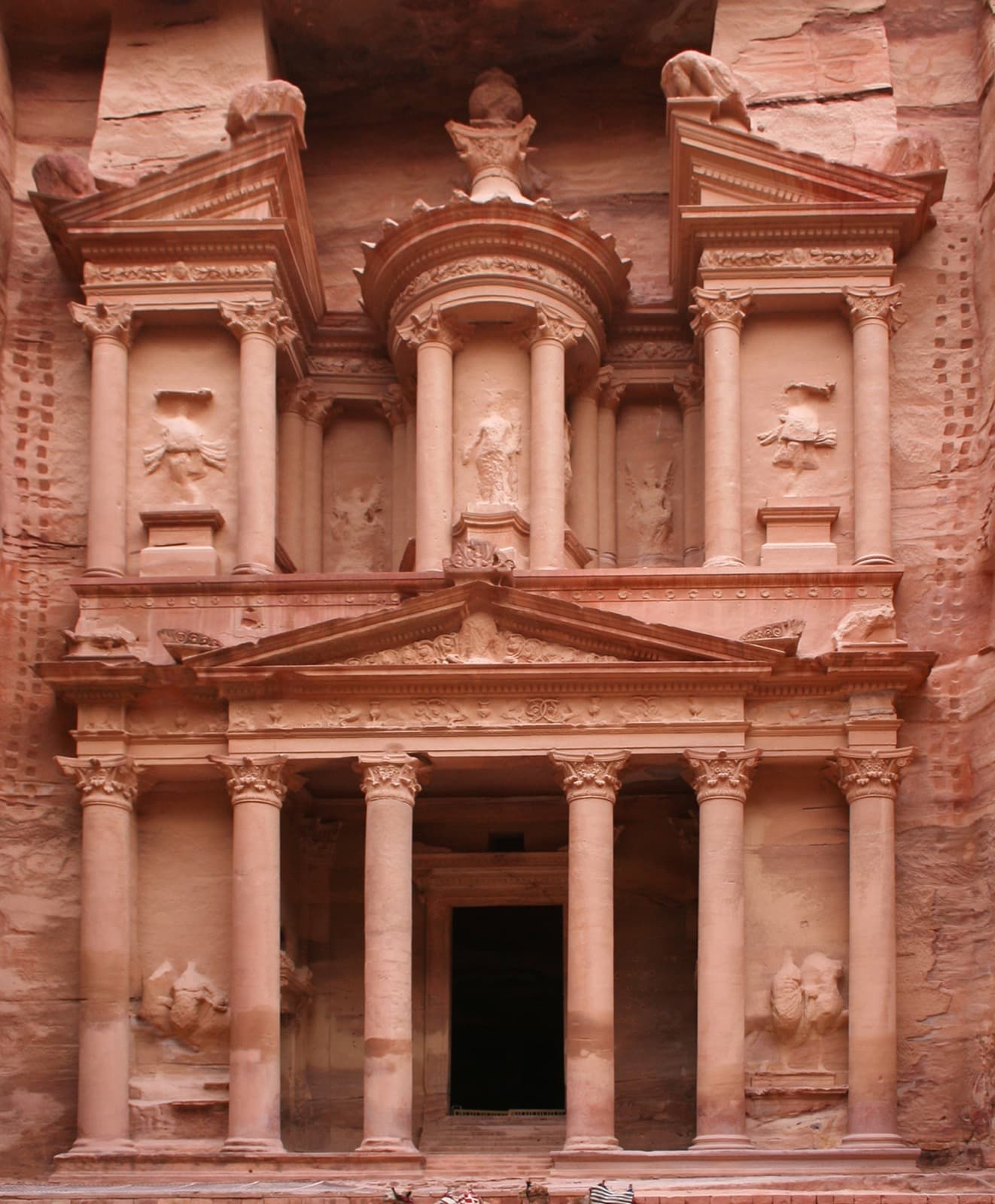
Follow the great processional approach into Petra, from the first strange tombs at the gate down the shadowed kilometre of the Siq to the Treasury and a whole city carved from rose-red cliffs.
Start · Bab as-Siq and the Djinn Blocks: The First Strange Monuments
DirectionsStops
- 1
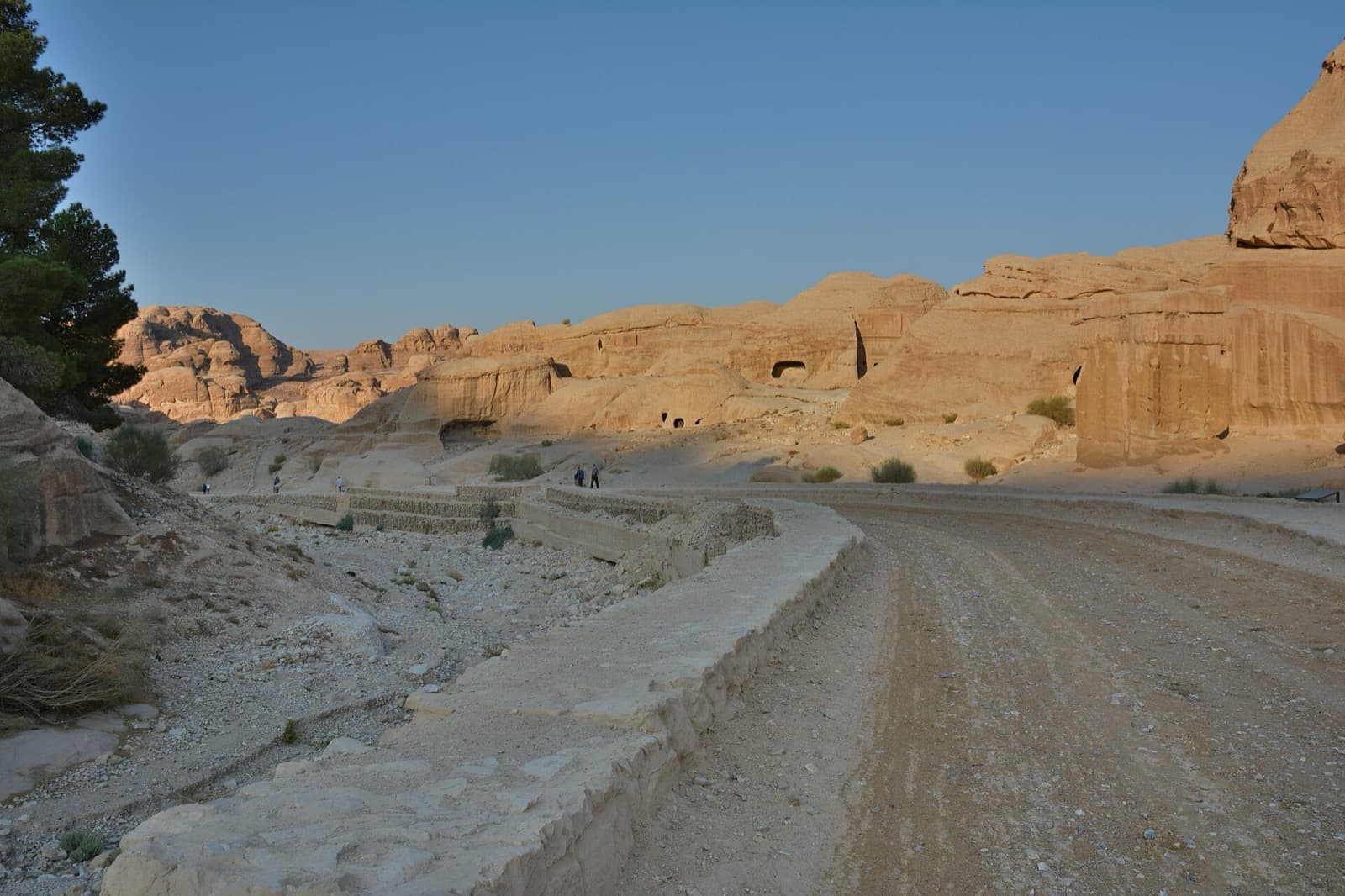
Bab as-Siq and the Djinn Blocks: The First Strange Monuments
The open approach valley where Petra's first Nabataean monuments, the great cube-shaped Djinn Blocks and the multi-storey Obelisk Tomb, stand before the gorge narrows.
- 2
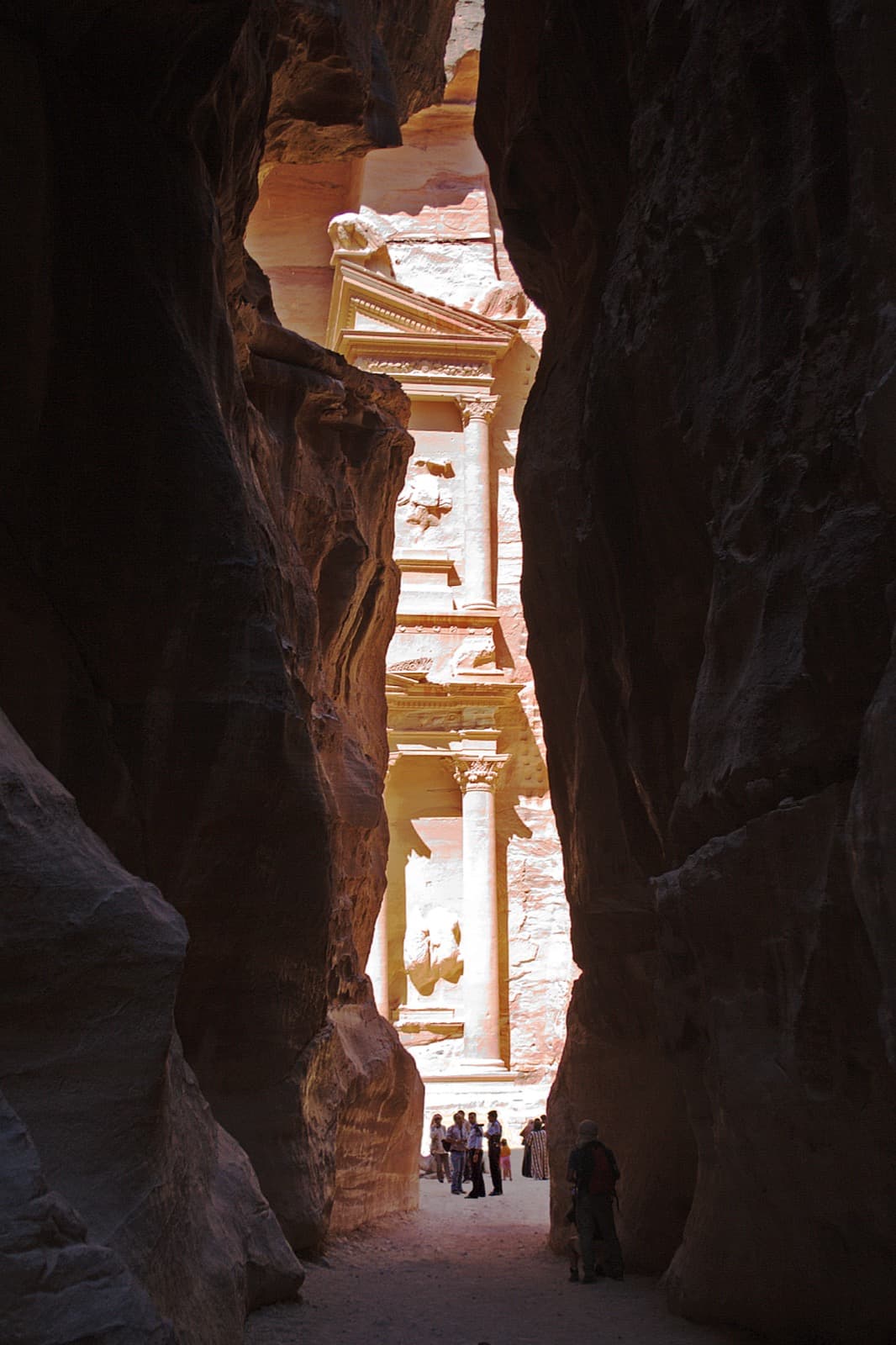
The Siq: A Kilometre of Shadow
The natural sandstone gorge, about one and a fifth kilometres long and in places only three metres wide, that forms Petra's suspenseful main entrance.
- 3
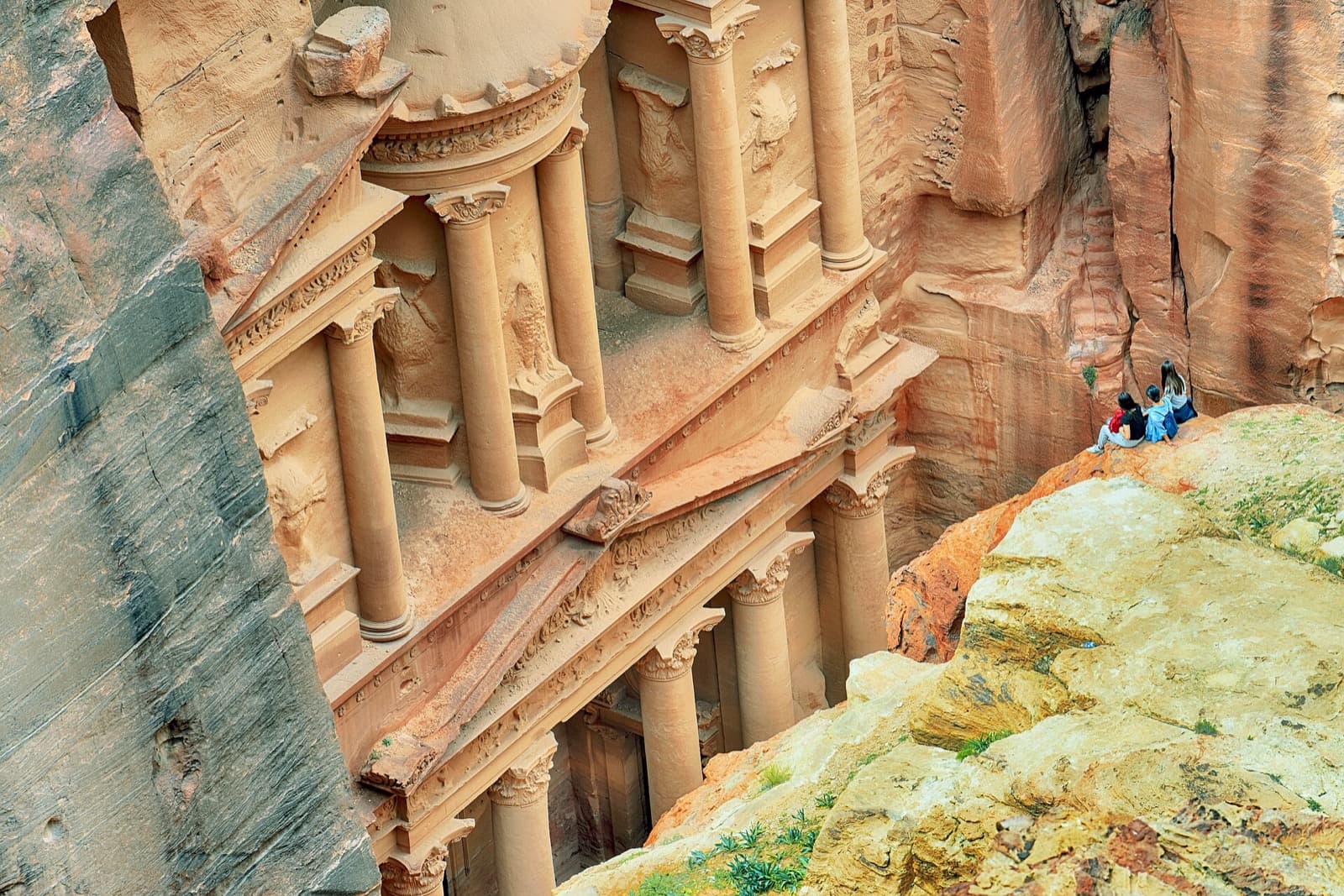
Al-Khazneh: The Facade That Steps Out of the Gorge
Petra's most famous monument, the roughly forty-metre rock-cut Treasury facade, most likely built as the tomb of the Nabataean king Aretas the Fourth.
- 4
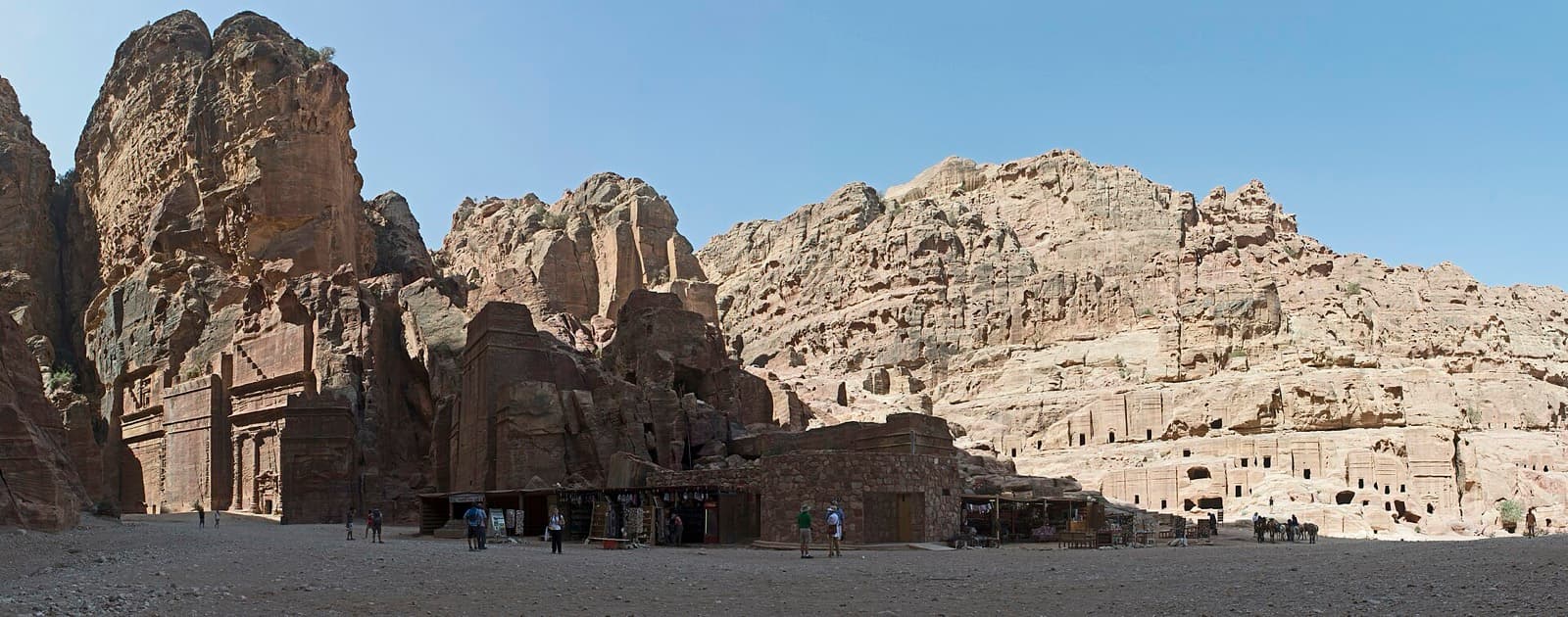
The Street of Facades and the Theatre: Carved Through the Dead
A row of Nabataean tomb fronts leading to the first-century theatre, carved from solid rock and later enlarged by the Romans through older tombs.
- 5
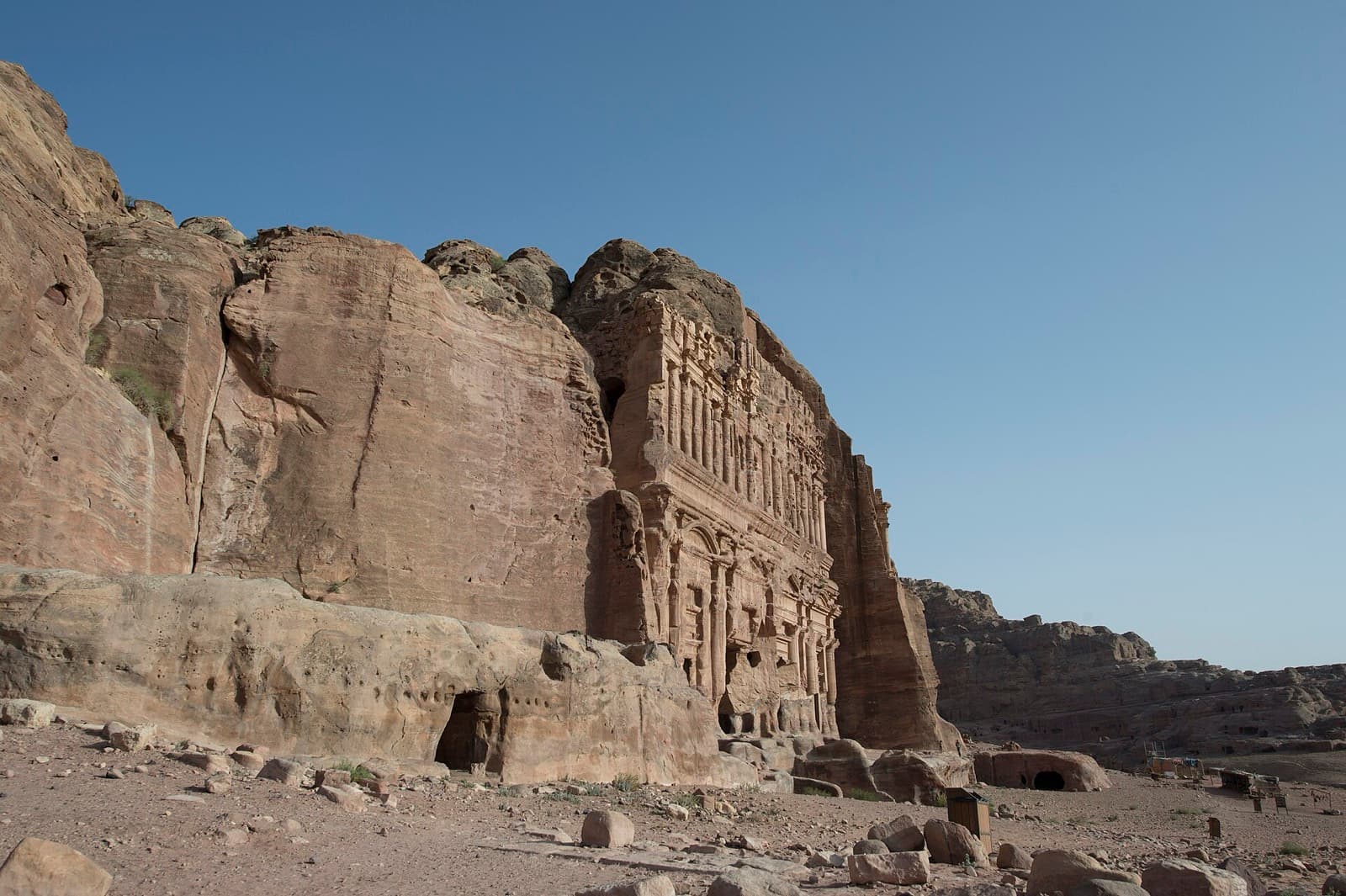
The Royal Tombs: The Wall That Glows at the Day's Edge
A line of the grandest Nabataean tomb facades cut into the western face of Jabal al-Khubtha, including the Urn, Silk, Corinthian, and Palace tombs.
- 6
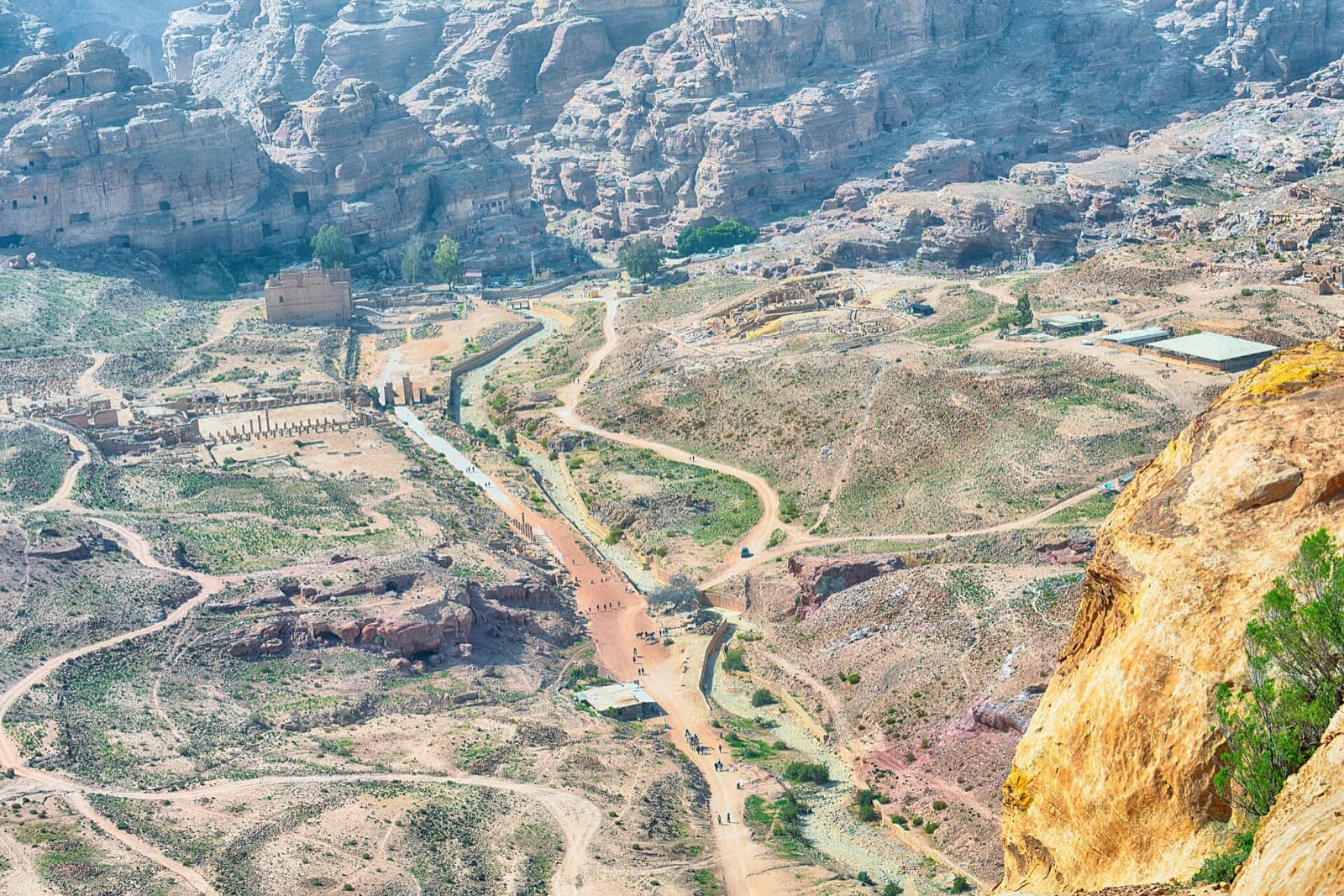
The Colonnaded Street: The Paved Spine of a Desert Metropolis
Petra's main paved avenue, Nabataean in origin and developed into a Roman-style colonnaded street, ending at the Temenos Gate before the sacred precinct.
- 7
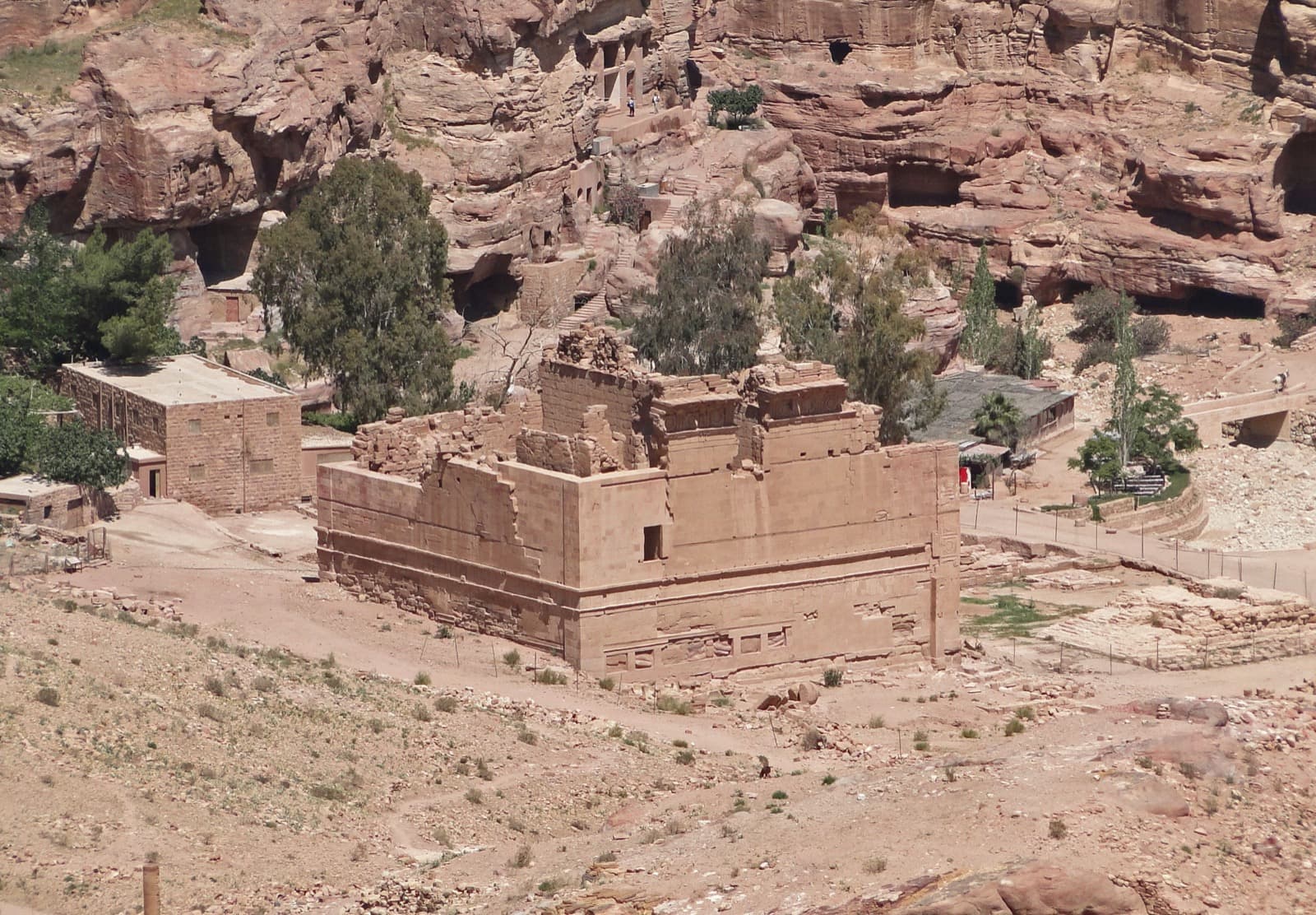
Qasr al-Bint: The One Great Building Raised Block on Block
Petra's main free-standing temple, built up in ashlar blocks rather than carved from the cliff, most likely dedicated to the Nabataean god Dushara.
Details
Best Time to Visit
Come early in the morning, soon after the gate opens, or in the late afternoon. The low sun sets the rose-red stone glowing, the Siq stays cool and shadowed, and the worst of the crowds and midday heat are avoided. Spring and autumn are the most comfortable seasons, with mild days; summer middays are punishingly hot with little shade, and winter can bring rare heavy rain.
Pro Tips
- •Budget a full half day at least. Petra is enormous, mostly on foot and over uneven ground, and this walk alone runs about four kilometres before any side climbs.
- •Start at first light or later in the afternoon to walk the Siq in cool shadow and see the Treasury and Royal Tombs in warm, low, glowing light.
- •Carry more water than you think you need and refill when you can; there is little shade once you leave the Siq, and the sun is strong.
- •Wear sturdy, broken-in shoes with grip. The rock is worn smooth in places and there are many steps, especially if you add the climbs to the High Place or the Monastery.
- •Carry small cash in Jordanian dinars for the site, and feel free to politely decline the horse, camel, and donkey rides offered along the trail; walking at your own pace is the whole point.
- •Treat the Bedouin who work the site with warmth and respect. The Bdoul Bedouin lived in Petra's rock-cut tombs until they were resettled to the nearby village of Umm Sayhoun in the nineteen eighties to protect the monuments.
Safety & Precautions
- •The distances are great and there are many rock-cut steps and stretches of uneven, sometimes slippery stone; pace yourself and take breaks in shade where you can find it.
- •Sun exposure is serious once you leave the Siq, with little natural shade. Bring a hat, sun protection, and far more water than for an ordinary walk.
- •Horse, camel, and donkey handlers will repeatedly offer rides for a fee. Agree any price clearly in advance or simply decline; you are never obliged to accept.
- •In rare heavy rain, flash floods can surge through the Siq very quickly. Heed any warnings, and do not enter the gorge if storms threaten.
Travel advisory: Reconsider Travel (Level 3).
Gallery
Related Reading
Go deeper on what you'll see, hear, and walk through.

Overview
Best Self-Guided Walking Tours in Petra (2026)
3 min
Overview
One Day in Petra: A Walkable Morning-to-Evening Itinerary
9 min
Overview
Petra Travel Guide: Days, Transport, Tickets, and Safety
7 min
Thematic
Petra, the City Carved Down: How to Read a Nabataean Capital on Foot
7 min
Companion
The Treasury at Petra: Why the Siq Was Built to Hide It
6 min
Deep dive
The Siq at Petra: The Kilometre of Shadow That Was Built to Delay You
6 min
Read
What to Eat in Petra: Mansaf, Zarb, and the Bedouin Table
8 min
Read the walk
The full story of Petra: The Siq, the Treasury, and the Rose-Red City, in words. Prefer to listen? Play it narrated, from home or on location.
Introduction
This is Petra, in Jordan, the desert capital that the Nabataeans, an Arab trading people, carved out of rose-red sandstone more than two thousand years ago. Over seven stops and roughly two and a half to three hours on foot, across about four kilometres of open valley, shadowed gorge, and city floor, you will read the wonder in the order its builders intended. It begins with the first cube-shaped monuments on the road to the gorge, then narrows into the kilometre of the Siq, and opens without warning on Al-Khazneh, the Treasury. From there the walk continues past a street of tomb fronts and a theatre cut through the dead, beneath the glowing wall of the Royal Tombs, along the paved civic spine of the ancient metropolis, and out to Qasr al-Bint, the one great temple raised block on block. This is your own pace, your own route, your own quiet map. Petra is famously busy, with guides, carriage and horse touts, and camel and donkey handlers all working the trail, so let the autonomy be the gift: linger as long as you like at the Treasury, or press on when you please, with no group and no schedule steering you. The ground is uneven, the steps many, the sun strong, so move slowly and drink water. A good local guide can be wonderful company at a site this vast, and nothing here argues otherwise. When you arrive at Bab as-Siq, the open valley just past the visitor centre, begin with stop one.
1. Bab as-Siq and the Djinn Blocks: The First Strange Monuments
Before Petra becomes a gorge it is a wide, bright valley, and the Nabataeans lined it with their first monuments. This is Bab as-Siq, which means the gateway to the Siq. Bab is gate, and siq is a narrow gorge, so you are on the open road that leads to the cleft. About four hundred metres from the visitor centre you pass the Djinn Blocks: three massive cubes of stone, carved free on all four sides, standing like sentinels along the path. Djinn is the Arabic word for spirits, and local tradition gave them that name, but they are Nabataean work, and recent study suggests they may be among the earliest monumental tombs at Petra, possibly cut in the second century B C, before the great facades. Opposite them rises the Obelisk Tomb, one of very few multi-storey tombs here, its facade about sixteen metres wide, crowned by four tall pyramid-shaped obelisks. These are nefesh, Nabataean symbols marking the dead, and between them a worn cloaked figure keeps watch from a niche. The tomb dates to around the first century A D. Cut just below it is the Bab as-Siq Triclinium, a funerary dining hall where banquets were held to honour gods or ancestors. This is where the carriage and horse touts gather near the entrance, calling out rides. You do not need them. Walking this stretch slowly, at your own clock, is the whole point: you see the first strange shapes gather and grow, and you feel the valley beginning to close in ahead. Take it in. The gorge is waiting, and it changes everything.
2. The Siq: A Kilometre of Shadow
Now the walls close over you. The Siq is a natural gorge, a winding cleft in the sandstone about one and a fifth kilometres long, roughly three-quarters of a mile, and in places no more than three metres wide. Above you the walls climb between about ninety and one hundred and eighty metres, so the sky becomes a thin ribbon and the light goes cool and blue. This is not a tunnel cut by hand. It is a fracture in the rock, though the Nabataeans engineered it brilliantly. Look low along both walls and you can trace their rock-cut water channels, which carried spring water from Wadi Musa, the valley of Moses, into the heart of the city. At the mouth of the Siq they built a dam to reroute floodwater away from this passage, later rebuilt in the twentieth century. Higher up, small carved niches held baetyli, sacred standing stones, which tells us the Siq itself was holy ground, a sacred approach and not merely a road. Watch for the worn relief of a caravan on the wall, uncovered in nineteen ninety-eight: two merchants, each leading two camels, almost twice life size, their feet still visible where the lower stone has weathered away. The way in slopes gently downhill, so let gravity carry you and go slowly. No group van sets the pace here. The suspense is the design. For a full kilometre you cannot see what waits at the end, and then, without any warning at all, the gorge will part.
3. Al-Khazneh: The Facade That Steps Out of the Gorge
There it is. After a kilometre of shadow the Siq releases you, and framed in the last slot of the gorge stands Al-Khazneh, the Treasury. Khazneh means treasury, but hold that name lightly, because the building is not what its name says. It is a rock-cut facade about forty metres high, roughly twenty-five metres wide, carved straight down into the rose-coloured cliff, columns and pediments and a great decorative urn all cut from the living stone rather than built up from blocks. It was most likely raised in the early first century A D as a royal mausoleum and crypt, during the reign of the Nabataean king Aretas the Fourth, who ruled from nine B C to forty A D. So this is a tomb, a place for the dead, not a vault of gold. The treasury name comes from a Bedouin legend. The story went that a pharaoh hid his treasure inside the great stone urn high on the second level, and over the years people fired at that urn hoping to crack it open and let the riches spill out. You can still see the bullet marks on it. But the urn is solid sandstone, carved in one piece, with nothing inside at all. This is where the crowds and the camel handlers gather, and where the pressure to move on is strongest. So let this be the moment the autonomy pays off. There is no group waiting. Sit on the sand, tip your head back, and stay as long as the wonder holds you.
4. The Street of Facades and the Theatre: Carved Through the Dead
Beyond the Treasury the gorge widens into the Outer Siq, and the walls fill with doorways. This is the Street of Facades: a row of Nabataean tomb fronts cut side by side into the rock, one after another, a whole avenue of the dead. Then the ground opens and you reach the…
Full narration for this stop unlocks with the tour.
5. The Royal Tombs: The Wall That Glows at the Day's Edge
Turn now toward the great cliff to the north, the western face of Jabal al-Khubtha. Jabal means hill or mountain, and this whole wall is lined with the grandest facades in Petra, the Royal Tombs, cut high above the city floor around the first century A D for the Nabataean elite…
Full narration for this stop unlocks with the tour.
6. The Colonnaded Street: The Paved Spine of a Desert Metropolis
Down on the valley floor the wonder gives way to something quieter and, in its own way, just as remarkable: an ordinary city. This is the Colonnaded Street, the main paved avenue running through the centre of Petra along the Wadi Musa. It began as a Nabataean creation, then,…
Full narration for this stop unlocks with the tour.
7. Qasr al-Bint: The One Great Building Raised Block on Block
You end at the one great building in Petra that was not carved from a cliff. This is Qasr al-Bint, and it is the city's main free-standing temple, raised up in ashlar blocks, real cut stone stacked into walls, rather than hollowed from the rock like almost everything else you…
Full narration for this stop unlocks with the tour.