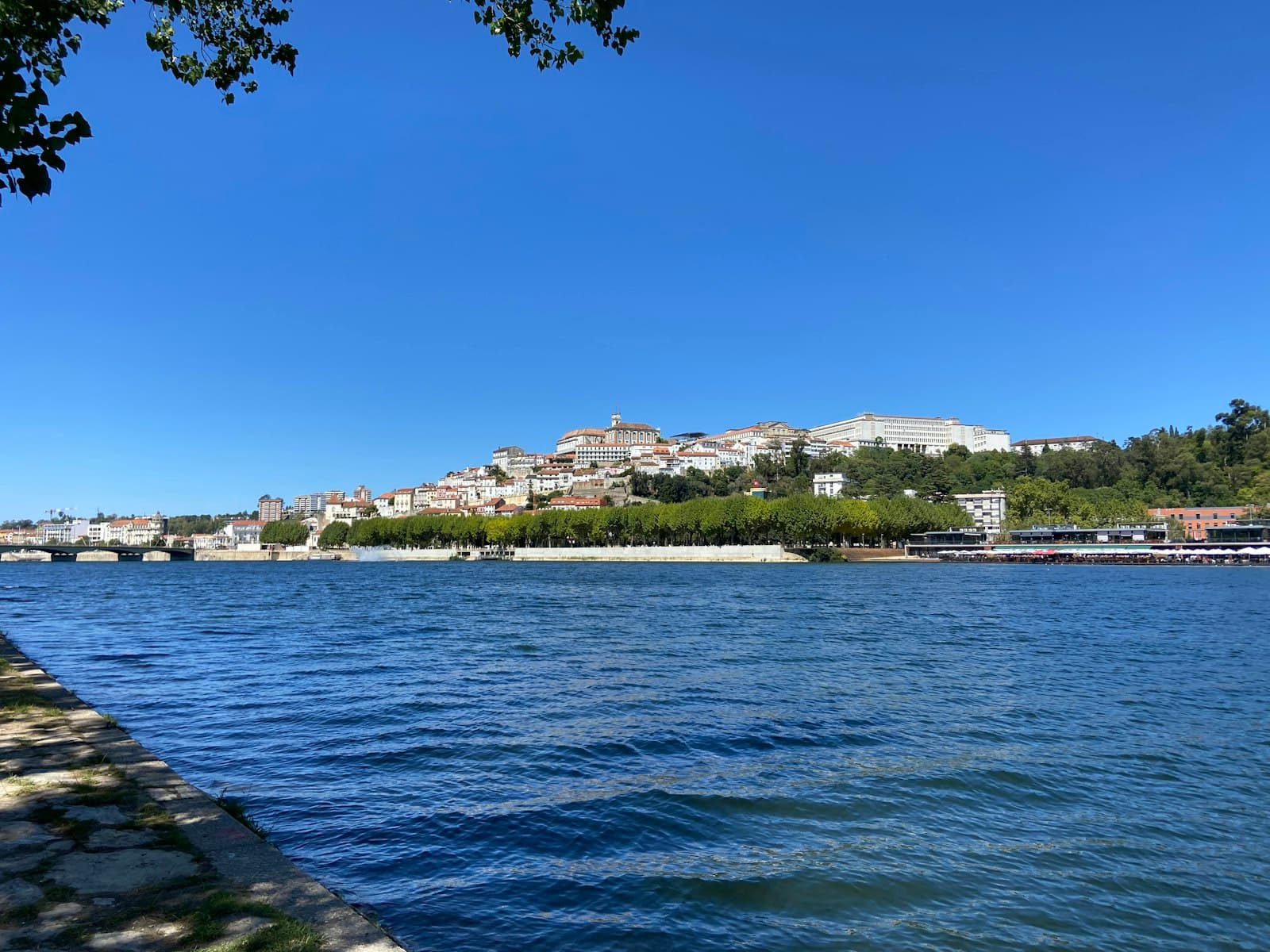
Cross the Mondego to Coimbra's left bank and you find a Gothic convent that the river slowly drowned, a murdered noblewoman whose story hardened into legend, and a saint-queen whose tomb the nuns carried uphill to dry ground. Santa Clara-a-Velha Monastery holds all three at once. It is the reason this walk exists, and it is the clearest place in Coimbra to watch history and legend share a single floor. This article is a pre-walk read for the Roamer self-guided audio tour of the same bank, and it uses the drowned convent as the door into everything the route argues.
The convent the river took
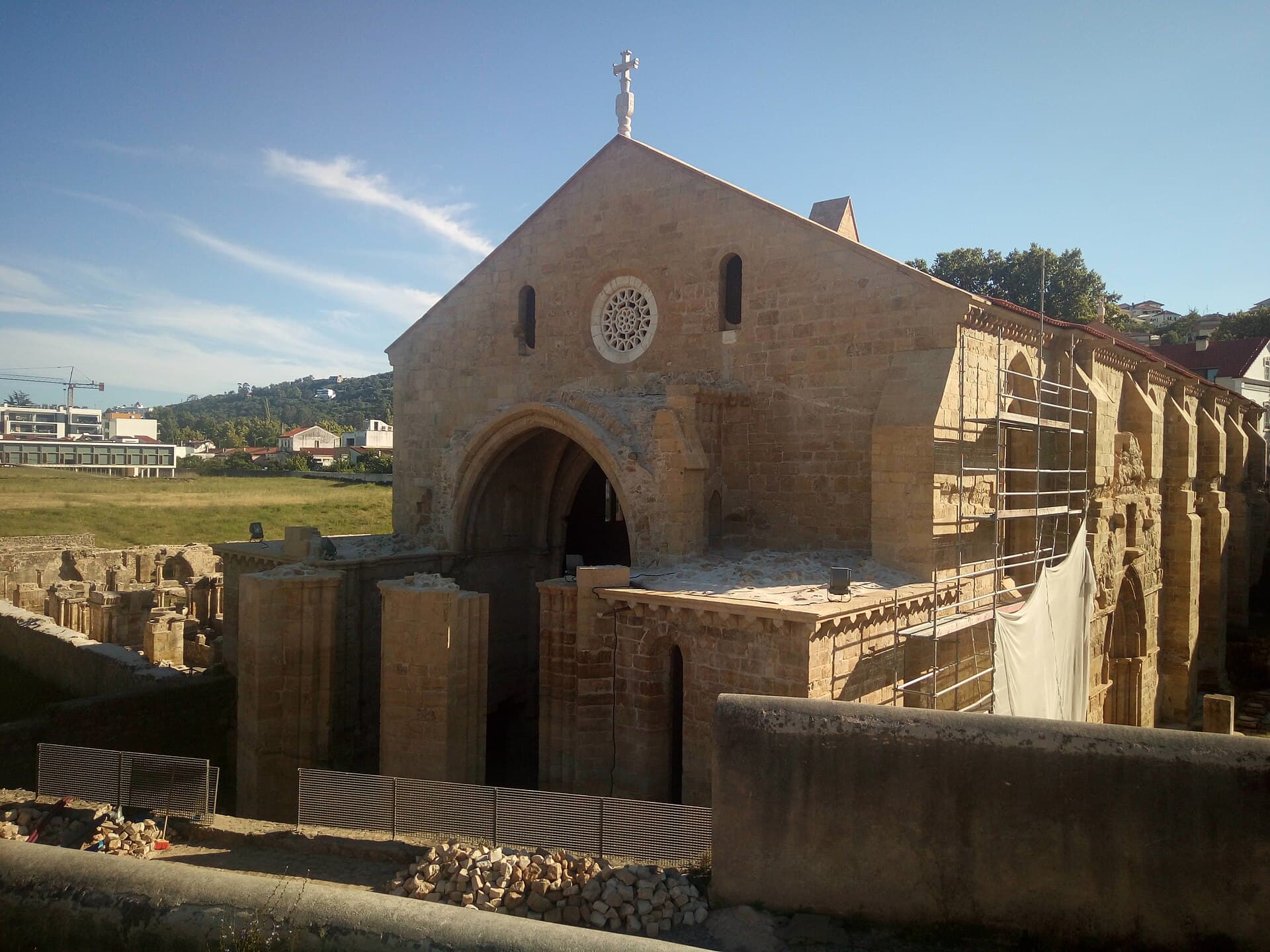
Santa Clara-a-Velha means "the old Santa Clara," and the name only makes sense once you know a newer one was built uphill to replace it. The monastery was a house of the Poor Clares, founded in the twelve eighties by a woman named Mor Dias and refounded in thirteen fourteen by Queen Isabel, wife of King Denis. It was built to endure: a church with a nave and two aisles under full stone vaulting, tall mullioned Gothic windows, three rose windows. This was permanent architecture, the kind meant to outlast the people who prayed in it.
The Mondego had other plans. The building was already flooding as early as thirteen thirty-one, and the nuns refused to leave. Instead they raised the floor. By the year sixteen twelve they had laid a whole new interior pavement partway up toward the roof, a second ground level built to keep the community living above the water that kept seeping in. Picture a congregation rising inside its own drowning church, decade after decade, unwilling to concede. Finally King John the Fourth ordered the abandonment in sixteen forty-seven, and the last nuns left in sixteen seventy-seven, carrying their royal tombs uphill to safety. Then the river won. The church silted up and was partly buried, and it stayed that way for centuries. Archaeologists began clearing it after nineteen ninety-five, and it reopened to the public in April two thousand nine with a visitor center.
Stand inside the excavated shell today and the flood story is legible in the stone. The visitor center explains the raised floor before you walk down into the nave, which is why the audio tour advises starting there. The ruin is not a picturesque accident. It is the record of a two-century argument between a religious community and a body of water, and the water was patient.
Where the legend and the record part ways
Hear a stop from this walk
Pedro and Ines de Castro: The Story Itself
Santa Clara-a-Velha carries a second weight. According to the documented account, this is where Ines de Castro was murdered in thirteen fifty-five, not at a garden fountain a short walk away. That single correction is the intellectual spine of the whole tour, because the rest of the bank is where the legend of Ines took root and grew.
The documented history is grief enough. Ines de Castro, born in thirteen twenty-five, was a Galician noblewoman and a lady-in-waiting at the Portuguese court. She became involved with Infante Pedro, heir to the throne, who was already married to Constance of Castile. After Constance died in thirteen forty-nine, Pedro and Ines lived together openly and had four children. King Afonso the Fourth, Pedro's father, disapproved, and on the seventh of January, thirteen fifty-five, three men killed Ines on the king's orders. Pedro became King Dom Pedro the First in thirteen fifty-seven, captured two of the killers, and in thirteen sixty-one had them publicly executed.
Everything past that point is the human habit of refusing to let a story die. The most famous version, in which Pedro exhumed Ines and forced the court to swear allegiance to her crowned corpse, is most likely a myth: the crowned-corpse tale first appears in a play by Jeronimo Bermudez in fifteen seventy-seven, more than two centuries after her death. The tombs of Pedro and Ines at the Monastery of Alcobaca, north of Coimbra, are often described as facing each other so the lovers will rise seeing one another at the Last Judgment, but they were first placed side by side and only turned to face each other centuries later. The Roamer tour tells you which part is stone and which part is story at every turn, and the drowned convent is where that discipline begins. To browse the full set of routes across the city, see Coimbra walking tours.
Reading the whole bank from one ruin
The convent explains the shape of the entire walk. Downstream at the Quinta das Lagrimas, an estate whose name means "Estate of Tears," romantic tradition places the murder at the Fonte das Lagrimas and says the fountain sprang from the tears Ines shed as she died. The genuine article there is the fabric of the fountain, a broken arch that probably dates to the fourteenth century. The tears are a story layered over centuries. Standing at the drowned convent first is what lets you hold both truths without feeling cheated.
The convent also sets up the tour's quiet triumph. When the nuns fled in sixteen seventy-seven, they carried Queen Isabel's tomb uphill to Santa Clara-a-Nova, the new monastery built on high ground the water could never reach. Isabel had been canonized in sixteen twenty-six as the Rainha Santa Isabel, patroness of Coimbra, and she rests there dry and safe. Keep her clearly separate from Ines: Isabel is the saint-queen, Ines the murdered lover, two different women a generation apart. The river took the building Isabel founded. It did not take her.
The route ends lighter, at Portugal dos Pequenitos, a miniature park where scale-model houses and monuments rebuild the country child-sized on the same bank the Mondego once threatened. Its construction began in nineteen thirty-eight, and by two thousand seven it drew roughly three hundred thirty-one thousand visitors a year. After an afternoon of drowned stone and murdered lovers, a whole Portugal rebuilt small and dry is a deliberate exhale.
You reach all of this on foot, across roughly three and a half kilometres, downhill to the water and then up to the high ground. The bank rewards slowness. Sit by a fountain if a fountain asks you to. The audio walk lets you set the pace and skip or double back, which suits a route that is really one long elegy about what a river takes and what people carry away in time. Start planning from the Coimbra city page, then walk the far bank with the story already in your ear.
Sources
- Monastery of Santa Clara-a-Velha, Wikipedia: foundation, flooding chronology, abandonment, and post-1995 excavation and 2009 reopening.
- Ines de Castro and Peter I of Portugal, Wikipedia: documented biography, the thirteen fifty-five murder, and the later crowned-corpse legend.
- Mosteiro de Santa Clara-a-Velha, Patrimonio Cultural (Portugal's official heritage authority): architectural description and site history.
- Portugal dos Pequenitos, Wikipedia: construction phases from nineteen thirty-eight and visitor figures.
- Roamer self-guided audio tour "The Convent the River Drowned" (fact-audited tour transcript): the six-stop route and its fact-versus-legend framing.
Ready to experience it?
Santa Clara-a-Velha: The Convent the River Drowned
110 min · 3.6 km · moderate
More from Coimbra
Explore more at your own pace.
Coimbra Travel Guide: Days, Getting Around, Safety, and Cost
Coimbra Has Been Portugal's Mind for Seven Centuries
Igreja de Santiago and the Case for Walking Coimbra's Low Town
The Old Cathedral That Explains All of Coimbra
Ponte de Santa Clara: Reading the River That Drowned a Convent