Coimbra is two cities stacked on one hillside, and the plainest way to read the working low town beneath the famous university is to stand on the corner of the old commercial square and look at the Igreja de Santiago. This sober Romanesque church was built by and for the merchants and artisans of the Baixa, the low town of trade and river that spills down from a medieval gate toward the Mondego. The gown up on the hill is the postcard. The church on the market square is the argument. It tells you that before the scholars arrived to write the country down, an ordinary working city was already here, governing its own daily business in stone.
A church that looks like the people who built it
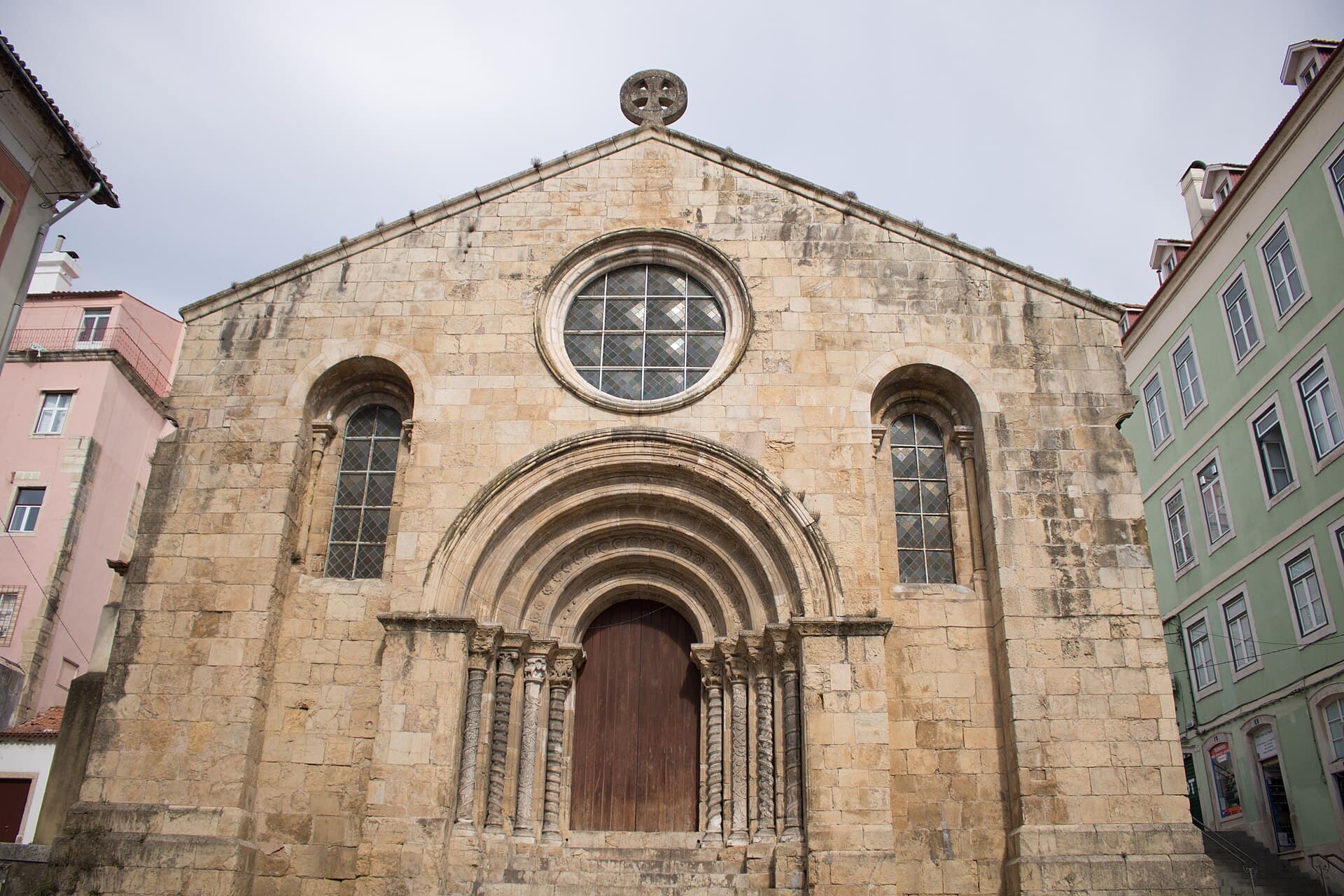
The Igreja de Santiago wears the low town's character in its walls. It is one of the great Romanesque monuments of Coimbra and a clear example of what scholars call the Coimbra Romanesque school: sober decoration, small openings, thick walls, and a fortified, almost military feel. There is nothing soaring or gilded about it. This is a building that looks like it was made by people who worked with their hands, and that plainness is not a shortcoming. It is the point. On the hill you will meet a very different vocabulary later. Down here, the stone is honest about who paid for it.
Look at the details when you arrive. The south portal, probably from the late twelfth century, keeps its archivolts unpainted, framed in a vine shape, with capitals carved in plant motifs. Inside there are three naves and three chapels, and a Gothic chapel was added on the north side in the fourteen hundreds. It is a modest church that has been added to, cut into, and rebuilt for eight centuries, which is exactly what happens to a building that sits in the middle of a working town rather than apart from it.
Four hundred years carrying a second church
Hear a stop from this walk
Fado de Coimbra: The Sound That Binds the Towns
The most extraordinary fact about the Igreja de Santiago is how much it has survived. In the fifteen forties a second church was raised directly on top of the original, serving as the city's Mercy church. For roughly four centuries the Romanesque building literally carried another church on its back. That upper structure was only removed during restoration work in the twentieth century, which is why the church you see today is a recovered thing rather than a preserved one.
It has also given up ground to the town around it. In eighteen sixty-one, the widening of the street cost the church much of its southern apse and part of the main chapel. Think about what that means. The working town reshaped even its own monuments for the sake of the traffic below. A church is usually the most protected thing in a European quarter. Here, the needs of commerce trimmed the sacred to keep the road moving. That single fact captures the whole personality of the Baixa better than any plaque could. The church was rebuilt during the reign of Sancho the First, the second king of Portugal, in the last decades of the twelfth century, and it is a National Monument today. It began, though, as nothing grander than the spiritual home of the parish that bought, sold, and made things.
Why the low town is the real story
Once you understand the Igreja de Santiago, the rest of the walk falls into place, because every stop deepens the same idea: the working city carried the famous one. The church stands on the Praca do Comercio, also called the Praca Velha or Old Square, the historic commercial heart of the Baixa. That square was not always a pleasant place to pause. In the fifteen hundreds it held the Royal Hospital, and it served as the city market for centuries until Saint Peter's Market opened in eighteen sixty-seven and took the trade indoors. Standing there, you are standing in the low town's front room, ringed by eighteenth-century buildings dressed in azulejo tiles.
A short climb away is the strongest evidence of all. The Mosteiro de Santa Cruz holds the tombs of the first two kings of Portugal, Afonso Henriques the founding king and his successor Sancho the First. The country's first two crowns rest not up on the university hill but here, in the working town. The monastery was founded in eleven thirty-one by Saint Theotonius, deliberately outside the protecting walls, and it became a center of medieval learning long before the university crowned the hill. In August of two thousand three it was granted National Pantheon status. So the low town was a place of burial and a place of the mind first, and the gown came later.
The route also carries the city's own sound. Fado de Coimbra is a distinct genre, tied to the university and traditionally sung by men in academic robes, accompanied by the Guitarra de Coimbra, a Portuguese guitar tuned a whole tone lower than usual for a darker, more sombre color. It drifts down at night from the students into the very streets you walk. Then Rua Ferreira Borges, the guild spine of the Baixa, runs down to the river. It is named for Jose Ferreira Borges, who lived from seventeen eighty-six to eighteen thirty-eight and wrote the Portuguese Commercial Code of eighteen thirty-three. A merchants' street named for the man who wrote the merchants' law. At its foot lies Largo da Portagem, the old toll gateway where arrivals once paid to enter the town.
The walk ends by climbing, because the town's whole story climbs. The Se Nova, the New Cathedral, began as the church of the Jesuit college, built from fifteen ninety-eight and inaugurated in sixteen ninety-eight. After the Jesuits were expelled from Portugal in seventeen fifty-nine, the bishop's seat moved here in seventeen seventy-two. From the top you turn around and look back down over everything you have read: the gate, the churches, the market square, the monastery of the kings, the guild street, the river.
Walk it in order, downhill first
The Below the Gown tour is seven stops over about two and a half kilometres, roughly ninety minutes at an unhurried pace, and it is designed to descend to the Mondego and then make the cathedral climb its natural finale. Wear shoes with real grip, because the calcada, the traditional stone paving, is smooth and slippery, and carry a few coins for the small fees at Santa Cruz and the Se Nova. Start in the late morning so the churches are open before the midday closures, and if you can, return to the Baixa after dark to hear the fado properly.
The audio guide walks with you at your own pace, so you can linger in a doorway or skip a lane without missing the thread. To plan the route and see the other tours in the city, browse Coimbra walking tours, or start from the Coimbra city page. Begin at the Arco de Almedina, the last medieval gate, and let the working town tell you the rest.
Sources
- Igreja de Santiago (Coimbra), Wikipedia. Building history, Romanesque school, the removed upper church, and the eighteen sixty-one street widening.
- Igreja de Santiago, Visit Portugal. Official tourism entry on the church and its low-town setting.
- Monastery of the Holy Cross (Coimbra), Wikipedia. Founding date, royal tombs, and National Pantheon status.
- Praca do Comercio / Praca Velha, All About Portugal. History of the square as royal hospital and market.
- New Cathedral of Coimbra, Wikipedia. Jesuit origins, construction dates, and the transfer of the bishopric.
Ready to experience it?
Baixa de Coimbra: Below the Gown
90 min · 2.5 km · easy
More from Coimbra
Explore more at your own pace.
Coimbra Travel Guide: Days, Getting Around, Safety, and Cost
Coimbra Has Been Portugal's Mind for Seven Centuries
Santa Clara-a-Velha: The Convent the Mondego Drowned
The Old Cathedral That Explains All of Coimbra
Ponte de Santa Clara: Reading the River That Drowned a Convent