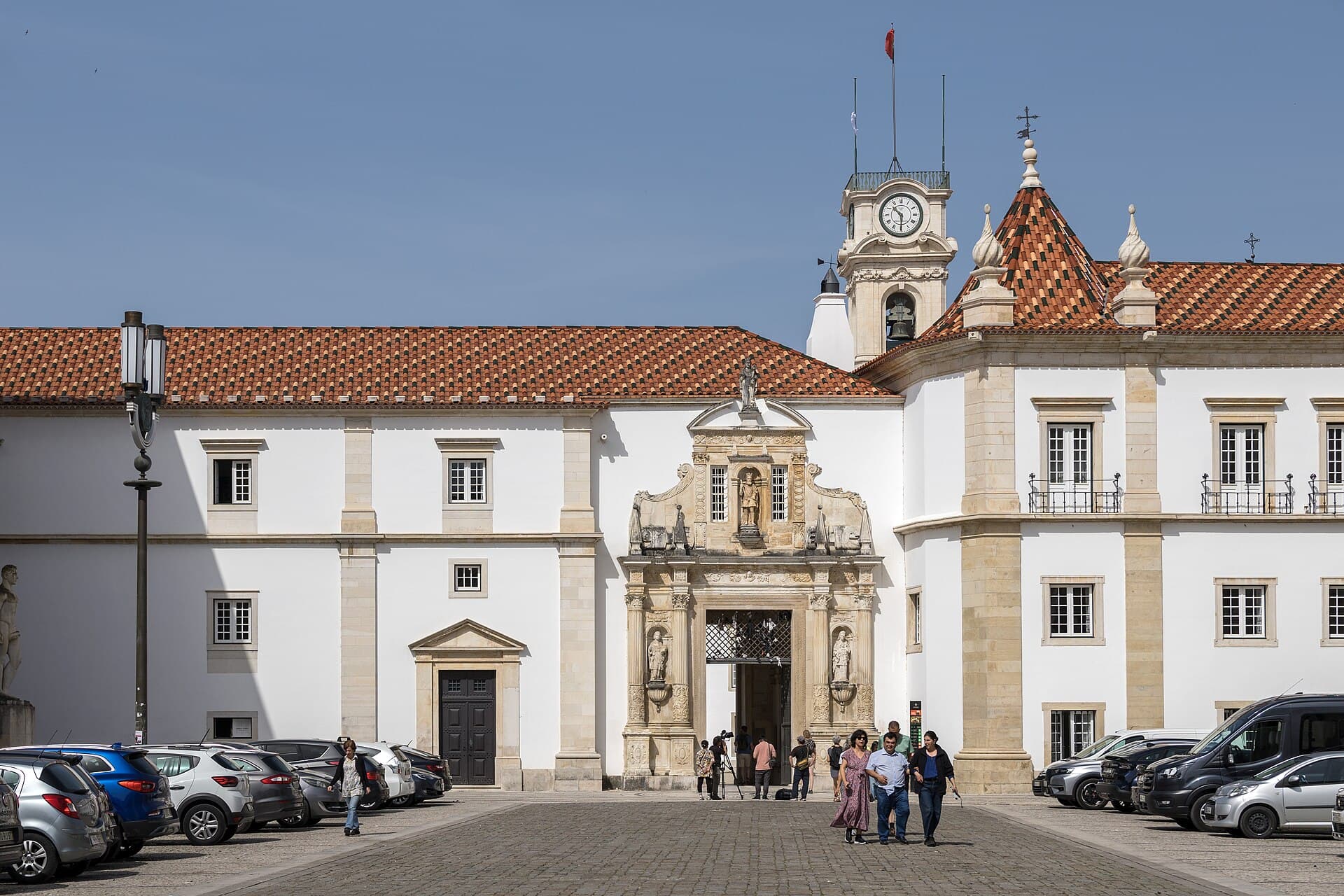
The Porta Ferrea, the Iron Gate, is a seventeenth-century ceremonial arch that marks the exact line where the ordinary city of Coimbra ends and the University of Coimbra begins. It stands on the site of the old Moorish citadel gate, so the spot has been a threshold for many centuries, first into a fortress and now into a school. Its carved kings and allegorical figures compress the university's whole origin story into a single stone doorway, which is why standing beneath it tells you more about Portugal's oldest university than most of the rooms inside.
A threshold that was always a threshold
Before the arch, before the university, before the kings whose portraits it carries, this was a gate in a wall. When the Christian Reconquista took Coimbra, the entrance to the Moorish citadel stood on this ground. Centuries later, the university built its own gateway on the same footprint, and that continuity is the first thing worth holding onto. People have been passing from an outside world into a guarded inner one at this precise point for the better part of a thousand years.
The gate you see now belongs to a specific moment of institutional ambition. The crown acquired the old royal palace above for the university in 1597, and the Porta Ferrea was among the first major works the school undertook after that palace passed into its hands. It was built in 1634 under Rector Alvaro da Costa, designed by the architect Antonio Tavares in a robust Mannerist style, with heavy Doric columns flanking the archway and a weighty pediment above. The university was not just installing a door. It was announcing that it now owned the hill.
The arch as a page you can read
Hear a stop from this walk
Paco das Escolas and the Via Latina: The Palace of the Schools
The Porta Ferrea is double-sided, and each face carries one of the two monarchs the university treats as its founders. On the outer face, looking back toward the city, you meet King Denis, Dom Dinis in Portuguese, who chartered the university in the year 1290. On the courtyard side stands King Joao the Third, under whom the school moved permanently to Coimbra in 1537. Placing them on opposite faces is not decoration. It is a compressed timeline. You walk in past the founder and emerge past the king who anchored the institution here for good, and in the few steps between them you have crossed roughly two and a half centuries of history.
Above the kings sits a figure of Wisdom, the insignia of the university itself. Around them, allegorical female figures personify the school's early faculties. The sculptural program lays out the four founding disciplines: Medicine and Law on the outer face, Theology and Canon Law on the courtyard side. In other words, the gate is a small stone curriculum. Everything the university claimed to teach is announced on the arch before you set foot in a single classroom. A student arriving on the first day would read, carved above their head, the exact shape of the knowledge about to be demanded of them.
That is the one thing to understand while standing in front of the Porta Ferrea. This is not a triumphal arch celebrating a battle. It is a declaration of purpose. Kings on the sides for legitimacy, Wisdom on top for aspiration, faculties in between for substance. The whole institution argues its case in the space of a doorway.
Why a palace, and not a campus
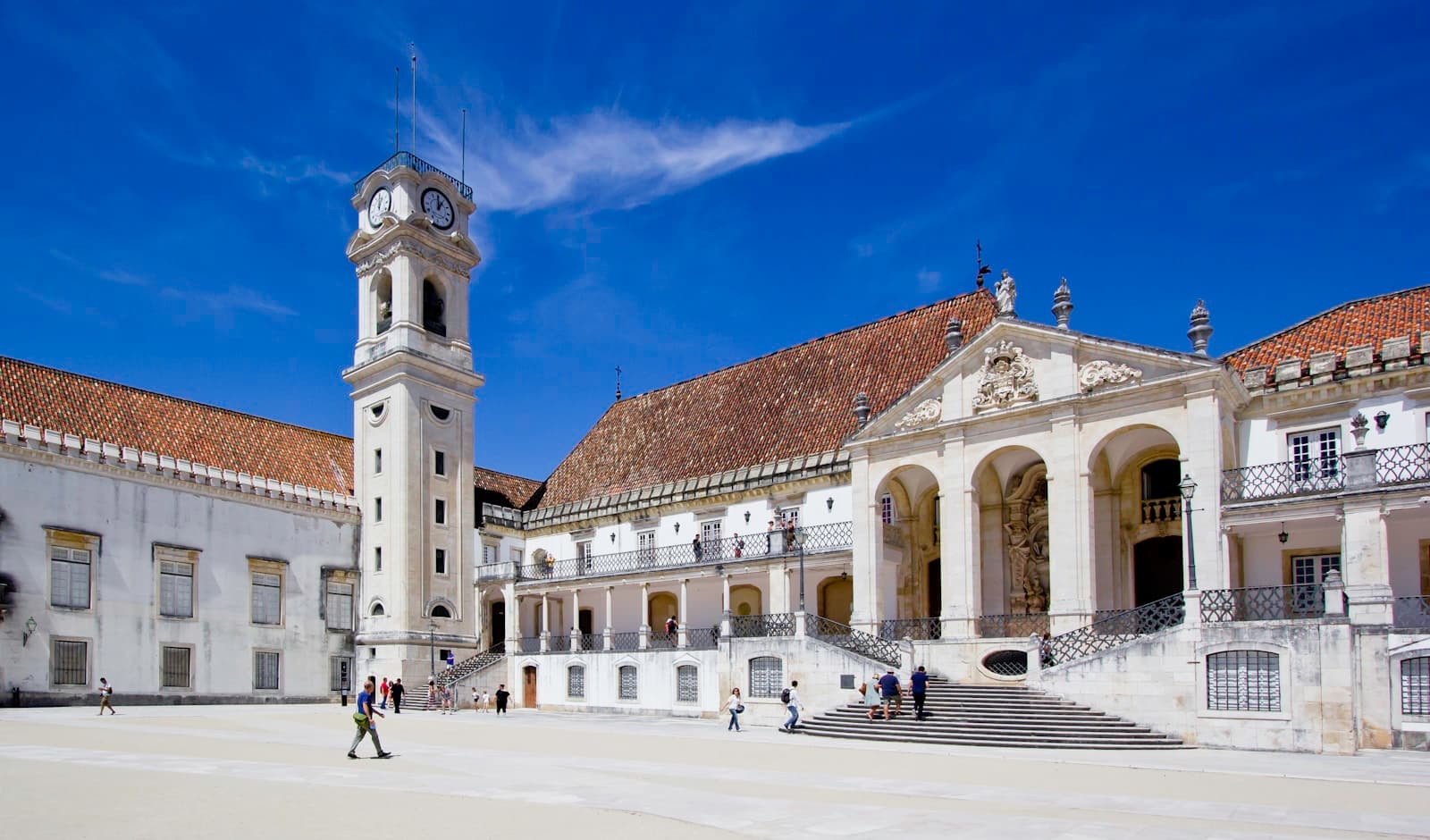
To feel the full weight of the arch you have to know what lies beyond it. Through the gate opens the Paco das Escolas, the Palace of the Schools, a U-shaped courtyard that was, quite literally, a royal palace. Portuguese kings used this building from the reign of King Denis until the crown handed it to the university near the end of the sixteenth century. A palace of kings became a palace of scholars. The school did not build itself a campus beside the city. It moved into the throne room.
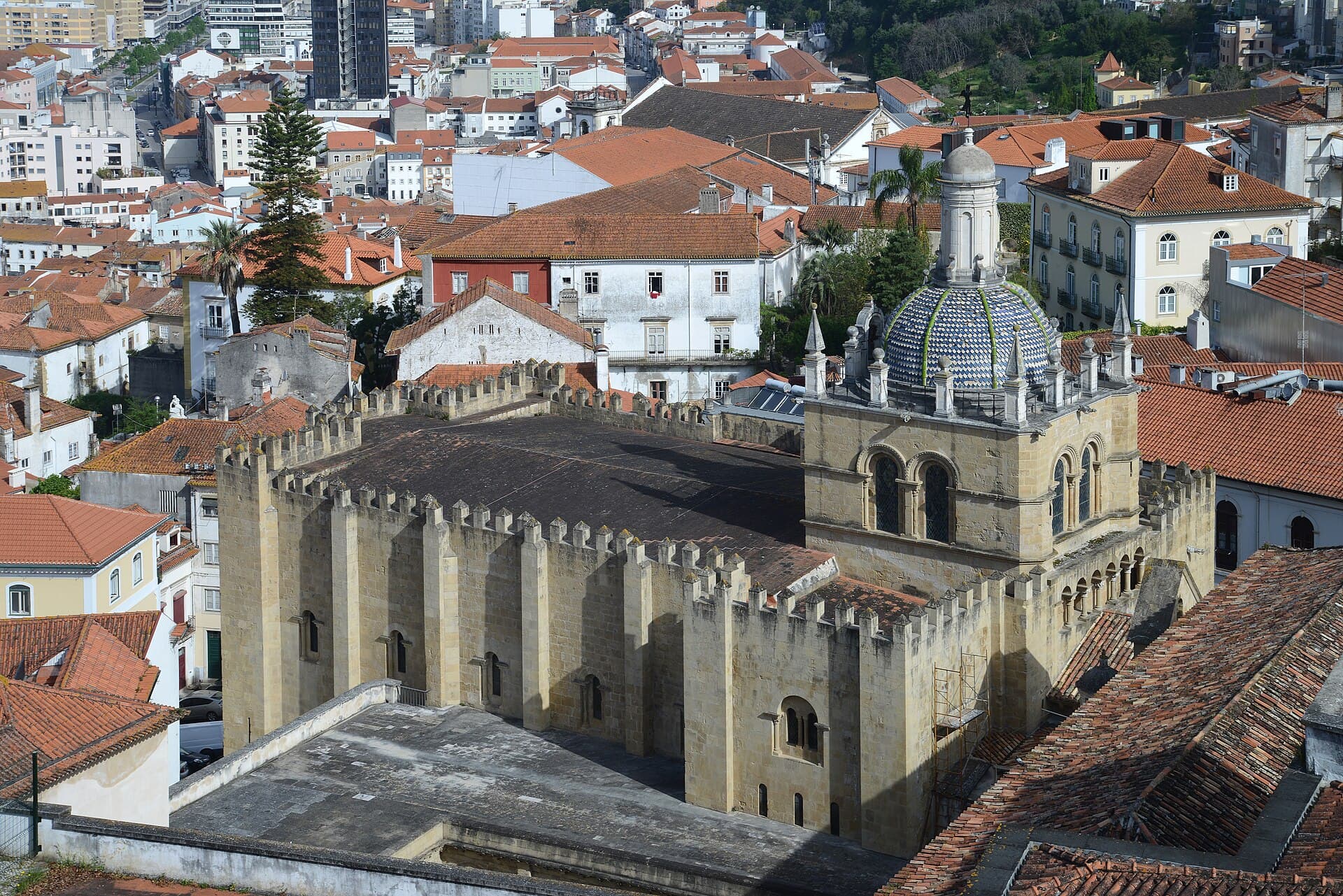
The Porta Ferrea is the hinge of that inversion. It is the point where a royal residence stopped being royal and started being academic, and its carvings make the transfer explicit by honoring the crown even as the crown withdrew. Kings gave the building; the university kept their faces at the door. Walk through and you leave the medieval town behind and enter the ground where Portugal has trained its lawyers, doctors, and theologians since the sixteenth century. The wider Coimbra walking tours trace how the entire hill reorganized itself around this single institution, from the fortress-like Old Cathedral at the bottom to the gilded baroque library at the top.
Standing under the arch
Pause under the Porta Ferrea before you cross it. Notice how the noise of the town falls away behind you and the courtyard opens ahead, the river Mondego and the red rooftops of the lower city visible beyond the far edge. Generations of students have passed through this exact spot on their first day, wearing the black academic capes that still move through these streets, nervous, about to be absorbed into an institution that has been in continuous operation for more than seven centuries. The tradition of walking through this gate as a rite of arrival is not staged for visitors. It is simply how the day begins here.
The gate rewards slow looking. Find King Denis on the city side and King Joao the Third on the courtyard side. Pick out the figure of Wisdom at the summit. Trace the allegorical faculties and match them to the disciplines the university built its reputation on. Each element is doing a job, and once you see the arch as a sentence rather than an ornament, the rest of the university hill reads more clearly too. The threshold is the thesis, and everything above it is the argument spelled out at length.
Walk the whole hill
The Porta Ferrea is the second stop on the Coimbra University Hill self-guided audio tour, positioned exactly where it belongs: the moment of transition, after the ancient cathedral and before the palace courtyard, the tower with its curfew bell, the tile-wrapped chapel, and the Joanina Library guarded at night by a colony of insect-eating bats. Walking the route in order, uphill from stone permanence to living student ritual, lets the gate do its work as a genuine threshold rather than a photo stop. If you want to stand under the arch and understand every figure carved into it, plan a visit to Coimbra and let the tour carry you from the city into the oldest classroom in the country.
Sources
- University of Coimbra visitor site (visituc.uc.pt), Iron Gate page: official description of the Porta Ferrea, its founding kings, and its allegorical faculty program.
- Coimbra University Hill tour transcript (fact-audited, Roamer): primary source for the arch's role, the 1634 build under Rector Alvaro da Costa, and the Moorish-citadel siting.
- Lonely Planet and Arquipelagos records, Porta Ferrea: architect Antonio Tavares, the 1634 date, and the Mannerist Doric composition.
- UNESCO World Heritage listing 1387, University of Coimbra, Alta and Sofia: context for the palace-to-university transfer and the site's continuous operation.
Ready to experience it?
University of Coimbra: The Oldest Classroom in the Country
90 min · 0.7 km · moderate
More from Coimbra
Explore more at your own pace.
Coimbra Travel Guide: Days, Getting Around, Safety, and Cost
Coimbra Has Been Portugal's Mind for Seven Centuries
Igreja de Santiago and the Case for Walking Coimbra's Low Town
Santa Clara-a-Velha: The Convent the Mondego Drowned
The Old Cathedral That Explains All of Coimbra