Coimbra is a Portuguese city organized around a single medieval school, and the fortress-like Se Velha at the bottom of the hill is where you learn to read it. Before you climb toward the palace courtyard, the bell tower, the tiled chapel, and the gilded library at the top, you stop at the Old Cathedral, because everything above it grew from here. The whole town leans toward the university on the hilltop. The cathedral is the ground it leaned from first.
Why the cathedral comes first
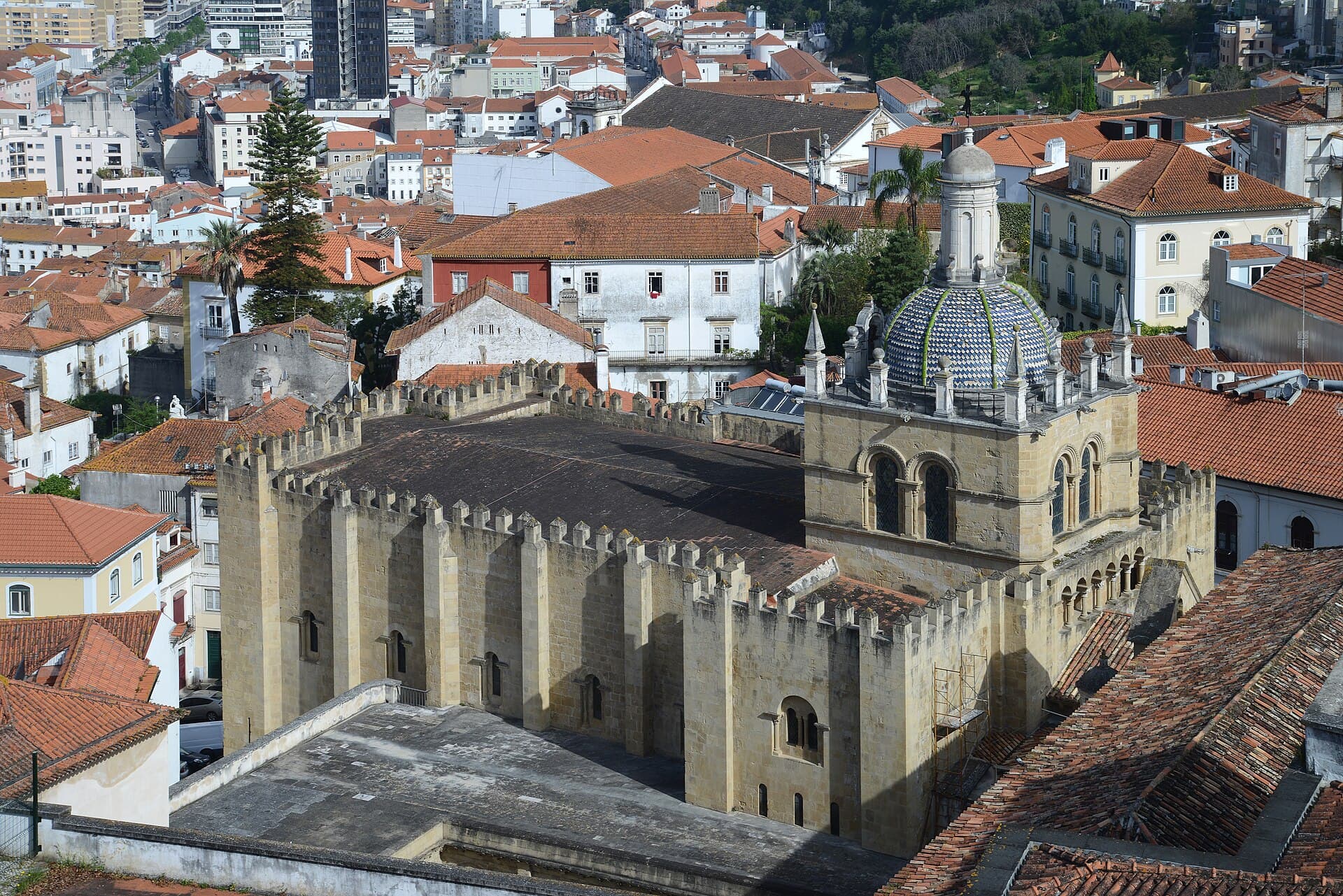
Se simply means the cathedral. This one is Romanesque, heavy and built like a fortress, with crenellations running along its top that make it look ready for defense as much as for prayer. That look is not decorative. Construction began after 1139, in the years following the Battle of Ourique, under King Afonso Henriques, Portugal's first king, with financial support from Bishop Miguel Salomao. Coimbra in those decades was a frontier city, freshly held, genuinely insecure. A church here might also need to hold a wall. The silhouette records that anxiety in stone.
The building came far enough along for a royal event by 1185, and the basic structure was finished by the early thirteenth century. According to Wikipedia, this is the only one of Portugal's Romanesque cathedrals from the Reconquista period to survive relatively intact. That fact is the reason a traveler should start low rather than rushing to the famous library above. Standing at the Se Velha, you are as close to the actual twelfth century as Portugal lets you get.
Look at the exterior, then step inside if you have a few minutes (entry runs about 2.50 EUR). The stone masters who shaped it carry names that come down to us: Master Robert, who also worked on Lisbon's cathedral, along with Master Bernard and Master Soeiro. Inside are hundreds of sculptured capitals, roughly 380 of them, each carved with foliage, beasts, and geometry, no two quite alike. On one facade you will find the Porta Especiosa, a Renaissance portal added in the 1530s, a softer style grafted onto the older fortress. The cathedral is not a single moment. It is centuries of taste layered onto one insecure beginning.
The date that moves the city uphill
Hear a stop from this walk
Paco das Escolas and the Via Latina: The Palace of the Schools
Here is the detail that turns the Se Velha from a monument into an argument. This cathedral was the religious heart of Coimbra, its episcopal seat, until 1772. That year matters because by then the true center of gravity in the city had already moved. It had climbed the hill, to the school. The cathedral lost its rank as the town's chief church, and the reason it lost it is the reason this walk exists: Coimbra had reorganized itself around learning.
So the Se Velha is Coimbra before the university existed, and the rest of the hill is Coimbra after. That single inversion, cathedral below and classroom above, is the thesis of the entire route. Once you see it standing here, you cannot unsee it as you climb. This is why the Coimbra walking tours built around the university hill begin at the bottom and read upward, letting gravity and chronology work together.
Reading the hill above the cathedral
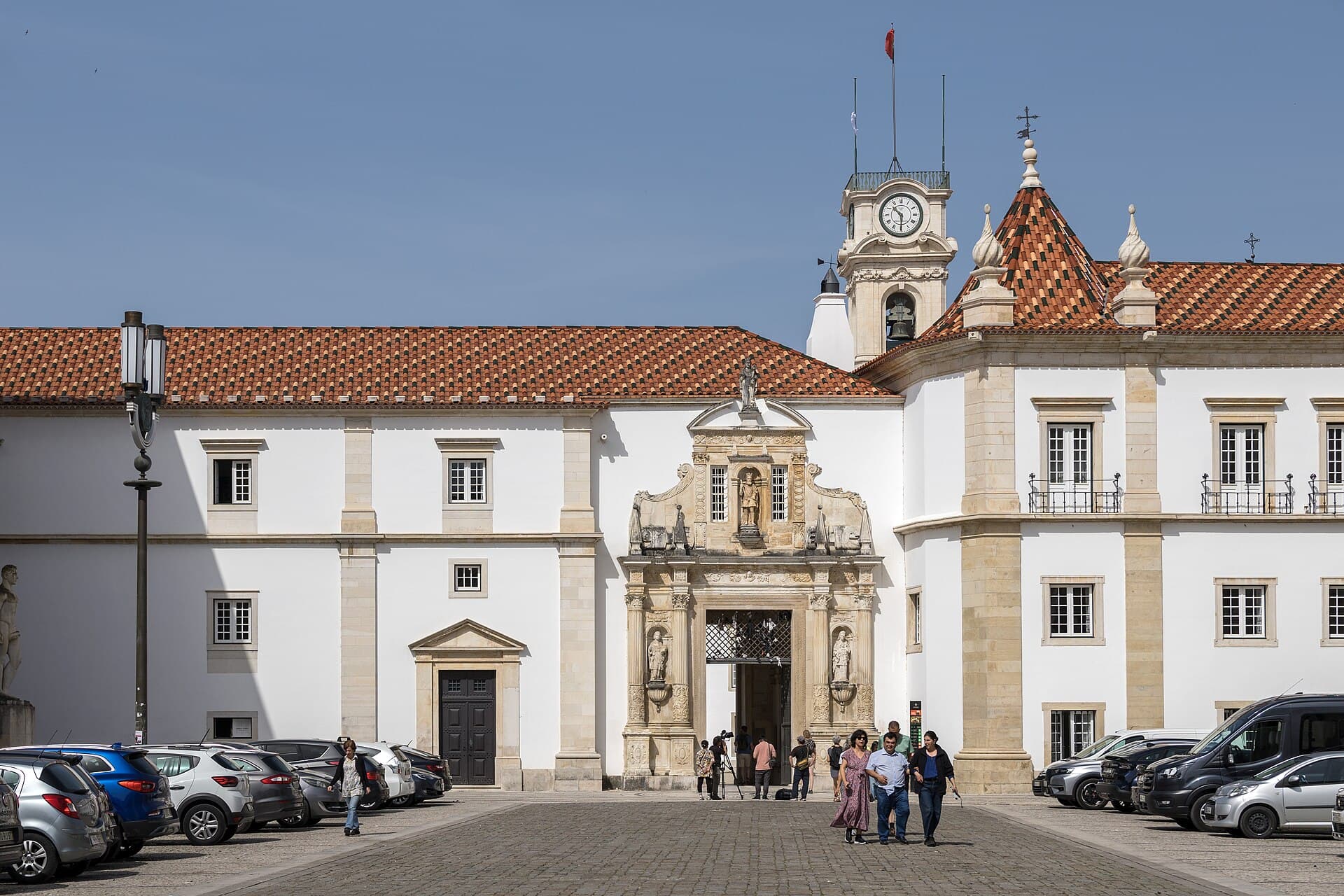
From the cathedral the road rises, and each stop restates the same idea in a new register. First comes the Porta Ferrea, the Iron Gate, a seventeenth-century ceremonial arch commissioned around 1634 under Rector Alvaro da Costa. It stands on the site of the old Moorish citadel gate, so the spot has been a threshold for a very long time. The arch carries the university's two founding kings: Denis, who chartered the school in 1290, and Joao the Third, under whom it moved permanently to Coimbra in 1537. Carved female figures personify the early faculties. The gate is a curriculum written in stone before you even walk through it.
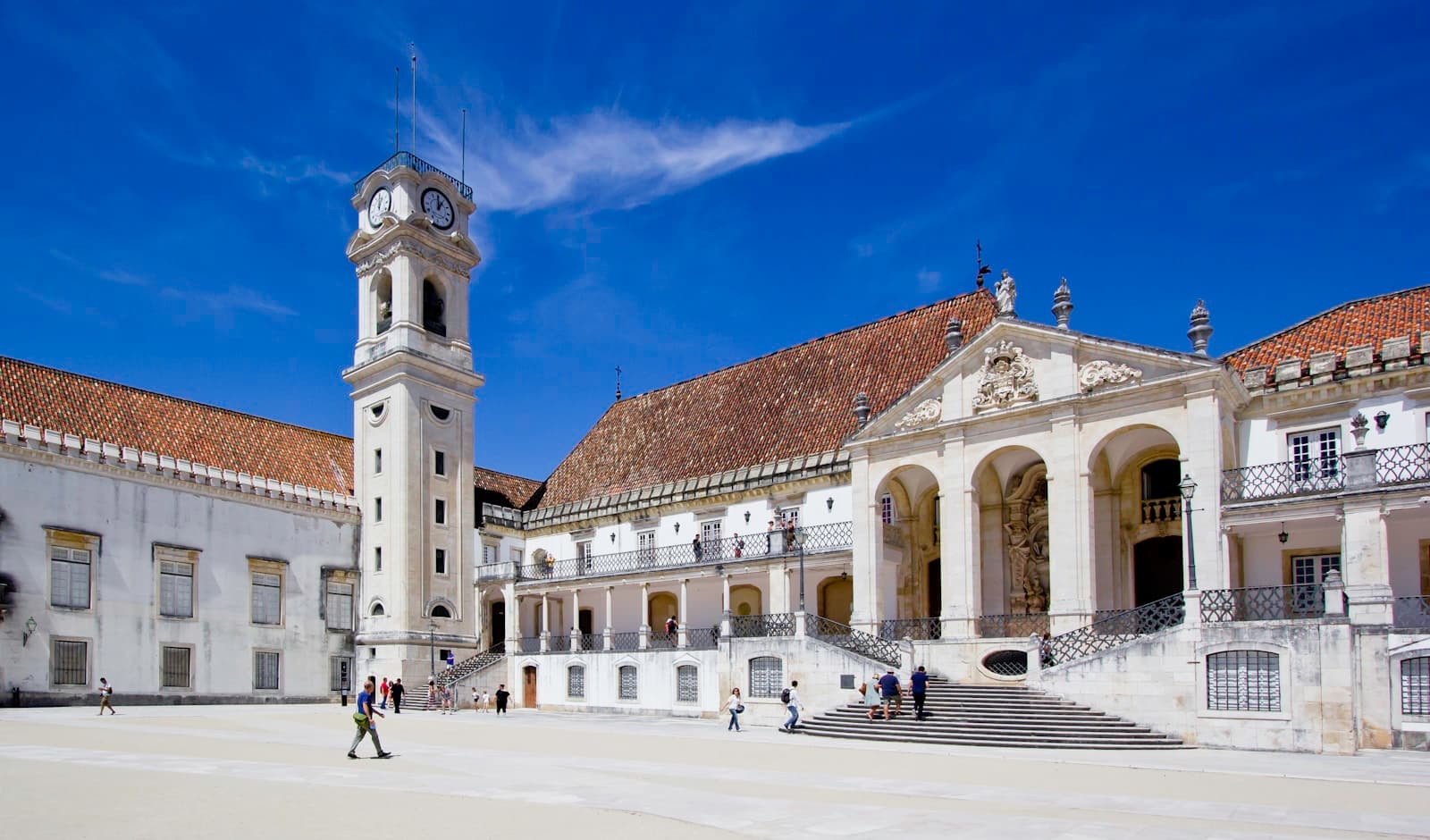
Beyond it opens the Paco das Escolas, the Palace of the Schools. This U-shaped courtyard was quite literally a royal palace, the old Alcacova, home to Portuguese kings from the reign of Denis until the crown transferred it to the university around 1597. A palace of kings became a palace of scholars. The long arcaded veranda along the main facade is called the Via Latina, its present form dating to around 1773, named for Latin, the official teaching language until the Pombaline reform of 1772 replaced it with Portuguese. The name freezes the exact year the university changed its own tongue. UNESCO inscribed this site as World Heritage in 2013, recognizing one of the oldest continuously operating universities in the world.
Above the courtyard rises the Torre da Universidade, built roughly between 1728 and 1733, whose bell students nicknamed a cabra, the goat. For centuries that bell rang the hours and the evening curfew, structuring student lives down to when they had to be indoors. Nearby, the Capela de Sao Miguel wraps its interior in azulejo tiles painted in Lisbon in 1613, beneath a baroque organ of roughly two thousand pipes, on the site of a twelfth-century oratory. Prayer has happened on that ground for nearly a thousand years.
Then the summit: the Biblioteca Joanina, built between 1717 and 1728 under King Joao the Fifth, its chamber gilded in exotic wood largely from Brazil, a royal portrait by Domenico Dupra from 1725 presiding over tens of thousands of volumes. Wikipedia notes it is regularly considered one of the most beautiful libraries in the world. It is also guarded, genuinely, by a colony of bats that eat book-damaging insects at night while staff drape the tables in leather. It is one of the oldest working pest-control systems anywhere.
The school that never closed
The walk ends not in stone but on the body. Students still move through these streets in the traje academico, the black cape called a capa formalized in the seventeenth century, its torn edges often worn with pride. The praxe initiation, the Queima das Fitas ribbon-burning festival first organized in the 1850s, and the mournful Fado de Coimbra all carry the school into the present. The point is that the palace of kings became the palace of scholars, and the scholars never left.
That is what the Se Velha prepares you to understand. Start at the cathedral, climb in order, and the city reads itself. Plan the route from the Coimbra city page, buy the timed university ticket early, and give yourself the full ninety minutes. The school is still, in every sense, in session.
Sources
- Old Cathedral of Coimbra, Wikipedia: dating, master builders, surviving Romanesque form, and the 1772 loss of episcopal seat.
- University of Coimbra, Wikipedia: 1290 charter, the 1537 move to Coimbra, and the Via Latina naming.
- University of Coimbra, Alta and Sofia, UNESCO World Heritage Centre: 2013 inscription and institutional history.
- Biblioteca Joanina, Wikipedia: construction dates, the Dupra portrait, the resident bat colony, and its reputation.
- University of Coimbra visitor site (visituc.uc.pt): Porta Ferrea, the University Tower, and ticketing details.
Ready to experience it?
University of Coimbra: The Oldest Classroom in the Country
90 min · 0.7 km · moderate
More from Coimbra
Explore more at your own pace.
Coimbra Travel Guide: Days, Getting Around, Safety, and Cost
Coimbra Has Been Portugal's Mind for Seven Centuries
Igreja de Santiago and the Case for Walking Coimbra's Low Town
Santa Clara-a-Velha: The Convent the Mondego Drowned
Ponte de Santa Clara: Reading the River That Drowned a Convent