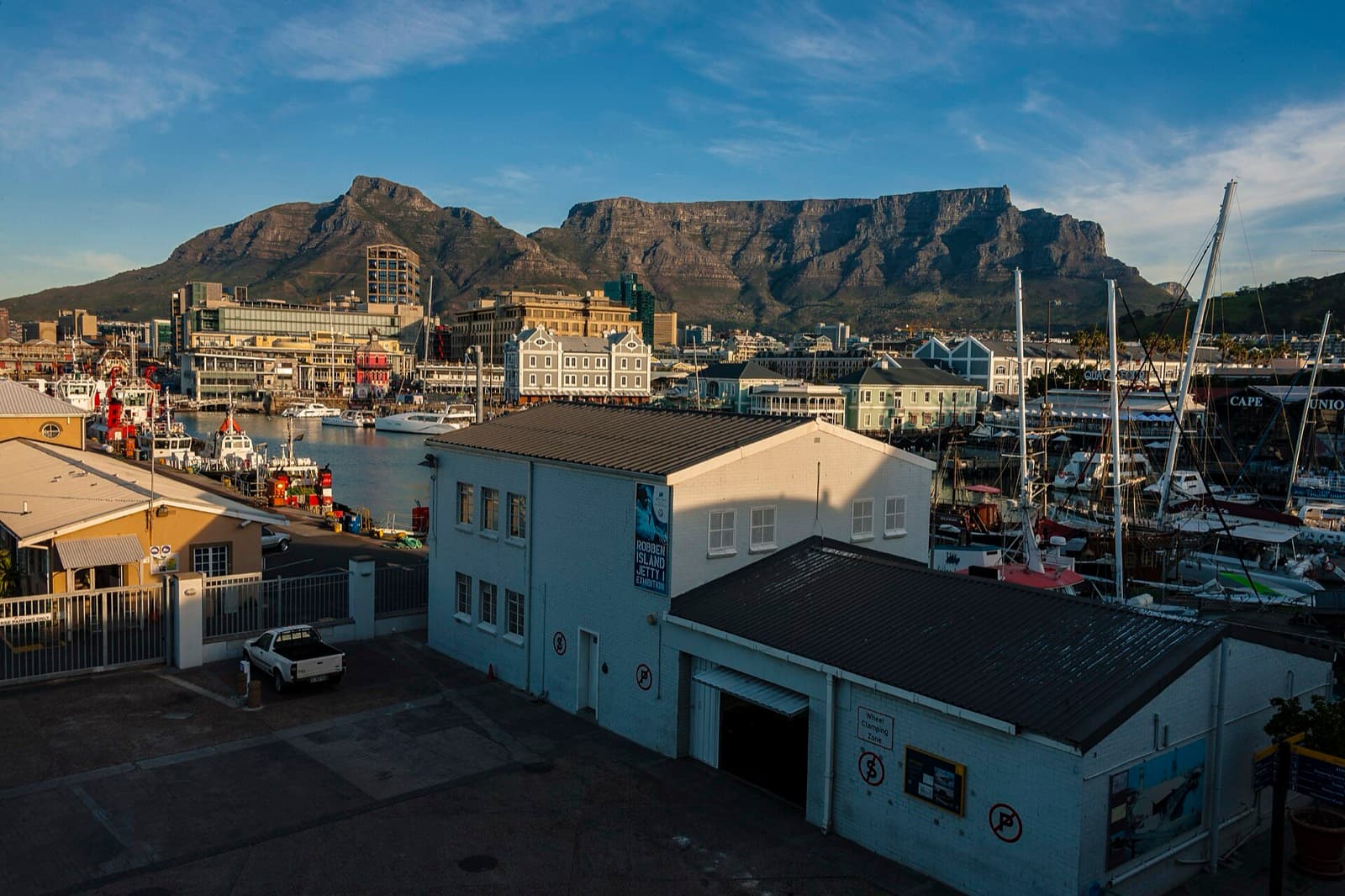
The V&A Waterfront reads as a shopping precinct, but around the Alfred Basin and the Robinson Dry Dock it is still a real, working Victorian harbour, and once you learn to read it that way the whole place changes. Somewhere around twenty-four million people come here each year, most of them for the restaurants, the boutiques, and the view. They walk past tugs, a dry dock, and basking seals without noticing that the polished precinct is laid over a labouring port that has never stopped operating. The single stop where that becomes impossible to miss is the working harbour around the swing bridge, and it is the argument the entire tour is built to make.
A harbour born from disaster
Cape Town did not want a great harbour so much as it was forced into one. In June 1858, severe winter storms wrecked over thirty vessels in Table Bay in a single stretch of bad weather. The losses were so heavy that Lloyd's of London refused to insure ships spending the winter here. A port that insurers will not cover is a port with no future, and so the city finally committed to building proper enclosed basins.
The first load of stone for the breakwater was tipped on the seventeenth of September, 1860, by Prince Alfred, the second son of Queen Victoria. The two basins that grew out of that work, built between 1860 and 1920, carry his name and his mother's: the Alfred Basin and the Victoria Basin. The initials on every sign and shopping bag in the precinct, V and A, are not a brand invented by developers. They are Victoria and Alfred, the queen and her sailor son, stamped on the water more than a century and a half ago.
The still-turning dry dock
Hear a stop from this walk
The Working Harbour and the Swing Bridge: The Tugs and Seals That Share the Quay
Stand near the swing bridge and look toward the Alfred Basin, and you are looking at the oldest part of the operation. The Robinson Dry Dock opened in 1882, named for Governor Sir Hercules Robinson, with its foundation stone laid by Prince Alfred himself. A dry dock is a basin that can be sealed and pumped empty so a ship can settle onto blocks and be worked on below the waterline. Cape Town Heritage describes the Robinson as the oldest dry dock of its kind still in operation anywhere in the world, and it is not preserved as a display. Vessels still come out of the water here to be scraped, welded, and repainted, exactly as they did in the eighteen eighties.
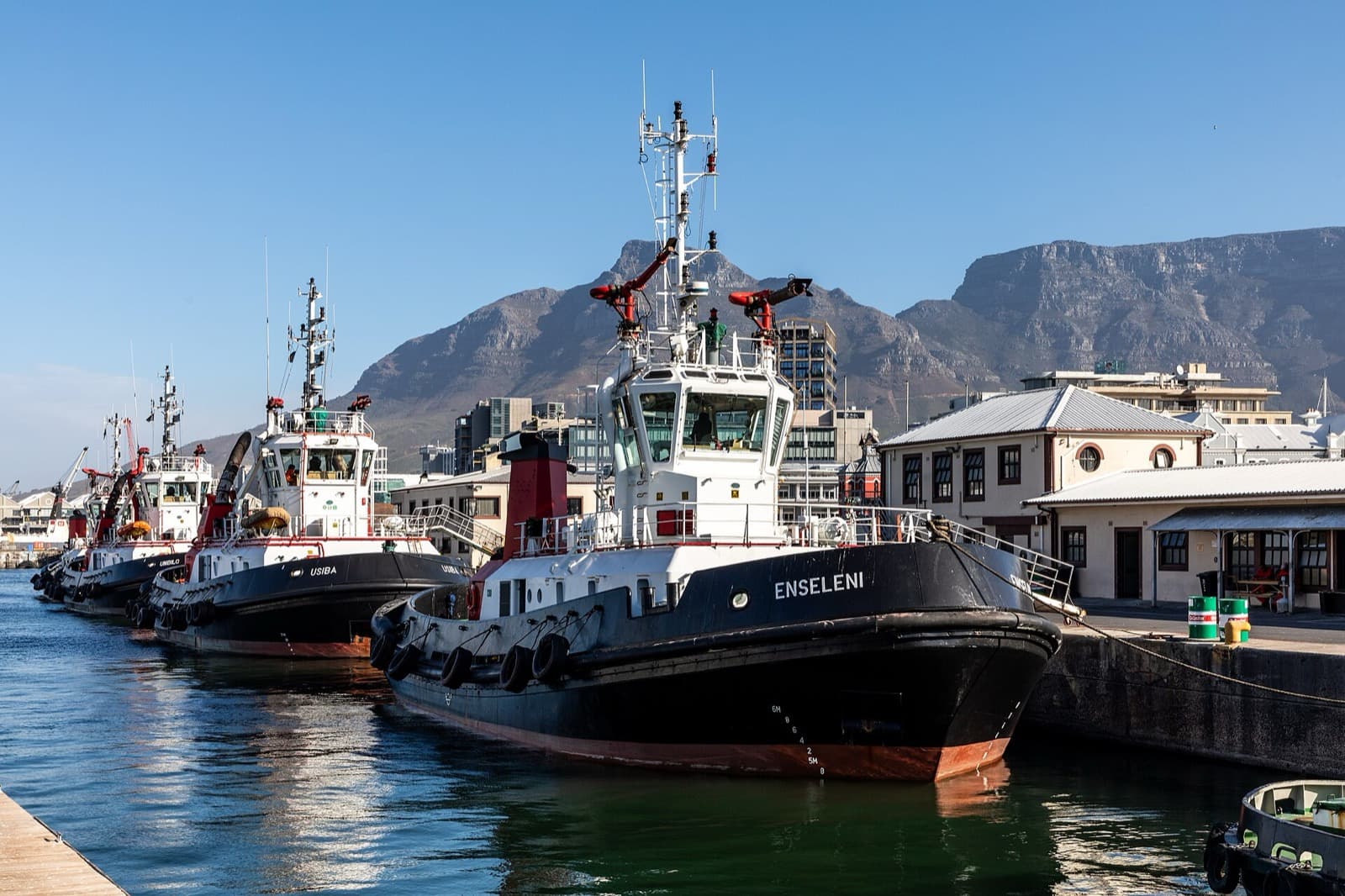
That word "still" is the heart of the tour. Wikipedia records the V&A as the oldest working harbour in the Southern Hemisphere, and it is not a museum piece dressed up for visitors. Fishing boats, tugs, and the dry dock all continue their work a few metres from people photographing shopfronts. The bascule swing bridge that crosses the cut is part of the machinery: it lifts and swings open to let boats through, and when a vessel needs the channel, you wait. Those few minutes at a stopped bridge are the port quietly asserting that it was here first.
The seals settle the argument
If any single detail proves the point, it is the seals. Cape fur seals often haul themselves out along the Alfred Basin quays, slick and heavy, grunting a few metres from the crowds. They are drawn by the fish and the working water, not by anyone's marketing plan, and they are a common though never guaranteed sight. There is no cleaner emblem of this waterfront: a wild, functioning port and a designed retail precinct sharing one edge of the bay, neither quite acknowledging the other. Watch a tug do its job while a seal dozes on the quay and a family eats gelato behind you, and you have understood the tour in a single frame.
Reading the harbour this way rewards slowness, which is exactly what a self-guided walk gives you. There is no group at your shoulder and no schedule pressing you along, so you can stand at the bridge as long as the port makes you wait and treat it as the show rather than the delay. If you want the wider context before you go, the overview of Cape Town walking tours sets out how this route sits among the others in the city.
What the harbour connects to
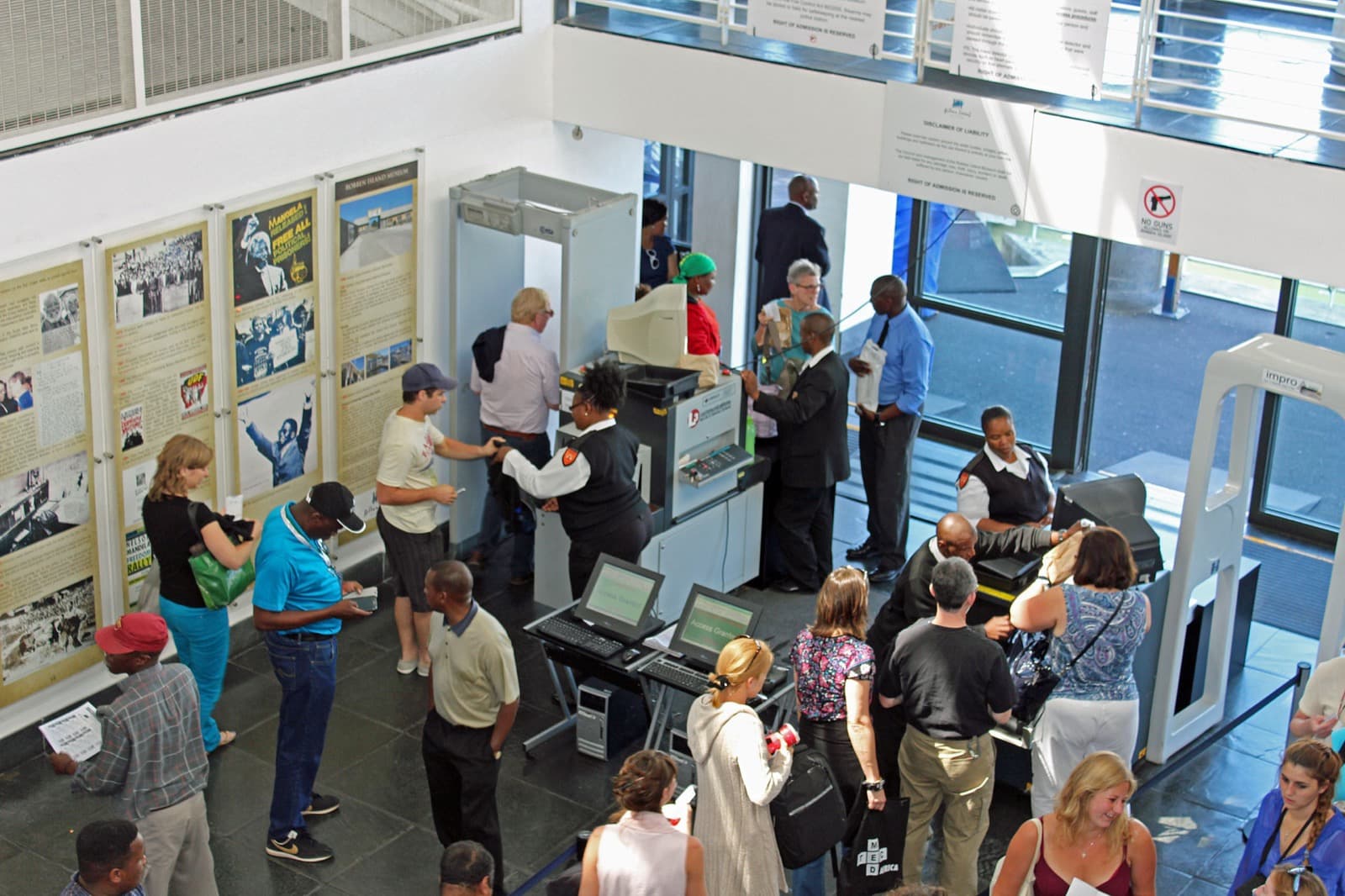
The working port is the spine, and every other stop on the route hangs off it. A short walk away stands the little red Clock Tower, built in 1882 as the Port Captain's Office, with a tidal gauge on its ground floor and a second-floor mirror room whose angled mirrors let the captain watch the whole harbour without turning his head. It was the eye of the port before the port had shops. Nearby, the Nelson Mandela Gateway is the sober quay where ferries leave for Robben Island, the prison where Mandela was held for eighteen of his twenty-seven years, inscribed by UNESCO as a World Heritage Site in 1999. Nobel Square gathers South Africa's four Nobel Peace laureates in bronze, their backs to the mountain.
Then there is the grain silo. Built between 1921 and 1924, it stood about fifty-seven metres tall and was once the tallest building in South Africa, a plain concrete tower of forty-two packed cylinders that stored the country's grain. Thomas Heatherwick and his studio carved a soaring atrium straight out of that solid mass, and in 2017 it reopened as Zeitz MOCAA, a major museum of contemporary African art. It is the perfect twin to the dry dock: the same instinct to keep the old industrial bones and give them new work rather than tear them down. The route ends where every Cape Town view resolves, with the harbour, the city bowl, and the flat 1,085-metre wall of Table Mountain lined up in a single frame, Robben Island low and grey out in the bay.
Six stops, roughly two kilometres, about ninety minutes at an easy pace. The harbour holds them all together. Start planning from the Cape Town page, then walk it slowly, keep the water on one side and the mountain behind the city, and let the working port do the talking.
Sources
- V&A Waterfront (Wikipedia): the twenty-four-million annual visitors, the 1858 storms and Lloyd's refusal, Prince Alfred and the 1860 breakwater, the Victoria and Alfred Basins, and the claim to the oldest working harbour in the Southern Hemisphere.
- Robinson Dry Dock (Cape Town Heritage): the 1882 opening, Prince Alfred's foundation stone, and the dock's standing as the oldest of its kind still operating.
- Zeitz Museum of Contemporary Art Africa (Wikipedia): the 1921 to 1924 grain silo, its forty-two concrete cylinders, Heatherwick Studio's carved atrium, and the 2017 opening.
- Table Mountain (Table Mountain Cable Car and Britannica): the mountain's height of about 1,085 metres and its flat-topped form framing the harbour.
- Nelson Mandela Gateway to Robben Island (V&A Waterfront): the ferry terminal and the crossing to the World Heritage prison island where Mandela served eighteen of his twenty-seven years.
Ready to experience it?
V&A Waterfront: The Harbour That Still Works
90 min · 1.7 km · easy
More from Cape Town
Explore more at your own pace.
Cape Town in Three Layers: The Garden, the Painted Hill, and the Harbour That Still Works
Auwal Mosque: The Door That Reframes Bo-Kaap's Painted Lanes
The Company's Garden: The Vegetable Patch Cape Town Grew Out Of
Chiappini and Rose Streets: The Steep, Coloured Heart of the Bo-Kaap
Nelson Mandela Gateway: The Cape Town Quay Where Boats Leave for the Prison Island