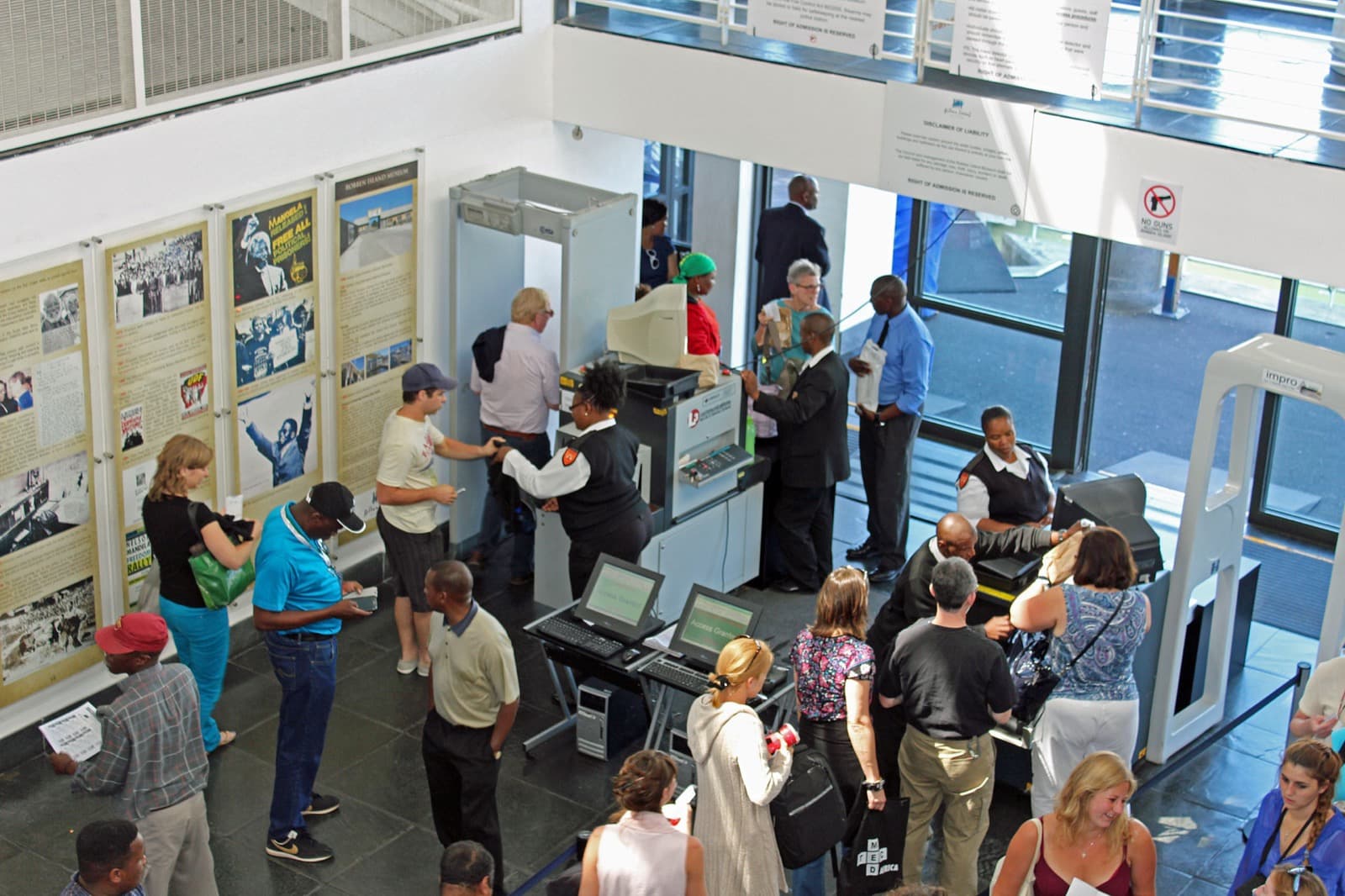
Stand at the Nelson Mandela Gateway on Cape Town's V&A Waterfront and you are standing at a threshold, not a museum. This triple-storey glass terminal is where the ferries leave for Robben Island, the prison across Table Bay where Nelson Mandela was held for eighteen of his more than twenty-seven years behind bars. The building matters less for what it contains than for what it faces and what it makes possible: a crossing of about thirty minutes to the place that tested, and did not break, the men who would later govern the country. Understanding this Gateway means understanding that the polished shopping precinct around it opens, at exactly this spot, onto the hardest chapter of South Africa's twentieth century.
A terminal built to carry weight
The Gateway sits a few steps from the little red Clock Tower, and the shift in tone is deliberate. Where the rest of the Cape Town waterfront is given over to restaurants, shops, and harbour views, this glass building is quiet by design. Inside are exhibition areas, an auditorium, and a museum shop. Outside, at the quay, the boats load and depart daily for the island that lies low and grey on the water beyond.
What gives the terminal its meaning is who opened it. Nelson Mandela himself officially opened the Nelson Mandela Gateway to Robben Island on the first of December, two thousand and one. Read that sequence carefully. A man who had been shipped to Robben Island as a prisoner returned, decades later and as a free citizen of a democratic country, to cut the ribbon on the building from which visitors would now travel to see his former cell. The Gateway is not simply named after him. He inaugurated it. That single fact folds the whole arc of the anti-apartheid struggle into one modest ceremony on a Cape Town quay.
What the crossing leads to
Hear a stop from this walk
The Working Harbour and the Swing Bridge: The Tugs and Seals That Share the Quay
The island itself was inscribed as a UNESCO World Heritage Site in nineteen ninety-nine, two years before this terminal opened. UNESCO frames Robben Island as bearing witness to the triumph of the human spirit, of freedom and democracy over oppression. That framing is worth holding onto as you stand at the departure quay, because it explains why a ferry terminal has been treated as a place of memory rather than mere transport.
Mandela's own timeline is inseparable from the island. The Rivonia Trial ended on the twelfth of June, nineteen sixty-four, with life sentences, and Mandela arrived on Robben Island the very next day. He remained there from nineteen sixty-four to nineteen eighty-two before being moved to the mainland, and he was finally released in February nineteen ninety. Eighteen years of a single life, spent within sight of a city that could not reach him, on an island that visitors now cross to in about half an hour.
He was not the only prisoner whose name the island carries. Robert Sobukwe, the founding leader of the Pan Africanist Congress, was also held there. The Robben Island Museum, established in nineteen ninety-seven, has been guided in part by former political prisoners who returned to tell what happened, which is a rare and unusual thing for any historic site: the people who explain it are often the people who survived it.
The one thing to understand standing here
If you take a single idea away from the Gateway, let it be this: you do not have to board the ferry to grasp the meaning of the place. The crossing to Robben Island runs on a fixed timetable, with a group, and it is ticketed separately in rand. It is a powerful half-day if you have the time. But the Gateway itself asks something quieter of you. It asks you to stand at the departure quay, look out toward the low grey line of the island in the bay, and simply hold the thought of what happened there.
This is where a self-guided walk earns its keep. On a scheduled group tour you would be moved along on someone else's clock, hustled toward the next photo stop or the next departure. Here, at your own pace, you can linger at the quay for as long as the moment holds you, or move straight on if you would rather carry the weight lightly. There is no guide steering you and no one waiting on you. The Gateway rewards the visitor who is willing to stop, and it does not punish the one who is not.
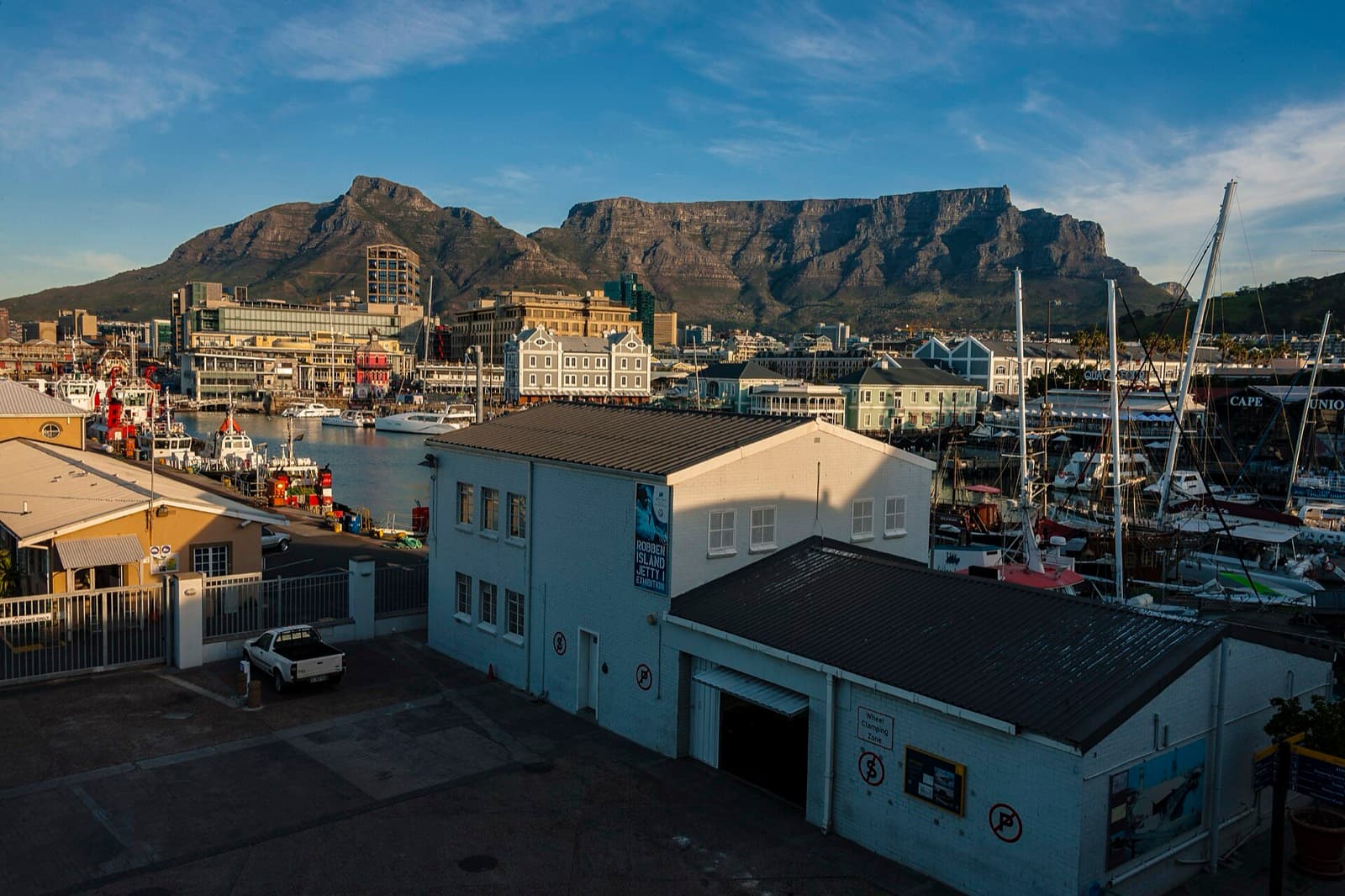
Later on the same walk, at a waterfront viewpoint, Robben Island reappears in the classic Cape Town composition: the working harbour in the foreground, the city bowl behind, and the long flat wall of Table Mountain above it all, with the island low and grey out in Table Bay. It is a gentler encounter with the same place. Seeing it twice, once up close at the departure quay and once at a distance framed by the mountain, is part of how this stretch of waterfront teaches. The island is never far from the city, and the city never quite escapes the island.
Walk it yourself
The Nelson Mandela Gateway is the second stop on the V&A Waterfront self-guided audio walk, a route of six stops and roughly two kilometres that takes about ninety minutes at an easy pace. The walk reads the waterfront as a working Victorian harbour hiding beneath a shopping precinct, and the Gateway is its moral centre: the point where the pretty surface opens onto real history. Around it, the walk gathers the little red Clock Tower, Nobel Square with its four bronze Peace Prize laureates, the still-turning Robinson Dry Dock where seals share the water with tugs, the grain silo reborn as the Zeitz MOCAA art museum, and the Table Mountain view that ties the whole scene together.
Because the tour is self-guided, the Gateway gets exactly the time you decide to give it. Stand at the quay in your own quiet. Read the exhibition inside if you wish. Then walk on when you are ready, with the island still visible over your shoulder. For more routes through the city, see our guide to Cape Town walking tours, and when you are ready, open the V&A Waterfront walk and begin at the Clock Tower before crossing to the Gateway.
Sources
- V&A Waterfront official listing, Nelson Mandela Gateway to Robben Island. Confirms the terminal's function, facilities, and role as the ferry departure point.
- Nelson Mandela Foundation Archive, record of the Gateway's official opening. Documents that Mandela opened the building on the first of December, two thousand and one.
- UNESCO World Heritage List, Robben Island. Source for the nineteen ninety-nine inscription and the "triumph of the human spirit" framing.
- Robben Island Museum. Background on the museum founded in nineteen ninety-seven and the role of former political prisoners as guides.
Ready to experience it?
V&A Waterfront: The Harbour That Still Works
90 min · 1.7 km · easy
More from Cape Town
Explore more at your own pace.
Cape Town Travel Guide: Days, Transport, Seasons, Safety, and Budget
Cape Town in Three Layers: The Garden, the Painted Hill, and the Harbour That Still Works
Auwal Mosque: The Door That Reframes Bo-Kaap's Painted Lanes
The Company's Garden: The Vegetable Patch Cape Town Grew Out Of
Chiappini and Rose Streets: The Steep, Coloured Heart of the Bo-Kaap