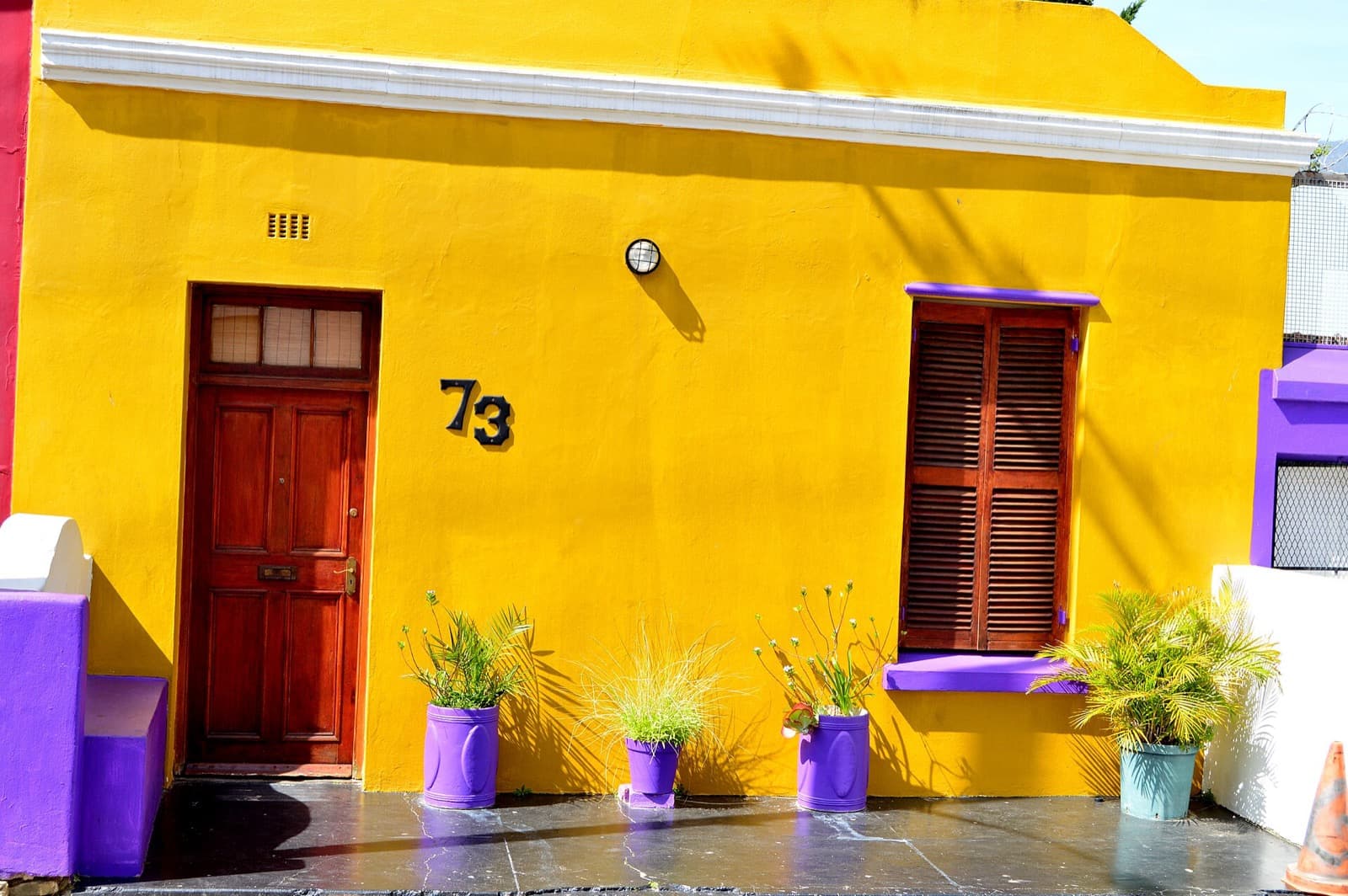
The lanes around Chiappini and Rose streets are the steep working heart of Cape Town's Bo-Kaap, and standing in them you understand that the painted houses sit on top of something. This is where the quarter climbs hardest and colours hardest, cobalt beside pink beside lime, and where the Cape Malay culinary and craft tradition still lives in the buildings, not in a museum case. The colour is what pulls the cameras up the hill. The reason to stay is everything the colour rests on: a community of tailors, cobblers, cooks, and craftspeople that held its ground when other Cape Town neighbourhoods were scattered.
What you are actually standing in
The Bo-Kaap sits on the lower slopes of Signal Hill, above the old town of Cape Town. The name means "above the Cape," the quarter above the old town. The people who made it are the Cape Malay, or Cape Muslim, community, descended in large part from enslaved and exiled people brought here by the Dutch East India Company from Southeast Asia, India, and East Africa. Chiappini and Rose are two of the streets that carry that history uphill, and they are among the streets protected under South African heritage law. Part of the Bo-Kaap, including Wale, Church, Shortmarket, Rose, and Chiappini streets, was declared a National Monument in nineteen sixty-six, which is why the facades you are looking at survive at all.
Take the climb slowly. These upper lanes are genuinely steep and uneven, and there is no reward for rushing them. The point of this stop, unlike the mosque or the cemetery you will pass elsewhere on the walk, is not a single grand object. It is the texture of an ordinary place that stayed ordinary against long odds. Let the quarter be a living neighbourhood rather than a backdrop, and you will notice how much of it is simply people at home.
The kitchen you can smell before you see
Hear a stop from this walk
The Noon Gun and the City Below
Historically these streets were home to tailors, cobblers, and craftspeople, and they remain the beating centre of the Cape Malay culinary tradition. That tradition is a fusion of Southeast Asian, African, and Dutch cooking, carried here across generations, with the spice trade at its centre. On a still afternoon you may catch it on the air before you see any sign of it: warm, sweet, layered.
This is the home of the koesister, a spiced fried dumpling rolled in coconut. It is worth being precise about this, because it trips up visitors. The Cape Malay koesister is a different thing from the plain, syrup-soaked koeksister you find elsewhere in South Africa. Same rough name, different dish, different heritage. This is also the home of bredie, a slow-cooked stew, and of bobotie, spiced minced meat under a soft baked egg topping. These are not tourist inventions. They are what a Cape Malay Sunday can taste like.
You will notice this article points you to no single door, no one shop or stall to queue at. That is deliberate, and it matches how the tour treats the place. The tradition belongs to the whole quarter, not to one operator with the loudest sign. Follow the scent and the sound of the lanes and let them decide for you. If you want to buy something, a small bakery or a spice seller will find you long before you find it.
Why this is a story of survival, not decoration
Here is the part that reframes the colour. Through the apartheid years, the Cape Malay community held onto its cultural identity in a way that few Cape Town neighbourhoods managed. Across the city, apartheid's forced removals broke communities apart and scattered them to distant townships. The most infamous case is District Six, cleared and bulldozed within living memory. The Bo-Kaap, its mosque, its cooking, its craft, its language, stayed largely intact and rooted to this hill.
So when you look at the painted walls, understand that they are the visible surface of something far older and far tougher underneath. This is a place that was not moved and did not forget itself. The brightness is real and the community treasures it, but it is worth knowing that the record suggests the bright-colour custom took hold much later than the popular tale claims, in the late twentieth century, rather than as an emancipation celebration. That does not make the colour less meaningful. It makes it a living tradition rather than a frozen legend, which is a better and more durable thing to be.
That distinction matters most right here, in the steep lanes, because this is where visitors are most tempted to treat the neighbourhood as a set. It is not one. People live behind these doors. Ask before photographing anyone or the inside of a home. A little courtesy is the price of admission to a place that let you walk through it at all.
Standing here, understand one thing
If you take a single idea away from the corner of Chiappini and Rose, let it be this: the colour is the youngest thing on this street. Older than the paint is the food, older than the food is the craft, and older than all of it is a community that was brought to this hill in chains and made it home. The steepness you are climbing is the same steepness that, in a strange way, protected the place. It sat just out of the old town's reach, high enough to keep to itself, and it never let go.
This stop sits in the middle of a longer climb. Below you are the lower painted lanes and the Auwal Mosque, the first mosque established in South Africa. Above you wait the Tana Baru, the hilltop burial ground of Cape Islam, and higher still the Noon Gun that has told this city the time since eighteen oh six. Chiappini and Rose are the hinge between the neighbourhood as spectacle and the neighbourhood as sacred, working place. Walk it slowly, breathe the spice, and carry both.
To walk the full route at your own pace, with audio at every stop and no group and no schedule, follow the Bo-Kaap Cape Malay tour on the Roamer app. It is one of several Cape Town walking tours that climb through the city's oldest quarters, and you can browse the rest for Cape Town before you go.
Sources
- Cape Town Tourism, "The Traveller's Guide to Bo-Kaap." Background on the quarter's streets, food, and craft traditions.
- The Heritage Portal, "History and Style of the Bo-Kaap." Notes on the National Monument declaration and the built fabric of streets including Chiappini and Rose.
- Wikipedia, "Bo-Kaap." Overview of the quarter's origins, the Cape Malay community, and the painted-house tradition.
- Roamer, "Bo-Kaap: The Colour of the Cape Malay Quarter" self-guided tour transcript. Primary source for the culinary tradition, craft history, and apartheid-era survival of the quarter.
Ready to experience it?
Bo-Kaap: The Colour of the Cape Malay Quarter
90 min · 2.3 km · moderate
More from Cape Town
Explore more at your own pace.
Cape Town Travel Guide: Days, Transport, Seasons, Safety, and Budget
Cape Town in Three Layers: The Garden, the Painted Hill, and the Harbour That Still Works
Auwal Mosque: The Door That Reframes Bo-Kaap's Painted Lanes
The Company's Garden: The Vegetable Patch Cape Town Grew Out Of
Nelson Mandela Gateway: The Cape Town Quay Where Boats Leave for the Prison Island