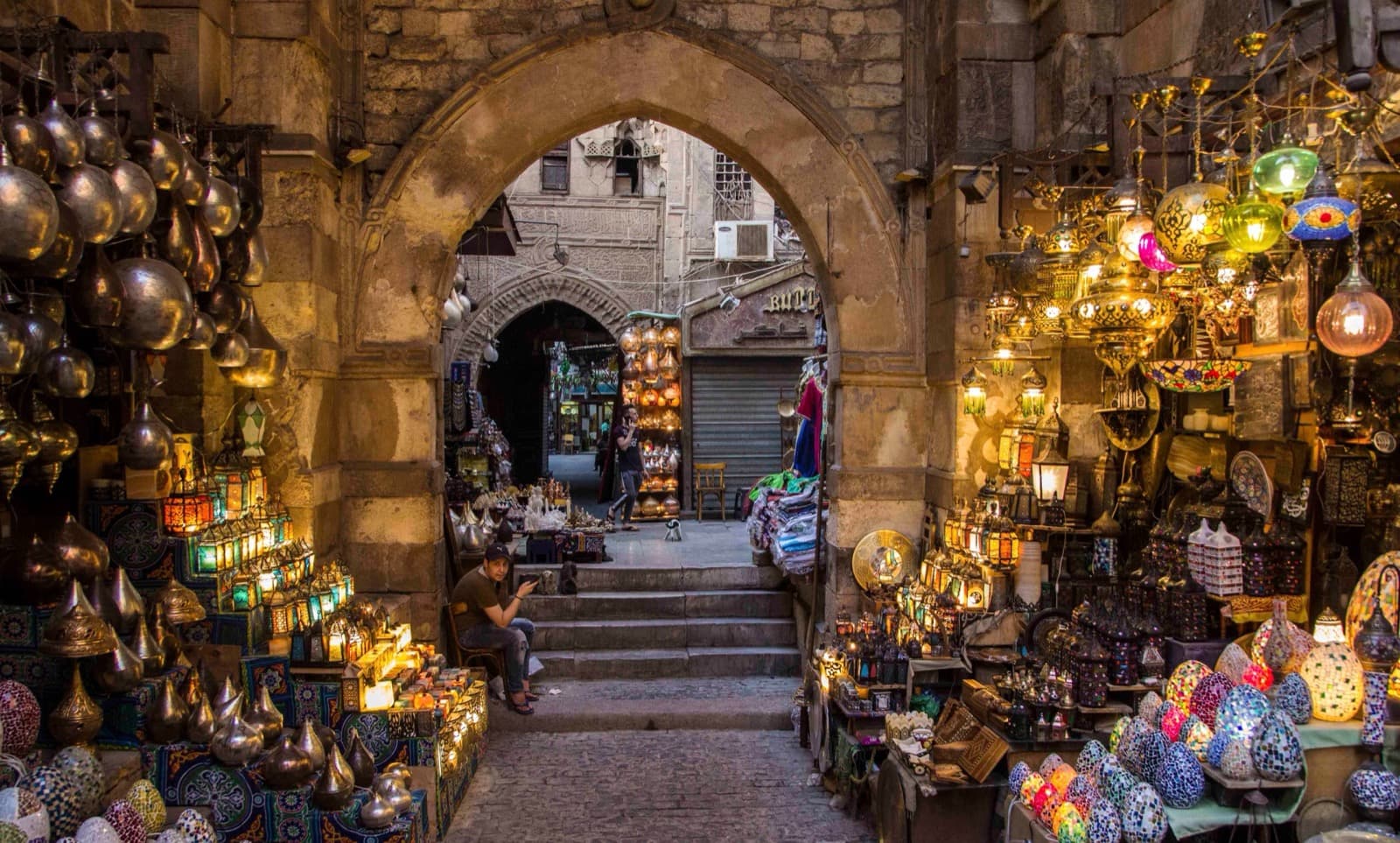
Khan el-Khalili began not as a market at all but as a merchants' inn, and the fastest way to understand the great bazaar of Islamic Cairo is to hold two facts side by side: it was built on the tombs of the dynasty that founded the city, and it has never stopped trading since. The covered lanes that open off al-Muizz Street, loud with hammering copper and the murmur of bargaining, sit on ground that once held the mausoleum of the Fatimid caliphs. A Mamluk official cleared that ground in the fourteenth century to raise a caravanserai, and the warren of goldsmiths, coppersmiths, and spice sellers grew outward from it. Standing in front of it, the one thing worth understanding is that this is a working market layered directly on top of the buried medieval city, not a reconstruction of one.
An inn on a royal graveyard
A khan is a caravanserai: a walled inn built around a courtyard, where traveling merchants stabled their animals below and slept and stored goods above. That is exactly what stood here first. The structure was built in the years thirteen eighty-two to thirteen eighty-nine by Jaharkas al-Khalili, who held the title Master of the Stables, the amir akhur, under the Mamluk sultan Barquq. His name is the one that stuck to the whole district.
The site he chose was not empty. It held the Turbat az-Za'faran, the Saffron Tomb, the burial ground of the Fatimid royal family who had founded Cairo in the year nine hundred and sixty-nine. The Fatimids had been overthrown two centuries earlier by Saladin and his Ayyubid successors, and the Mamluks who followed felt no obligation to preserve the graves of a dynasty they regarded as heretical. Al-Khalili demolished the mausoleum to make room for his commercial building. According to the record, he disposed of the bones of the Fatimid royal family by throwing them onto the rubbish hills east of the city. It is a brutal detail, and it is also the clearest possible statement of how medieval Cairo treated its own past: as ground to be reused. The bazaar that draws visitors today is quite literally built over the erased tombs of the dynasty that built the city.
From caravanserai to a center of world trade
Hear a stop from this walk
Bab Zuweila: The Southern Gate
The inn did not stay an inn. From a place where caravans unloaded, the district thickened into a dense commercial quarter, and by the late fifteenth century the area around Khan el-Khalili had become the major center of foreign trade in the region, dealing in precious stones and other high-value goods. Merchants clustered here because the model worked: secure storage, a fixed address, and a steady flow of buyers along the city's main street.
The next great rebuilder was one of the last Mamluk sultans. Around the year fifteen eleven, Qansuh al-Ghuri demolished al-Khalili's original khan and rebuilt it, and he reworked the adjacent quarter into a planned commercial district, imposing a more regular grid on the surrounding streets and adding a souk with monumental stone gates. Al-Ghuri's own complex still faces al-Muizz Street a short walk to the south, which lets you read the two men's work in a single afternoon: the sultan's striped funerary monument at one end of the quarter, the market he reshaped at the other. That continuity of rebuilding, one ruler tearing down and improving on the last, is why the bazaar has no single founding date so much as a chain of them.
What you are actually looking at
Wander a little way in and you find the quarter still organized the medieval way, by craft rather than by chance. Whole lanes are given over to one trade: goldsmiths and silversmiths in one run of shops, coppersmiths beating trays and lamps by hand in another, then sellers of spices, glass, and inlaid boxes. This is the detail that separates Khan el-Khalili from a tourist stage set. The goldsmiths' souk still serves ordinary Cairenes buying wedding jewelry and gold as savings, not just visitors hunting souvenirs. A working market is one where locals do their real business, and this one passes that test.
The coffee-house tradition runs just as deep. The old house known as El Fishawy, traditionally dated to about seventeen seventy-three, has become the emblem of that culture: generations of Cairenes drinking mint tea and talking beneath its long mirrors, in an alley barely wide enough to pass. You owe no one a purchase for being here. Browsing is free and expected, and a polite, unhurried no is all that a persistent vendor requires. That freedom to look, to watch a coppersmith work for ten minutes and then drift back out with no one waiting, is the entire point of visiting on your own clock rather than on a group's schedule.
The one caution worth carrying is ordinary big-city awareness. The lanes get crowded, so keep a bag zipped and in front of you, and treat the crush of people the way you would any dense market anywhere.
Reading the bazaar in sequence
Khan el-Khalili makes far more sense as one stop in a longer line than as a destination on its own. It is the fifth of eight stops on the self-guided islamic-cairo-al-muizz audio walk, which runs the full medieval spine of the city from the northern gate of Bab al-Futuh down to the southern gate of Bab Zuweila. Arriving at the bazaar after the Fatimid mosque of al-Hakim and the Mamluk Qalawun complex gives the market its proper weight: you have already met the dynasties whose tombs it displaced and whose sultans rebuilt it, so the covered lanes read as the living tissue holding the monuments together rather than a shopping detour. From here the walk continues to the thousand-year mosque and university of al-Azhar and the al-Ghuri complex, closing the loop on the sultan who reshaped these very streets.
The best hours are morning, from about nine to eleven, when the coppersmiths' lanes are opening but not yet packed, or late afternoon into the golden hour, though the bazaar grows busy then. If you want to see how one covered market fits into a thousand years of continuous city, the whole route is laid out at Cairo walking tours, and the city itself is worth exploring further at Cairo.
Sources
- Khan el-Khalili, Wikipedia: origin as the amir akhur Jaharkas al-Khalili's khan built 1382 to 1389 on the demolished Fatimid Saffron Tomb (Turbat az-Za'faran), the disposal of the royal family's bones onto the rubbish hills east of the city, the late-fifteenth-century rise as a center of foreign trade, and al-Ghuri's rebuild in 1511 with a regridded district and monumental stone gates.
- UNESCO World Heritage Centre, Historic Cairo (List entry 89): the 1979 inscription describing Cairo as one of the world's oldest Islamic cities, founded in the tenth century and reaching its golden age in the fourteenth century.
- Roamer tour transcript, "Islamic Cairo: The Medieval City Along al-Muizz Street" (fact-audited): the working goldsmiths' souk, the craft-lane organization, and the El Fishawy coffee house tradition.
- El Fishawy Café, Wikipedia: the Khan el-Khalili coffee house and its place in the bazaar's social life; its opening is variously placed in the late eighteenth century, with a traditional date of about 1773 and a documented date of 1797.
Ready to experience it?
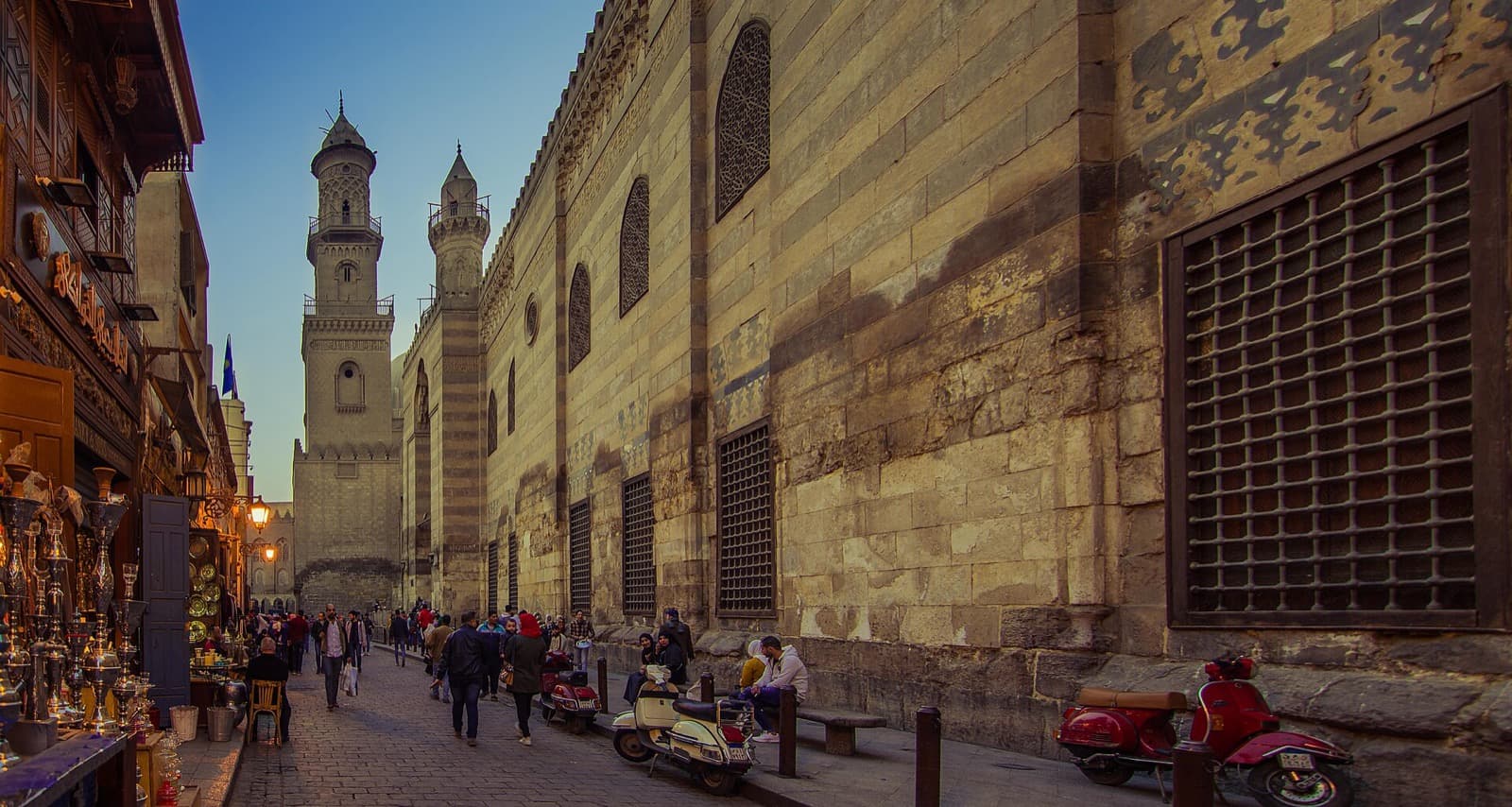
Islamic Cairo: The Medieval City Along al-Muizz Street
150 min · 2.5 km · easy
More from Cairo
Explore more at your own pace.
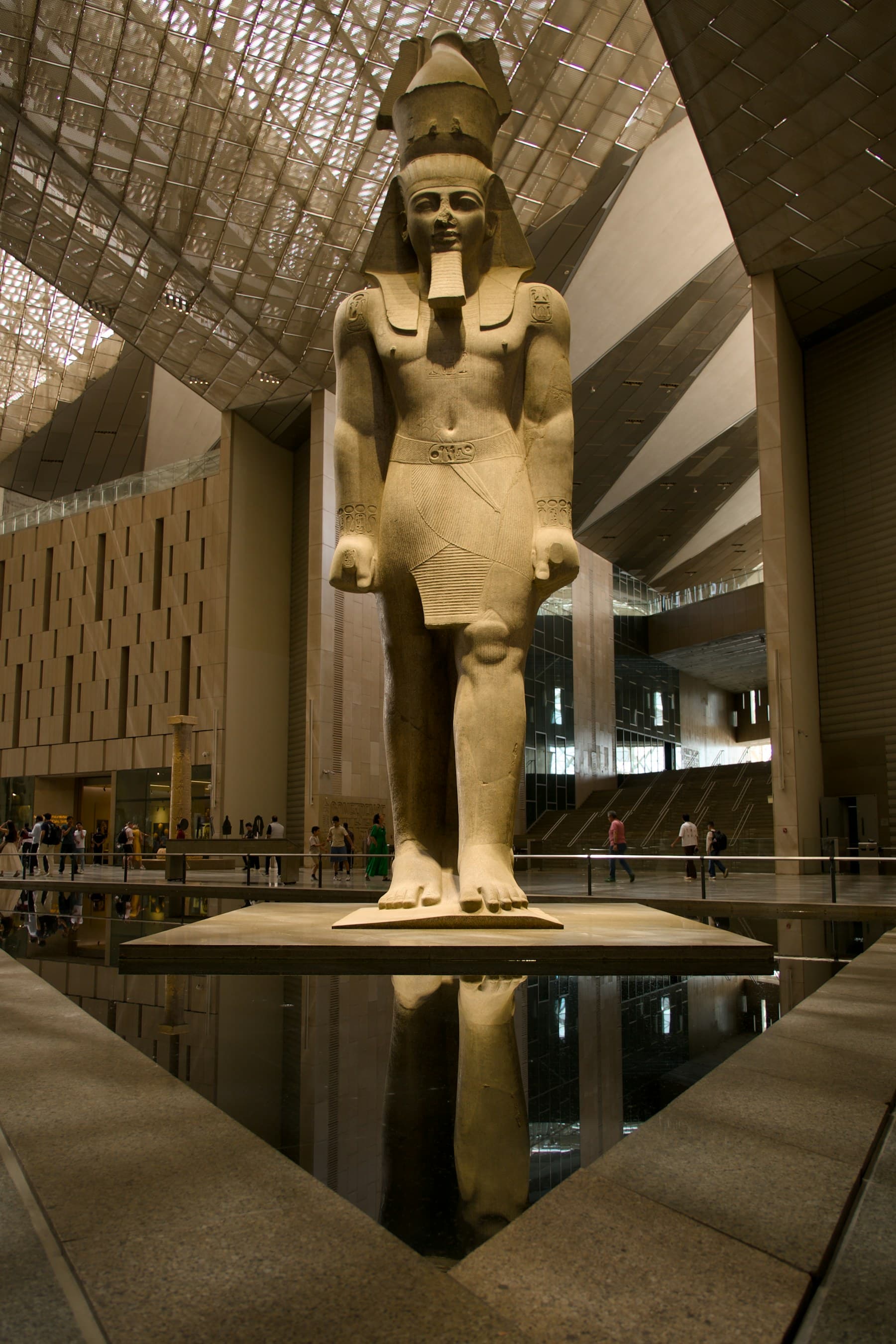
Grand Egyptian Museum: What to See, From the Grand Hall to Tutankhamun
The Colossal Ramesses II at the Grand Egyptian Museum: From Memphis to Ramses Square to Giza
The Grand Staircase at the Grand Egyptian Museum: Six Storeys of Kings
Tutankhamun's Gold Mask at the Grand Egyptian Museum: What to Look For
Al-Muizz Street: Reading a Thousand Years of Cairo on One Pavement