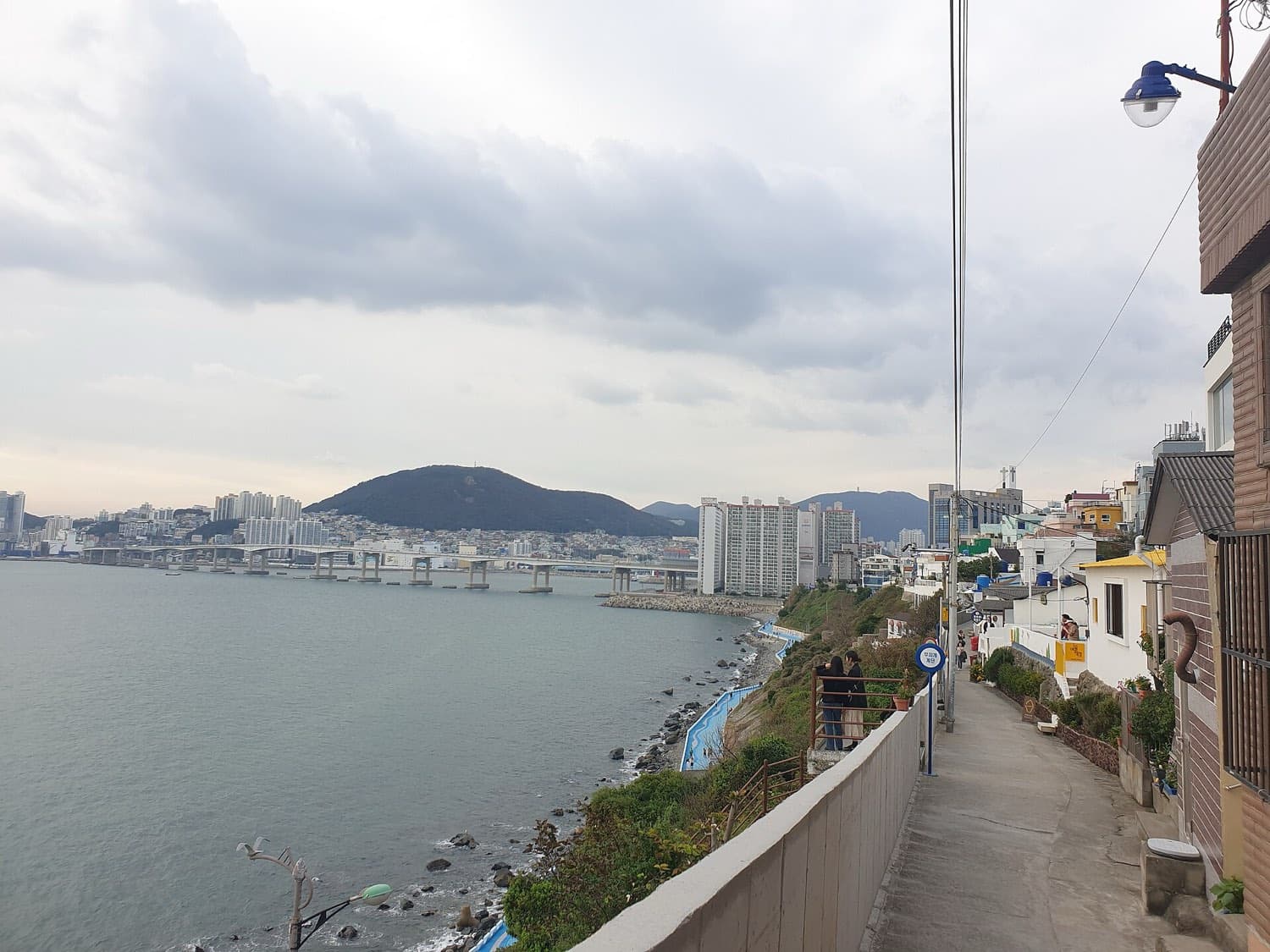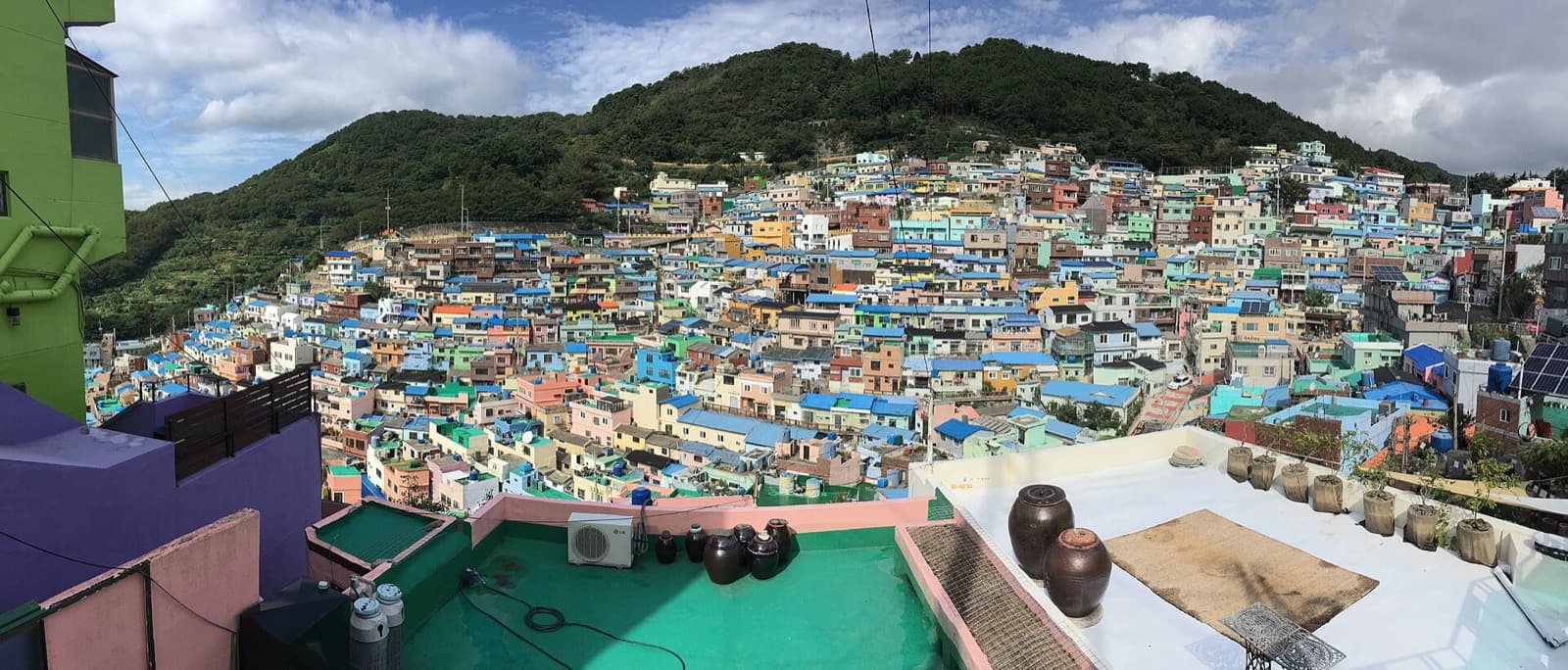
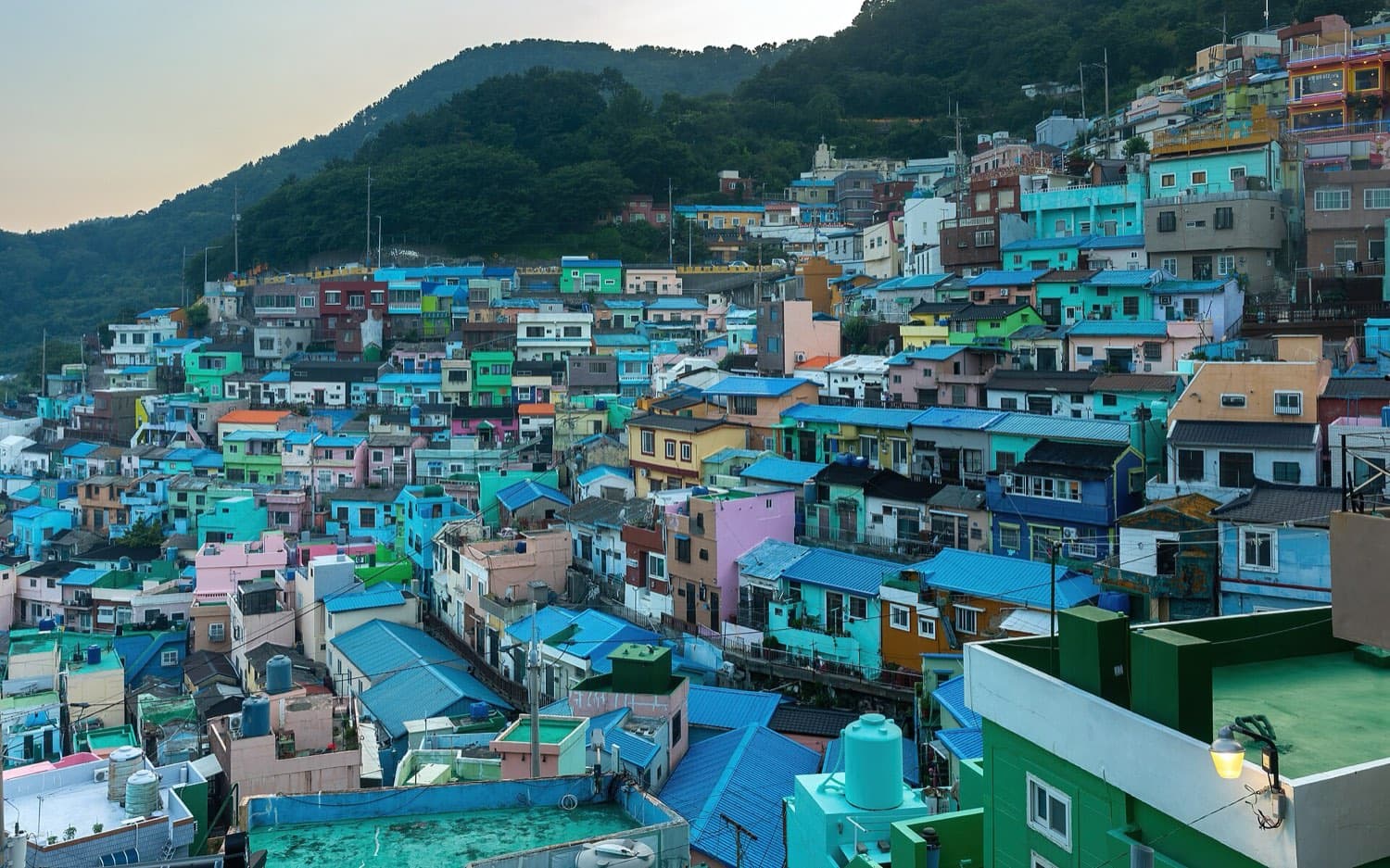
Stand at the Gamcheon Panorama Viewpoint and you frame a hillside of pastel houses stacked in tiers above a working harbour. That view is the whole reason most people come to Gamcheon Culture Village, on the western edge of Busan in South Korea. What the viewpoint does not announce is that this painted slope was born as a Korean War refugee settlement, that real families still live behind almost every wall you can see, and that the color sits on top of hardship rather than replacing it. Learn to read the panorama two ways at once, and this single vantage becomes the most honest introduction to the village you will get all day.
What you are actually looking at
The Korean name is Gamcheon munhwa maeul, where maeul simply means village. It sits in Saha District, in western Busan, and the houses climb the hillside in tiers, each painted a different soft shade: blue, pink, mint, cream. Between them run hundreds of narrow stepped alleys, so the streets here are as often staircases as they are roads. The houses all face downhill toward Gamcheon harbour, which means the slope works like a great open amphitheatre turned toward the sea.
From the viewpoint you can read the shape of the place before you walk into it. You will also hear it sold to you. Guides and signs call Gamcheon the Santorini of Korea or the Machu Picchu of Busan. Those are marketing nicknames, not history, and the truth underneath them is more interesting than either comparison. What you are looking at is a working refugee neighbourhood that later became art. According to the village's own records, around 1.4 million visitors came in a single recent year, and yet people still live in nearly every one of these painted houses. That gap, between a crowd of over a million and a quiet residential slope, is the tension you carry the whole walk.
The one thing to understand from here
Hear a stop from this walk
Two Thousand Nine: The Art That Saved the Village
If you take a single idea away from the viewpoint, make it this: the pastel colors came last. The tiered form came first, and it came out of poverty and belief.
During the Korean War, from 1950 to 1953, Busan became the temporary capital of the Republic of Korea, sheltering the government for a combined total of 1,023 days while the peninsula was at war. The city's population roughly tripled as refugees poured in, and they built dense shanty neighbourhoods up the hillsides. This slope was one of them. Then, in 1955, during the hard years of recovery, around 800 families settled here and grew the community of the Taegeukdo, an ascetic Korean religious movement descended from Jeungsanism. It was the Taegeukdo who gave Gamcheon its planned, orderly, terraced layout, which is what sets it apart from the scattered refugee villages nearby.
Look closely from the viewpoint at how the houses are stacked, and you can see the logic. They were arranged in terraces so that no single home fully blocks the sunlight or the downhill view of the house behind it. That is a remarkable rule for a poor, crowded hill, and it came from two places at once. It reflects a Taegeukdo teaching about letting others prosper, a communal ethic written into brick and stairs. It was also simply practical, a way to fit many families onto one steep slope so that each still caught a little light and a little of the sea below. The color you photograph today was laid over this older grammar of shared light. The shape is the meaning. The paint is decoration on top of it.
The color arrived in 2009, and no one was evicted
By the early 2000s, Gamcheon was emptying out. Its population was thinning and houses were falling vacant. Then, in 2009, the Ministry of Culture, Sports and Tourism, together with the Saha district office, ran a public-art project to revive the fading village, remembered under names like Dreaming of Machu Picchu in Busan. Murals went up through the lanes, and abandoned houses were remodelled into small galleries and studios.
Here is the part that matters most, and the reason the panorama can hold beauty and hardship without one erasing the other: the artists and the residents worked together, and the transformation happened without mass eviction. People were not pushed out to make room for the pretty village that tourists came to see. They stayed in their homes, and the art was layered around and among them. That is genuinely rare. Regeneration projects that turn a struggling neighbourhood into a photogenic destination usually price out or clear out the people who made it. Gamcheon chose its own people. When you frame the rooftops from the viewpoint, you are looking at a rescue that kept its residents in place.
How to stand here
The viewpoint sits near the village entrance on Gamnae 2-ro, and it is free, like the village itself. Because it is a public vantage rather than someone's doorway, it is exactly where your camera belongs. Keep the lens on the rooftops and the hillside. Do not point it down residential lanes or into windows and doorways. The alleys below are people's front paths, their stairs home, their route to carry groceries up the hill. A low voice and a bit of patience are the whole etiquette.
Give the panorama real time before you move. Let your eye follow one painted lane up the slope, then another, then find the line where the houses stop and the harbour begins. Everything the walk will show you in detail is already arranged below you here: the refugee slope, the shared-light terraces, the color added decades later, the working port the whole village faces. The viewpoint is the thesis. The rest of the walk is the argument.
From here, the natural move is to drop into the village and follow the story downhill toward the sea, stop by stop. The full route, the Gamcheon Culture Village self-guided audio walk, threads seven stops across roughly two kilometres, from this panorama through the Taegeukdo origins, the alley maze, the Little Prince and the Fox, the Haneul Maru sky deck, the 2009 art lanes, and finally down to Gamcheon harbour itself. If you are planning a wider trip, the Busan walking tours hub and the Busan city page will help you line up the rest of the city around it.
Read the color, then read what it sits on. Both are true, and the viewpoint is where you learn to hold both at once.
Sources
- Gamcheon Culture Village, Wikipedia: origin as a refugee and Taegeukdo settlement, the 2009 art project, terraced shared-light layout, and visitor figures.
- Sites of the Busan Wartime Capital, UNESCO Tentative List: Busan's role as the Republic of Korea's temporary capital and the wartime population surge.
- Gamcheon Culture Village Project, OBS Agenda21 Culture case study: the public-art regeneration model and its resident-first, no-eviction approach.
- Roamer, The Painted Hillside self-guided audio tour (Gamcheon Culture Village): fact-audited stop narration and route used as the primary grounding for this article.
Ready to experience it?
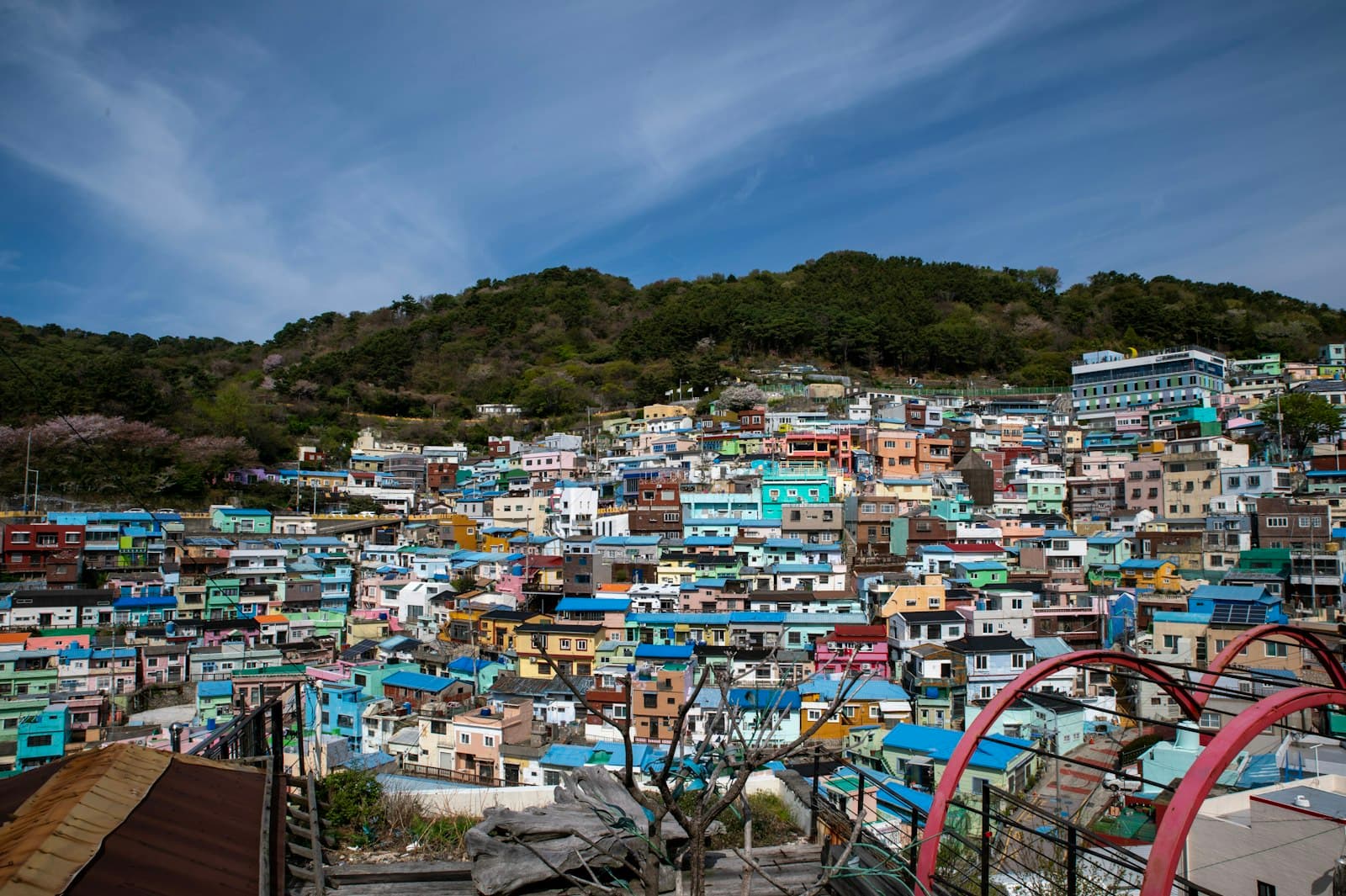
Gamcheon Culture Village: The Painted Hillside
90 min · 1.8 km · moderate
More from Busan
Explore more at your own pace.
Busan Travel Guide: Days, Transport, Weather, Safety, Budget
Busan's War-Made City: How a Port Refuge Became a Painted Coast
Gamcheon's Refugee Origins: Reading Busan's Painted Hillside
Jagalchi Market: How Busan's Fish Market Explains the Whole Port City
The Stacked White Houses of Huinnyeoul: Busan's Cliff Village Beneath the Postcard