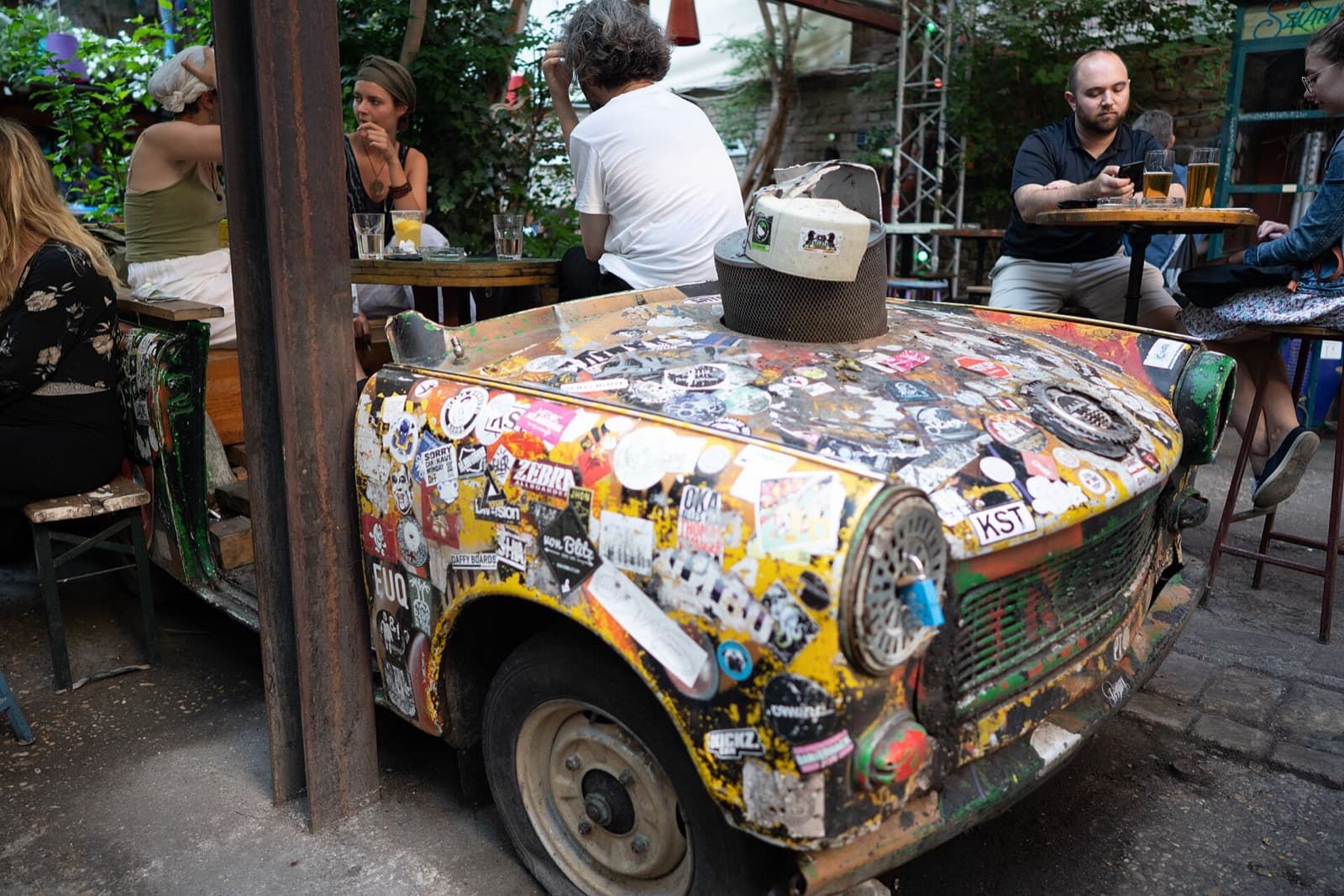
Szimpla Kert turned a condemned building into a bar, and in doing so it saved it. That small act of reoccupation, repeated across the emptied streets of Budapest's old Jewish quarter, is why the district now called Erzsebetvaros reads as one continuous story rather than two unrelated ones. The party you can find here at night sits directly on top of the wartime ghetto. The buildings full of music are the same buildings that stood emptied after the community that filled them was destroyed. Start with the ruin bars and you have the thread that runs back through every stop on this walk: destruction and rebirth, told in stone and memory.
What a ruin bar actually is
The Hungarian word is romkocsma, which translates plainly as ruin pub. The movement began in the early two thousands, in the emptied, dilapidated pre-war buildings and courtyards of the seventh district. To understand why those buildings were empty, you have to hold the district's recent past in view. This quarter had been the sealed ghetto in the winter of nineteen forty-four to forty-five. In the decades after the war, once the community that filled these streets had been deported and murdered, the fabric fell derelict. Condemned apartment blocks and factory yards stood awaiting demolition.
Then something unexpected happened. Rather than being torn down, some of those ruined buildings were reoccupied as improvised bars, furnished with whatever could be salvaged: mismatched chairs, old bathtubs, cast-off tables. The origin point, widely considered the first and defining ruin bar, is Szimpla Kert, whose name means simple garden. It opened in two thousand two and settled into its ruined home at fourteen Kazinczy utca, Kazinczy Street, in two thousand four, when its founders saved a condemned complex of former homes and a stove factory from demolition. From there it grew into Budapest's signature nightlife and a kind of community centre, with film screenings, live music, a gallery, and a farmers' market.
The deeper point is the one worth carrying: the movement helped save the buildings themselves. Structures that would have been demolished were kept standing because people found new use for them. Renewal and gentrification, revival and memory, all press together on these streets at once.
The quarter the bars grew back into
Hear a stop from this walk
The Rumbach Street Synagogue: A Community's Inner Diversity
To feel why that matters, you need the arc the ruin bars sit at the end of. Seven streets in this one district carry the whole span of a community: confident nineteenth-century belonging, the sealed ghetto of that final winter, and an improbable rebirth. Everything is within a few hundred metres, which is what makes the paradox so physical. You can stand in one spot and read all three chapters.
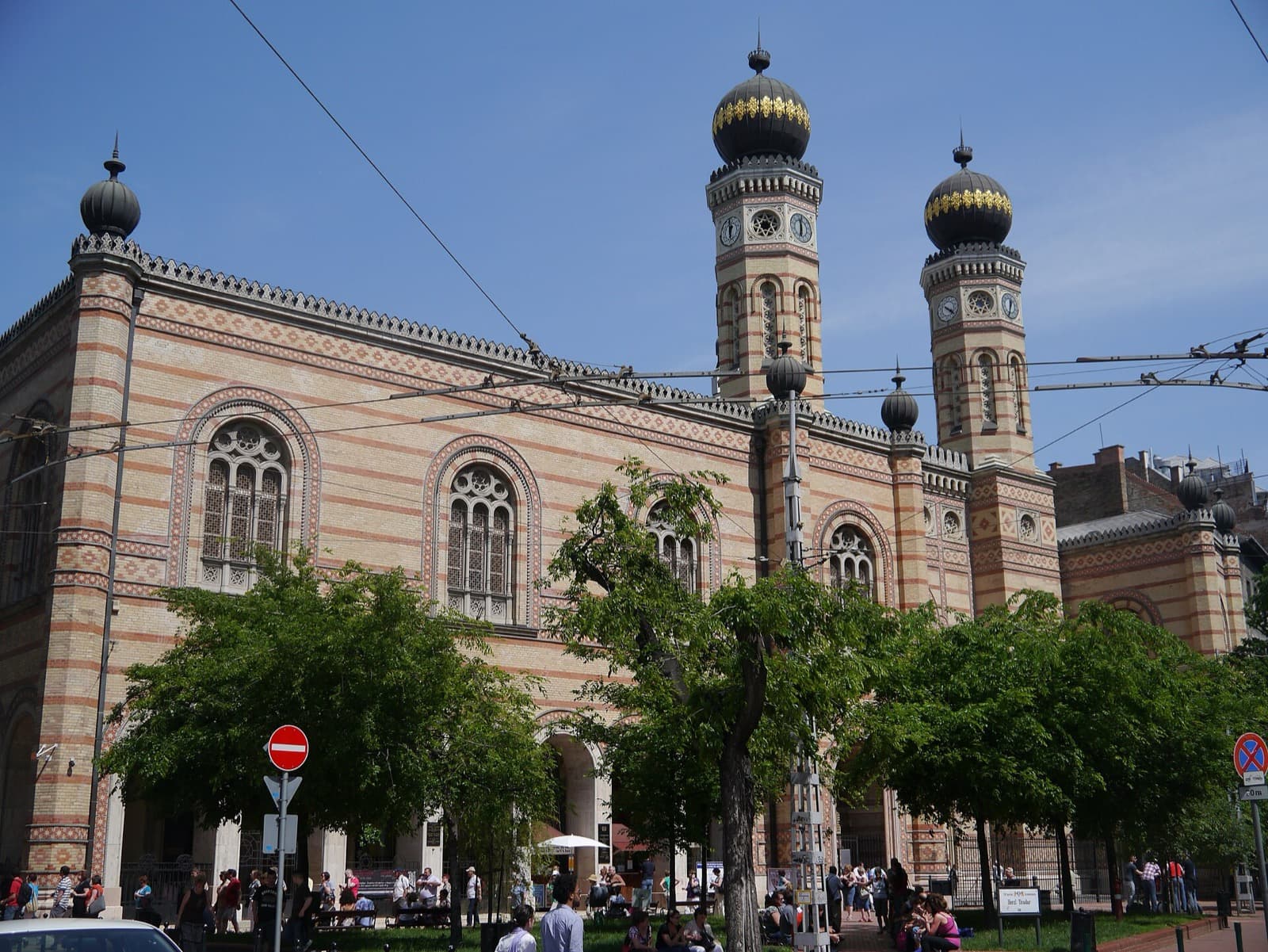
The chapter of belonging opens at the Great Synagogue on Dohany Street, the largest synagogue in Europe, consecrated on the sixth of September eighteen fifty-nine. Its Moorish Revival facade was built deliberately grand and deliberately visible, a statement from a community that felt it had arrived. A few steps on, the Hungarian Jewish Museum stands on the plot where Theodor Herzl, the founder of modern political Zionism, was born in eighteen sixty, beside the Heroes' Temple raised in nineteen thirty-one to honour Hungarian Jews who died fighting for Hungary in the First World War. These were people who saw themselves as fully Hungarian. That confidence is the note you carry into the darkness.
The darkness has an exact centre: Klauzal ter, the largest square of the historic quarter and the effective heart of the sealed ghetto. The order that established the ghetto came by decree in late November nineteen forty-four, and by the end of that month roughly seventy thousand Jews were crowded behind a wooden fence into these few streets, with conditions so catastrophic that the square itself held temporary mass graves. The Red Army liberated the ghetto in January nineteen forty-five. Behind the Great Synagogue, the Tree of Life, a metal weeping willow by the sculptor Imre Varga unveiled in nineteen ninety-one, inscribes victims' names on its leaves and rises over ghetto graves. Nearby memorial stones honour the diplomats Raoul Wallenberg and Carl Lutz, who placed tens of thousands of Budapest Jews under protection.
Between grief and rebirth sit the quieter surprises. The Rumbach Street Synagogue, an octagonal Moorish Revival building designed by a young Otto Wagner and reopened in June twenty twenty-one after decades of decay, was built for the status quo ante congregation, the middle path in a community that split three ways in the eighteen sixties. The Kazinczy Street Orthodox Synagogue, a Hungarian Art Nouveau landmark built by the Loffler brothers in nineteen twelve to nineteen thirteen with stained glass by Miksa Roth, is not a museum piece at all. It anchors a living Orthodox complex of school, prayer house, kosher kitchen, and a ritual bath serving the community since nineteen twenty-eight.
Reading the district in one eye
Gozsdu Courtyard, a chain of seven connected courtyards built around nineteen hundred and reconstructed in the early two thousands, is the everyday version of the same reversal that Szimpla Kert made loud. It was derelict; now it hums. The ruin bars and the memorials are not in tension so much as they are two halves of the same sentence. The courtyards now full of conversation are the physical fabric that stood empty after the community here was destroyed. The rebirth is real, and so is the memory beneath it.
That is why this quarter rewards a self-paced walk over a rushed pass. The stops are tight and skippable, some grand, some grave, and they ask for different things: attention at the synagogues, silence at the graves, honesty about the party built on both. You set the rhythm, linger where you need to, and hold reverence and revival in the same eye rather than choosing one. If you want to plan the route or compare it with other options in the city, browse the full list of Budapest walking tours or start from the Budapest city page and walk the eight stops at your own pace.
Sources
- Szimpla Kert, Wikipedia. Founding date, the two thousand four move to fourteen Kazinczy Street, and its role as the first ruin bar.
- Ruin bar, Wikipedia. The romkocsma movement, its reoccupation of condemned pre-war buildings, and its preservation effect.
- Dohany Street Synagogue, Wikipedia. Consecration date, scale, Herzl's birthplace, and the Tree of Life sculpture by Imre Varga.
- Budapest Ghetto, Wikipedia, and Budapest, United States Holocaust Memorial Museum. The late-November nineteen forty-four ghetto decree, its population of roughly seventy thousand, and the January nineteen forty-five liberation.
- Kazinczy Street Synagogue, Wikipedia, and Gozsdu-udvar, Wikipedia. The Loffler brothers, Miksa Roth stained glass, the mikveh from nineteen twenty-eight, and the seven-courtyard passage built around nineteen hundred.
Ready to experience it?
Jewish Quarter: Destruction and Rebirth in Seven Streets
90 min · 3.5 km · easy
More from Budapest
Explore more at your own pace.
Budapest Travel Guide: How Many Days, Getting Around, Best Time, Safety, and Budget
Heroes' Square and the Boulevard That Reads Like a Sentence
Matthias Church: Why Budapest's Prettiest Roof Is the Newest Thing on Castle Hill
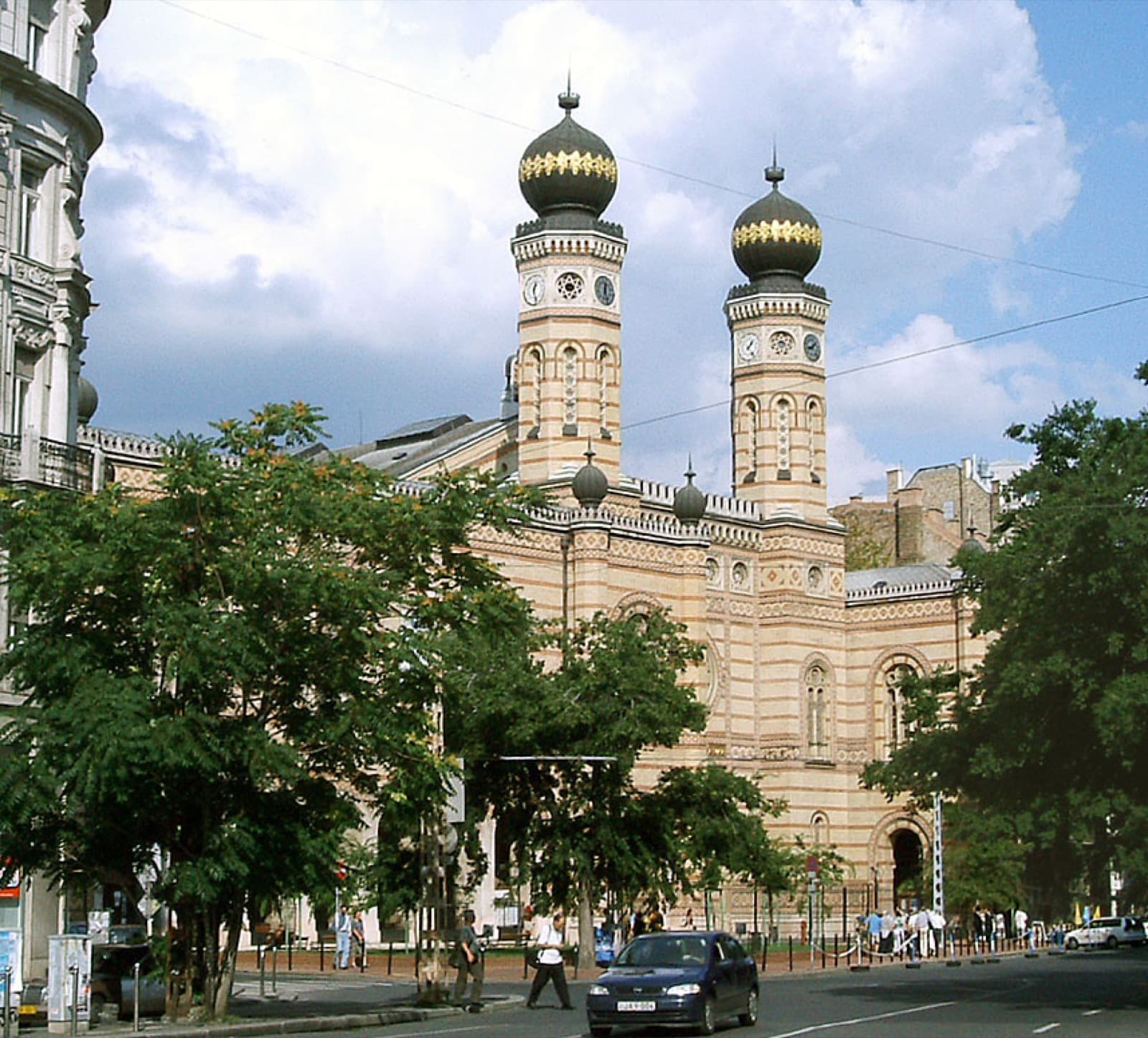
Dohany Street Synagogue: Europe's Largest, and What It Was Built to Say
Fisherman's Bastion: The Fortress That Never Defended Anything