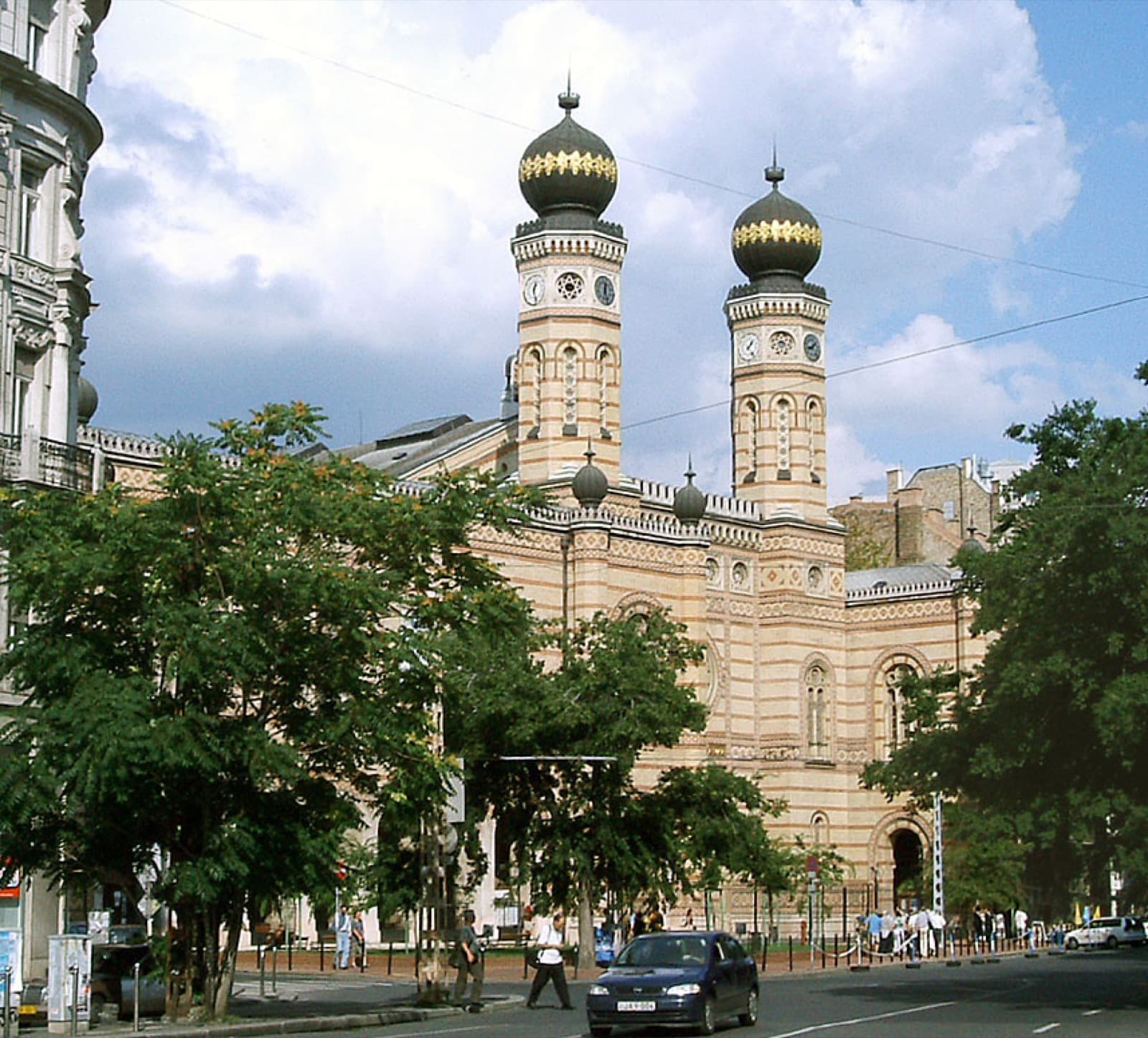
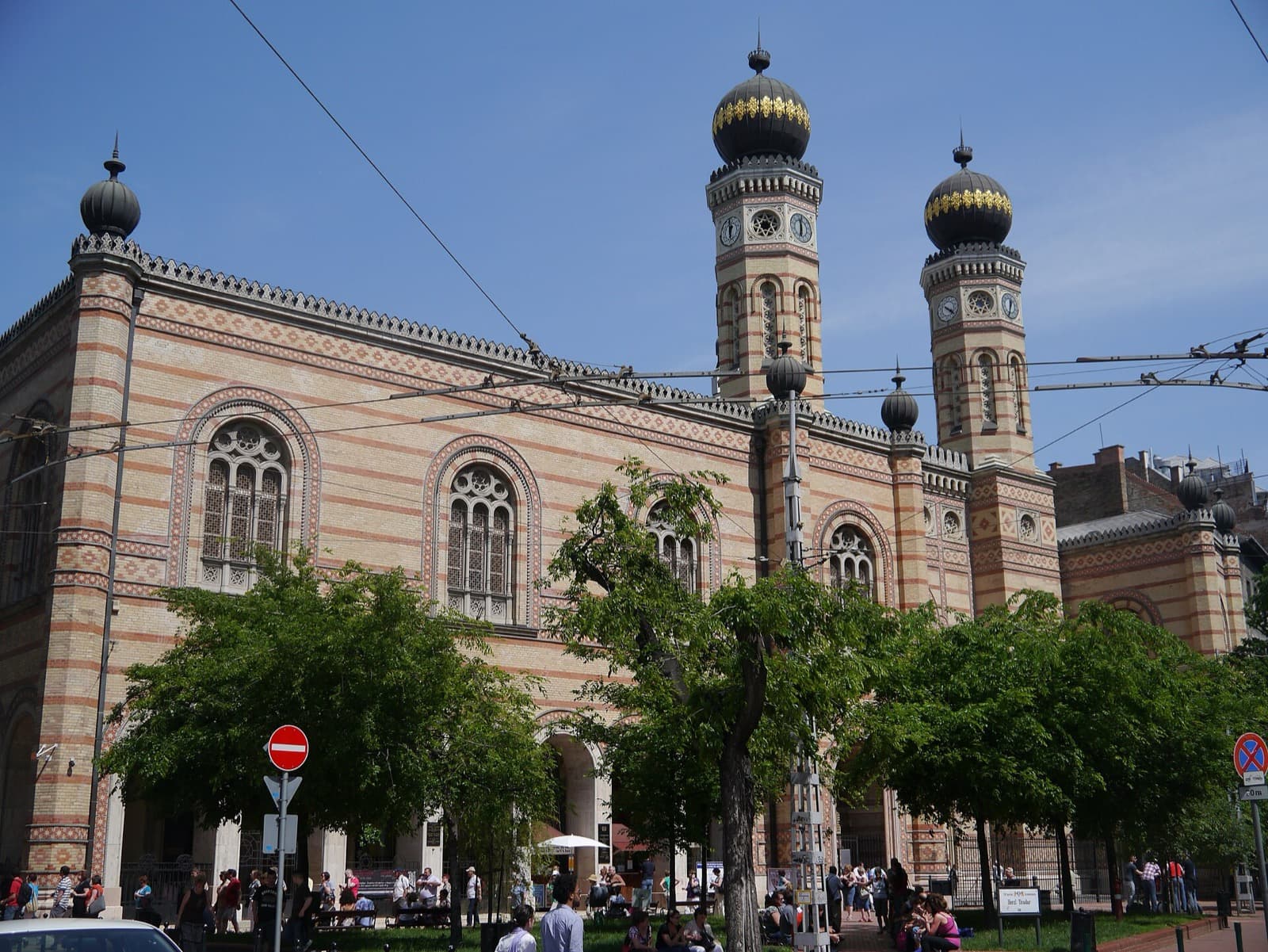
The Dohany Street Synagogue in Budapest is the largest synagogue in Europe, and its grand Moorish Revival facade was built to make a claim: that the Jews of Pest belonged fully to the growing city around them. Standing on Dohany utca in the seventh district, the building seats close to three thousand people, and its twin onion-domed towers rise more than forty metres over the street. To read it correctly, you have to understand that its architecture is an argument. A community that had just won emancipation chose to build something deliberately grand, deliberately visible, right on a public street, and that choice is the one thing worth carrying with you when you stand in front of it.
A statement made in brick
Construction ran between 1854 and 1859, and the synagogue was consecrated on the sixth of September 1859. The exterior came from the Viennese architect Ludwig Forster; the interior was shaped by the Hungarian architect Frigyes Feszl. The result is a building roughly seventy-five metres long and twenty-seven metres wide, reaching about forty-three metres at its highest point, with something close to two thousand nine hundred sixty-four seats divided between the men's floor and the women's galleries.
The style is Moorish Revival, folded together with Byzantine, Romanesque, and Gothic Revival touches. That was a common choice for grand European synagogues of the era, and it did double duty. It signalled a distinct identity, drawing on an architectural language read as Eastern and Jewish, while at the same time asserting a confident civic presence on a major street. This was not a house of worship built to be hidden in a courtyard. It was built to be seen, with a striped facade in yellow and red brick, a rose window, and towers meant to hold their own against any church spire in the district.
Whose synagogue this is
Hear a stop from this walk
The Rumbach Street Synagogue: A Community's Inner Diversity
The Dohany Street Synagogue is the seat of Neolog Judaism, the reform-leaning stream of Hungarian Jewry. To understand why that matters, you need the schism. In the 1860s, Hungarian Jewry split, and it did not split cleanly into two. There were the Neolog, the reform-leaning branch; there were the Orthodox; and there was a third path in between, the status quo ante congregations, who chose to remain as they were and align with neither side. Dohany Street belongs to the first of those streams, and its architecture speaks its language. This is a synagogue of a community that felt it had arrived, that emancipation was real, and that visibility was safe.
That confidence is not an abstraction here. The full complex around the synagogue documents it in detail. Next door, on the plot where the Hungarian Jewish Museum and Archives now stands, a Classicist house once stood, and in that house, on the second of May 1860, Theodor Herzl was born. Herzl would become the founder of modern political Zionism, and he lived as a boy in that house next to the synagogue. Beside the museum stands the Heroes' Temple, a smaller synagogue added in 1931, built as a memorial to the Hungarian Jews who died fighting for Hungary in the First World War. A community that buries its war dead as patriots is a community that considers itself fully at home. The confidence in the brick of the main building and the dedication of that memorial temple are the same statement, made twice.
The paradox the building sets up
The reason to slow down at Dohany Street is that its optimism is the setup for everything that follows in the quarter around it. The same district that raised this monument would, within a single lifetime, become a sealed ghetto. In the winter of 1944 to 1945, roughly seventy thousand Jews were crowded behind a wooden fence into these few streets, and behind the Great Synagogue itself lies the Raoul Wallenberg Holocaust Memorial Park, built over the mass graves of those who died in the ghetto. At its centre stands a metal weeping willow, the Tree of Life, its leaves inscribed with victims' names, made by the Hungarian sculptor Imre Varga and unveiled in 1991.
So the building holds two things that do not resolve. It is a monument to belonging, and it stands a few metres from a monument to the destruction of the people who built it. This is the honest note to keep at the first stop. The optimism was real. It was not naive; it was earned, the product of a century of gradual acceptance. That is exactly what makes the later chapter so heavy. When you stand on the street and take in the scale, you are looking at a community's confidence in its most permanent form, raised in stone before anyone knew what the century would bring.
Standing in front of it
The single thing to understand here is that the architecture is not decoration. It is testimony. The Neolog builders wanted the largest, most public, most declarative synagogue they could raise, and they got it. Take in the two towers, the rose window, and the striped brick from the pavement, because the facade alone carries the message the builders intended, and the street view costs nothing. If you go inside, remember that this is a working synagogue: modest dress is expected, and men are usually asked to cover their heads. A combined complex ticket, roughly nine thousand forint, covers the synagogue, the museum, the Heroes' Temple, and the memorial park together, so the belonging and the loss can be visited on one entry. Prices shift by season and platform, so confirm the current rate when you book.
Dohany Street is the opening chapter of a much larger story pressed into a few hundred metres of Erzsebetvaros: confident belonging, catastrophe, and an improbable twenty-first-century revival. The best way to hold all three in one eye is to walk them in order. Our self-guided Jewish Quarter tour begins here at the Great Synagogue and moves at your own pace through the museum, the memorial park, the sealed ghetto's central square, and the ruin bars that grew from the district's own decay. For the wider city and its other routes, see our guide to Budapest walking tours.
Sources
- Dohany Street Synagogue, Wikipedia. Construction dates, architects, dimensions, seating, and Neolog affiliation.
- Theodor Herzl, Wikipedia. His 1860 birth on the plot next to the synagogue.
- Raoul Wallenberg Holocaust Memorial Park, Wikipedia. The Tree of Life sculpture, Imre Varga, and the ghetto graves behind the synagogue.
- United States Holocaust Memorial Museum, Budapest article. The 1944 to 1945 ghetto and the fate of Hungarian Jewry.
- Roamer tour transcript, "Jewish Quarter: Destruction and Rebirth in Seven Streets." Fact-audited primary source for this deep dive.
Ready to experience it?
Jewish Quarter: Destruction and Rebirth in Seven Streets
90 min · 3.5 km · easy
More from Budapest
Explore more at your own pace.
Budapest Travel Guide: How Many Days, Getting Around, Best Time, Safety, and Budget
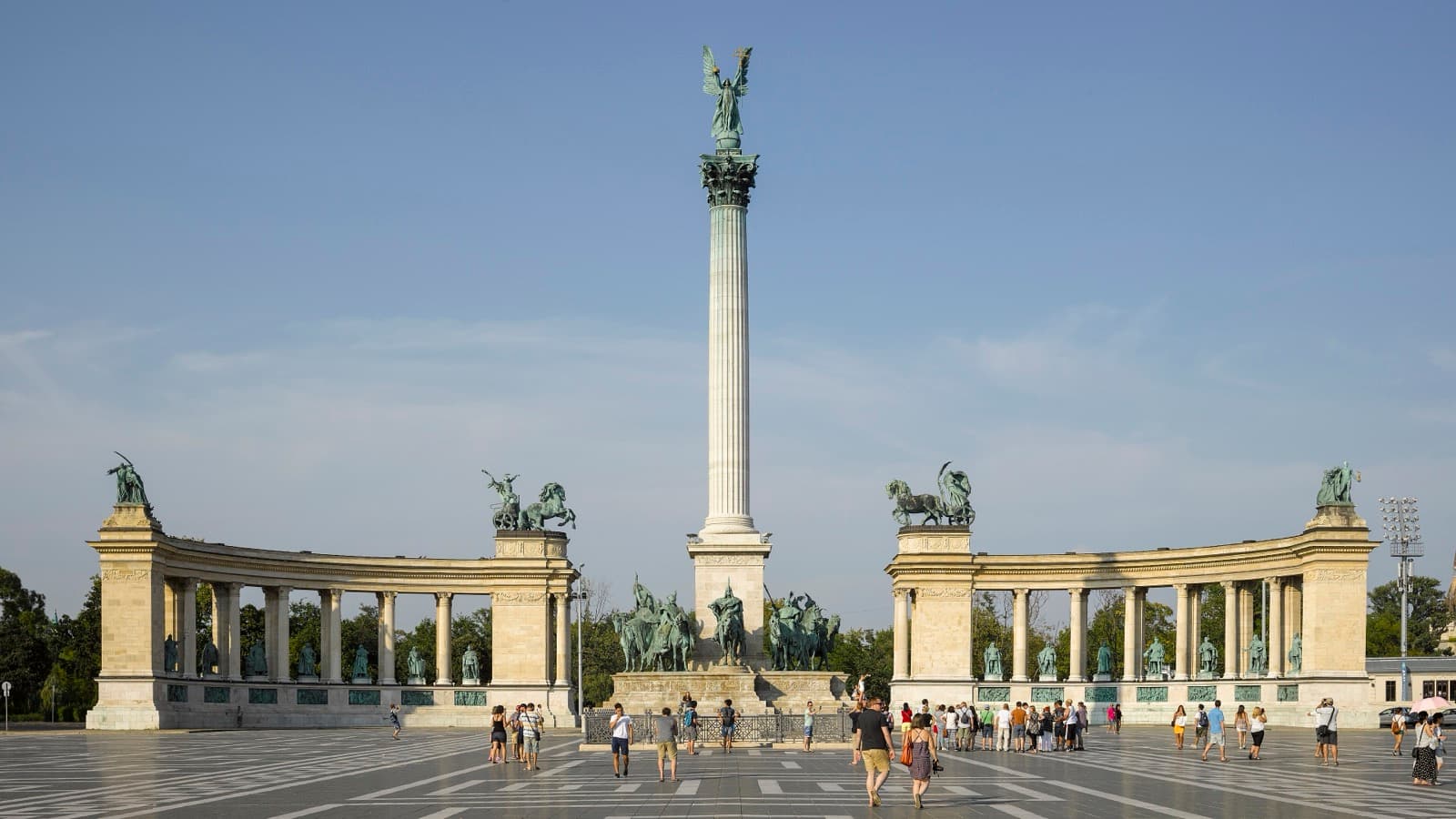
Heroes' Square and the Boulevard That Reads Like a Sentence
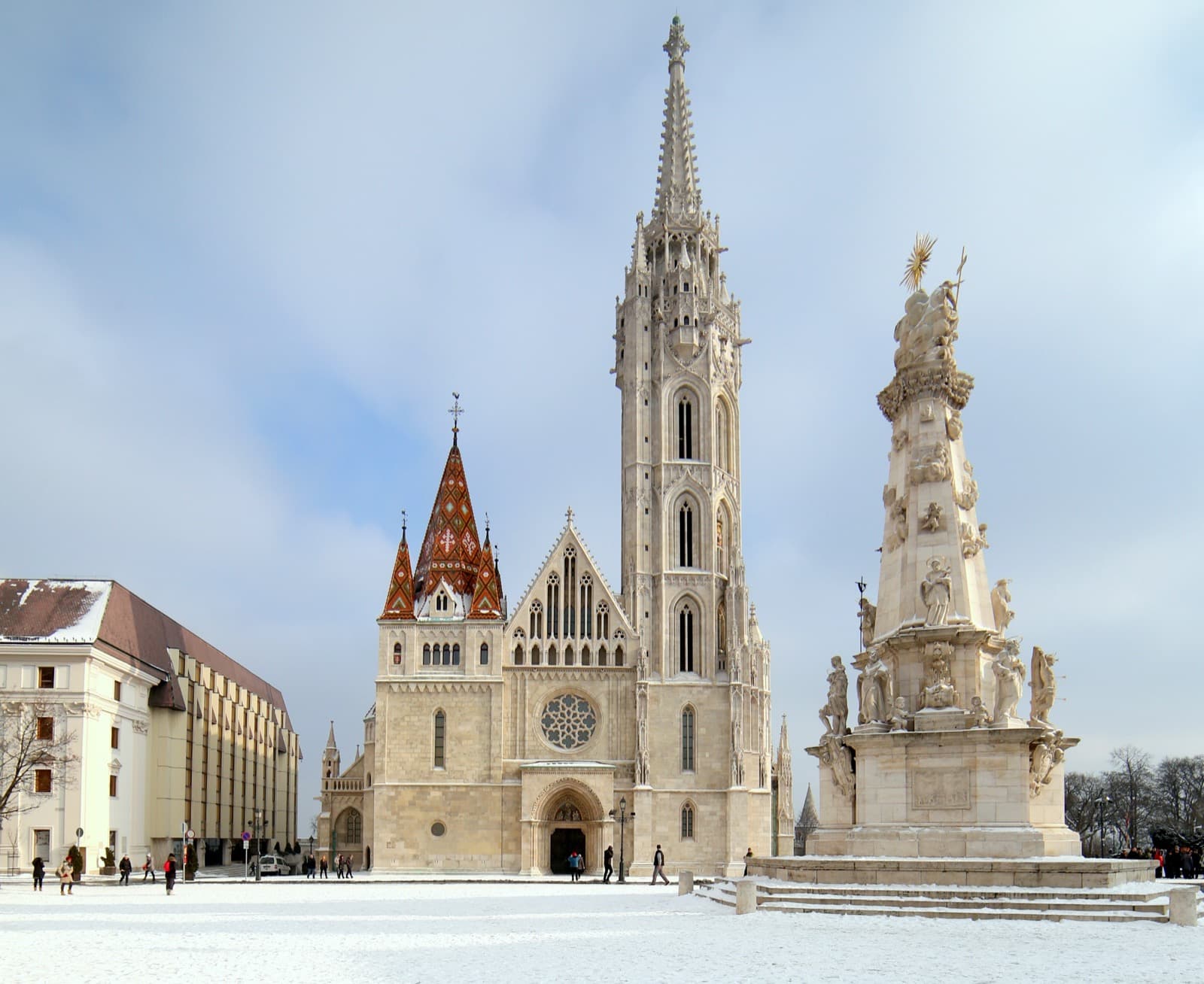
Matthias Church: Why Budapest's Prettiest Roof Is the Newest Thing on Castle Hill
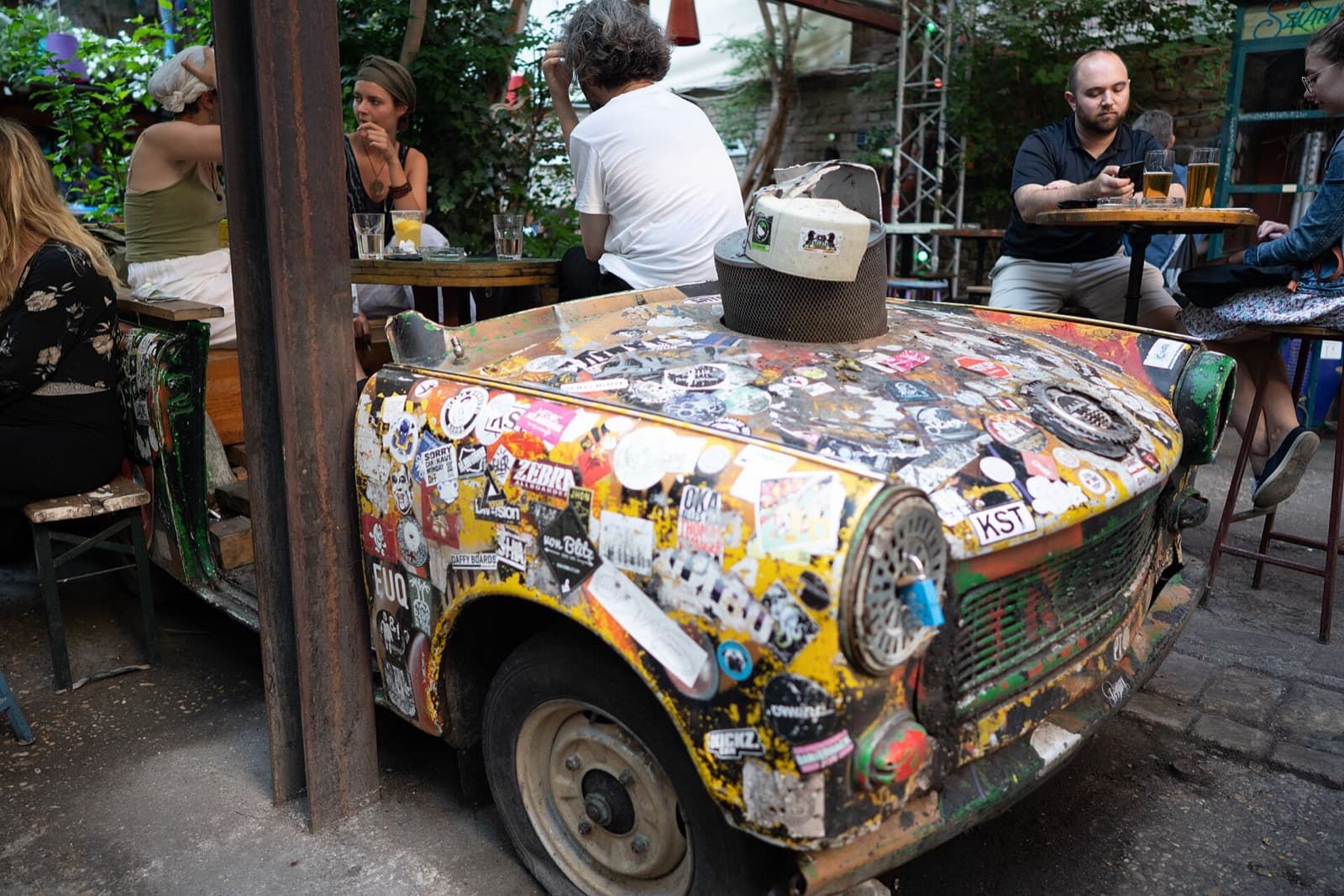
Szimpla Kert and the Ruin Bars: Why Budapest's Party Quarter Is Really a Memorial
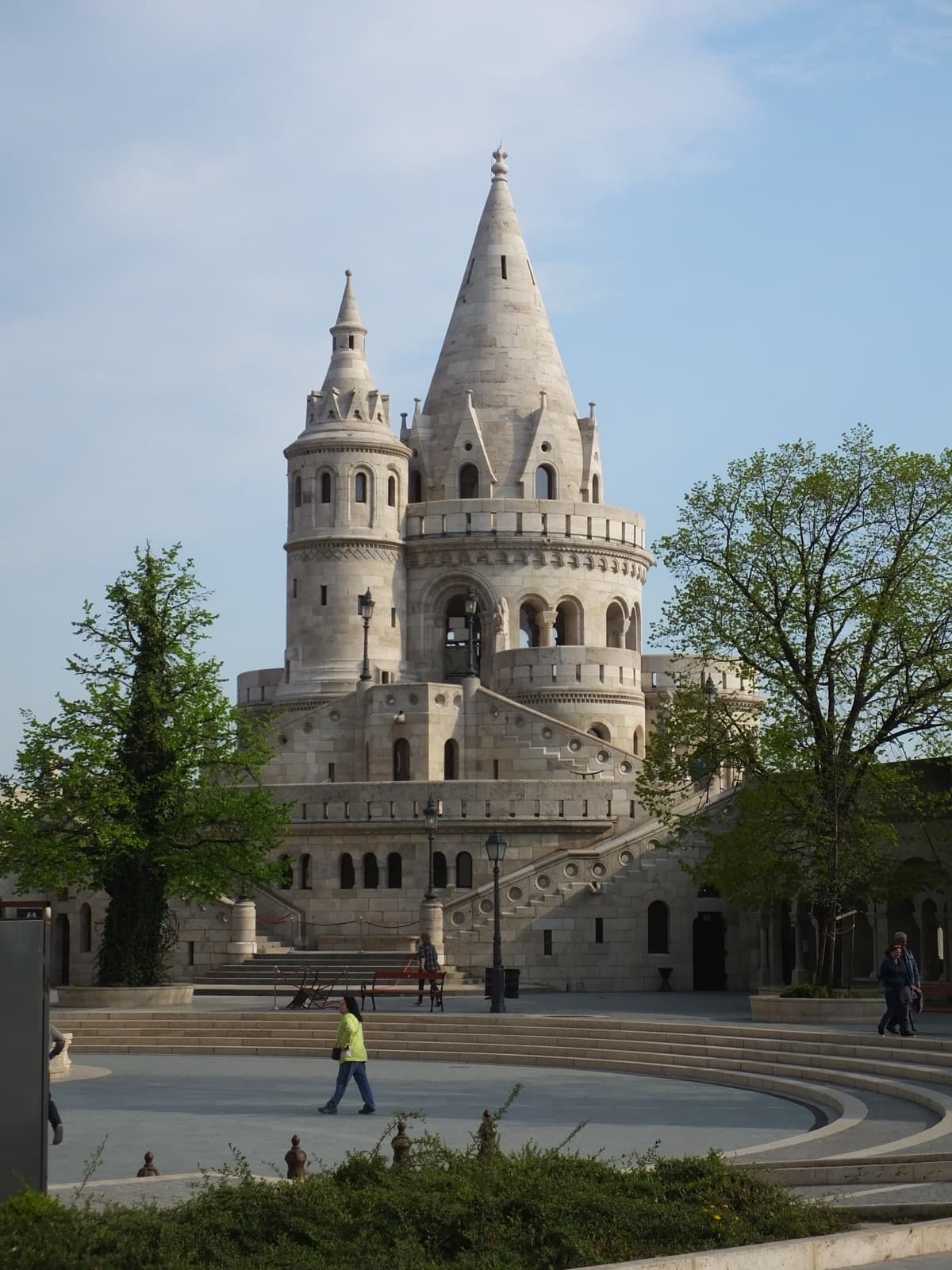
Fisherman's Bastion: The Fortress That Never Defended Anything