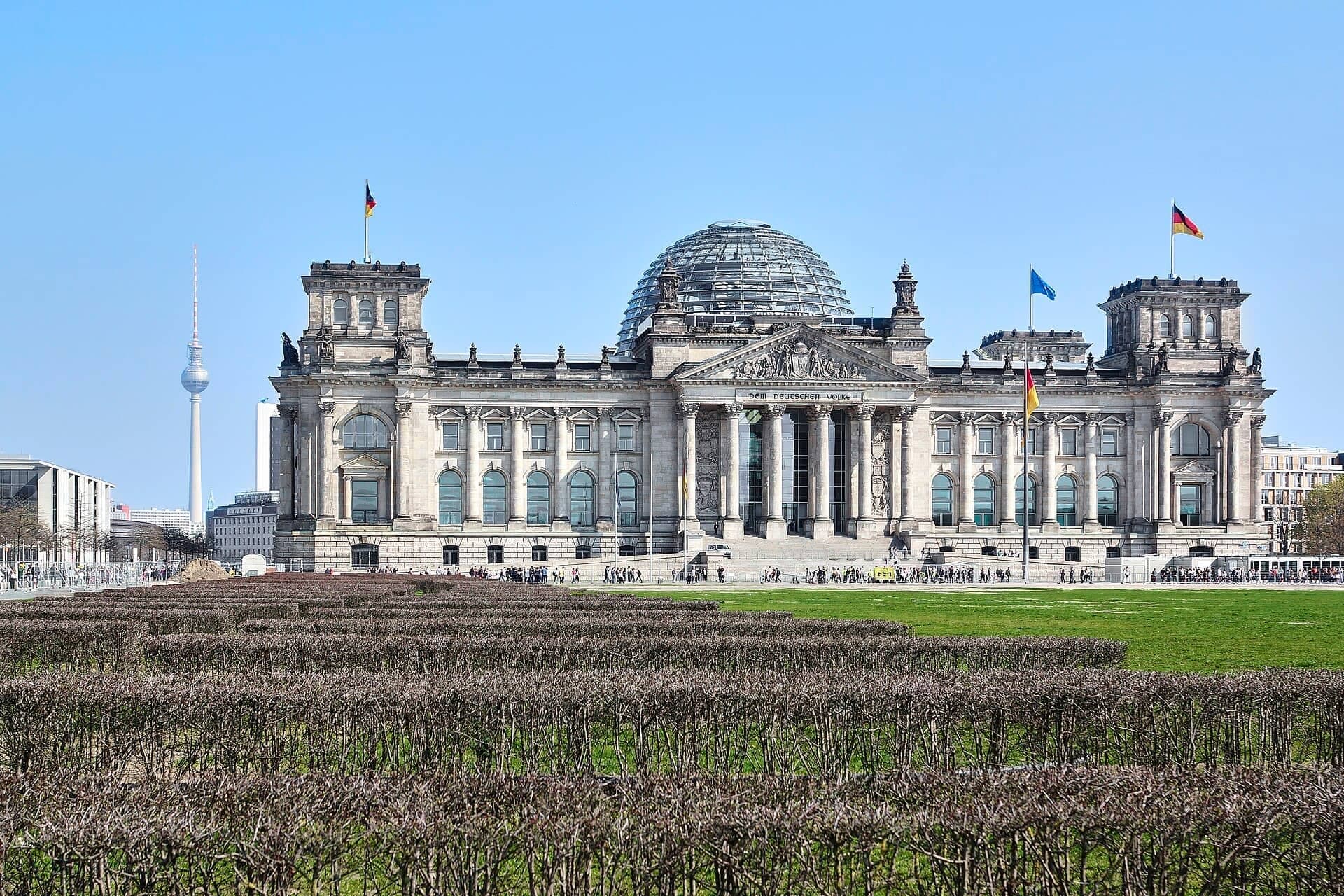
The Reichstag matters because Berlin rebuilt its damaged parliament with a walkable glass dome that lets citizens look straight down onto the debating chamber below, turning a building that once witnessed the collapse of German democracy into a structure that makes democracy visible. Standing on Platz der Republik, you see a heavy stone facade with the words Dem Deutschen Volke carved across it. Look up, and the crown of glass tells you the real story. This is the seat of the Bundestag, the German parliament, and it has carried some of the hardest hours of the twentieth century.
A building older than the nation it now serves
Construction on the Reichstag began on the ninth of June, 1884, and the building was completed in 1894. It was raised to house the parliament of a German Empire that had existed only since 1871, a young nation giving itself a monumental home. The heavy stone dignity of the original design was meant to project permanence. What followed instead was a century in which the building was burned, shelled, captured, abandoned, divided from its own government, and finally restored. Few structures in Europe have absorbed so much of a nation's turbulence into a single set of walls.
By the time you reach it on a walk from the Brandenburg Gate through the Tiergarten, the Reichstag reads less as a triumph than as a survivor. Much of what stands on the ground nearby, the field of concrete stelae, the memorials to the persecuted homosexuals and to the Sinti and Roma, follows from the moment German democracy failed inside this building.
The fire that opened the door to dictatorship
Hear a stop from this walk
Pariser Platz: A Square Named for Paris
On the twenty-seventh of February, 1933, an arson attack set the debating chamber ablaze. The identity of who lit the fire remains unsettled to this day. What is not in question is what the fire was used to do. The Nazis seized on the blaze as a pretext to suspend civil liberties across Germany, and the dictatorship began to close its grip within days. A burned room became the excuse for emergency powers, and the emergency powers never lifted.
It is worth standing with that sequence for a moment, because it is the hinge of everything the memorials around it record. The collapse did not arrive with tanks in the street. It arrived with a fire, a decree, and a parliament that stopped functioning as a parliament. The building that was supposed to hold German democracy became, briefly, the instrument of its suspension.
Ruin, a flag, and a photograph
Twelve years later, at the very end of the war in Europe, the Reichstag stood in ruins as the Red Army fought its way into central Berlin. A Soviet soldier raised a flag over the wrecked building as the army took it, and the photograph of that moment, taken by Yevgeny Khaldei on the second of May, 1945, became one of the defining images of the century. The stone shell in that picture is the same stone you are looking at now, patched and cleaned but structurally the same building.
Then came the long division of the city. The Reichstag sat close to the line that split Berlin, a damaged monument on the western side, useful to no government for decades. The parliament of West Germany met far away in Bonn. For a generation the building was less a working institution than a wound that no one quite knew how to close.
Christo, Jeanne-Claude, and a threshold
Before the renewal came a strange and beautiful gesture. In 1995, the artists Christo and Jeanne-Claude wrapped the entire Reichstag in silvery fabric, sheathing the whole structure so that its familiar bulk became a soft, shifting form. Millions of people came to see it. The wrapping was temporary by design, and when the fabric came down the building stood exposed and ready for the work that followed. It functioned as a symbolic threshold, a way of covering the old wounded thing before uncovering something new. Reconstruction began soon after.
Democracy made visible
The architect Norman Foster rebuilt the Reichstag and crowned it with a great walkable glass dome, finished in 1999, the year the Bundestag returned to the building that April after decades of German government sitting elsewhere. The dome is not decoration, and it is not a viewing platform bolted on for tourists. From its spiralling interior ramp, visitors climb above the debating chamber and can look straight down through the glass onto the parliament at work below.
Consider what that arrangement says. In most seats of power, the citizens sit below and the government looks down on them from a balcony or a raised chamber. Here the geometry is inverted. The people stand above their representatives and watch them govern. On the same ground where a parliament once burned and democracy once collapsed, the building now insists that the government remain visible to the people it serves. That is the single thing to understand standing in front of the Reichstag: the transparency is literal, engineered into glass and steel, and it is an argument in physical form.
The dome is free to visit, but access requires advance registration and a photo identity document, with booked timeslots and rarely any walk-up entry. If you plan to go inside, arrange it before you arrive. Even from the square, though, the meaning is legible. Heavy stone below, clear glass above: the weight of the past held up beneath the light of an open present.
Walk the ground it stands on
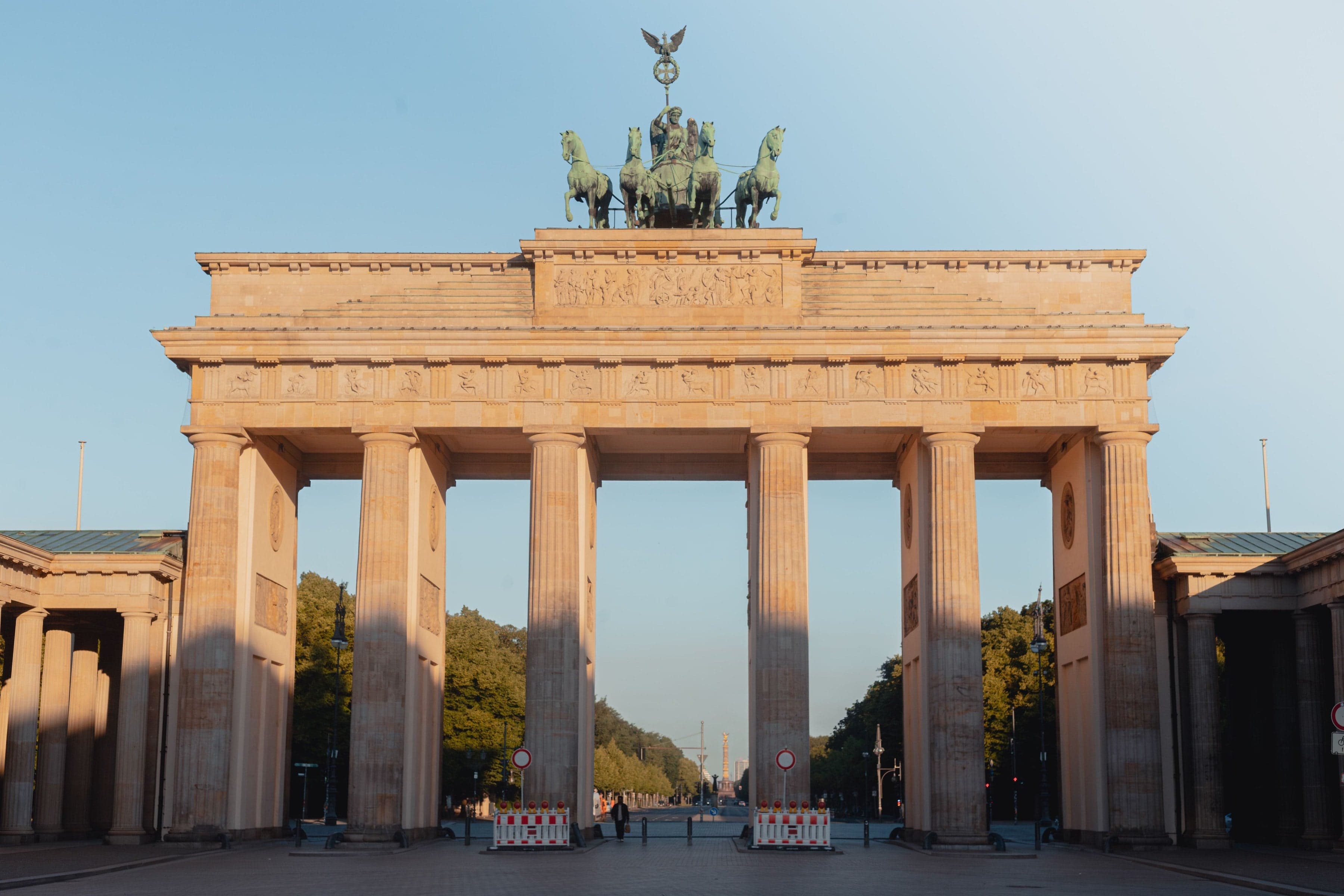
The Reichstag is the climax of Roamer's self-guided audio walk Brandenburg Gate and Reichstag, ten stops over about two point nine kilometres in roughly an hour and a half. It starts on Pariser Platz, passes through the Brandenburg Gate into the Tiergarten, past the Memorial to Persecuted Homosexuals, the Soviet War Memorial and the Memorial to the Sinti and Roma, then reaches the Reichstag's west front and its glass dome before ending at the White Crosses on the Spree, where the river was the border. The walk lets you take the weight of it at your own pace.
You can browse the full route and the other routes in the city among the Berlin walking tours, and see everything on offer in Berlin before you set out. Stand at the Reichstag, look up at the glass, and let the rest of Mitte explain why Berlin chose to keep its hardest history in plain sight.
Sources
- Reichstag building, Wikipedia: construction dates, the 1933 fire, the 1945 capture, and Foster's reconstruction.
- Reichstag dome, Wikipedia: the 1999 completion of Norman Foster's walkable glass dome and its design that reveals the chamber below.
- German Bundestag visitor service: the dome is free to visit but requires advance registration and a valid photo identity document.
- Yevgeny Khaldei photograph records: the second of May, 1945 image of the Soviet flag raised over the Reichstag.
Ready to experience it?
Brandenburg Gate and Reichstag: A Gate, a Park, a Parliament
90 min · 2.9 km · easy
More from Berlin
Explore more at your own pace.
Berlin: The City That Reads Its Own Scar
Best Architecture Walking Tours in Berlin (2026)
Best Culture Walking Tours in Berlin (2026)
Little Istanbul at Kottbusser Tor: How Guest Workers Made Kreuzberg
The Memorial to the Murdered Jews of Europe: How Berlin Reads Its Own Reckoning