Museum Island and Unter den Linden: Stone Where It Shows
75 min · 1.8 km · easy
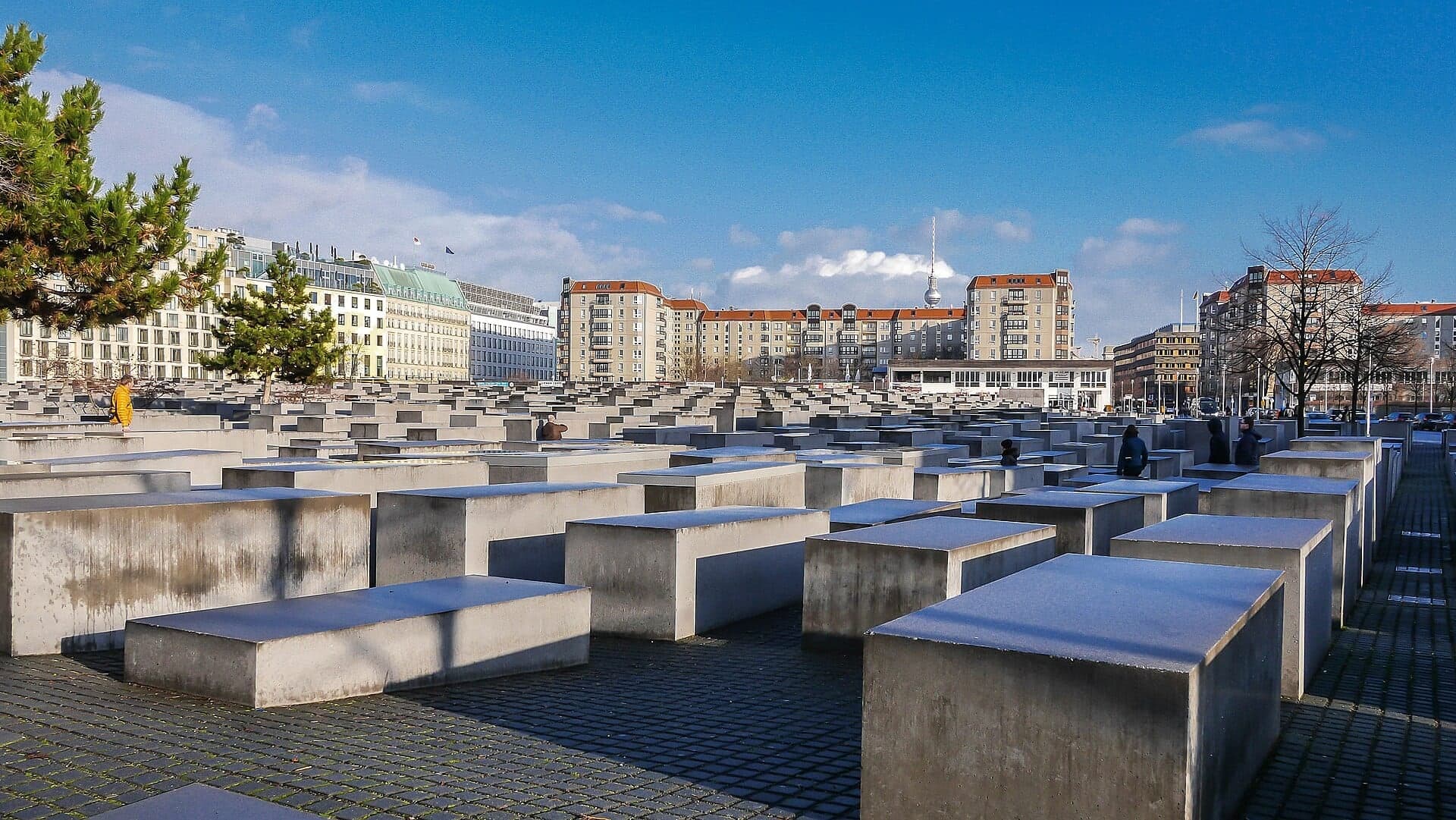
Berlin's Memorial to the Murdered Jews of Europe does not tell you what to feel about the Holocaust, and that refusal is the key to reading the entire memory quarter of Mitte. Peter Eisenman laid out 2,711 concrete slabs on sloping, undulating ground one block south of the Brandenburg Gate. There is no inscription in the field, no comforting symbol, no figure to organize your grief. The memorial makes remembrance a physical experience of disorientation rather than a message you consume and forget. Understand why that works, and you understand why Berlin built a landscape to its worst crimes instead of paving the ground over.
The field that refuses to console you
Walk into the field from any edge and the slabs are low, no higher than a bench. Keep moving toward the center. The paving dips beneath your feet while the stelae climb far above your head, until the traffic noise of the government quarter falls away and you are alone in narrow grey corridors that turn at right angles you cannot see around. Eisenman gave the memorial no explanatory text and no central monument. He wanted the visitor to feel small, disoriented, and quiet, not instructed.
That design choice was deliberate, and it was risky. A conventional memorial gives you a caption and a way out. This one gives you neither. The result is that the meaning arrives through your own body, through the loss of bearings and the sudden solitude, rather than through anything you read. The field was dedicated on the tenth of May, 2005, sixty years after the war in Europe ended, and opened to the public two days later. It commemorates up to six million Jewish people murdered in the Holocaust.
Beneath the field lies the Ort der Information, the Place of Information, which holds the names of roughly three million individual Jewish victims. The exhibition documents the fate of families across occupied Europe, with names gathered in cooperation with Israel's Yad Vashem. The contrast is the whole point. Above ground, an abstraction that names no one. Below ground, three million people restored to their names. The memorial forces you to move from the scale of the crime, which is unimaginable, to the scale of a single person, which is not.
Reading the rest of the walk through this stop
Hear a stop from this walk
Gendarmenmarkt: Towers Built as Scenery
Once you grasp what Eisenman did, the other memory sites of central Berlin, several of them stops on Roamer's Berlin walking tours, become legible as a set of related answers to one question: how does a country keep its worst history visible without turning it into spectacle? Each stop solves the problem differently.
A short walk south sits the Site of the Führerbunker, and here Berlin chose the exact opposite of a monument. The ground where Adolf Hitler killed himself on the thirtieth of April, 1945, is now an ordinary residential car park. Mark it grandly and you risk building a shrine for those who might admire the man who died there. So the city kept the surroundings anonymous. For decades nothing stood here at all. Only on the eighth of June, 2006, was a single modest information board installed, written as plain historical record rather than commemoration. The stelae field overwhelms you with absence; the bunker site denies the perpetrator any stage. Both are refusals of the conventional monument, aimed in opposite directions.
At the Topography of Terror, on Niederkirchnerstrasse, the approach shifts again. This gravel ground once held the headquarters of the Gestapo, the SS, and the Reich Security Main Office, the command center of the terror apparatus. The documentation center that opened here on the sixth of May, 2010, is not a memorial to victims so much as a cold accounting of perpetrators. It names the machinery. It shows how ordinary offices and ordinary paperwork drove an extraordinary crime. Along the site's edge runs one of the longest surviving stretches of the Berlin Wall, so the death strip of one dictatorship sits directly over the ruins of an earlier one. Two systems of unfreedom, stacked on a single patch of ground.
Bebelplatz answers the question with a void you have to look down to find. On the tenth of May, 1933, exactly seventy-two years to the day before the stelae field was dedicated, Nazi students and the German Student Union burned around twenty thousand books in this elegant square, works by Heinrich Mann, Erich Maria Remarque, Karl Marx, and Albert Einstein among them. Joseph Goebbels gave a speech to the flames. Micha Ullman's memorial, unveiled on the twentieth of May, 1995, is a subterranean room of empty white shelves seen through a plate of pavement glass, enough shelving for the twenty thousand missing volumes. A nearby plaque carries a line the poet Heinrich Heine wrote in 1821: where they burn books, they will in the end also burn people. The distance from a burning book to a burning person turned out to be short.
The Stolpersteine take Eisenman's move to its logical extreme. Where the stelae field is one vast site with no names, these small brass stones, begun by the artist Gunter Demnig in 1992, are pure name and no site at all. Each ten-centimeter cube is set into the pavement before the last home a victim freely chose, before the state took that choice away. By 2023, more than one hundred thousand had been laid across more than twenty-five countries, described as the world's largest decentralized memorial. You do not visit these victims. You nearly trip over them on the way to somewhere else.
Why the anchor matters before you go
Further along Unter den Linden stands the Neue Wache, a stop on the Museum Island and Unter den Linden walk, where a single enlarged cast of Käthe Kollwitz's grieving mother sits beneath an open oculus, so that rain and snow fall on her. Kollwitz lost a son in the First World War and a grandson in the Second. After the abstraction of the stelae and the accounting of the terror state, it comes down to one mother and one lost child, gathering the whole century's dead into a quiet room.
You can stand in the field of stelae for free at any hour. But the memorial rewards a slow, prepared reading, which is exactly what an unhurried audio walk gives you. Roamer's Checkpoint Charlie and the Topography of Terror walk begins at the field's edge, so give the stelae the silence they ask for before you carry their disorientation past the bunker site and the Topography of Terror into the rest of Berlin.
Sources
- Memorial to the Murdered Jews of Europe, Wikipedia. Overview of Eisenman's design, the 2,711 stelae, the 2005 dedication, and the underground Place of Information.
- Stiftung Denkmal, official memorial foundation site. Authoritative detail on the Place of Information, opening hours, and the names archive held with Yad Vashem.
- Topography of Terror Documentation Center, official site. Confirms the 2010 opening and the site's function as a documentation of the Nazi terror apparatus.
- The Empty Library and Bebelplatz, Wikipedia. Documents the 1933 book burning, Micha Ullman's 1995 memorial, and the Heine quotation.
- Stolperstein, Wikipedia. Confirms Gunter Demnig's project, the count exceeding one hundred thousand stones across more than twenty-five countries by 2023.
Ready to experience it?
Museum Island and Unter den Linden: Stone Where It Shows
75 min · 1.8 km · easy
More from Berlin
Explore more at your own pace.
Berlin: The City That Reads Its Own Scar
Best Architecture Walking Tours in Berlin (2026)
Best Culture Walking Tours in Berlin (2026)
Little Istanbul at Kottbusser Tor: How Guest Workers Made Kreuzberg
Brandenburg Gate: The Triumphal Arch Marooned by the Berlin Wall