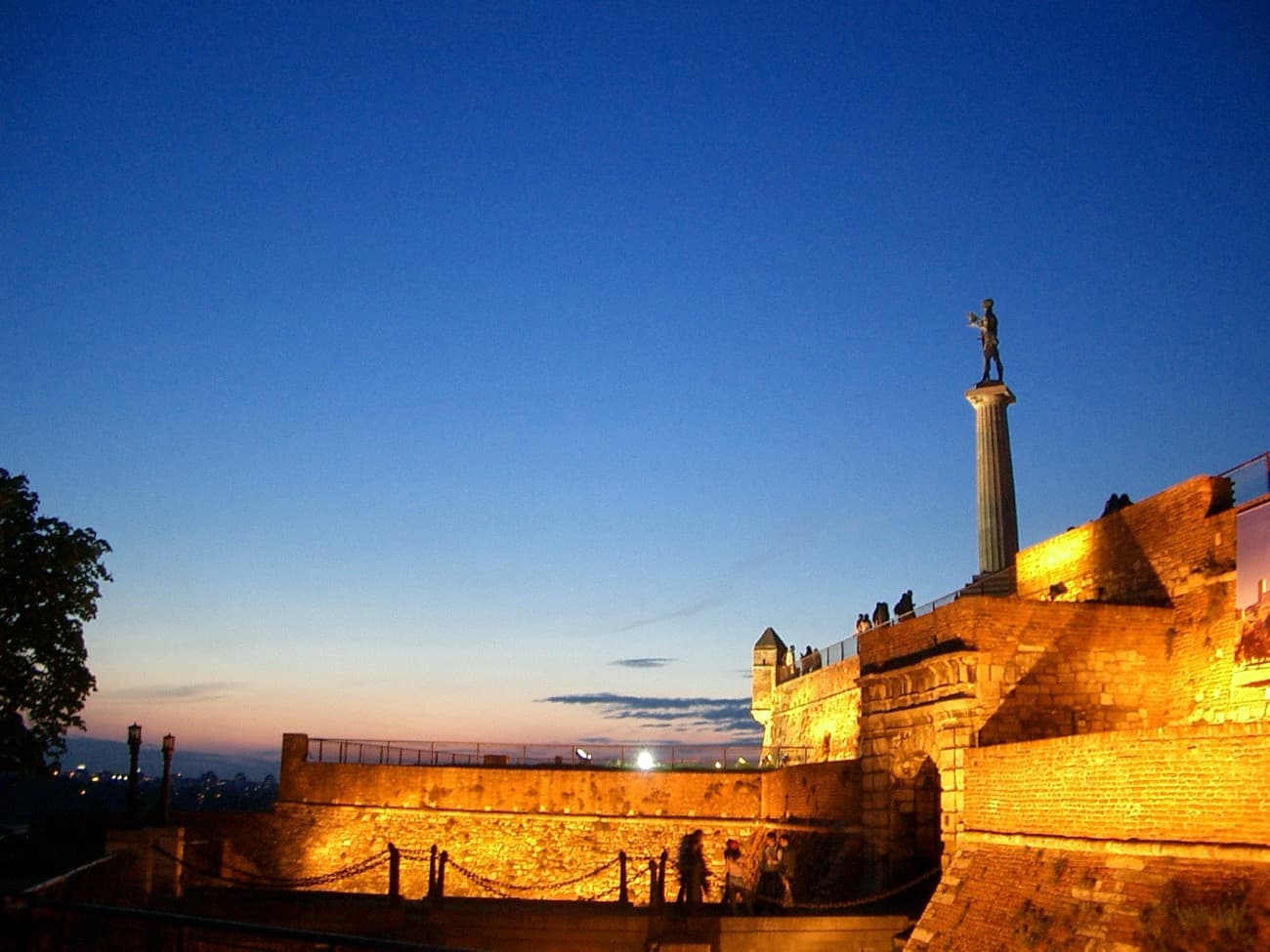
The Victor, in Serbian Pobednik, stands on the highest edge of Kalemegdan's Upper Town not because a committee wanted a monument there, but because a committee wanted it gone from somewhere else. Ivan Meštrović sculpted a bronze nude male figure, cast it in 1913, and intended it for Terazije Square in the middle of Belgrade, mounted on a fountain. The figure never got there. It was rejected, relocated, and eventually raised on a column at the fortress edge above the point where the Sava River pours into the Danube. So the statue that now reads as the confident guardian of the confluence is, in its origin, an exile. That is the one thing to understand while standing in front of it.
What you are actually looking at
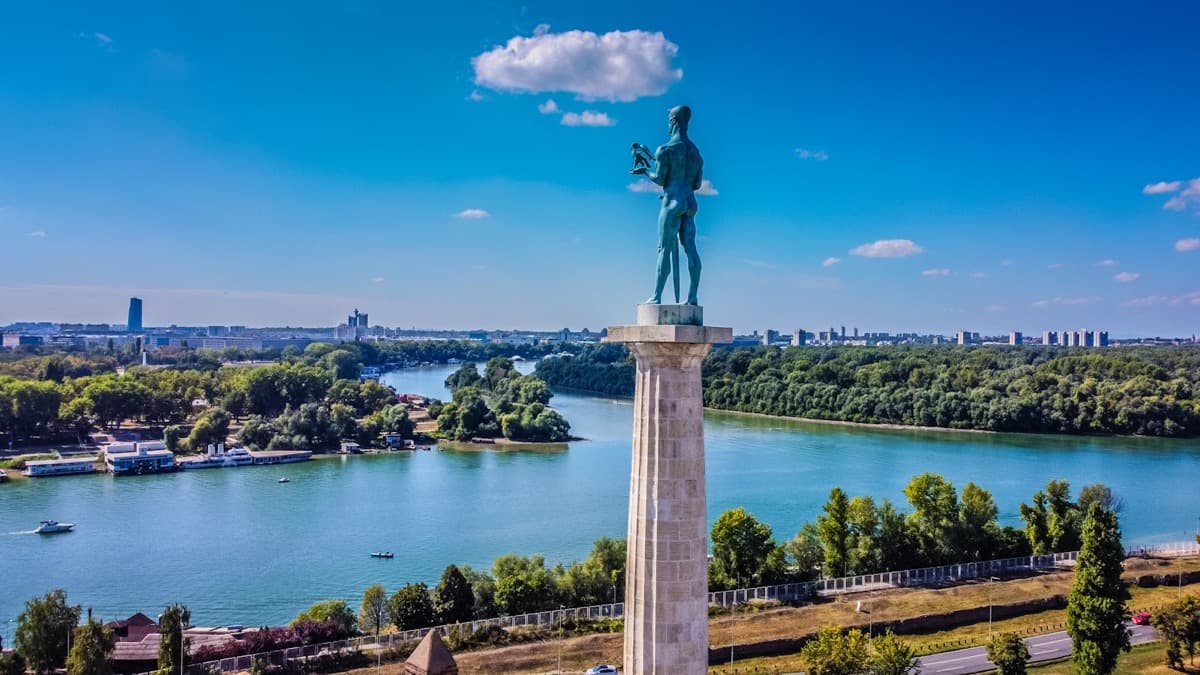
The figure is a bronze nude man, roughly fourteen metres tall counting the Doric column and cubic base that carry him. The column and base were designed by the architect Petar Bajalović, kept deliberately plain so nothing competes with the figure or the river view behind it. In his left hand the Victor holds a falcon, a symbol of peace. In his right he holds a sword, a symbol of war. That pairing is the entire idea compressed into one body: a fighter who has already won, holding the weapon down and the peace up.
He commemorates Serbia's victory over the Ottoman and Austro-Hungarian empires in the Balkan Wars and the First World War. That is the whole of the war story the monument tells, and it is enough. He does not narrate battles or name generals. He is a single upright figure marking the end of a long stretch of fighting over this exact hill, which is why the placement above the rivers matters so much. Meštrović was among the most significant sculptors of the South Slav world in the early twentieth century, and the Victor is one of his most recognized public works. Belgrade did not commission a modest civic ornament. It got a major sculptor's nude, and that is where the trouble started.
The 1927 outcry
Hear a stop from this walk
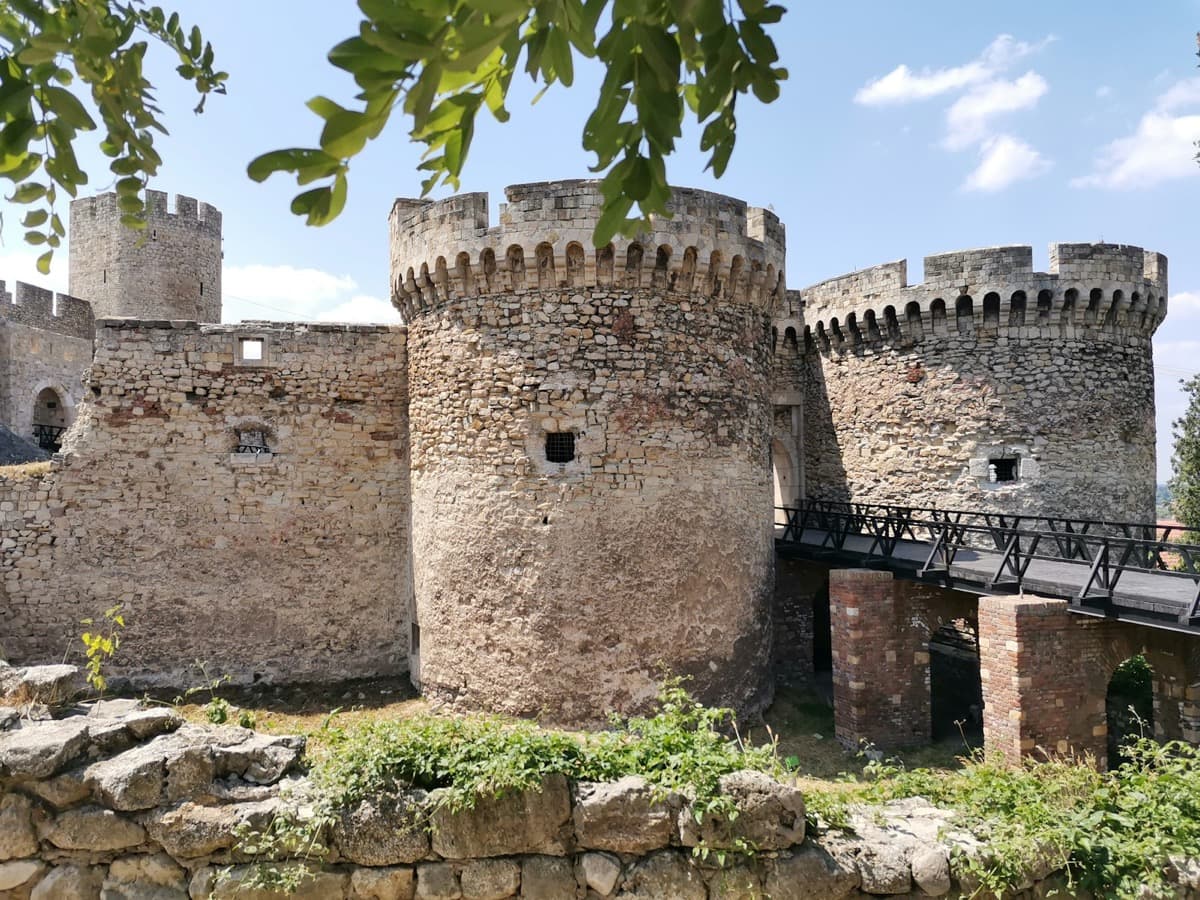
The Inner Stambol Gate: The Newest Conqueror's Front Door
The Victor was cast in 1913 but not unveiled until the seventh of October, 1928. That fifteen-year gap is the story. A statue does not sit in limbo for a decade and a half by accident.
The plan had been Terazije Square, a busy space in the city centre, with the figure standing on a fountain. But the figure is nude, and a naked bronze man looming over a downtown square provoked an outcry. In September of 1927 the Arts Commission decided to relocate it. The writer Petar Odavić and several women's organizations objected on moral and artistic grounds to a naked figure placed over a public square where families walked and shopped. There were also complaints about something the statue lacked: Serbian national insignia. A victory monument with no national markings, and a naked one at that, was too much for the intended location. The Terazije site was rejected.
So the Victor was moved out to the fortress rampart above the water, where he now faces the rivers instead of the shoppers. The relocation solved two problems at once. Away from the square, the nudity offended no one on a daily promenade. And at the fortress edge, facing the Sava and the Danube, the figure gained a meaning the downtown fountain could never have given him. He stopped being decoration in a plaza and became a sentinel over the exact geography that Serbia had just finished fighting for.
Why the rivers make sense of it
Turn where the Victor looks. Below the rampart, the Sava flows into the Danube, and that meeting of two rivers is the reason Belgrade exists at all. A fortress on this ridge watches both waterways, controls the crossing, and taxes the trade. Whoever held this hill held the door between central Europe and the Balkans, which is why the site was fought over and rebuilt dozens of times across two thousand years. The Victor commemorates the wars that ended that long contest, at least the ones fought against the Ottoman and Austro-Hungarian empires. Placing him here, above the confluence he symbolically won, closes a loop that Terazije Square never could have.
There is a quiet irony in the exile, then. The commission moved the statue to hide a nude body from downtown propriety, and in doing so gave it the most meaningful address in the city. A monument to victory over empires now stands on the rampart those empires spent centuries trying to hold. What began as a compromise reads today like the plan all along.
Standing in front of it
The Victor is free to visit. The fortress grounds, ramparts, and the terrace beside him cost nothing, and he is one of the most photographed points in Belgrade for a simple reason: the sightline behind him is the confluence itself, with the low green shape of Great War Island at the junction and the towers of New Belgrade beyond. Late afternoon into early evening is the light to catch, when the sun drops over the water in front of the figure.
If you take one fact away, let it be this: the confidence you read in the pose is real, but the address is accidental. The Victor was banished here, and the banishment made him. He is a rejected downtown fountain figure who found, at the fortress edge, the one spot in Belgrade where a victory monument actually belongs.
The Victor is the third stop on Roamer's self-guided audio walk through Kalemegdan, "The White City: A Fortress Everyone Had to Have." The full route climbs through Roman, medieval Serbian, Ottoman, and Austrian stone, pauses at the confluence terrace the Victor faces, and drops to a Danube tower that was a cannon platform, a prison, and a museum in turn. You can walk it at your own pace, free to linger where a wall holds you. Browse the Belgrade walking tours to start, or see everything on offer in Belgrade.
Sources
- Pobednik, Wikipedia. Details on Ivan Meštrović's authorship, the 1913 casting, the 1928 unveiling, and the Terazije relocation.
- The Victor monument, Belgrade Fortress official site (beogradskatvrdjava.co.rs). Official description of the monument, its symbolism, and Petar Bajalović's pedestal.
- Roamer tour transcript, "The White City: A Fortress Everyone Had to Have" (fact-audited, 2026). Primary source for the walk framing and the confluence context.
- Belgrade Fortress, Wikipedia. Background on Kalemegdan and the strategic role of the Sava-Danube confluence.
Ready to experience it?
The White City: A Fortress Everyone Had to Have
105 min · 4.3 km · moderate
More from Belgrade
Explore more at your own pace.
Belgrade Travel Guide: How Many Days, Getting Around, Safety and Budget
The Bombed Generalstab: How One Belgrade Ruin Holds the Whole Downtown
The House of Flowers: Why Belgrade Still Keeps Tito's Grave
The Stacked Stone of Kalemegdan: Reading Belgrade's Layered Fortifications
Skadarlija: Reading Belgrade's Bohemian Quarter, Cobblestone by Cobblestone