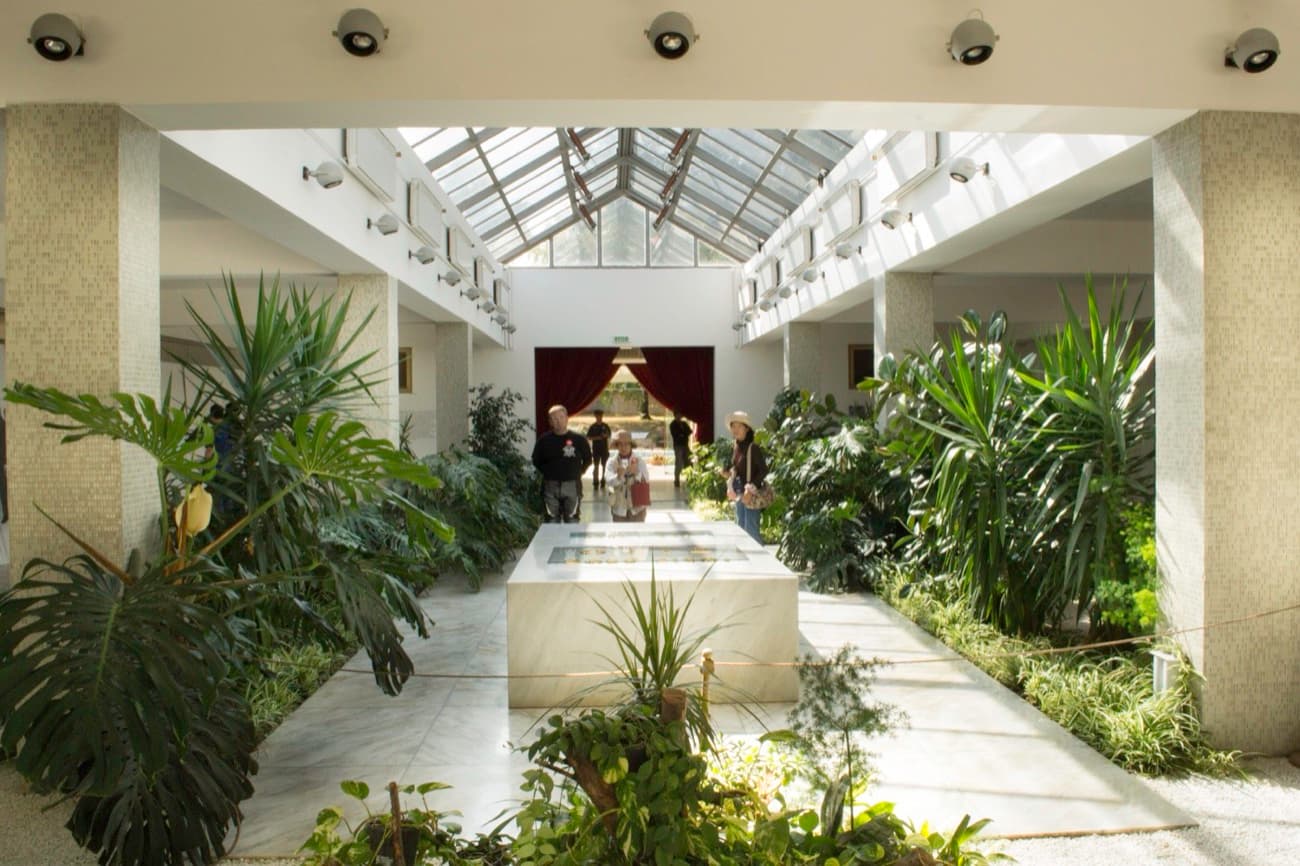
Josip Broz Tito, the Yugoslav leader born in 1892, is buried in the House of Flowers (Kuca cveca) on Belgrade's Dedinje hill. Built in 1975 as a winter garden by architect Stjepan Kralj, it became his tomb after he died on 4 May 1980 and was buried there on 8 May under a plain white slab.
Belgrade still tends the grave of Josip Broz Tito inside a building called the House of Flowers, and that single tended tomb, kept for a country that no longer exists, is the honest question the whole Dedinje museum campus poses. Yugoslavia dissolved decades ago. Its grave did not. People still climb the elite hill above the city, buy a ticket, and stand quietly over a plain white slab that once drew one of the largest funerals of the twentieth century. If you want to understand what Yugoslavia was, and what it means that its memory is still cared for, you begin here, at the House of Flowers, and you let the tomb ask the question the rest of the walk tries to answer.
A winter garden that became a tomb
The House of Flowers, in Serbian Kuca cveca, was never designed to hold a body. It was raised in 1975 as a winter garden, roughly nine hundred square metres of glass and green with rooms for work and rest, built by the architect Stjepan Kralj near the residence where Tito lived after the Second World War. It was a place to grow plants and to think, not a mausoleum. Then, in 1980, it became one.
Tito, born in 1892, died on the fourth of May 1980 at the medical centre in Ljubljana, of complications following a long illness. He was buried here on the eighth of May, by his own wish, in the garden of the house he had lived in for years. The choice matters. A man who had led a state from the end of the war until his death, first as prime minister and then as president for life, chose to rest not under a monument but under the glass roof of his own garden. Notice the simplicity of the stone when you stand over it. There is no cult in the marble itself. The cult is everywhere around it, in the campus you are about to read, but the grave is quiet.
The funeral that measured one man's reach
Hear a stop from this walk
The Relay Batons and the Day of Youth
To understand why this quiet tomb still draws visitors, it helps to know what happened at the funeral. The numbers are precise, and they are worth stating precisely, because they measure the reach of a single leader in a way few other facts can. According to the record of the funeral, delegations came from 128 of the 154 member states of the United Nations at the time. Among the mourners were four kings, six princes, twenty-two prime ministers, thirty-one presidents, and forty-seven foreign ministers. By the count of heads of state and statesmen who gathered, it remains one of the largest funerals of its century.
Sit with that for a moment. Leaders from both sides of the Cold War stood together in one garden on the Dedinje hill. That was possible because of a decision made decades earlier. Tito's 1948 break with Stalin had set Yugoslavia on its own socialist path, independent of the Soviet bloc, which is precisely why figures from both Cold War camps could mourn him without contradiction. The funeral was not only grief. It was a final demonstration of the third way he had tried to build, a country that answered to neither Washington nor Moscow.
In 2013, Jovanka Broz, Tito's wife and the country's former First Lady, who lived from 1924 to 2013, was buried beside him here, more than three decades after his death. The garden holds them both now.
Reading the campus the tomb belongs to
The House of Flowers is one building among three on this campus, and each one deepens the question the tomb raises. The Museum of Yugoslavia is the most visited museum in Serbia, drawing around 120,000 people a year, with a collection of more than 75,000 items: Tito's belongings, prints by the Spanish artist Goya, and the diplomatic gifts of a hundred states. The institution has changed its name at least four times since it opened, from a Tito memorial centre to a museum of Yugoslav history to, in 2016, simply the Museum of Yugoslavia. Each renaming is a small record of a country arguing with itself about how to remember.
Walk from the tomb to the Twenty-fifth of May Museum and the cult becomes literal. That building opened on the twenty-fifth of May 1962 as a birthday present, given by the City of Belgrade to Tito for his seventieth birthday, and it was the first purpose-built museum in Belgrade, designed by the architect Mihailo Jankovic. A museum built as a gift, to house gifts. The date on the door was Tito's official birthday, not his real one, which fell in 1892. The state fixed the twenty-fifth of May and hung an entire apparatus of ceremony from it.
You can see that apparatus at its purest in the relay batons. The Relay of Youth, in Serbian Stafeta mladosti, carried a birthday pledge to Tito across the country each year, beginning in Kumrovec, the village where he was born, and ending on the twenty-fifth of May, the national Day of Youth. It was first run in 1945, formalized as a holiday in 1957, and continued after Tito died. The final relay came in 1988, as the whole structure began to weaken. The batons here are beautiful objects and instruments of control at once, and both things are true.
Then the story widens beyond the cult entirely. Among the diplomatic gifts are objects from the Non-Aligned Movement, whose first summit was held in Belgrade from the first to the sixth of September 1961, chaired by Tito and gathering twenty-five full-member countries. Alongside him sat Gamal Abdel Nasser of Egypt, Jawaharlal Nehru of India, Sukarno of Indonesia, and Kwame Nkrumah of Ghana. Around a thousand journalists from more than fifty countries came to cover it, a summit sometimes called the Third World's Yalta. A middling European country helped convene a bloc that would eventually speak for much of the planet.
Why the whole walk starts at a grave
The campus ends where the country did. Yugoslavia came apart across 1991 and 1992, and the dates are not in dispute: Slovenia and Croatia declared independence on the twenty-fifth of June 1991, and a new federal constitution formally ended the old state on the twenty-seventh of April 1992. What is in dispute is everything around those dates, and this walk deliberately does not choose among the accounts that a Slovene, a Croat, a Bosniak, a Macedonian, a Montenegrin, an Albanian, and a Serb each carry. That reckoning belongs to a deeper telling, and our Learn library holds it with the care it needs.
Which returns you to the tomb. The House of Flowers is the entry point precisely because it holds the paradox whole: the grave is visited, the country is not, and you are the one who gets to sit with what that means. Reading it is a calm, self-paced hour on one tight campus, every stop short and skippable, and the full route is waiting whenever you want to walk it. Start with the Belgrade walking tours hub, or explore everything on offer in Belgrade.
Sources
- Museum of Yugoslavia, official site (muzej-jugoslavije.org): campus buildings, collection scope, visitor context.
- House of Flowers (mausoleum), Wikipedia: the 1975 winter-garden origin, Stjepan Kralj, Tito's 1980 burial, Jovanka Broz.
- Death and state funeral of Josip Broz Tito, Wikipedia: delegation and statesmen figures for the 1980 funeral.
- First Summit of the Non-Aligned Movement, Wikipedia: the September 1961 Belgrade conference, member count, and founding leaders.
- Breakup of Yugoslavia, Wikipedia: the 1991 and 1992 independence and constitutional dates.
Ready to experience it?
Tito's Yugoslavia: The City That Still Keeps a Country's Grave
60 min · 0.6 km · easy
More from Belgrade
Explore more at your own pace.
Belgrade Travel Guide: How Many Days, Getting Around, Safety and Budget
The Bombed Generalstab: How One Belgrade Ruin Holds the Whole Downtown
The Stacked Stone of Kalemegdan: Reading Belgrade's Layered Fortifications
Skadarlija: Reading Belgrade's Bohemian Quarter, Cobblestone by Cobblestone
The Museum of Yugoslavia Entrance: Where Belgrade Still Tends a Vanished Country's Grave